Category Archives: Kwethluk

Nature

Borderlands

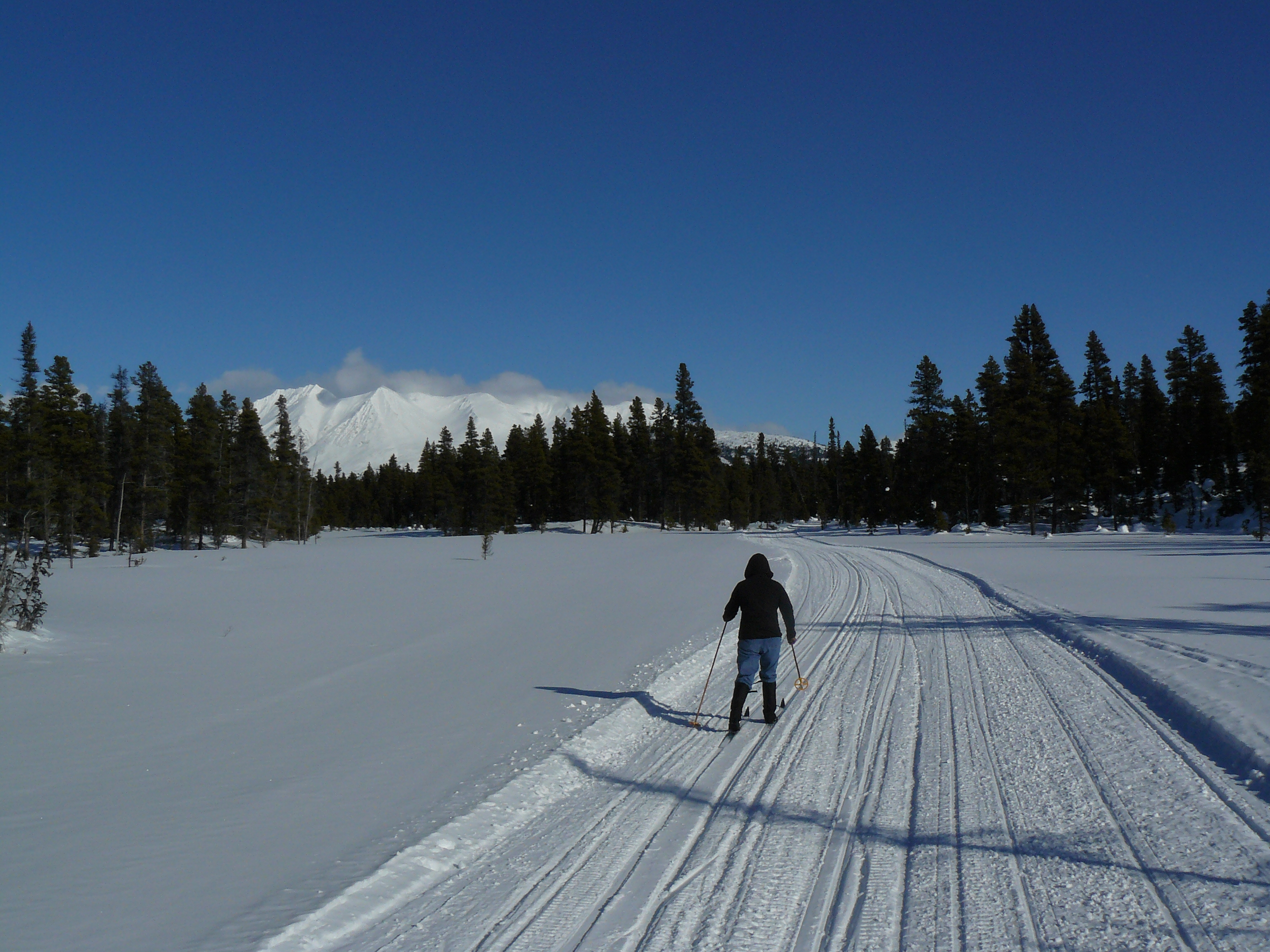
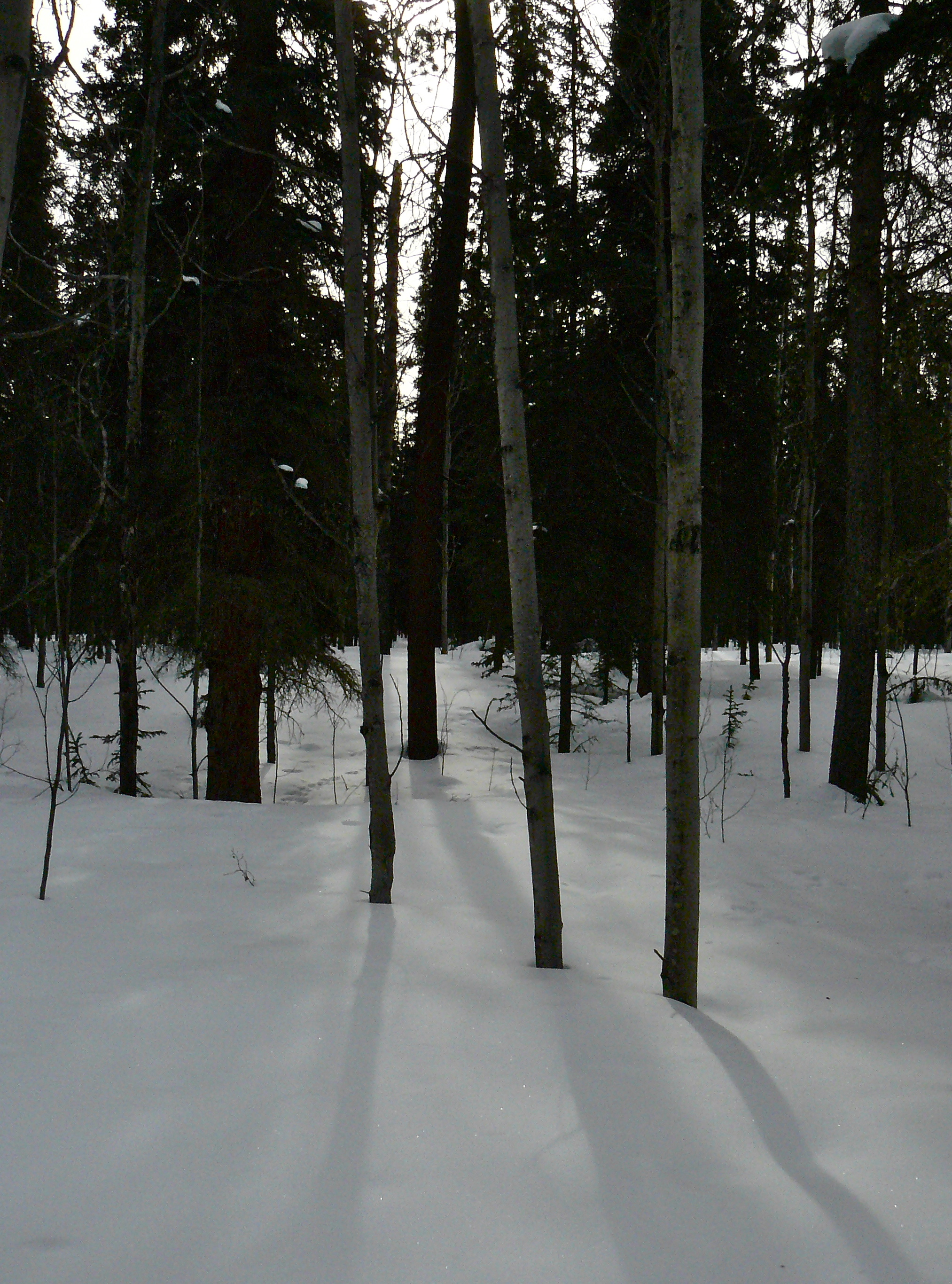
This Whitehorse ski area is an intersect area where man and wild things coexist. Men move most freely in daylight but the abundance of animal tracks show that they own the night. I choose the smaller, less used tracks that meander through a mixed forest of hard and soft woods. White spruce, some showing the red bark of mature trees space themselves between well formed alders. Yesterday’s overcast skies remain but let though enough sunlight to cast shadows on the snow.

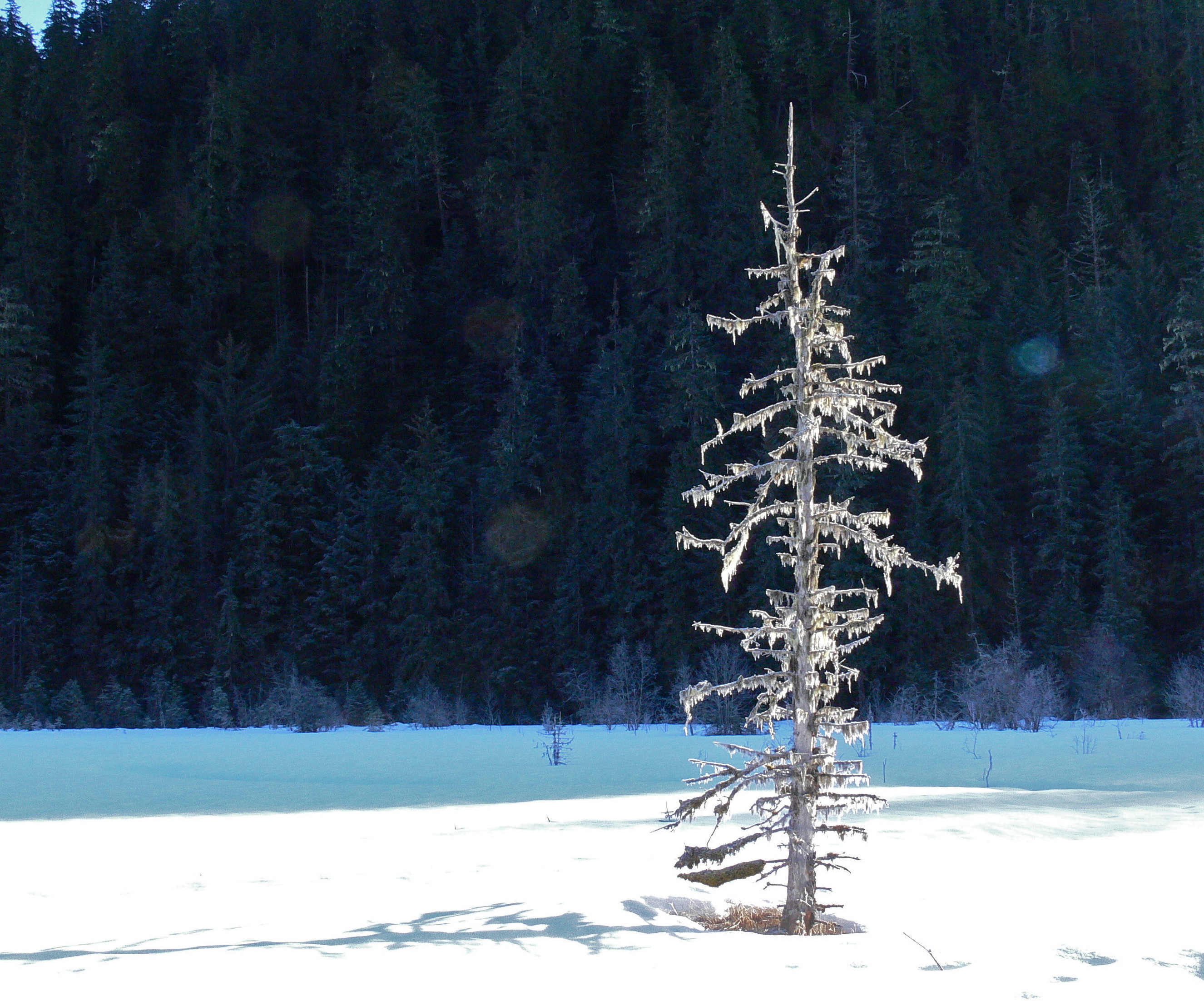
Deep in the woods I watch a squirrel wait by the side of the trail like a homeless person timing the crossing of  an expressway. Forming a question mark with its tail, it tenses then springs across the ski tracks to the safety of the bordering trees. Minutes later I reach a disturbed meadow where large standing spruce, needless and black, dominates the surrounding willows. A small bird of prey flies from the top of a spruce with a quick flutter, then a glide, and another flutter. I’m surprised to see that the willows have already formed fuzzy catkins which are dropping seeds.
Back in the heavy woods a raven waits by the side of the trail until I stop. Then he waddles into the middle  of it and nests down next to the ski tracks.  He knows I am coming for I am the train. The train stops and reverses, leaving the bird stranded at the station.

Someone has hung an eagle feather at the junction of two trails. It dangles by an almost invisible thread, a tired thing of cinnamon white and brown. The eagle discarded it. Man hung it here where no decoration is needed.
A Whitehorse Day in Black and White.

We feel a little betrayed by the promising pink sunrise that started the day. Since then a thin gray cloud layer has blocked the sun from Whitehorse Yukon Territory. Thin as  it is this overcast is made edgy by the sunlight filtering through and offers none of the comfort or drama offered by cloudy days in Juneau. Our hotel is full of Asian tourists here for the Northern Lights. They may have to wait a day or two to see them.

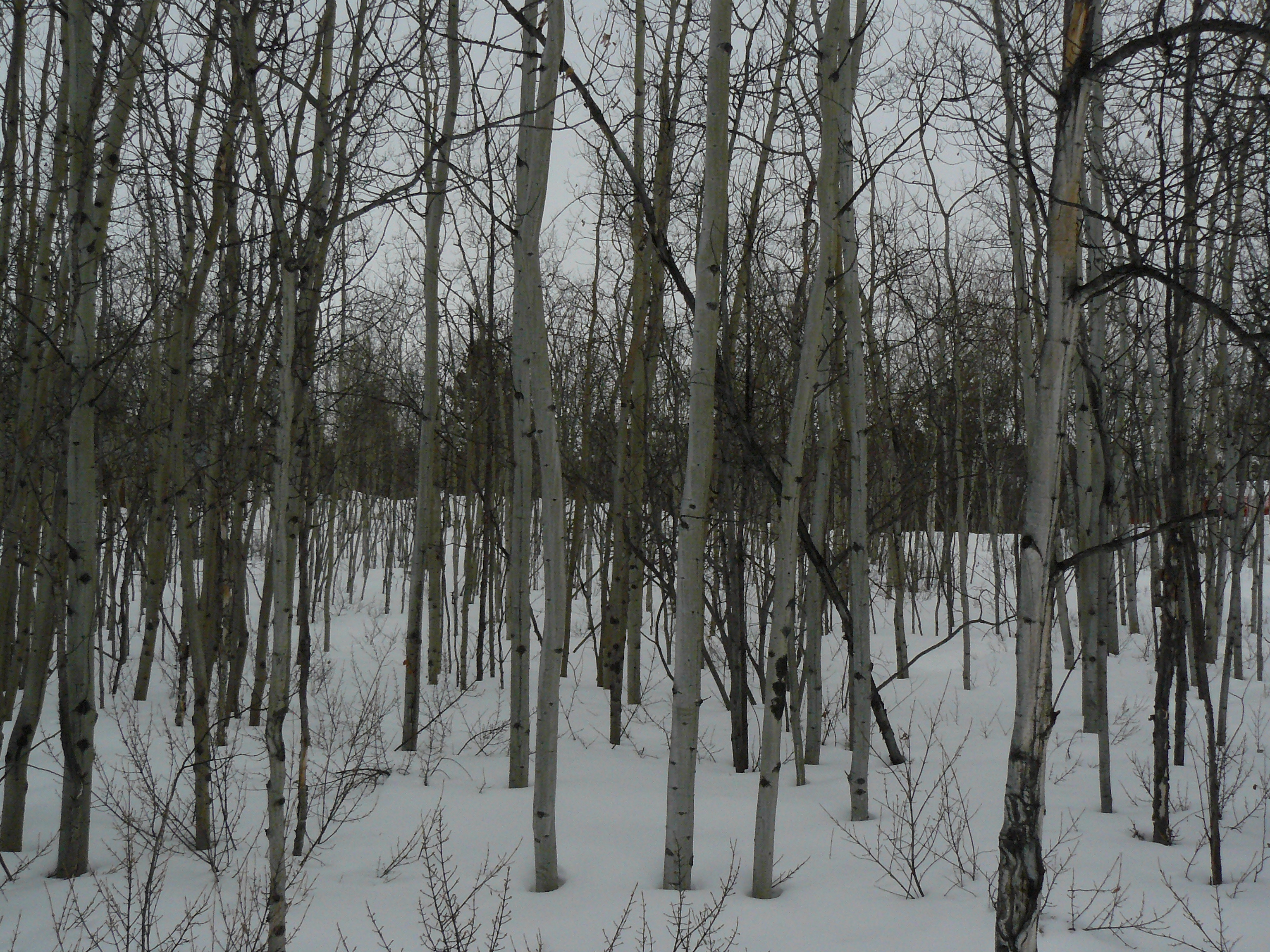
With plans to visit the Canadian Tire store on the way home we drive 35 kilometers north to a hot springs complex where cross country ski trails snake through a poplar forest. It’s good skiing but we miss the drama of yesterday’s ski near Lake Bennett.  Moose tracks cross the ski tracks many times but none of the big animals has walked on the tracks themselves. With the forest floor covered with deep soft snow you would expect them to use the packed trails. At one point we passed nearby a moose, which startled us when he broke nosily away. Every though they look like some kind of farm animal moose scare me more than bears. When they take it into their mind to stomp you they persist until you either escape or feel pain. It is worst if you get between a cow moose and her calf.

While the gray ski offers little beauty, that of the gray barked poplar forest has all the romantic beauty of a black and white film from the 40’s.  The trees have a Scandinavian sense of personal space, leaving a couple of feet between each neighbor. Thin, tall, and always just a little crooked, their trunks rise ten or fifteen feet above the snowy ground before sending out branches. Even then they grow upward like saints in prayer rather than out like an apple tree.

Ferry Rides and a Raven’s Snow Angel

On the Alaska Marine Highway, the ferries always depart at inconvenient times. Today we left Juneau on the MV LeConte at 7 am. While that hour may seem reasonable, we still had to leave the house at 5:30 in order to get the car in the proper loading line. It’s sunny but cold making it bard to spend much time on the deck. I make an exception for the Eldridge Rock Lighthouse, so isolated in the middle of Lynn Canal. The little block house structure sit on the apex of a rock bare but for a small spruce, probably planted by a previous lighthouse keeper. Today it can hardly compete with the sunlit peaks of the Chilkat Range that rise skyward behind it.

It takes six and a half hours to make the trip from Juneau to Skagway, Alaska — all of it beautiful in the sun. I don’t bother looking for whales who are still in transit from Hawaii. We do see one lively Dall Porpoise streaking down the waterfront nears Haines.

From Skagway we drive up the steep road from sea level to the Canadian border, passing through several active avalanche areas with signs warning drivers not to stop, With heavy snow loads above the road and warming temperatures I feel like a gambler. Just past Canadian Custom we stop near the terminus of the Chilkoot Trail and ski on rolling trails through a lodgepole pine forest. Some times we drop onto flat pocket meadows which offer views of pure white peaks. Some have captured their own cloud, which rides low over their summits as if pulled down to guard against the harsh sun. Many of the pines lining the trail have big patches of red needles, usually a sign of victimization by bark beetles. Will this whole forest die in the coming years? In 1898 men hungry for gold slayed the trees’ ancestors by the thousands to keep them warm while waiting for Lake Bennett to break up. Then they journeyed down the Yukon River to the Klondike Gold Fields. They cut down many other pines to form the rafts they used for the trip. From the looks of the needles on these trees I wonder if the insects will destroy what the avarice gold seekers could not.

Near the end of our ski I spot strange tracks in the snow. They must have been made by a bird, perhaps a raven, who strolled through the soft snow, made a sharp turn and pressed his breast in the snow. So secured, he reached out gently with his winds and made a light scratch with each of the four or five feathers at the tips of his wings. Susan called it a raven’s snow angel. It just confuses me.

Wild Barnyard of Geese

The hike starts with a strange sound heard in a familiar place. An angry little sound, hawk like, breaks the silence of morning followed quickly by that of a song bird. The thick forest hides both singers so we move up river. Afterwards I stop often to listen for more bird song but only hear Aki’s paw-falls on the crusty snow.

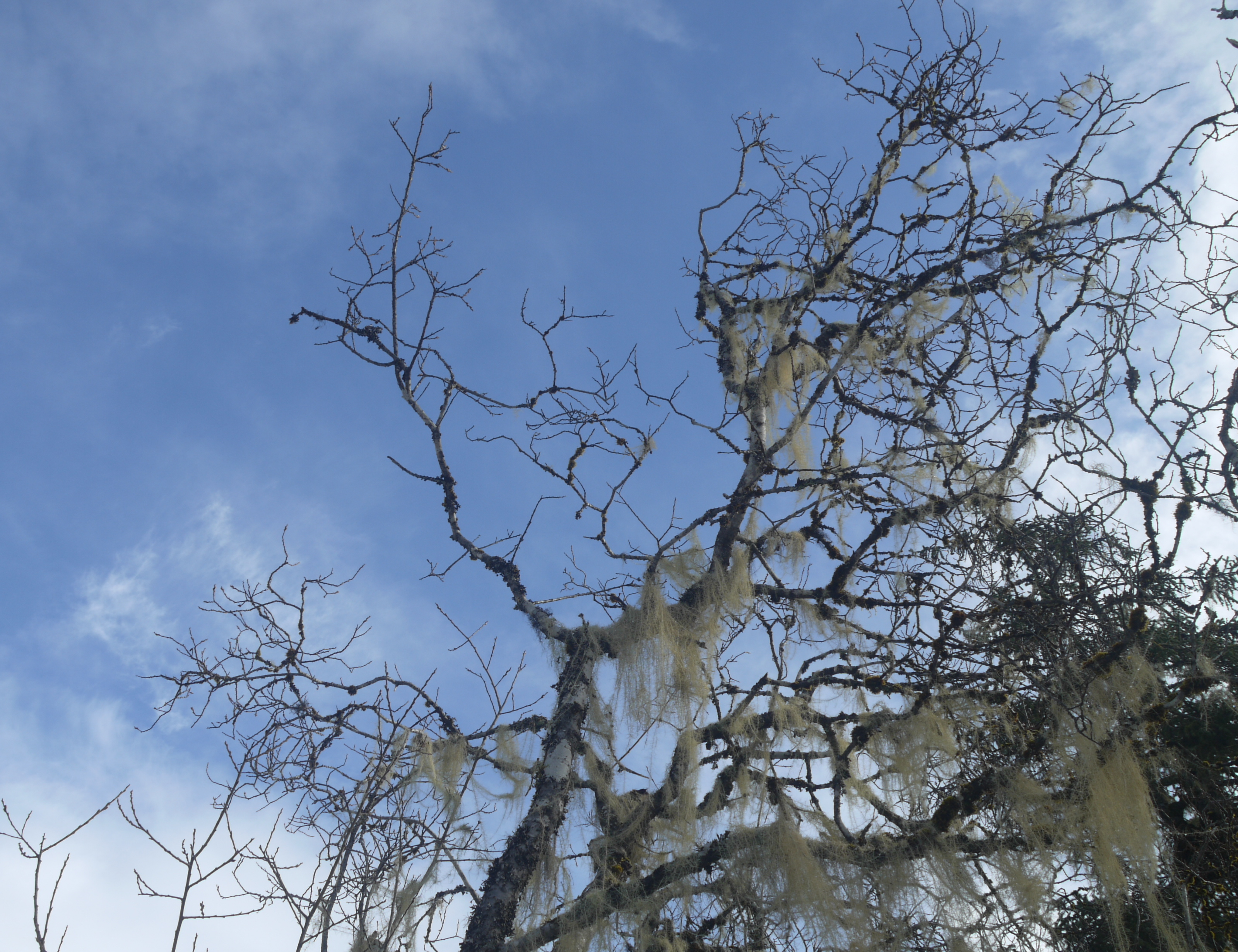
This morning’s low sun backlights the moss covering the big spruce and cottonwoods lining the trail making the moss grow with yellow green tones. I try again to capture a tenth of the beauty with my camera and fail. The place rewards physical, not virtual visitors.  

Leaving the boreal forest for a muskeg meadow we begin to hear the geese. We have been through this before — hearing a big flock of Canada Geese from this meadow but never seeing them when we reach the beach.  Today, the sound stirs Aki to explode down the trail. I find out why when we reach the river with its big meadow covered with geese.

Aki has driven at least one bear up a tree but has never before acknowledged the presence of waterfowl. Even today, when they strut openly on the dead grass land and shout out random warnings, Aki acts as if they do not exist. I see this as a sign of sensible caution, not arrogance.  Our mere presence, a couple of hundred yards away, seems to set the geese on edge so we keep our distance. Downriver a ringing geese alarm sounds, something like the amplified dithering of the Three Stooges, and a set of geese flies overhead. This is repeated several times — the die hard feeders being driven off their sand bars by a flooding tide.

Soon the meadow becomes an untidy barnyard of geese, heads down, looking for a meal. Above them snow whitened mountains rise into a darkening sky. Then it begins to snow.     

The Pocket Grove

This morning the mountains circling downtown Juneau stand as dowagers with shawls of snow melting under the morning sun. We stay close to home, choosing to explore lands drained by a nearby creek rather than head out to wilder places. It’s an odd choice on this warm sunny morning but, as it turns out, a good one.

We start across a broad meadow still covered with compressed snow. The sounds of fire crackers being set off at the nearby land fill compete with the roar of highway noise. Someone sets off the fireworks to chase eagles and raven from our decomposing garbage. The big birds now circle above us as we cross the meadow and enter into a hill side forest.

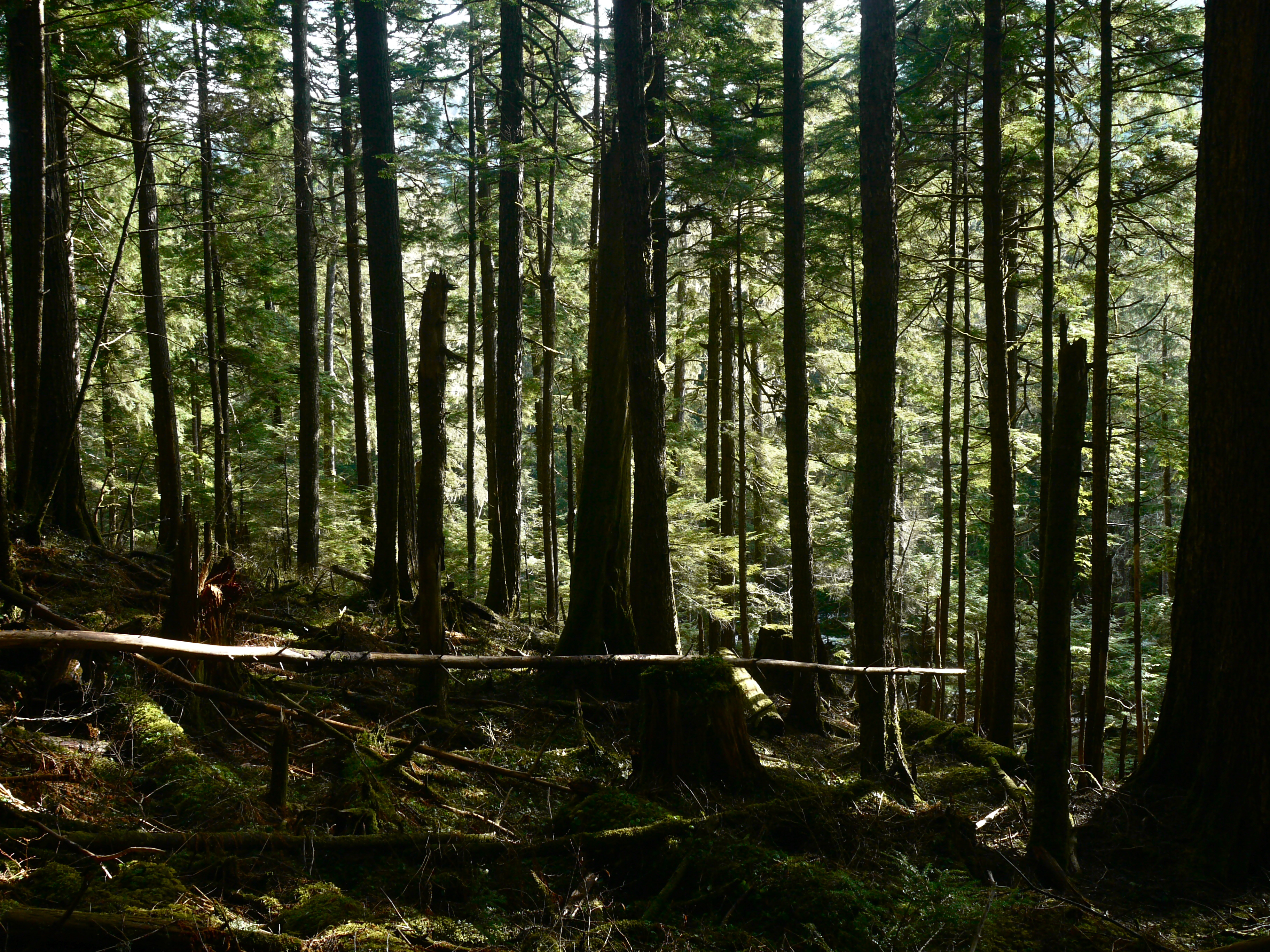
It’s a rich place with moderate sized spruce and hemlock trees rising straight as grain stalks above the stumps of their ancestors. No snow litters the ground in this well managed wood lot. Already blue berry leaf buds swell, looking lovely when backlit by shafts of sun light. The refugee eagles and ravens are settling into the trees above us. We hear the ravens sound out what may be a love song. It’s their time of year. The eagles just sound perturbed.  

We follow the trail as it climbs up the steep hillside to crest on a false summit that offers a view of more second growth forest. Rather than follow it over the hill we move on a diagonal line down the hill toward a promising splash of white snow showing through the trees. The chance to walk back all the way on a sun splashed field of snow draws me through patches of thorny devil’s club stalks and over countless fallen trees. We pass one hemlock with military posture and a two inch thick root climbing straight up the length of the trunk rather diving into the earth. The tree’s bark now partially encloses the errant root.

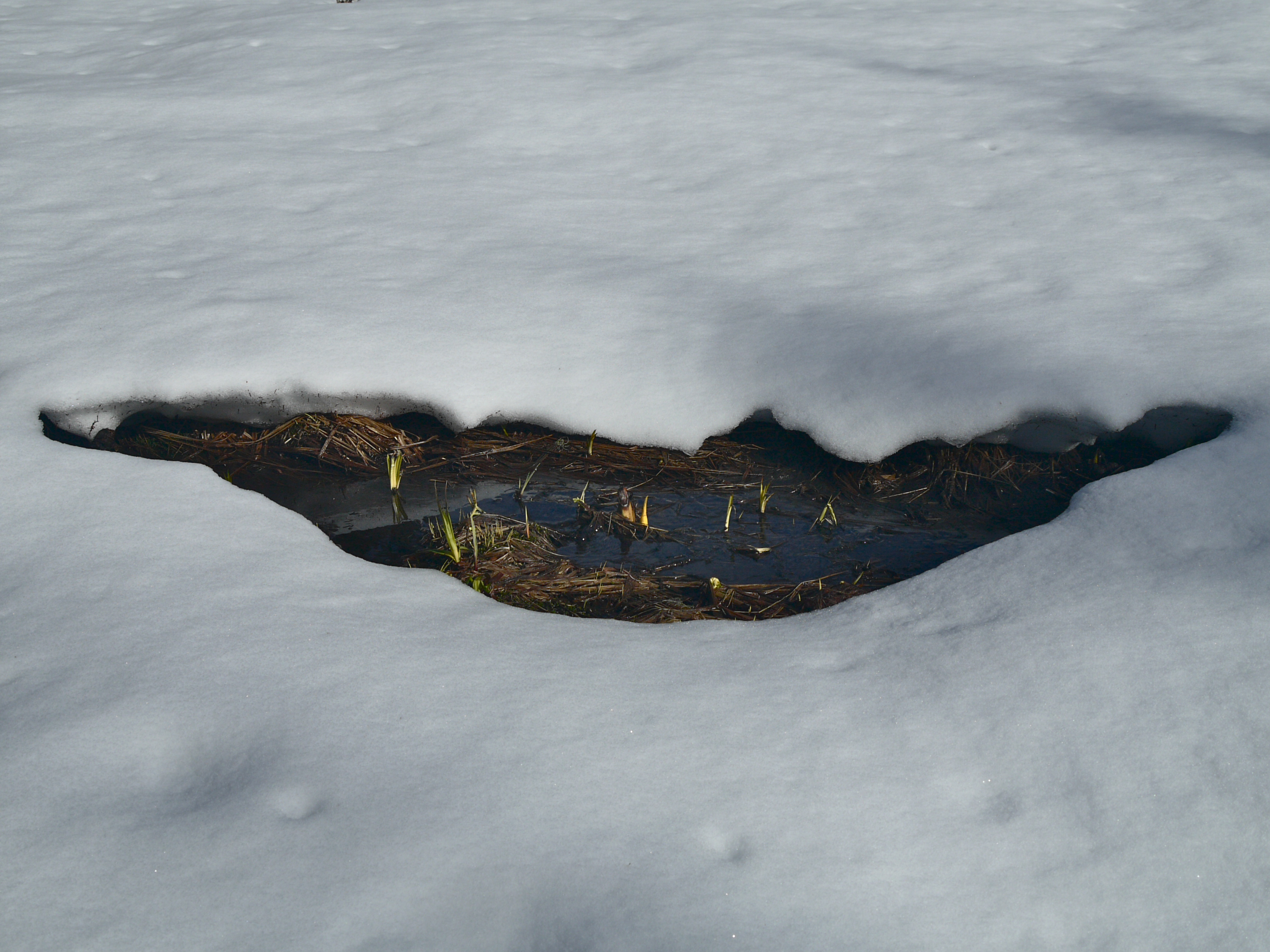
Just before our breakout we must cross a thick belt of devil’s club. In a few weeks when these nasty plants send out their prickly leaves we would have to turn around. Today it only requires caution to pass through. We find a stand of massive spruce on the other side. Here within ear shot of traffic and the dump we stumble on a pocket grove of majesty bordering a small snow covered meadow. A tiny stream drains the grove. Yellow shoots of skunk cabbage push up from the stream bed. I am not sure which is more surprising — the pocket grove of ancient trees or finding the first sign of spring in such an unexpected place. 

Aki ignores these wonders to concentrate on the snowy meadow where she dashes about before rolling in the sun softened snow. Looking beyond her I expect to see the meadow continuing along the base of the hill to offer an easy stroll to the car. I find a small pond backed by a rising hill.

Expecting another battle with devil club and windfalls we cross the meadow and entered an area still recovering from clear cutting. Here there is darkness and thin trees with reddish trunks. It’s lack of understory plants allows us to move quickly up the hill and then down through some old growth forest to where the big meadow begins. Compared to the complex forest, the meadow offers a simple beauty — a plane of white dotted with the twisted shapes of bare brush.

Hunting Moments in Time


If not for an old mine, no one would have cut this trail above Peterson Creek. Horses once dragged ore carts down it to tidewater. Did they, I wonder, start the journey deep inside a tunnel maze, moving from darkness into light?  Thankful I am not a horse, I plan on walking with Aki up this trail until it almost touches a big waterfall. Continuing on from there would take us along the creek to it’s source lake, which might finally be ice free given the warm weather.

It froze hard last night, which firmed up the trail. In early morning a brief storm dusted everything with a half inch of snow.  Now the sun shines above the forest. We look for tracks in the fresh snow and enjoy sunlight breaking through it through the forest canopy. Aki checks the pee mail messages left by passing wild things while I look at the prisms of light created by shafts of sunlight hitting the new snow.  Taking many pictures I try to capture these moments in time before they die with the movement of the sun.

Hoping to see the waterfall flooded with spring light I stash the camera and move up the trail. We hear it before seeing it, while crossing brightly lit ground. A minute later I down on the creek in deep shadow. We have missed the convergence of light, snow, and falling water.

I think about continuing on to the lake. A guy with a fly rod might catch some of the stunted rainbow trout that managed to eke out an existence in it. Fish and Game planted their ancestors in the lake years ago. With the waterfall blocking passage for the salmon that spawn in the lower stream, the trout can’t fatten themselves on salmon eggs and young like their native cousins, the cutthroat trout. Down at the fly fishing shop, the guys will tell you that some of the rainbows, swept over the falls, managed to make it to salt water and then return as massive steelheads — ocean going trout that can reach the size of salmon.  Legends of Peterson Creek.

We leave the trail near the falls and walk without guidance or hinderance over the snow covered ground. In summer we would be blocked by soft wet ground and thick stands of the thorny devil’s club brush.

Moving away from the creek I realize that it has produced the only sound we have heard since leaving the car. This late in winter, the forest should be almost burdened by bird song. Hope we don’t have a silent spring.

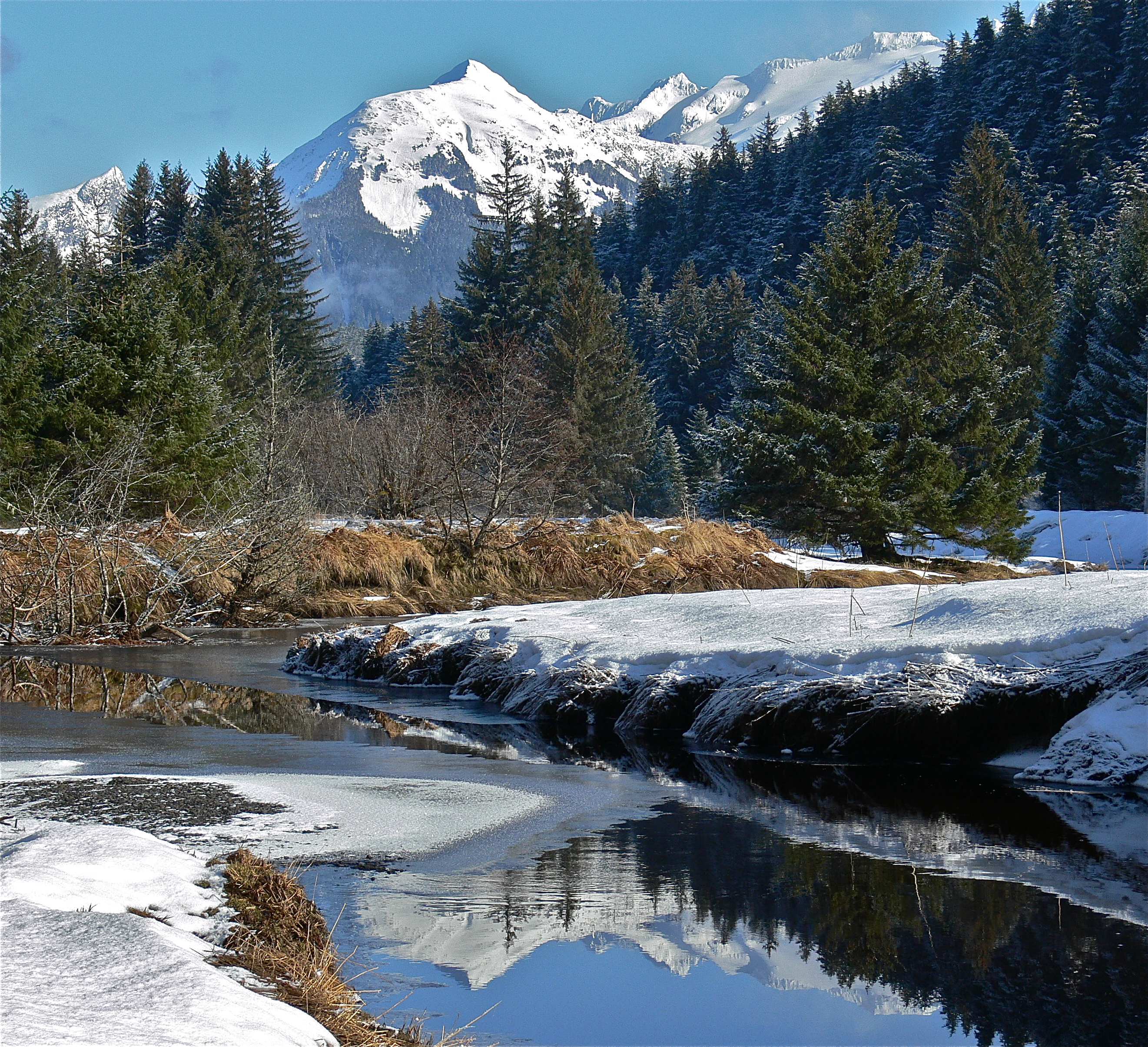
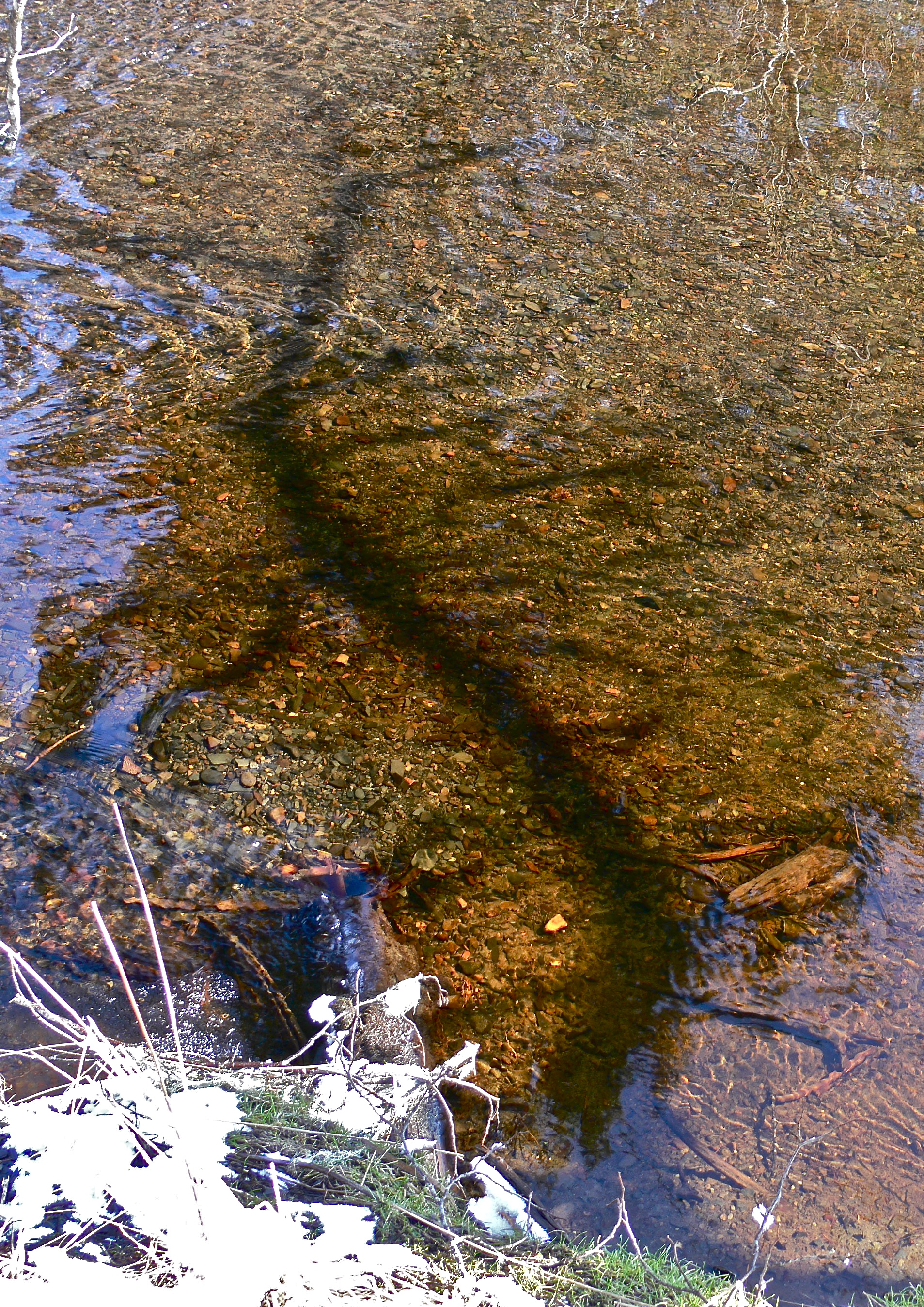
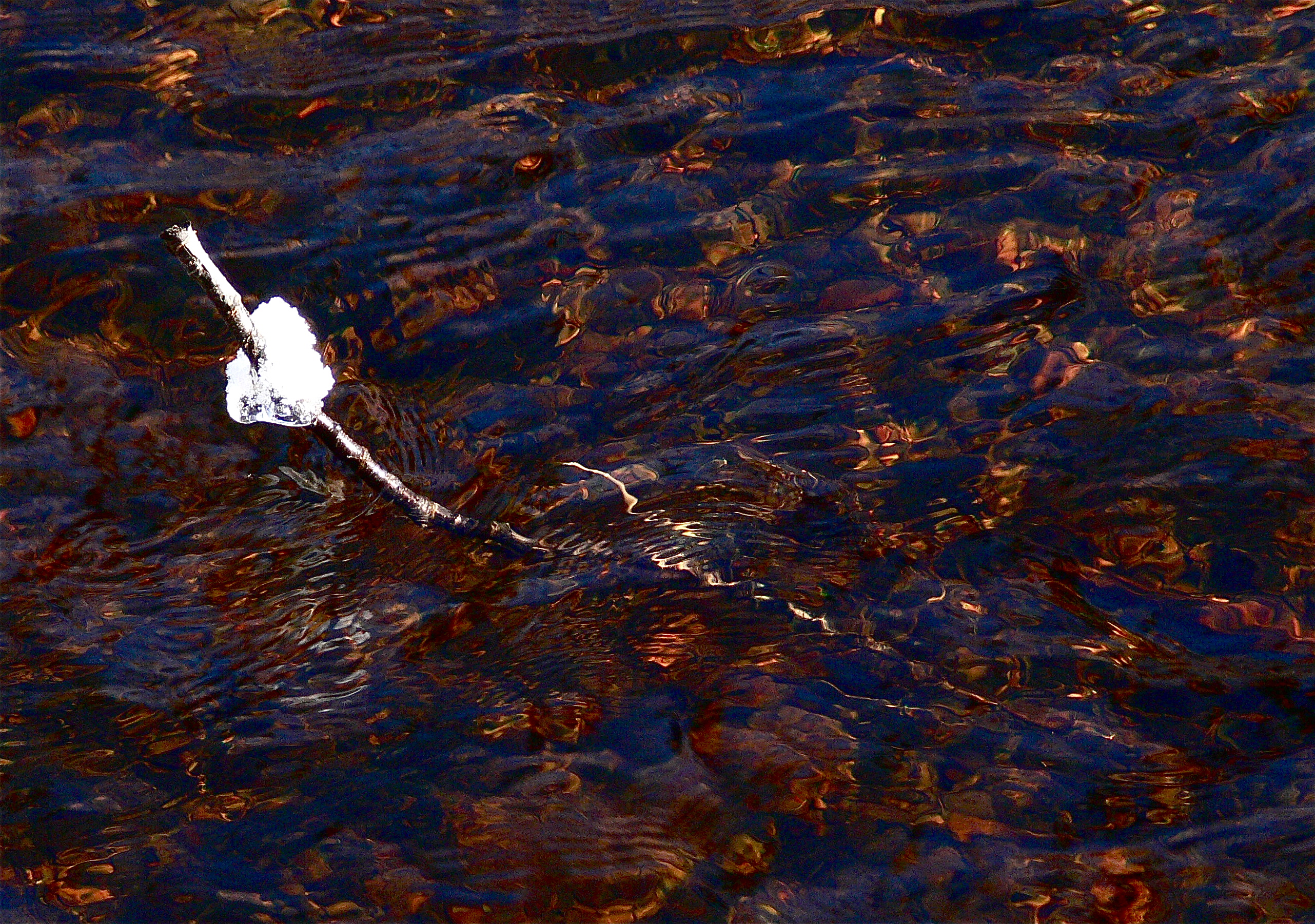
I continue taking pictures to catch the perfect moment in time. Most will die under the delete key but several taken at the end of hike catch some beauty. They show Lower Peterson Creek winding through a small grass land.  One photograph captures creek water reflecting Lion Mountain as it dominates the horizon.  Another features the reflection of bare alders. The last shows a ball of ice, still dusted with new snow that clings to a stick rising out of the moving stream. We watch its snow cover  shrink under the sun while being rocked by the current. I turn away before it can stand nude above the water where steelhead and salmon will soon travel.

Second Growth

Aki and I spend an hour walking this familiar trail from forest to the beach where a minus 2.6 foot low tide exposes a great expanse of sand and rock. Coming on a sunday morning, the event draws many people here for the chance to walk a now expose ribbon of rock to Shaman Island. Feeling anti social Aki and I head for a place that seldom receives visitors.

The early morning rain had given way to snow. Fat flakes, some an inch across, fall straight to the ground to whiten the forest through brakes in its canopy. I waste space on my camera’s memory card trying to capture their journey. In this low light they show as white streaks on the resulting photographs. 

We enter in area of second growth timber. Many years ago man or nature removed at once the large spruce and hemlocks that once grew here. This opened the way for their seedlings to take root. Brother shouldered out brother in the following fight for sunlight. Those trees able to form part of the new canopy lived. The others withered in the dark. We find these second growth survivors twisted and pale. Nothing grows in the shadow to feed the deer.

In minutes we pass through the mutant forest to a small grove of old growth hemlock trees. Here berry brush thrives along with other understory plants. Here in the past we have found many animal tracks. It will take at least 50 years for the second growth to reach this level of peace and abundance. 

Looking Down for Beauty

Today we look down for beauty but up for sound. Wet snow the consistency of stiff oatmeal covers the moraine trail. Snow shoeing over it tires. Even Aki plods behind in my tracks. What moisture falling from the sky arrives as rain. From their tracks in the snow the beavers, with their nifty waterproof coats, are not bothered by the slop.

After crossing a flooded portion of the trail we head over to the big beaver damn and find a hole in the lake ice near it. No tracks show in the surrounding snow, just a C shaped gap in the low white wall bordering the hole. River otters? There are juvenile king salmon wintering in the lake. 

Aki jumps a bit when we hear an avalanche rumbling down Thunder Mountain. This is not the roar made by Mt. Juneau avalanches but a manufacturer sound like that used to mimic thunder during a stage production of the Tempest. No Prospero here.

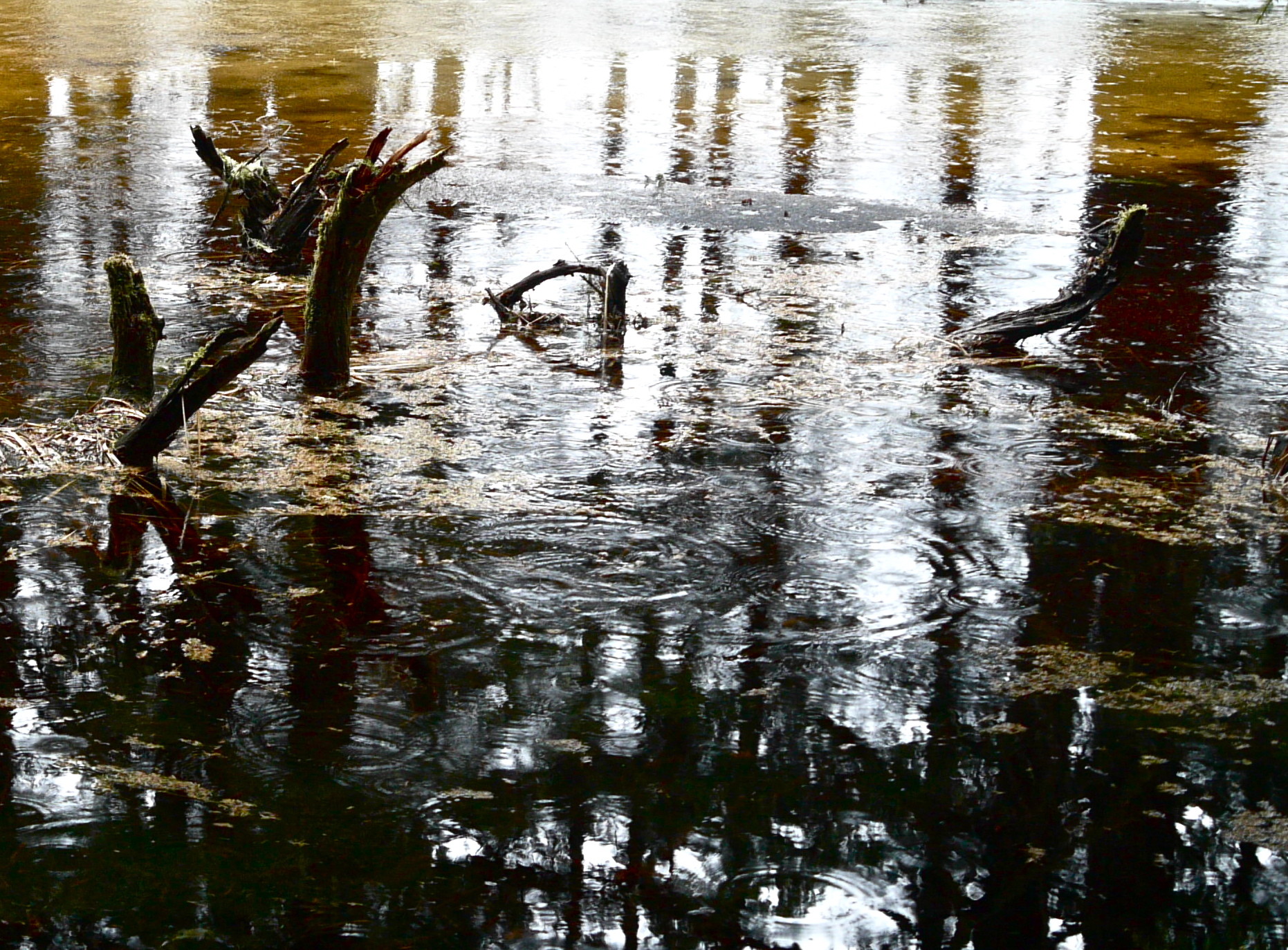
The trail deteriorates when we leave the damn. In places my snowshoes sink into water under the snow that soaks my boots. Aki manages to prance around this wet zones. The warm weather has flooded trail side watercourses which reflect spectral shapes of bare alder branches. Dripping water shatters these deep mirrors with rings of concentric waves. On a day stripped bare of sun and most color the effect is stunning.

Retreat from the Wetlands

Fresh snow this morning followed by sunshine drives us to the open spaces of the wetlands. Three or four inches of new snow almost covers everything, Enough straw colored grass and mud show through to provide an interesting contrast. A few weeks ago we tried to reach Gasteneau Channel from here only to be blocked by Duck Creek. Today I hope to cross the creek where it is still narrow.

Nothing has passed over this land since the last snow though we do spot the gull tracks in a tiny mud bar. Brightly colored plastic objects — buckets and bottles mostly, poke out from under the snow. I count myself lucky that I haven’t seen such flotsam on other parts of the wetlands.

The weather changes as we reach Duck Creek, which unfortunately is still impassible without rubber boots. An east wind rises, pushing clouds down channel to close over the diminishing blue sky. Aki takes shelter in my lee but I am exposed on this flat white plane. Ducks complain on the far side of the creek then take flight for more remote country. In minutes we received a replacement flight of Canada Geese fleeing from the direction that drew the ducks. Some form the traditional “V” shape while the rest fly as an organized gang.

On our retreat to the car we cross through a large patch of Fireweed plants that presented a brilliant magenta show late last summer. The dead stalks bent almost to the snowy ground by weather  offer a sad beauty. As a cold wind rises and snow begins to fall I join the stalks, as pathetic as the remnants of  Napoleon’s army retreating from Moscow, shouldering into the wind and make for the comfort of the car.

Standing Alone

This could be a story about the spirits that animate these trail side alders in the privacy of night. Each morning they leave the trees frozen in twisted last dance poses. Aki, with more common sense than imagination would not like that. For her even the arthritic swellings of the older alders are best explained by external forces of nature. She’d rather me tell a tale of her heroic efforts to clear the trail of red squirrels.

We start down this river side trail between snow flurries. Even this far from the sea an onshore wind carries the echo of nervous geese chatter. They must be feeding on exposed sand bars near the surf line.  The incoming tide should flood the bars and drive the geese to the big meadow on this side of the river. I pick up speed to be on the meadow when the geese take flight.

Reaching tidewater we find a big gang of stubborn Canada Geese holding on a shrinking sand bar across the river. Hundreds of gulls share the ground with them.  All locals, they intend to feed on the bar until the last second. Hoping we can witness the exodus from the flooded bar I walk toward the beach. Just as we reach it, a cloud of gulls explode off the geese’s sand bar and fly over to our side of the river. Many pass just in front of where we stand. Perhaps better judges of the sea, the geese hold fast as the tide begins to retreat. With no hope to see them fly, Aki and I turn to walk down the beach as the wind drives snow in our faces.

Aki hits my leg with a paw and looks up with a longing look. When I pick up a throwable stick she makes a small sound of excitement. Turning so my back is to the wind I toss the stick for her to retrieve.  For a few minutes only me and the sand and stick exist. When the stick suddenly loses its charm, Aki turns into the wind and we continue down the beach. Curtains of wind driven snow partially obscure the islands and waters of Favorite Passage and force us to leave the beach for a more protected meadow trail leading back to the river.

The meadow forms a yellow brown plain bordered on the far end by a scruffy collection of spruce and one bare cottonwood tree. Grey black snow clouds, shredded by wind, fill the sky above the tree line. It could be a fallow Montana wheat field and the line of trees could be the farmer’s windrow for providing a windbreak for the house and barn. Aki and I have cross this meadow often. Sometimes geese or crows or eagles hunt for food here. Even then my eye is drawn to the lone cottonwood tree.

Thinking of the old cottonwood dominating the meadow I lead Aki back to the river where a single Canvasback Duck, beak tucked into his back feathers, floats close to the far bank. His kind is rarely spotted in Southeast Alaska, especially in Winter. The big bird must be taking a break from his long compute to the Northern Tundra.  I can’t spot any other transit birds. Did he drop out of a northbound group or does he just seek solitude?  Not a very ducky thing to do.