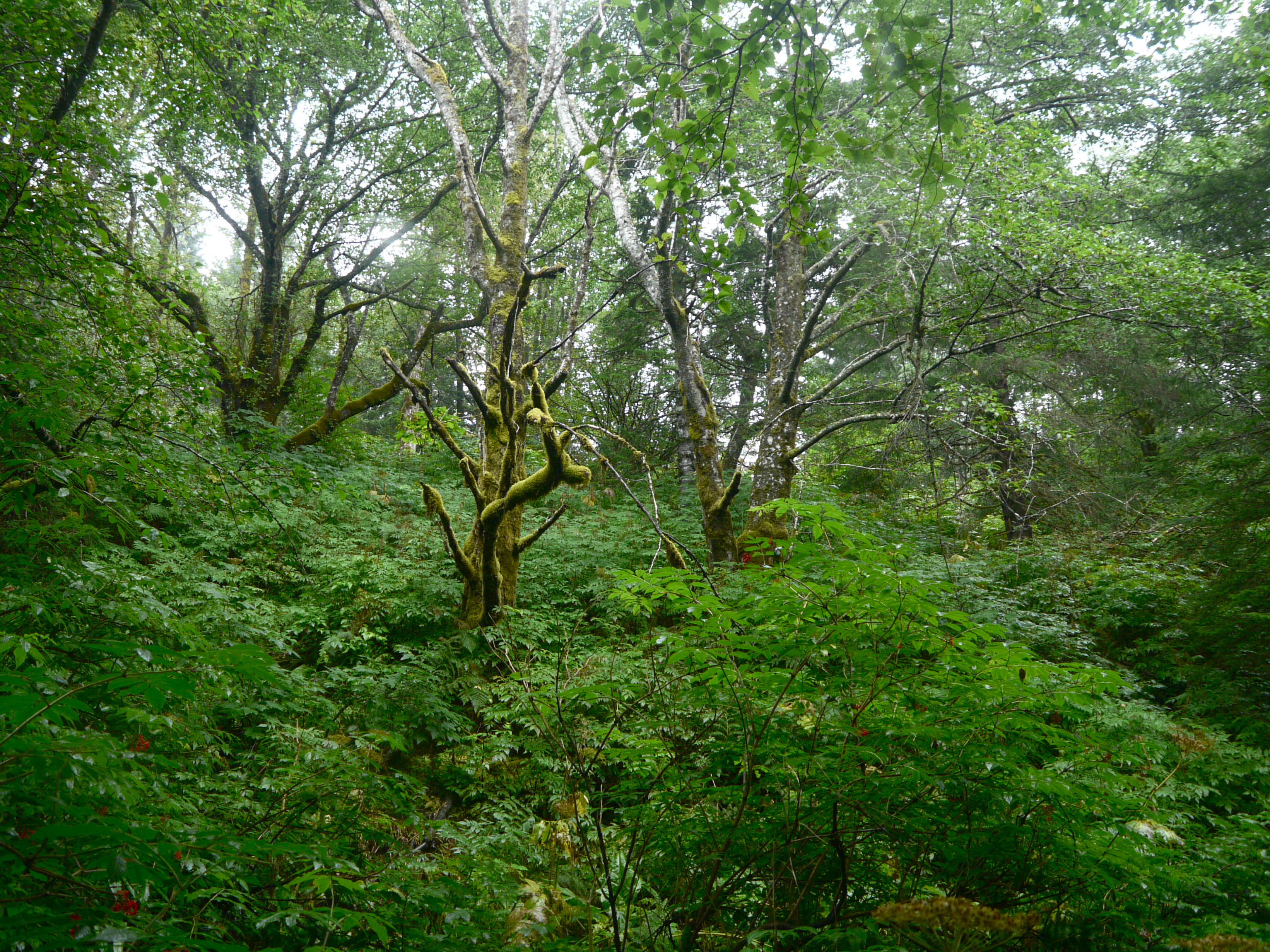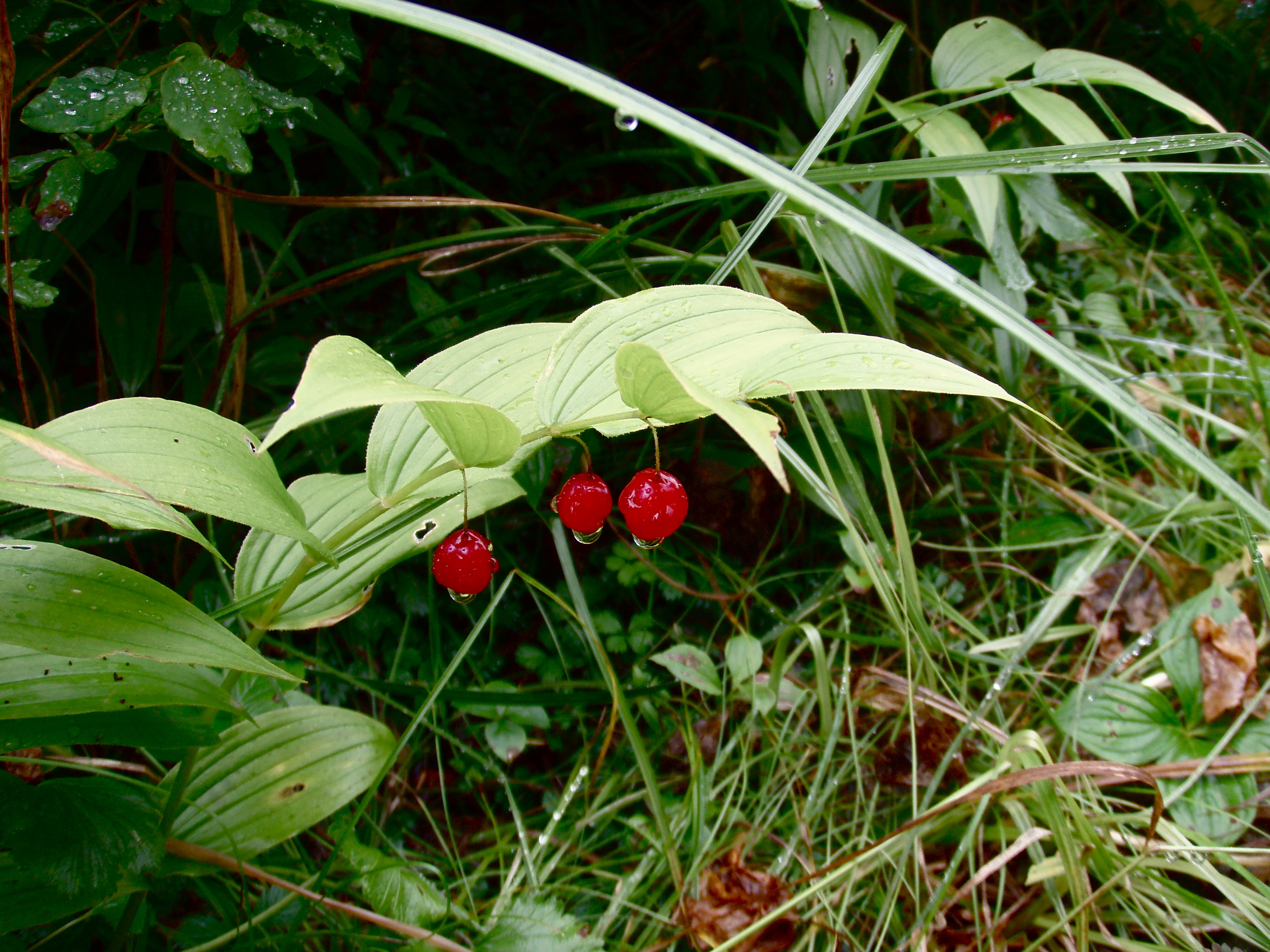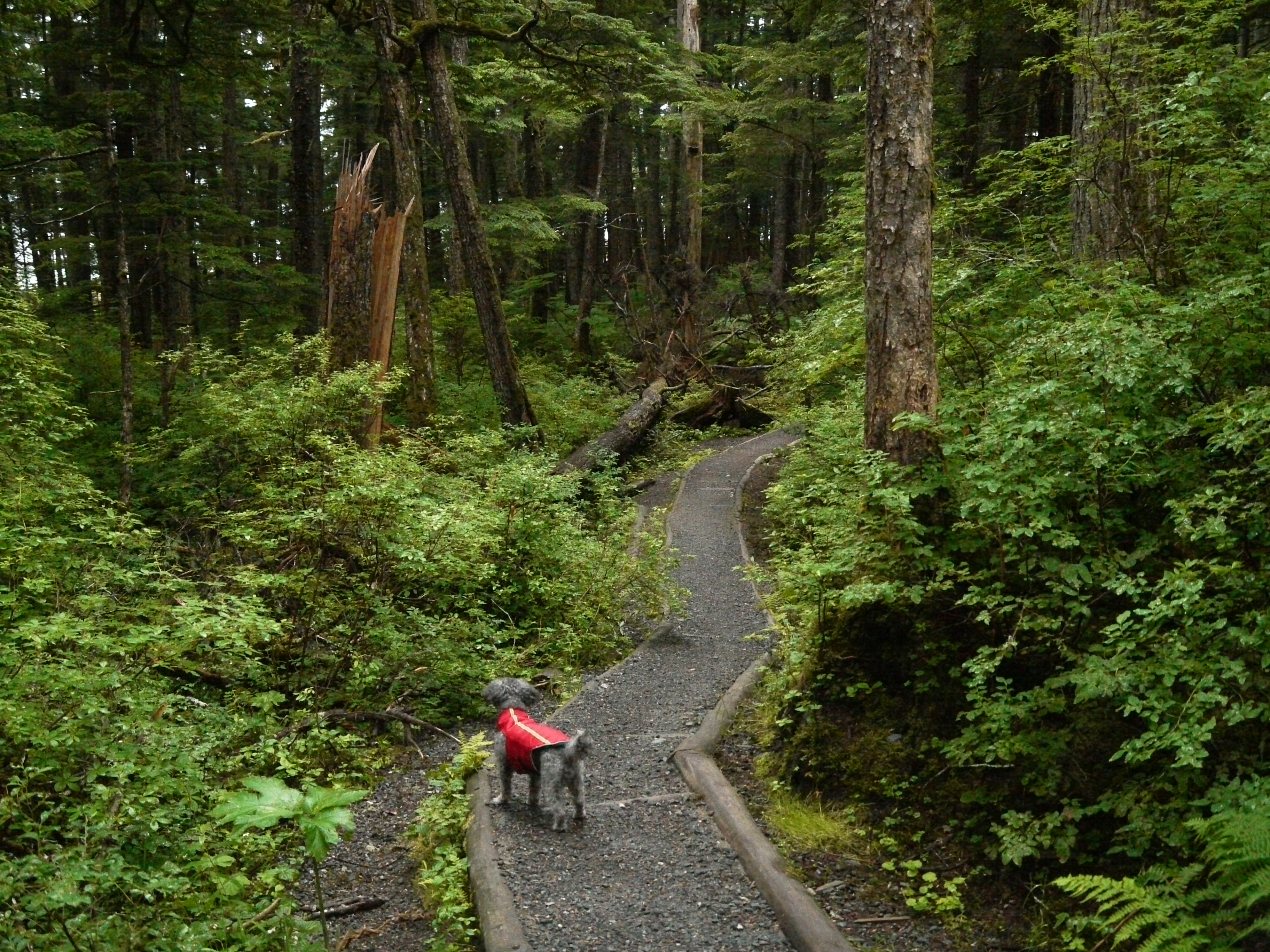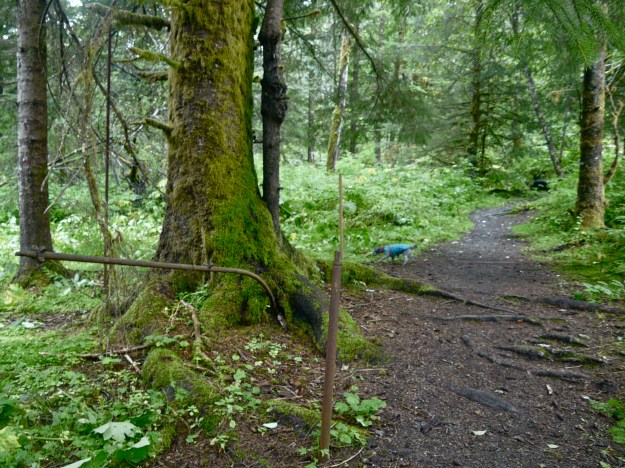
Walking with Aki up the Perseverance Trail, I silently ask why this small stand of devil’s club is yellowing up. “Aki, what about those currents growing along that protected drainage, why are their still perfect leaves already cadmium red?” Under today’s gray skies it is easy to forget the many bright days of this sun rich summer. Maybe the currents and this precocious devil’s club are early harvesters, rushing to secure their riches before the onset of autumn storms. More likely I’m misreading bruises of stress; ignoring ragged brown edges of insect damage to enjoy an early taste of Fall. 
Category Archives: Aki
End of Summer Blues
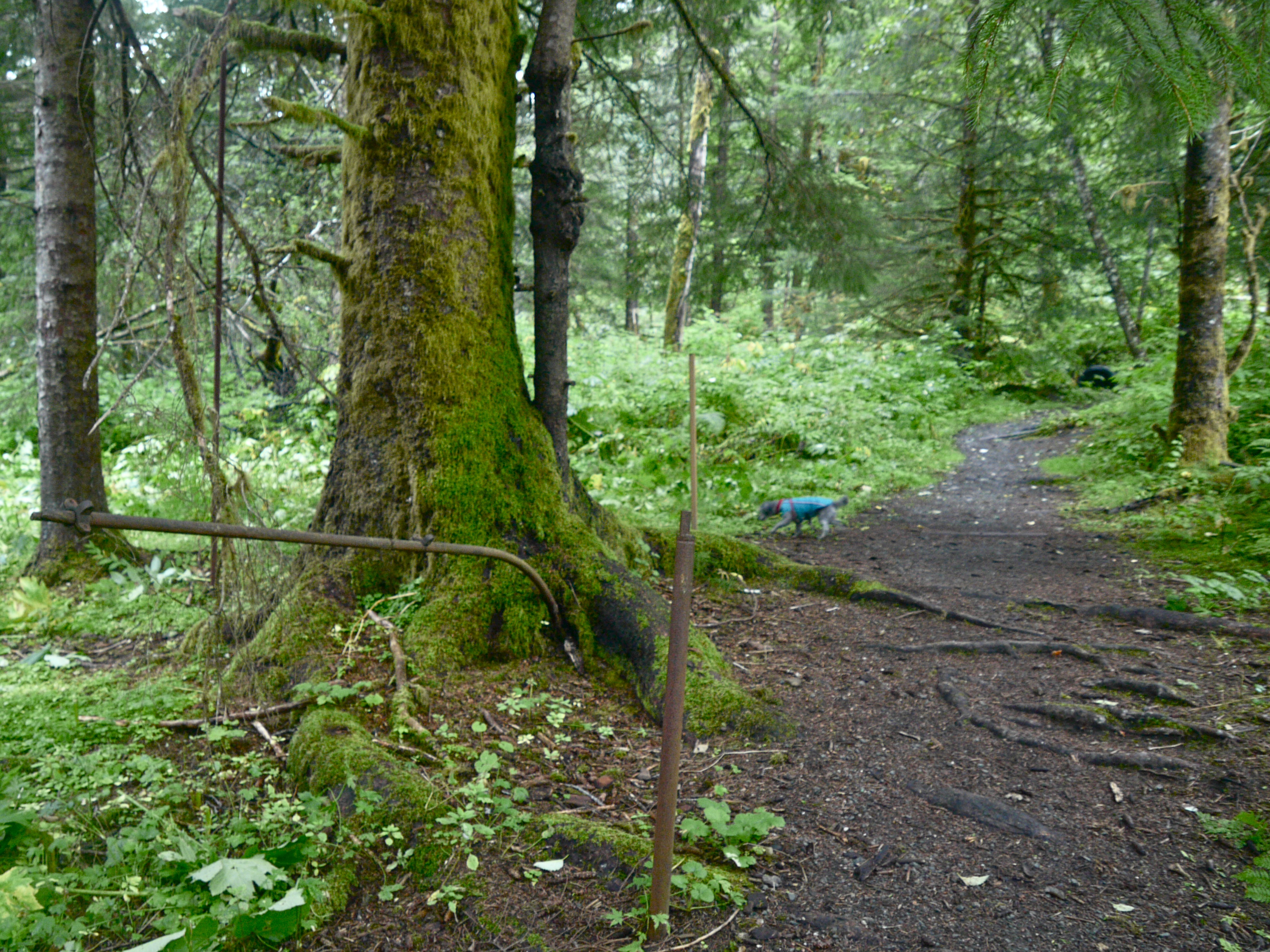
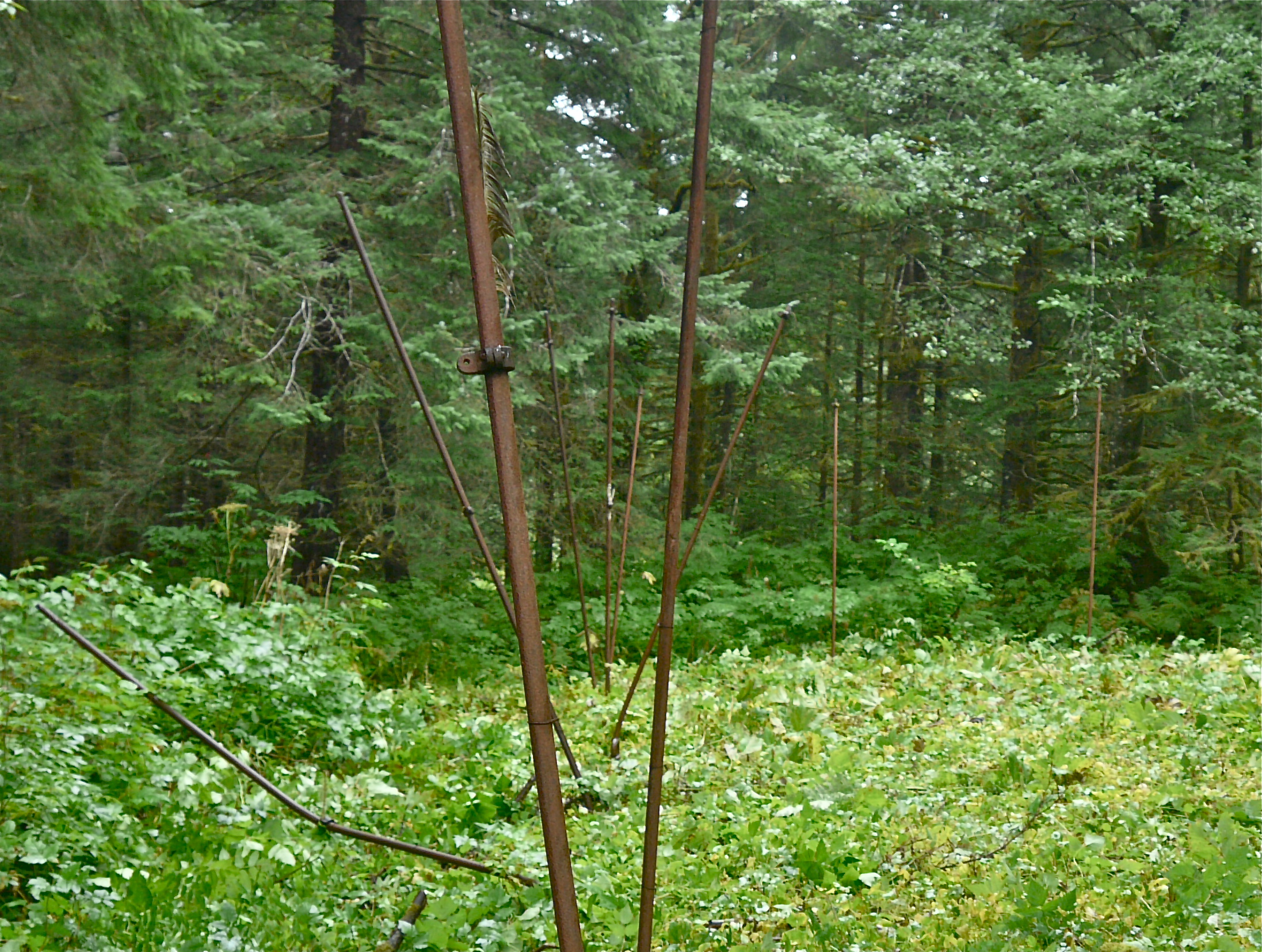
Aki and I walk the ghost trails of Treadwell. The once vibrant mining community was abandoned after a 1917 collapse flooded the tunnels it sent out into Gasteneau Channel. Today it’s ruled by deciduous trees: alders and cottonwoods. In summer they and the understory plants almost cover up the ruins. At summer’s end the cover slips away, revealing twisted rails and pipes that appear to grow out or through tree trunks. Weird machine parts, made beautiful by eroding rust appear leaning against spruce trunks.
Hard brown seeds of Cow Parsnip manage a tiny glow of beauty in the soft rain. The inverted pyramid assemblages contrast the droopy brown leaves of the mother plant. They have already sent a season’s worth of nutrients to the roots. So begins the end game of summer.
Treadwell, with it’s “all good things must come to an end” message, is a good place to adjust to summer’s end. It is coming. Already the fireweed are heading out with seeds they soon will release in a storm of white. Those berries not harvested by animal or man drop in ripeness, silver salmon color up in their natal streams, and bears build blankets of fat to take them through winter. In weeks Treadwell and other collections of leaf trees will be a celebration of shapes and we will look through them to the channel, our bringer of autumn storms. 
Mountain Berry Picking
Aki, her back to me and the berry patch, watches a nearby path. I’d like to think she is on guard duty. She never has to prove herself as only mosquitos threaten on this mountain meadow.
Perhaps it’s the result of a high summer of sunshine and warmth, or just luck. but big blue globes hang from many of these dwarf blueberry bushes. They taste sweet, unlike their cousins that grow on larger plants under old growth forest canopies. Mixed in I find the segmented, orange fruit of cloudberries. We once picked them and the low bush blues on the Kuskokwim River tundra. These mountain berries taste almost as good.
I pick for an hour before moving on, boots soaked by the saturated muskeg meadow, mind suffused with the peace that comes from meditation, effortless playing of music, and picking berries. My harvest will work its magic again in the morning, making a feast out of Scottish oatmeal and milk. 
Still More Sun
After packing the bicycle panniers for a seven day ride, I drive Aki out to North Douglas Island for a walk through the old growth forest. We are still rich in warm sunshine. It’s the middle of the day so open areas like beaches and meadows have all detail washed away by bright light. Not so in the forest where sun penetrates to illuminate hidden spider webs in sparkling light, turns the thorny devil club leaves into translucent green plates.
Warmth weather following a few wet days had triggered an eruption of fungus growth in the forest. My favorite are the orange waves of Chicken of the Woods (Polyporus) that just formed on broken tree fragments. Aki peed on this one, which is acceptable only if seen as a mark of respect. I never sure with dogs. 
Tasting Salmon Berries in the Sun
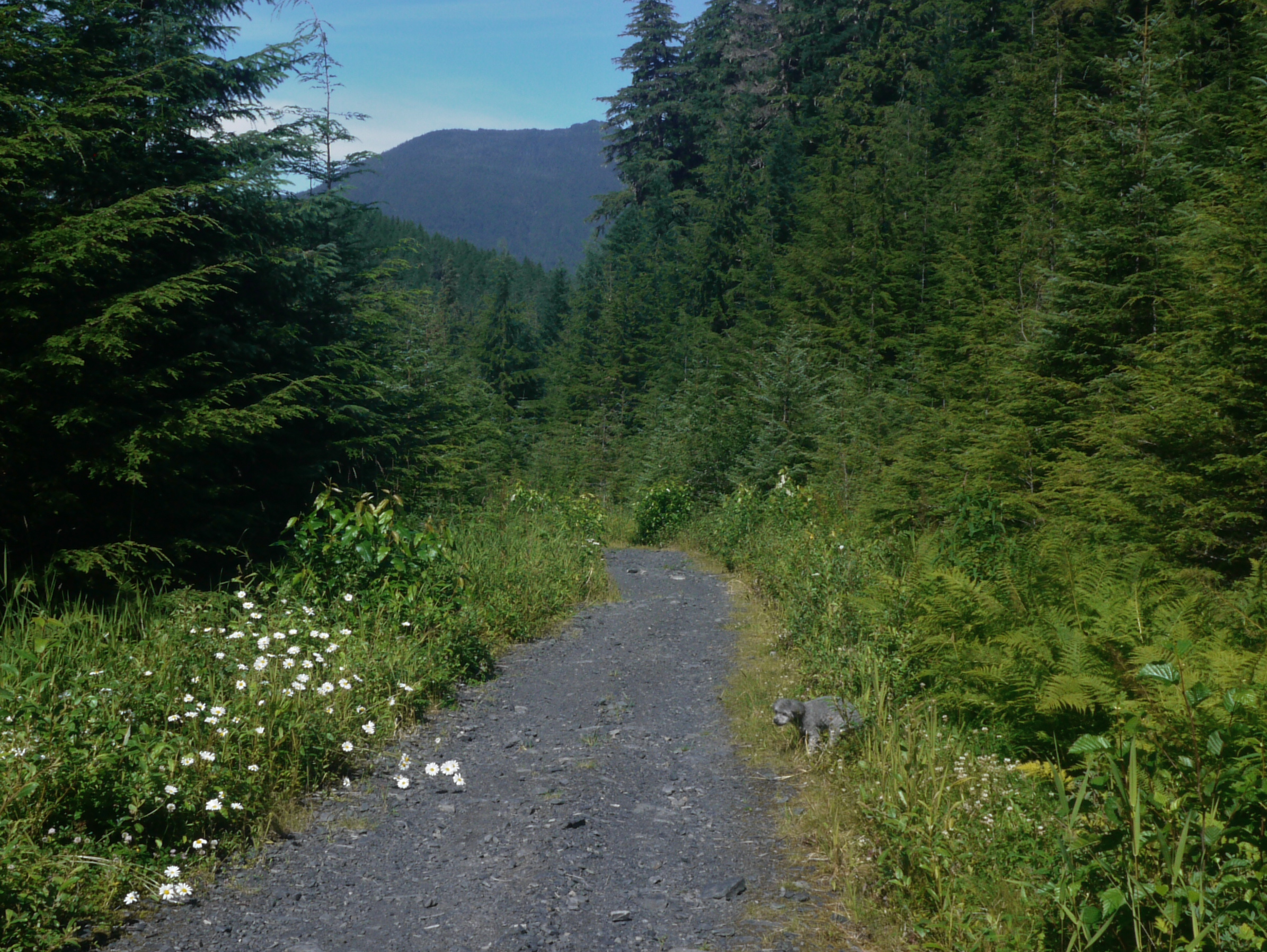
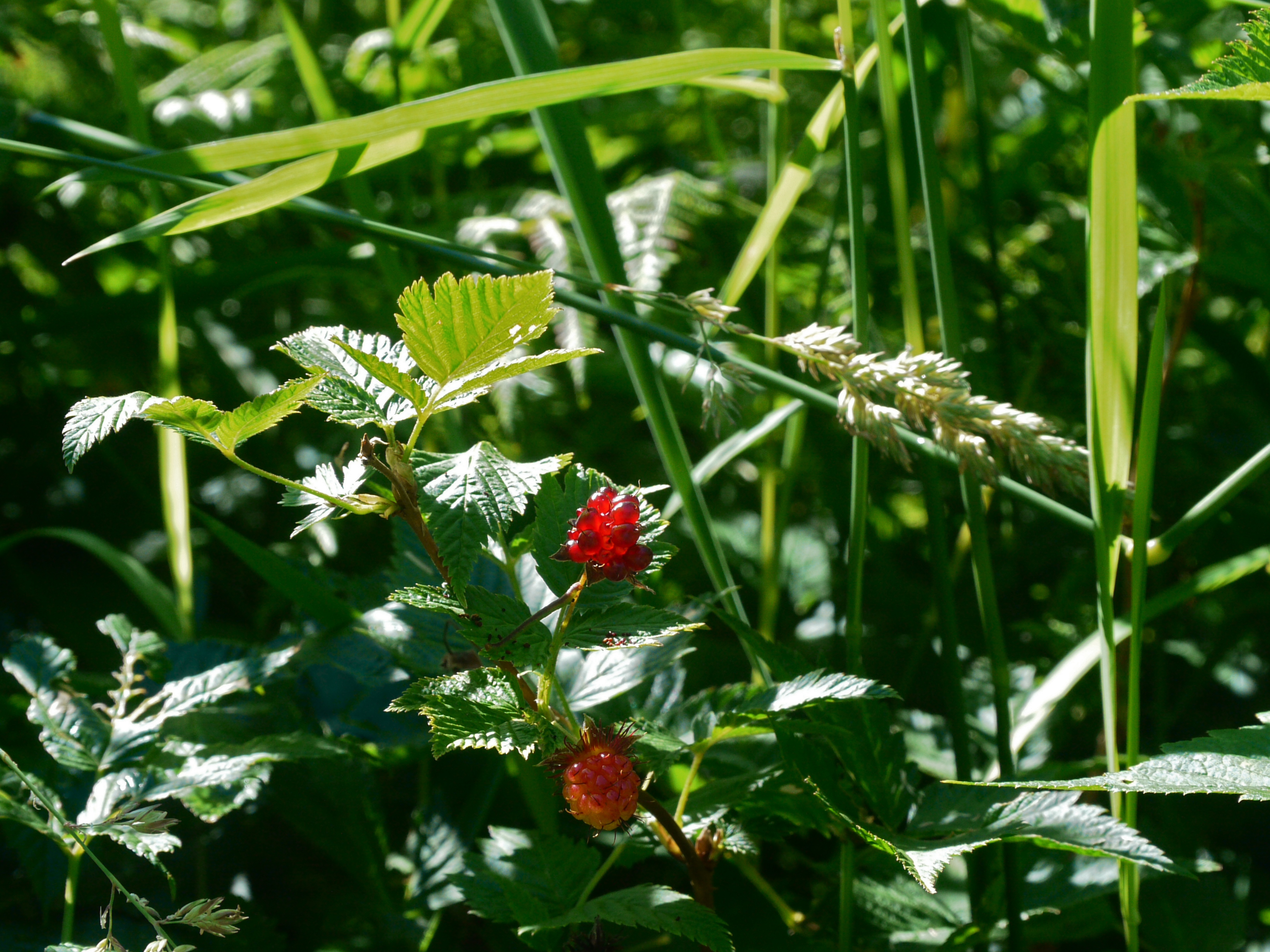
With the wealth of trails in the Juneau area, I knew we would have this one to ourselves, even on this warm, sunny Sunday. Just a gated gravel road ending at an old mine, the trail climbs through and then above an old growth conifer forest. Succulent salmon berries, red or yellow, grow along the trail. The red ones’ glittery translucent makes them the easiest to spot. When ripe they taste like watered wine and leave a wild after taste on the tongue. I haven’t worked out a way to describe the taste of the opaque yellow ones.
Away from flight and helicopter corridors, the trail offers silence as well as tasty berries. After minutes of climbing we only hear the sounds of boot strikes on gravel and Aki’s panting. Undeterred by the heat the little poodle mix pushes on ahead. I worry about the lack of trail side watering possibilities until we hear a small brook ahead. Even through thirsty, Aki won’t approach the water on her own but waits from me to slip and slide down a small slope to where the stream enters a culvert. Aki takes a few caution sips then moves up stream where blue berry brush and ferns form a shading canopy. When she has drunk her fill we return to the sun washed trail and find that American Robin just ahead— the one that all summer has waited for our approach on each trail taken. 
A Bear’ Bed. A Beaver’s Den
Back in the rain forest after two weeks of sun in Anchorage, I’m wandering the Troll Woods with Aki. A gray world of softness, the woods offer the best place to relax after cramming a semester’s worth of learning into 12 days. Yellow-green moss climbs the trees and covers the ground five inches deep. Beavers hauling freshly cut tree branches to their wood stash have worn a trail in the moss, which we follow to where a break in thick alders offers a filtered view of a pond.
I never noticed the pond before and wonder if it is another beaver public works project. Ever interested in finding the new in well known places I lead a reluctant Aki around an alder tangle then down a recent path formed through three foot tall grass. It ends in a circle of crushed grass near the pond’s edge—a bear’s bed. “Why not,” I tell Aki. If I were a bear recently sated by Sockeye Salmon snatched from Steep Creek while tourists snapped their cameras, had endured helicopter noise and bus fumes, I’d come here to contemplate this pocket pond. I’d watch water bugs skate its surface, dig the perfect reflection of the deep green buckbean stalks choking one bay, laugh at the how a solitary glacier erratic looks like a partially submerged skull sporting mossy hair. When darkness shuts down the industrial tourism machine I’d curl up on the still soft grass stalks and dream of more salmon. I’d wake in the morning before the mosquitos and snatch a few Nagoon Berries before heading to work.
Not wanting to be here when the bear returns, we take a reverse course on the beaver’s logging road. Near another pond, the one where last Spring she dashed across too soft ice to investigate beaver tail slaps, Aki stares at the water then dashes over to a newly formed beaver den of branches and mud. With the tense posture of an interested poodle and tail a metronome she stands on top of the den until reluctantly answering my summons to, “Get away from there you stupid dog.” When will she learn that the big toothy rodents do not want to be her friends?
Lessons in Solitude
This trail, beginning at the Alyeska Ski Resort and ending in a string of beautiful subalpine meadows, teaches the value of solitude. The first half mile hosts a near constant stream of hikers, most just taking a curious peak into a northern rain forest. A smaller number push on to see the Winner Creek Gorge and take a promised ride over the stream in a bucket suspended from a cable. The trail forks before the gorge where I right turn to explore a less visited section of the creek.
Before the fork, I dottled along finding spaces between groups so I can enjoy the play of lights of darks in the forest understory. After taking the road less traveled I am alone except for a tiny vole galloping up the trail then diving to safety beneath a blueberry bush. Aki would have loved that. There was also a raven sounding like a honking Canada Goose.
After the junction the trail climbs through a forest of smaller and smaller conifers before delivering me to the subalpine meadows. I guess you should call them that. They form in places where the creek valley opens into a shallow “V”—large swaths of grasses and taller plants like the Elderberry and Wild Rhubarb. In between I find almost hidden clumps of dark purple Monkshood, blue Wild Geraniums, and even red Columbine. Above rises two glaciated peaks. Here the wind cools and blows off the mosquitos, the stream sings its low sound without having to shout to be heard over the sound of passing conversation.
Signs from Canada
I am still in Anchorage, 1200 miles away from Aki, riding a rental bike each morning before classes begin. The sun shines down on the Chester Creek Trail on this morning’s ride, at one place striking Canada’s beautiful red and white maple leaf flag as it hangs next to a Stars and Stripes still in shadow. I catch the translucent thing through the forks of a birch tree while flying down the trail. Is it a sign?
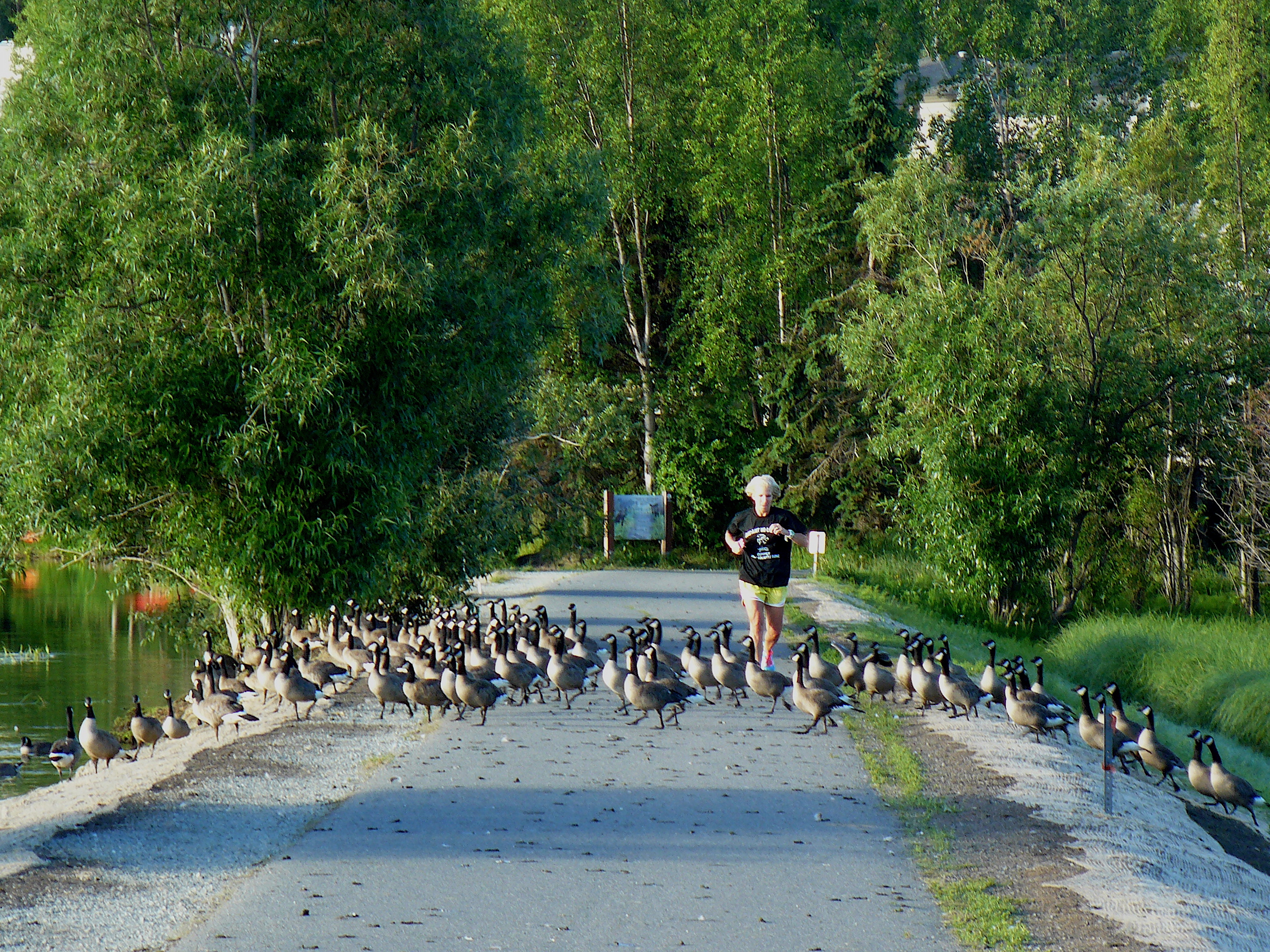
The plan was to ride all the way to Cook Inlet and back but a gang of Canada Geese, maybe 30 or 40 derailed me. They occupy the entire bike path near the bottom of Westchester Lagoon. A jogger on the other side of the geese waits a respectful time then slowly chugs through, Moses like, while the Geese part—driven by an unseen hand or common sense. At this time of the day either explanation works.
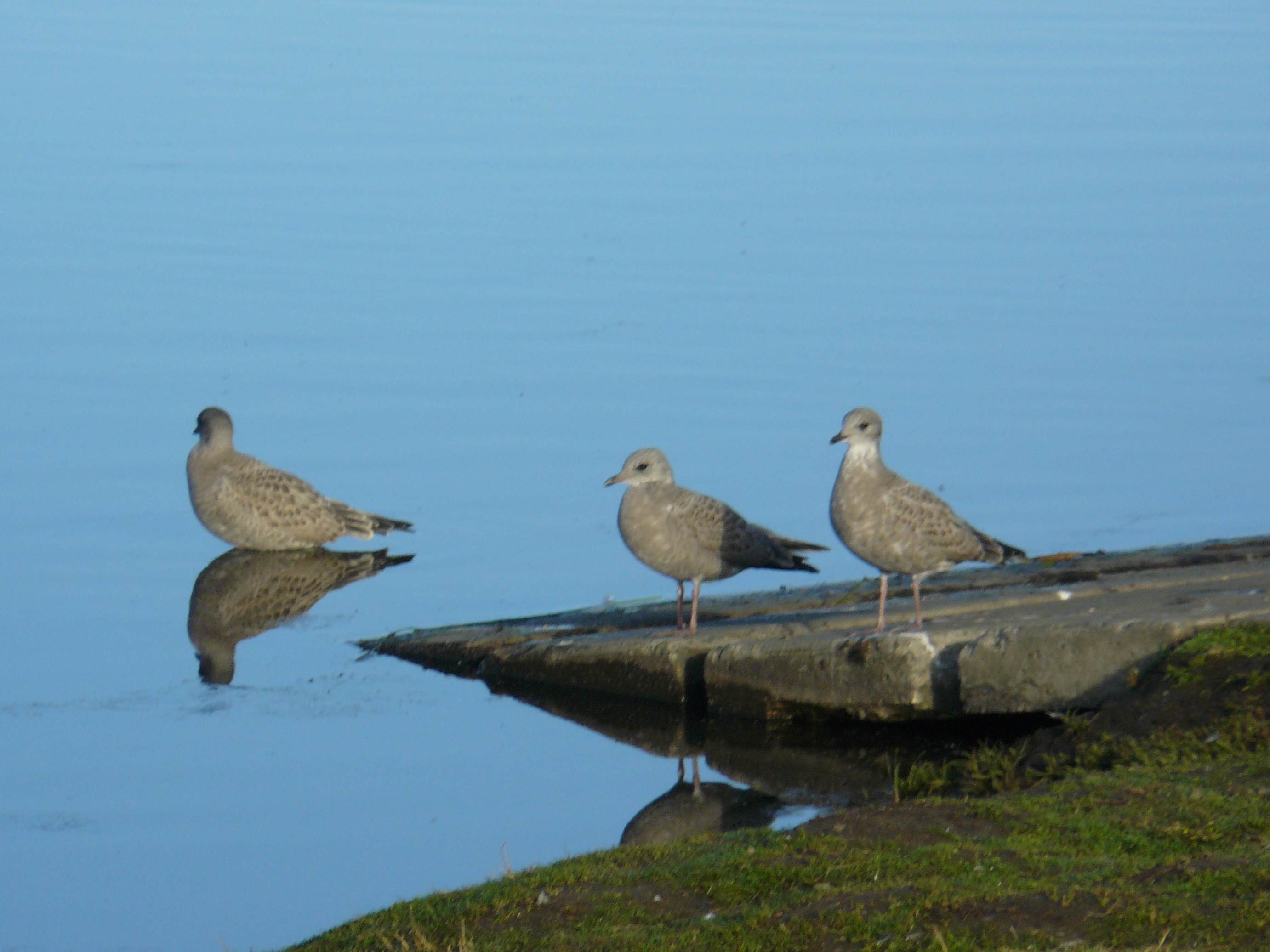
The geese close in behind the jogger to retake the ground. Not feeling the jogger’s power, I turn around and pedal back to the dorm, passing a surly looking group of chubby birds standing motionless in the water.
Testament
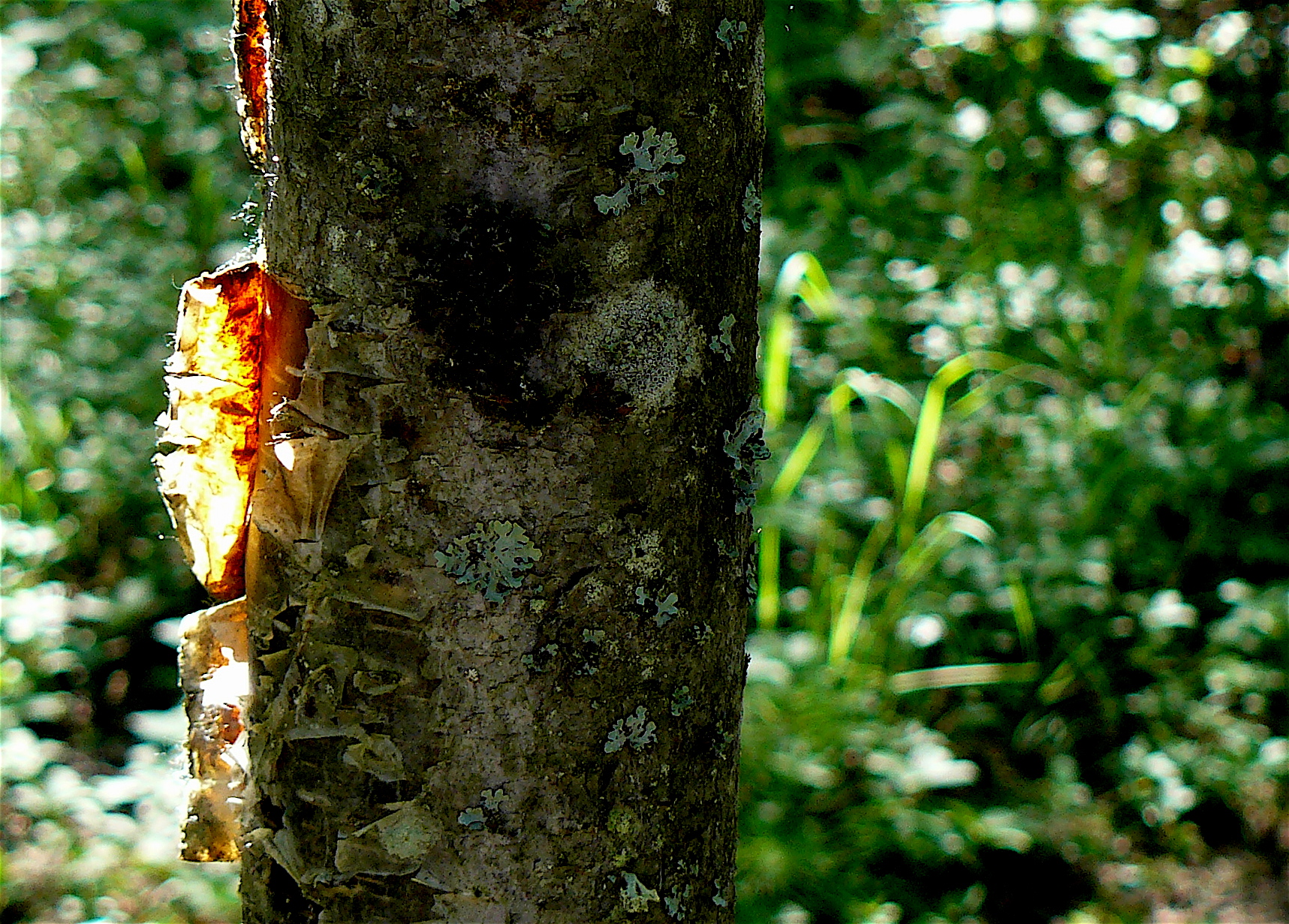
These birch trees retain beauty even though surrounded by Alaska’s largest city. Aki, only knowing the Southeast rain forest, has never lifted her leg to a paper birch. Even if she had walked many times through birch woods, the little poodle mix wouldn’t miss their parchment like bark, rough to the touch, that can peel back to a paper thin strip that glows when backlit by low angled sunlight. She might long for the perfume smoke of burning birch wood. I do.
Walking on a summer evening among birch and their taller cousin the aspen on trails crisscrossing the University of Alaska campus, I hear barking dogs, laughing children, the chimes of a clock tower, airplane noise, bicycle tires skidding on gravel, conversation carried out without reference to the birch. No one appears to notice the yellow green leaves dance under blue skies or the puzzle of cast shadows on the paths they walk. I wish I was so rich in birch trees, blue skies, and sun.
Blueberries after the Symphony
Until the blueberries, this walk was all about sounds–the typical coast forest early morning symphony: complaints, mostly gulls but sometimes an eagle drying its wings; the distant jack hammer sound of a red breasted sapsucker; a slightly off key bird song (not the bell clear tones of Robin); buzzing of the cruising bumblebee; gentle shushing of small wave action on a gravel beach; wet slaps of rain charged plant leaves hitting my cotton pant legs. All this builds to the crescendo finale delivered by a flight of old radial engine float planes on the morning run to Pack Creek—loaded with cruise ship tourists hopeful to see Alaska Brown Bears.
With my ears still ringing with airplane noise I follow Aki to where she growls at a fallen hemlock across the trail. “This is new,” I say in part to let Aki know there is no danger. We’ve had no storms since our last use of this trail so I wonder what delivered the coup de gras to this rotten tree; perhaps it was the pressure applied by a scratching bear or simply a yielding of the few fibers still holding the hemlock upright. I start to tell Aki the riddle about a tree falling in an empty forest but remember she has heard it before.
Late in the hike we reach the a patch of load bearing blueberry bushes, fruit just ripe. For weeks I’ve stalked the early setting Salmon Berry, find only empty or picked clean bushes. Here I am at the opening day of blue berry season. Is this karma rewarded or just luck? It matters little for the berries yield crisp sweetness that define an Alaska summer as much as the salmon, eagle, whale, and industrial tourism.