April is the Cruelest Month

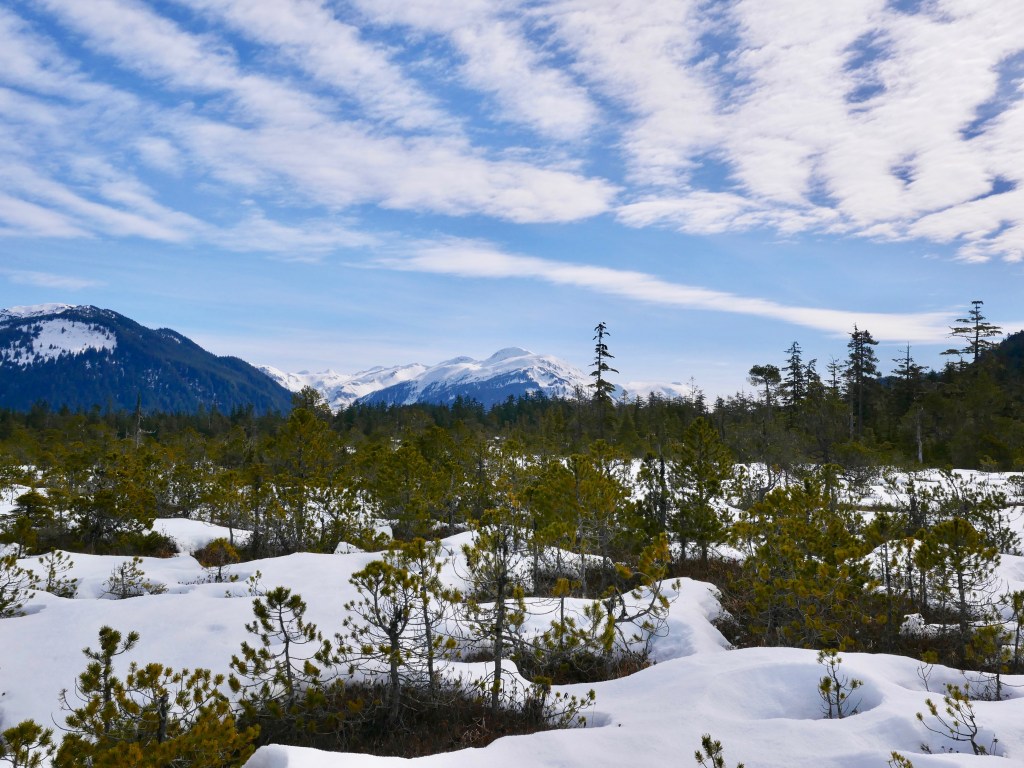
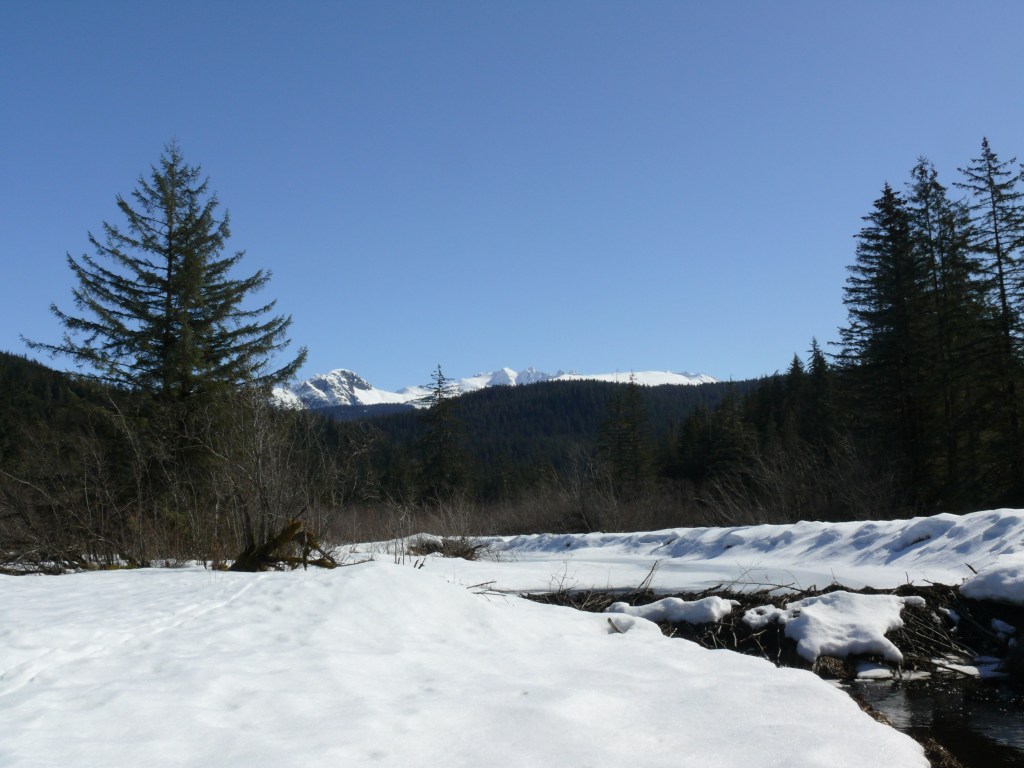
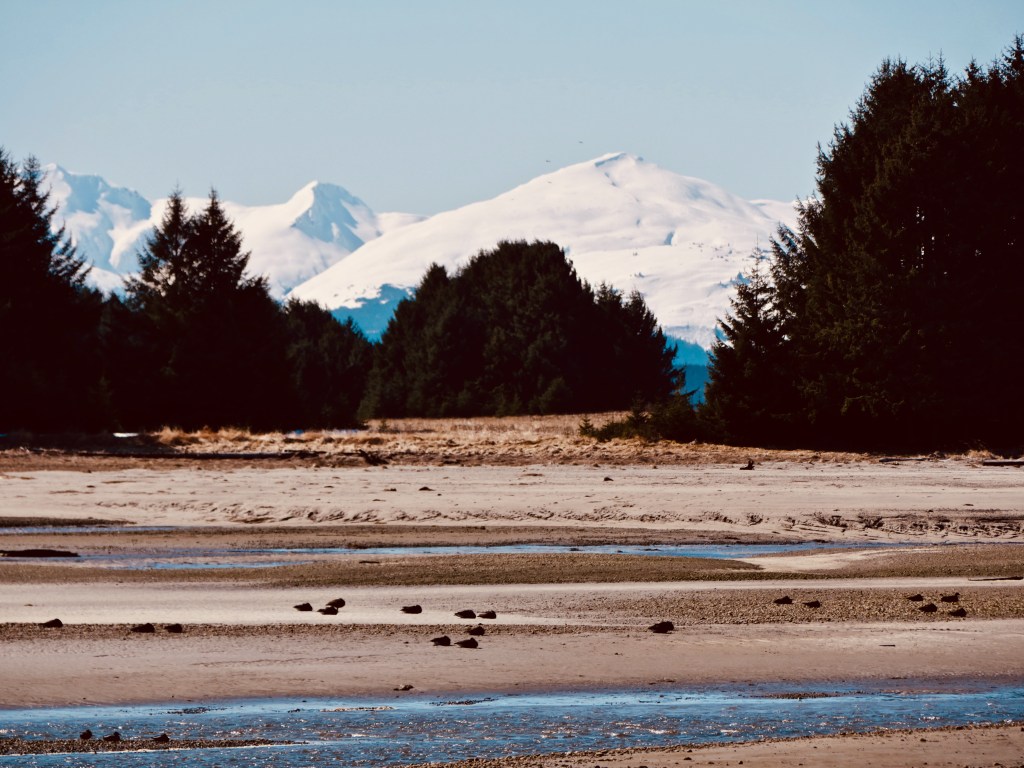
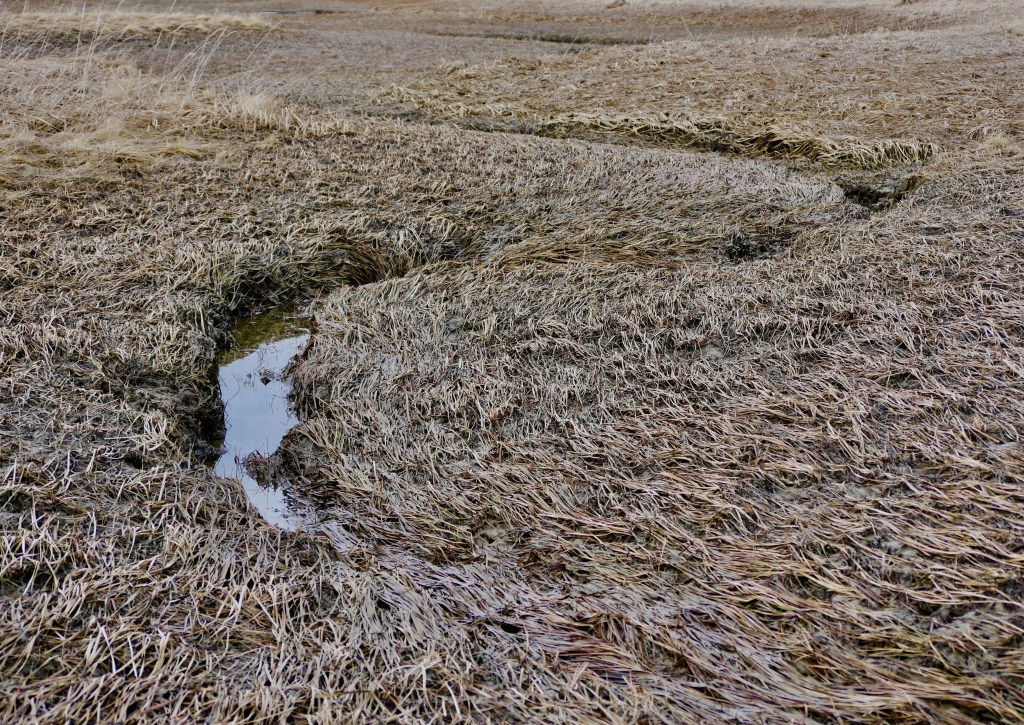
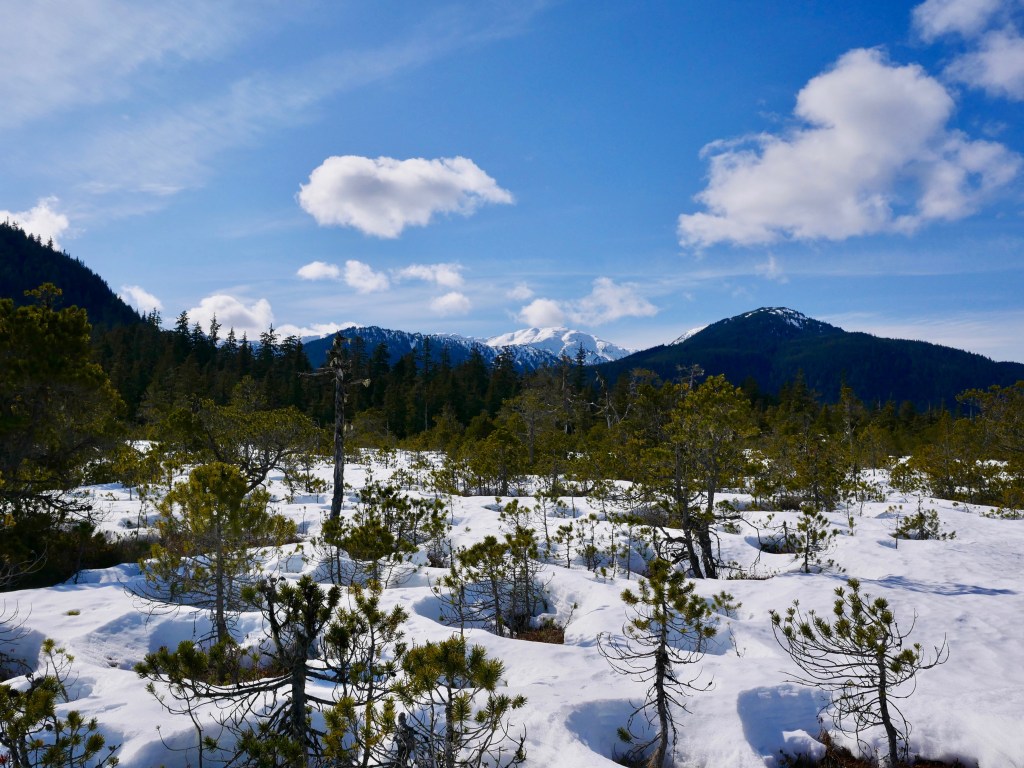
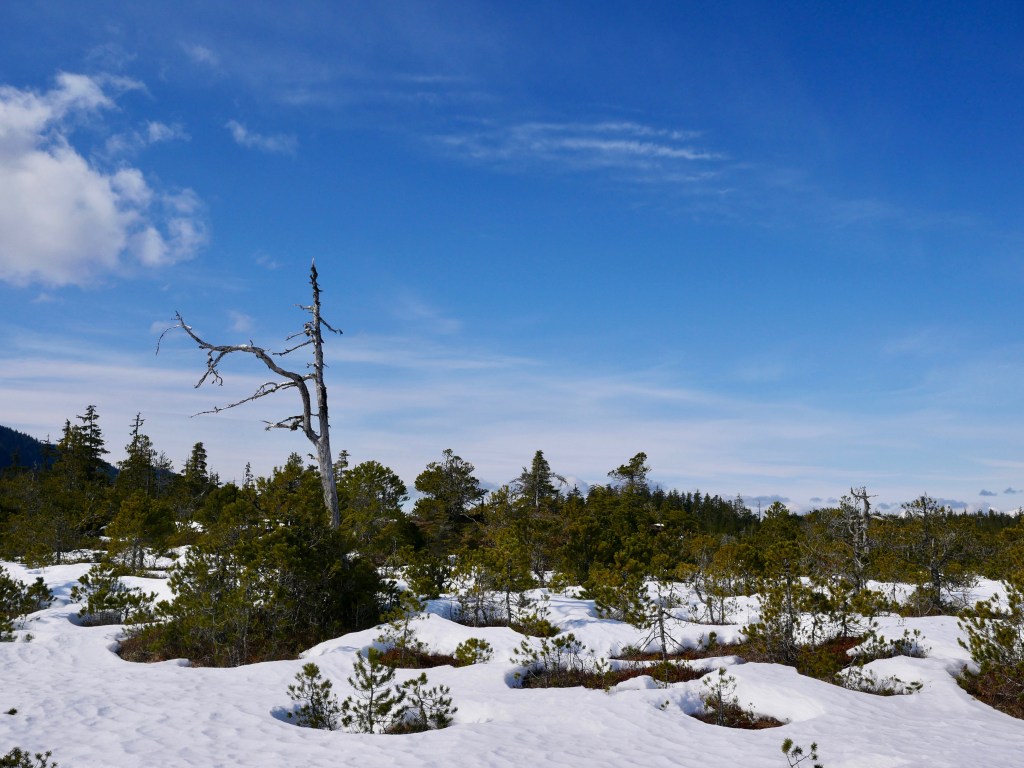
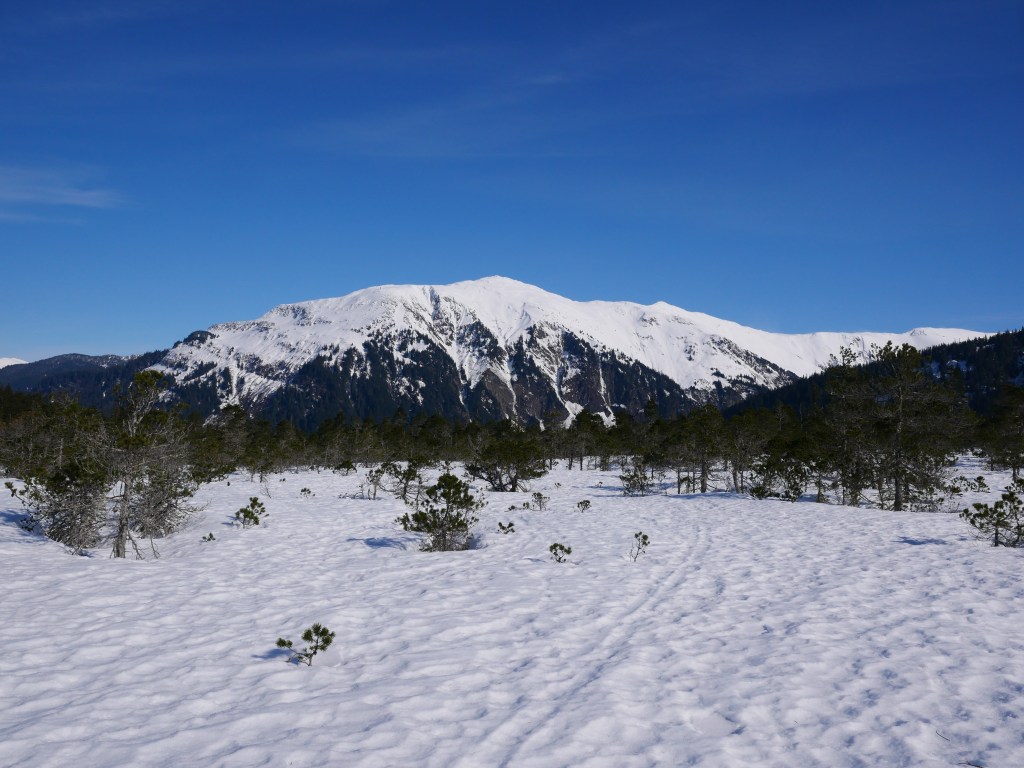
The meadow before the April Thaw

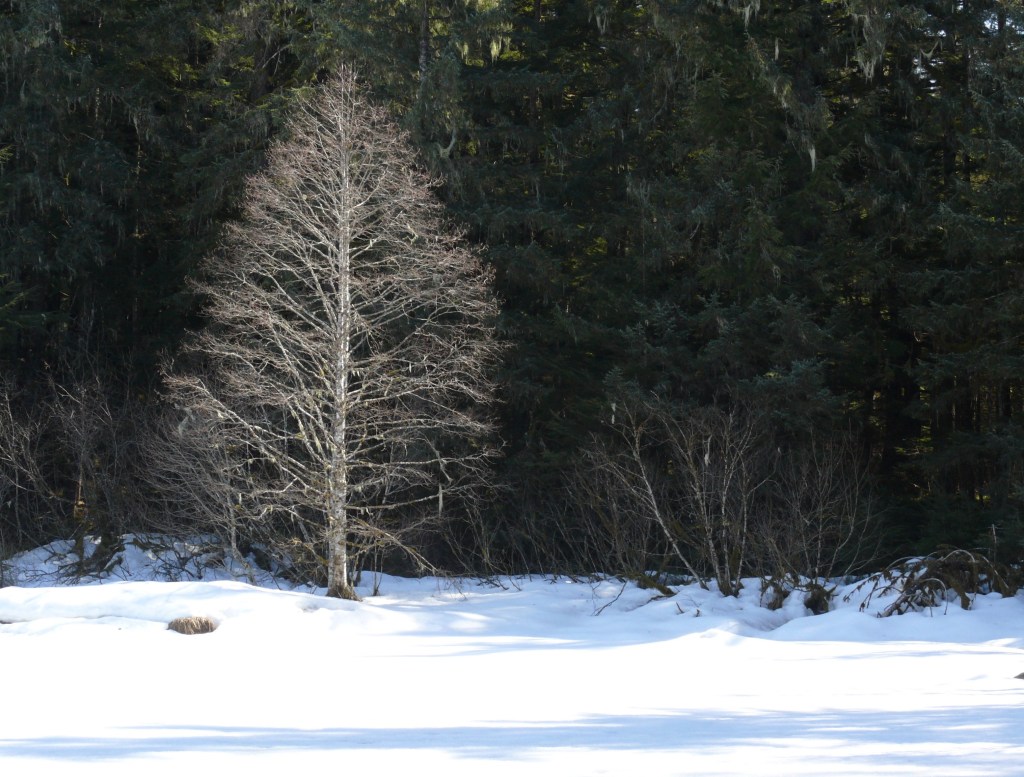
I prefer winter and fall, when you feel the bone structure in the landscape—the loneliness of it—the dead feeling of winter. Something waits beneath it—the whole story doesn’t show.

                                                                        American painter Andrew Wyeth

For winter lovers like Wyeth and I, April can be the cruelest month. Not, as T.S. Elliot suggests, because we feel out of sync with the joyful explosion of spring. Elliot’s spirits apparently fell as the sap rose in the English countryside. It is because April begins by melting the simplifying snow and ends by hiding the bone structure of the land with new leaves.

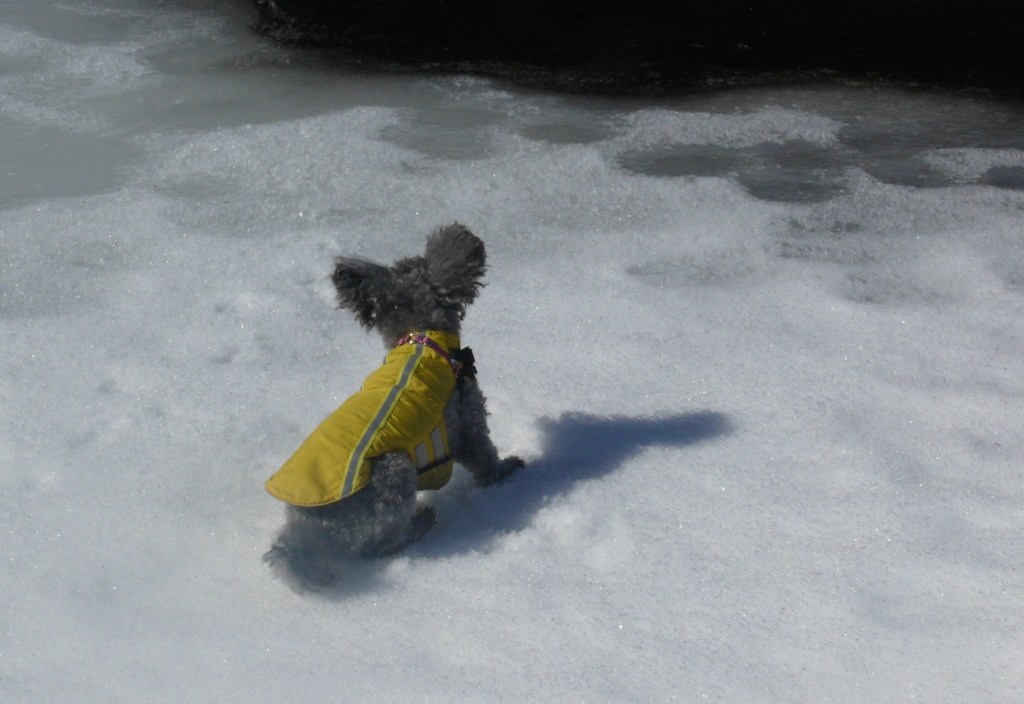
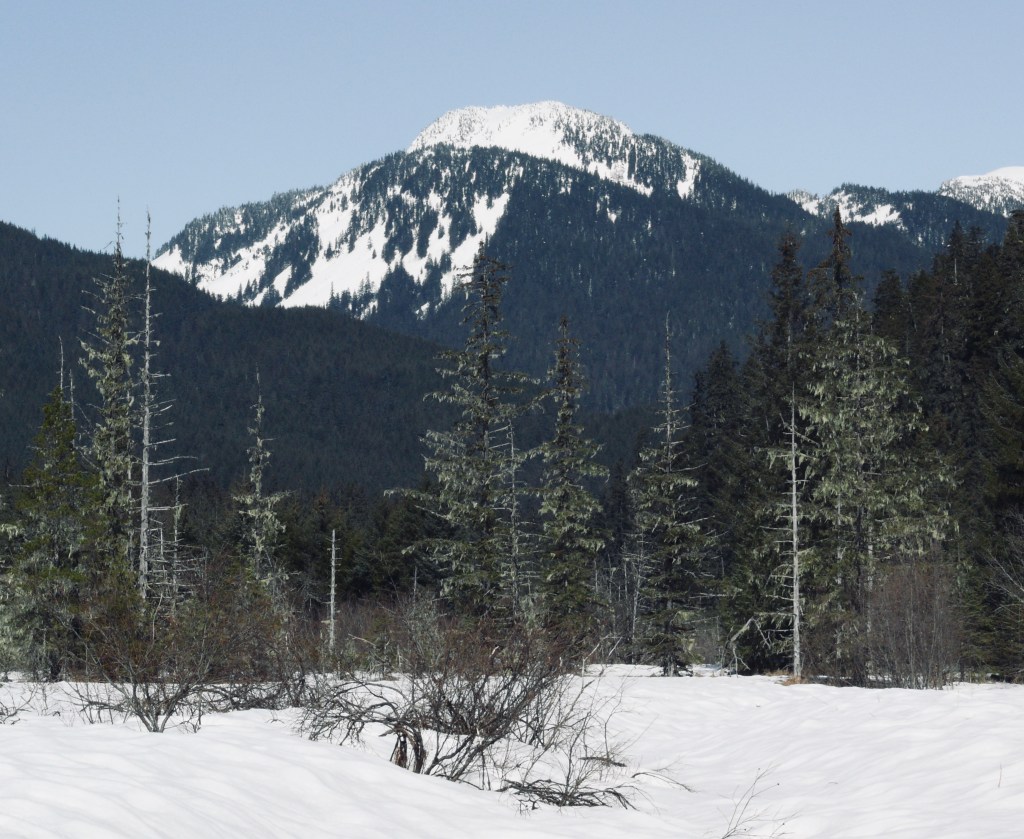
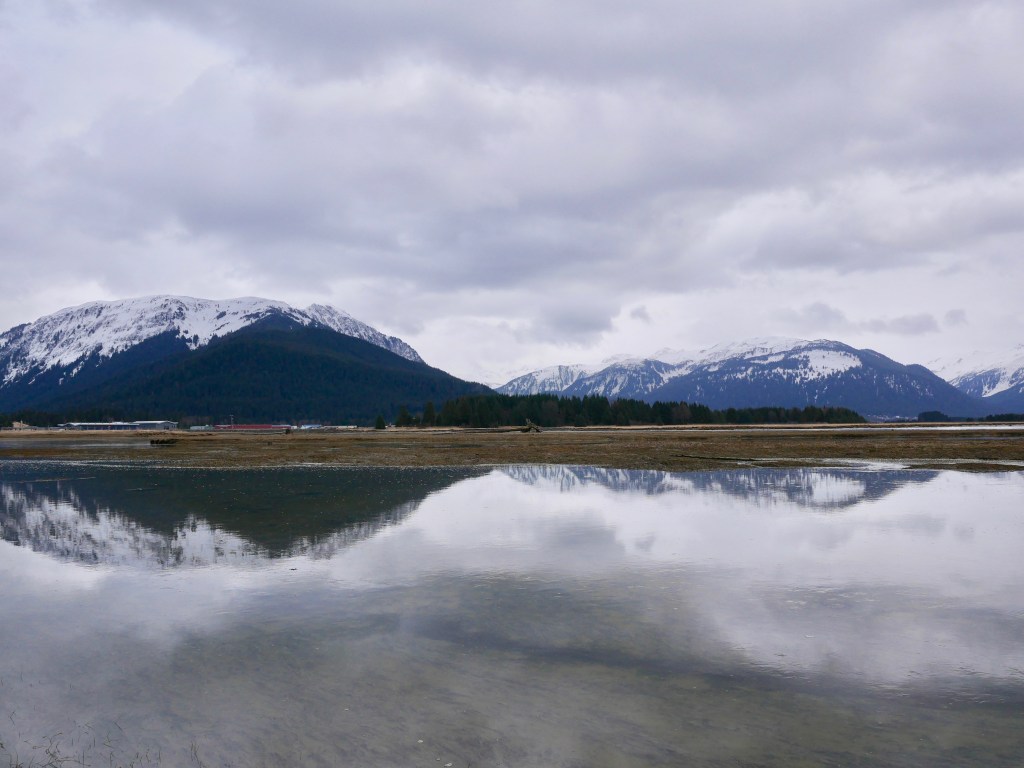
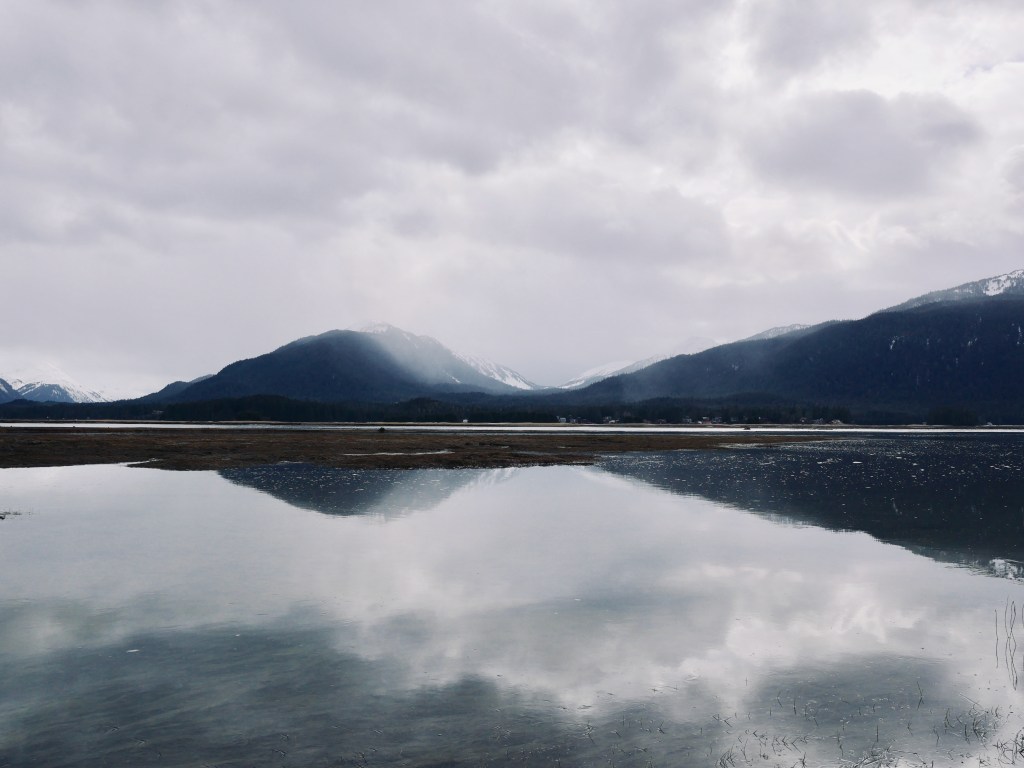
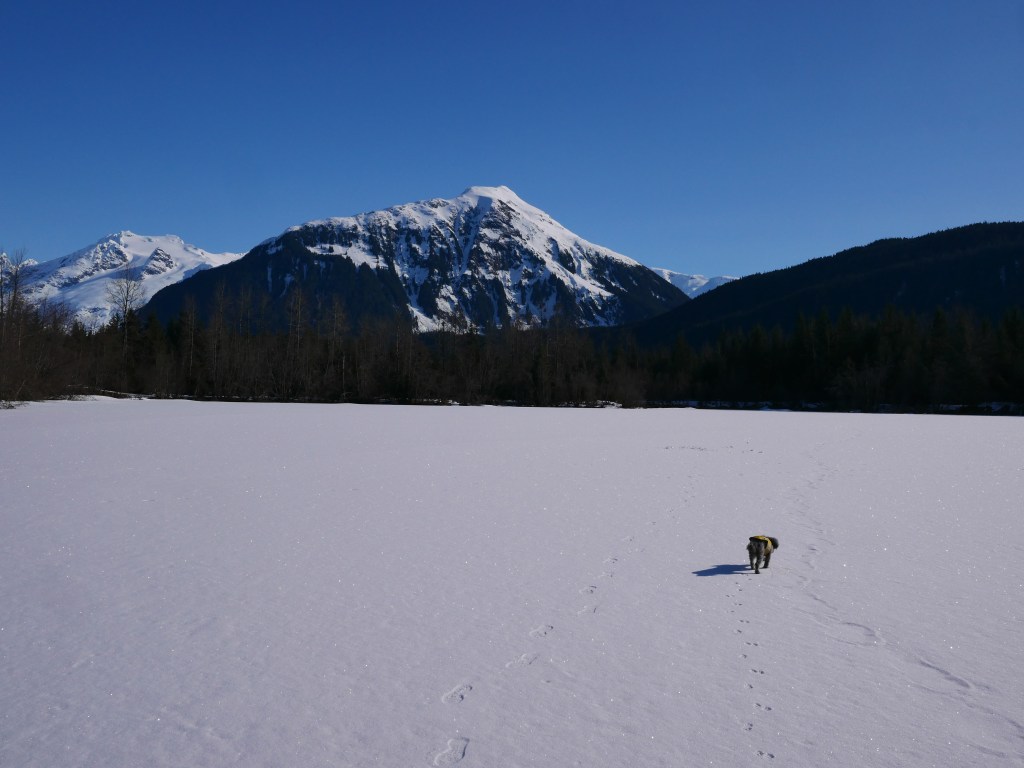
This morning, while I struggle across softening snow on Gastineau Meadow, Aki stops often to discover smells hidden all winter. The whole meadow has become an antique store of smells. She stops, sniffs, digs a bit with her right paw, sniffs again, pees. Just yesterday I could have strolled across the meadow on frozen crust. No clouds would have complicated the simple lines of the surrounding mountains. No rain collected in the tracks of deer that crossed just before we arrived. We were free to move across the uncomplicated landscape over snow that protected the cores of wildflowers, berries, and sun dews from winter winds. 
Easter Meadow

This post describes a walk yesterday, Easter Sunday.

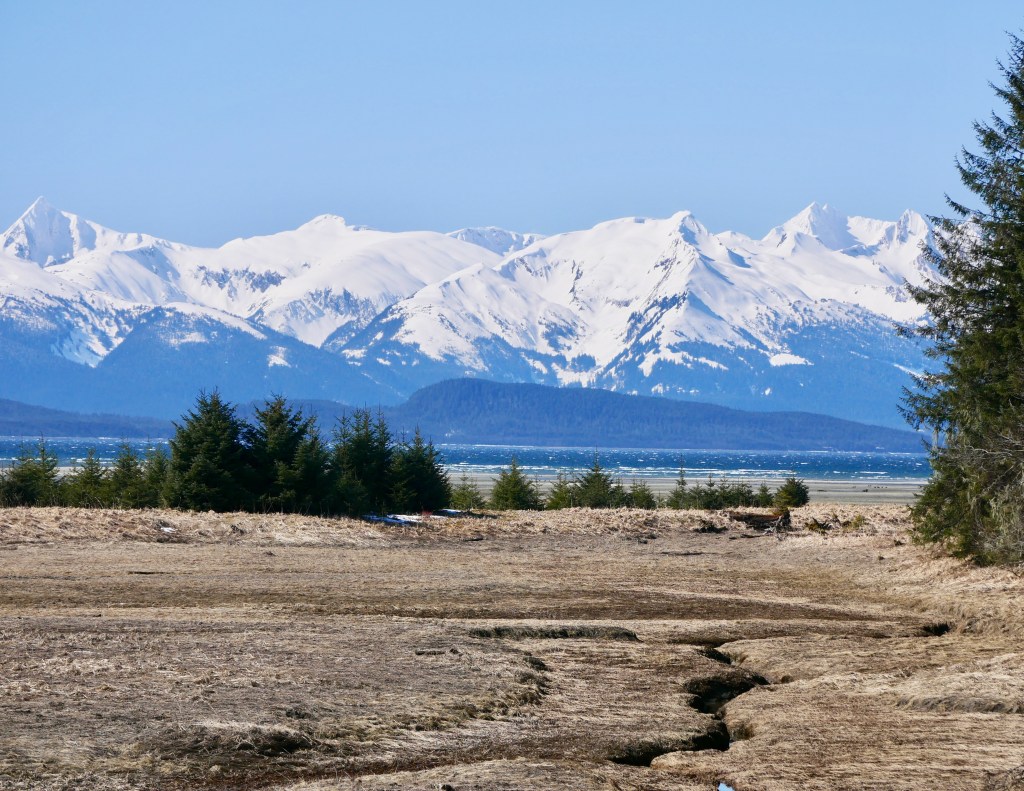
            This meadow was not my first venue choice. I wanted to walk with the dog along a beach offering views of the Chilkat Mountains and maybe the Mendenhall Glacier. But cars overflowed the beach trails parking lots. On a normal Easter Sunday, many trail users would be sitting in church, looking pretty in pastel ties or dresses. The pandemic closed our churches. This morning broke with springtime blue skies and strong sun. Are people worshipping with families under open skies? 

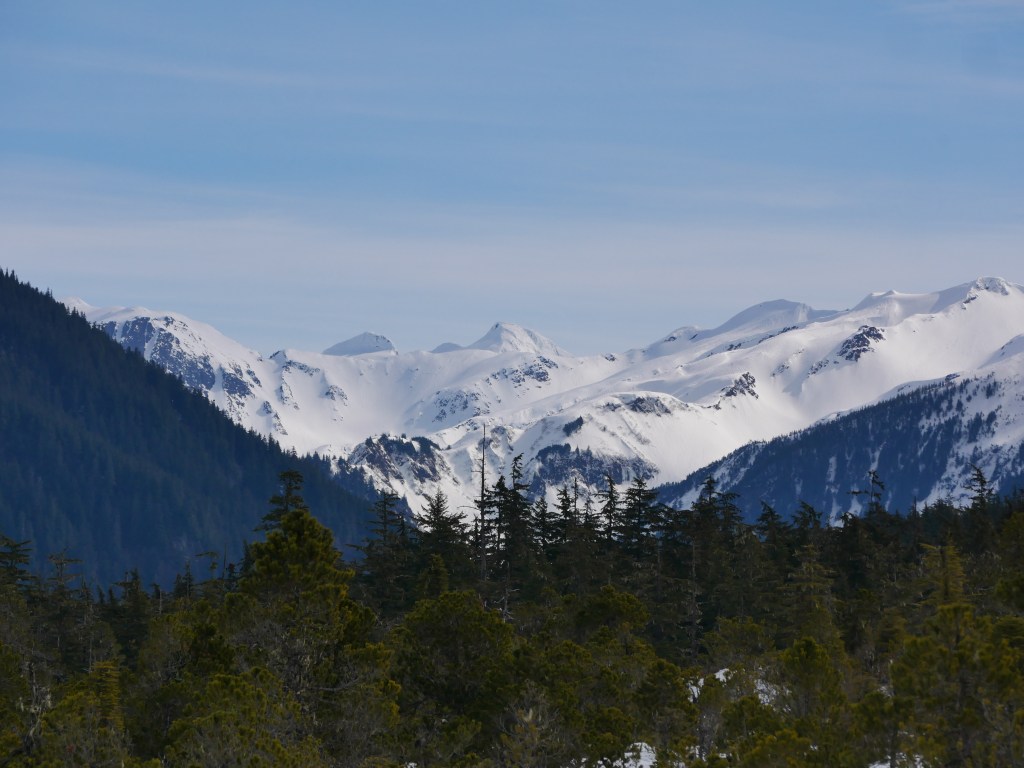
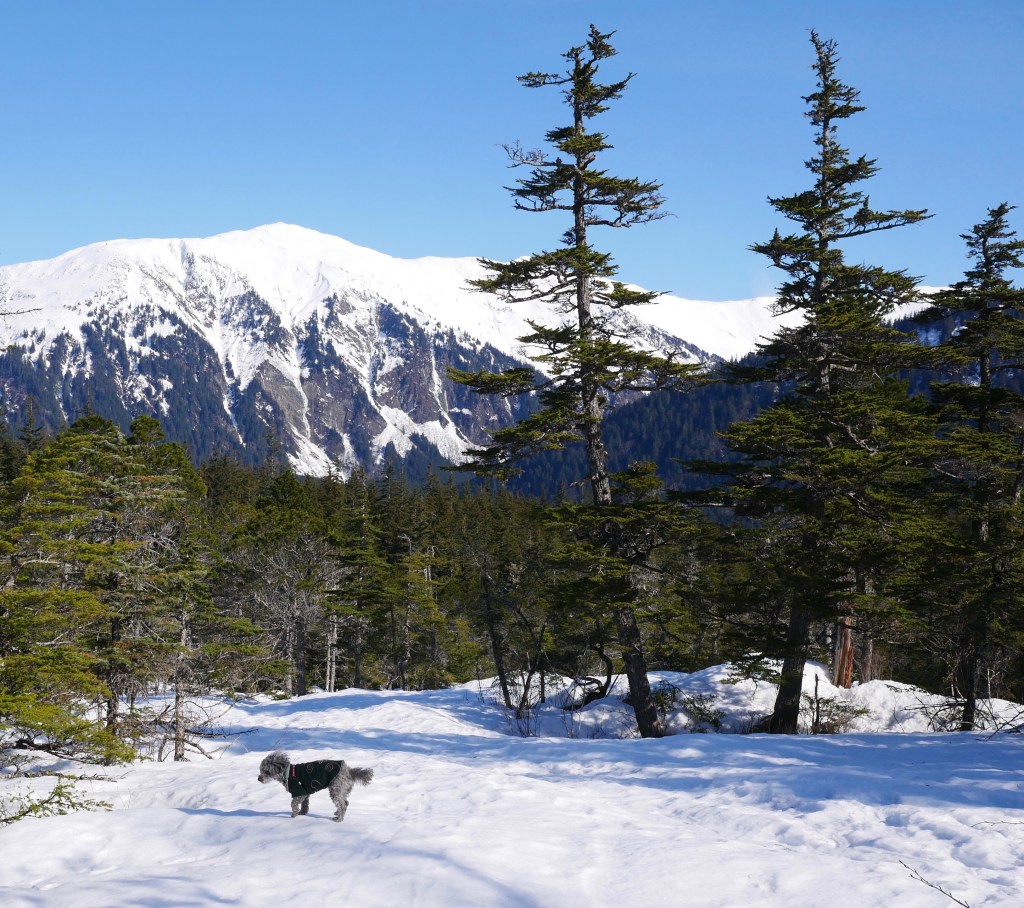
            Now we walk alone on an unnamed meadow. It offers mountain views. From the top of  a mound of glacial erratics (large boulders dropped haphazardly by a retreating glacier) I can make out the tips of the Chilkats poking above a line of spruce trees. The meadows also offers solitude. At first we only share it with eagles, ravens, and blue jays. Then the sound of squealing children floats over the snow-covered ground from the eastern edge of the meadow. 

Aki is searching for her Frisbee, which, thanks to an errant throw, is hiding in a tangle of pines. The children must be searching for Easter eggs hidden by parents. I hope they find them all before the ravens do. 

Debating the Value of Traffic Noise

This meadow would be almost quiet if not for a nearby Glacier Highway. During breaks in traffic, Aki and I can hear siskins and junkos busy hunting in alders and damaged pines. A jagged line of mountain peaks show above the tops of a spruce forest that starts on the other side of the highway.

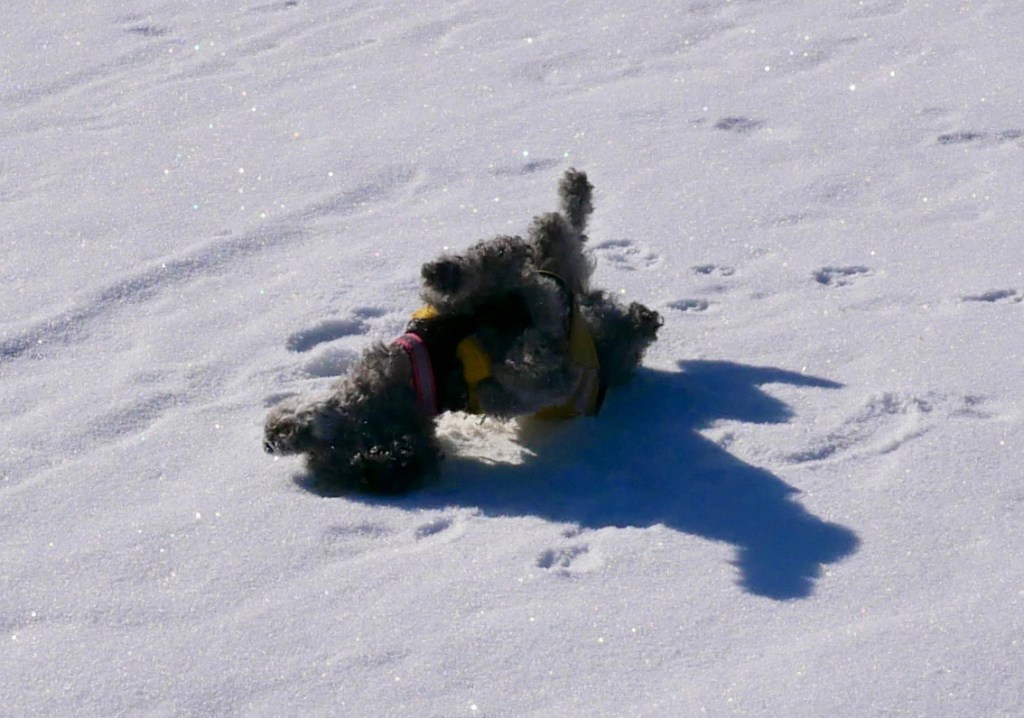
Dense snow covers the muskeg even though the temperature is already well above freezing. Aki rolls in the sugary snow as I study a straight line of tracks left by a large canine this morning. Should we follow what could be wolf tracks or pass through a screen of alders to visit a watercourse controlled by beavers? 

            Remembering the large beaver dam on the other side of the alders, I lead the little dog to a narrow but deep creek. Upstream is otter country. But recent warm weather has destroyed the otter’s slides. 

A few meters downstream is a beaver lodge mostly hidden by snow. Water cascading over the beaver dam blocks the road noise. I’m struck with the parallel of this meadow visit to a walk across land bordering a train line. When on trains in Europe, Britain, Scandinavia, or Japan, I find myself staring at these waste lands. Some look wild enough to shelter otters or badgers. On a ride through the Sami country of Sweden, a small herd of reindeer raced my train. Around cities, the railroad border lands have been divided into garden allotments. I imagine siting in the doorway of one of the little allotment shacks, sipping coffee from a thermos mug, watching tomatoes swell in the summer sun. 

Does the noise of rushing trains annoy an allotment gardener like today’s traffic noise bothered me, or does it carry away urban stress like a river, like spring melt rushing over a beaver dam? 

Tired Travelers

Aki has the sense to shelter behind a driftwood windbreak. Wanting to photograph a group of exhausted looking waterfowl, I let the wind chill me and shake my camera as I point it at the birds. One stands on one leg. The rest have flattened themselves against a mid-channel gravel bar. All, even the standing one, have tucked their beaks into their back feathers. The birds don’t flinch when a dog barrels down the beach on the opposite shore of the river. 
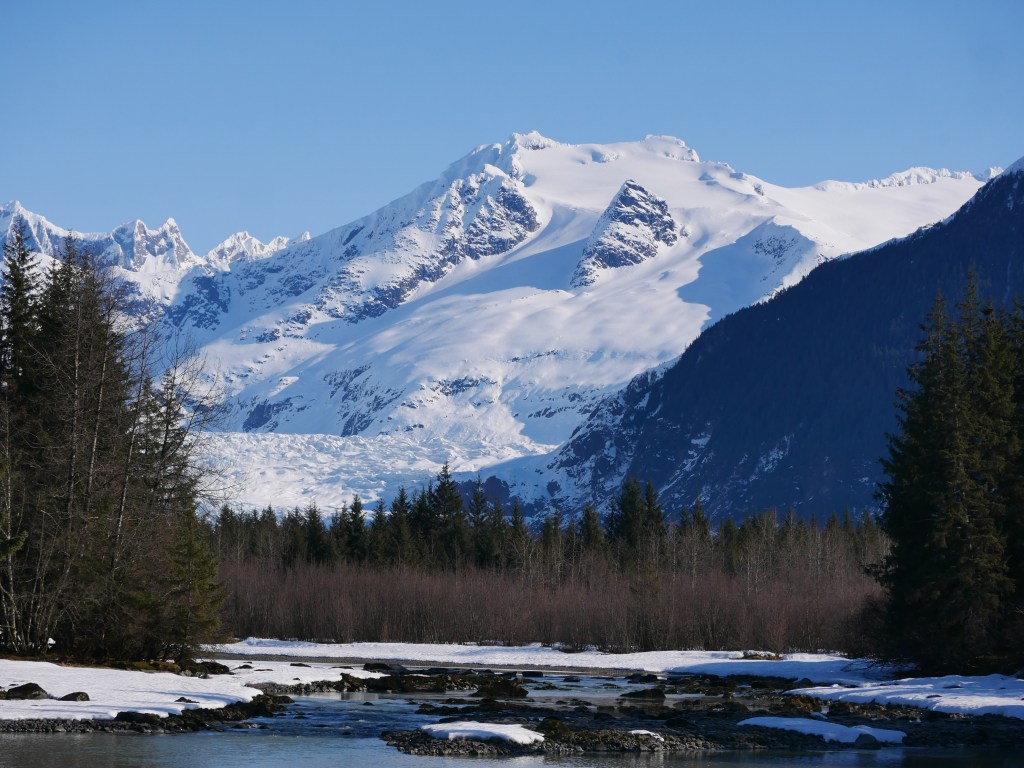
            The photos I take will be too blurry for me to identify the tired birds. I know that they are not part of the Canada goose gang that winters in the rain forest. They are nattering just upriver from the sleeping geese. I see a slash of white on one bird. Maybe they are brants. Rest while you can travelers. The flood tide will flush you off the gravelbar in a few hours. 

            The local Canadians huddle fifty meters away. Their watchman honks out an alarm when another dog bursts out of the opposite shore woods and gall lumps toward the river. The locals form a single file line behind the watchman and trot away from the dog.

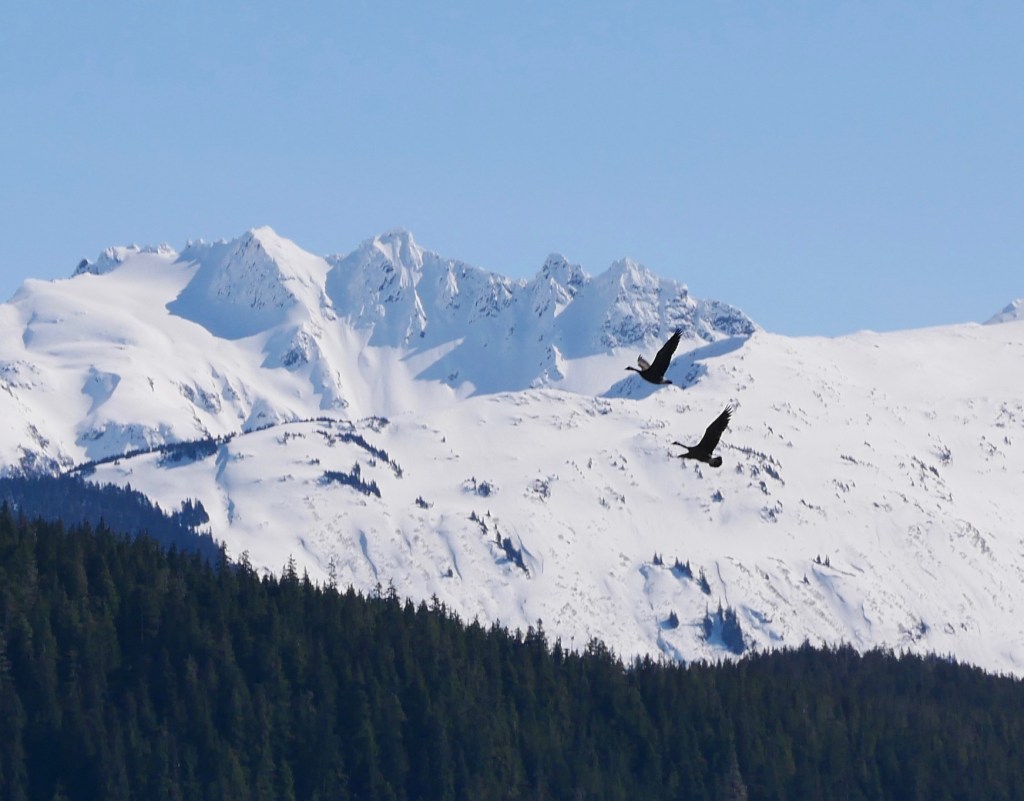
            Two other Canada geese linger on their own in the middle of a different gravel bar. When spooked by a pair of hikers, the geese flee. I expect them to join their cousins. But they spiral up until high above the river, then fly up river to a quieter place. 

Eagles in Love? Mallard’s Distain?

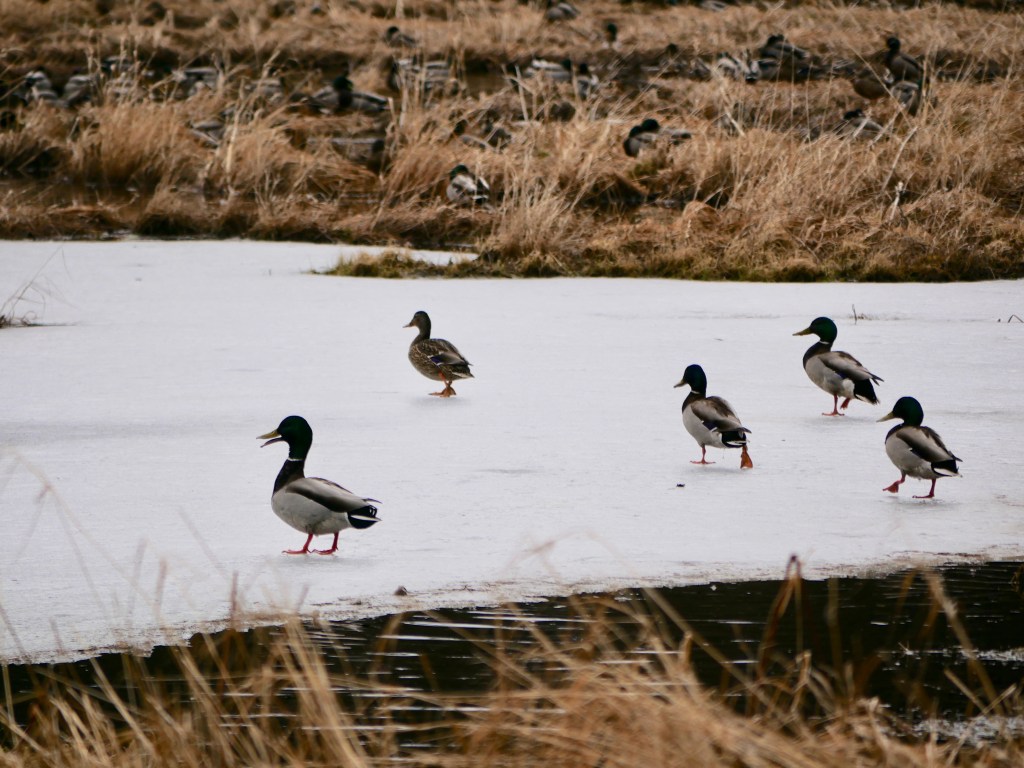
Hundreds of mallards have gathered on a tidal meadow pockmarked with thawing ponds. We would not have spotted them if one of the drakes hadn’t croaked, “crack, crack, crack” in the tone of a mean-spirited bully. He could be commenting on a karaoke performance at the neighborhood pub. I stop myself from anthropizing when I spot two eagles just setting onto limbs of a nearby spruce tree.  

 Aki and I are returning from the mouth of Fish Creek. It was barren of birds except for a half-dozen bald eagles. One of the big predators gave itself away with a long, plaintive call. I wondered whether the eagle was singing the blues until another eagle flew across Fritz Cove and landed in the singer’s tree. 

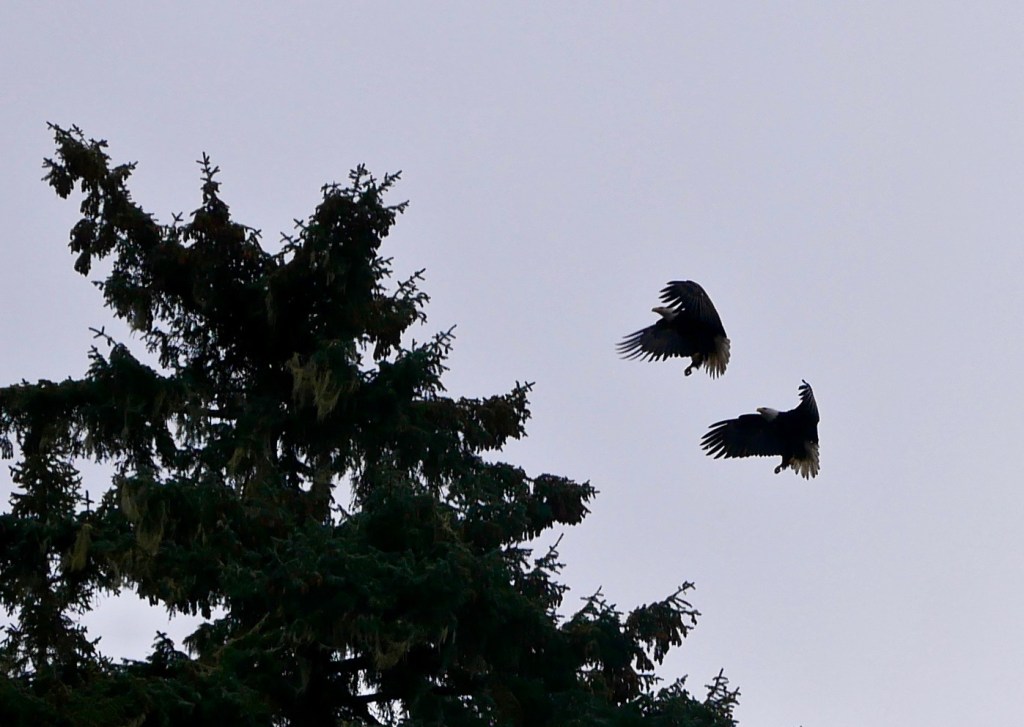
A hundred meters away, two other eagles launched into the air. They circled above Aki and I. One chased the other, who was making an uninspired attempt to escape.  When the pursuer thrusted his talons toward the pursued, she quickly headed toward a spruce tree. In a few seconds both birds were sharing the same spruce limb. 

I watched the performance, hoping to see the eagles complete their mating dance by locking talons and tumbling toward Aki and I. Another eagle, perhaps frustrated by love and not interested to seeing such a public display of affection, flew out of his spruce roost and landed at the edge of the cove. While he sulked yet another eagle called out for a lover. 

Escaping the Storm

            A storm moved in last night, bringing high winds and wet snow. We can feel the wind shaking the house and see snow flakes slam into our north facing windows. They melt on contact, creating little streams of waters that combine then course down the glass. Aki does not want to leave home this morning. 

            Always the family’s optimist, I dress the little dog for bad weather and carry her to the car. This spares her a trot through deep, wet snow. She huddles on the passenger seat as I brush slush from all the car windows. We drive through a downtown emptied by social distancing orders and out the old Auk Village site. 

            Surprising both of us, the weather clears just before we reach the trail head. We walk on a bare trail. No rain or snow soaks Aki’s curls. Only the storm’s wind remains, raising half-meter surf.  Just off shore, a small raft of golden eye ducks keep themselves pointed into the wind. They ride up and down on the waves, diving on tiny fish helpless in the turbulent water.

Tired Travelers

As a flood tide swells the Mendenhall River, Aki and I walk towards its mouth. The ice-free river must look like a miracle to migratory waterfowl looking for a feed. On this flat-light day, the river looks to me like a dark-gray snake slithering across a barren grassland. A Canada goose might agree with me. It flies low over the drab scene, repeating over and over a honking lament. 

            Ignoring the lamentation, I lead Aki off the trail. We cross tide-soaked grass to the top of a low bluff. Below, the current carries three sleeping ring necked ducks up river. At least 50 more of their fellow travelers are waking up to feed a kilometer down river. They have a long way to go to the breeding grounds in central Alaska. After they resume their northern migration, we won’t see their kind again until next spring. 

            Aki and I squelch our way back to main trail and use it to continue our own journey to the river’s mouth. Out of the corner of my eye I spot a large mammal slinking through the wetland grass. It moves with feline sensuality rather than lumber like a bear or lope like a dog. I can’t make out a tail. Is it a lynx? A short way away from the mystery guy, two Labrador retrievers start toward it until their owners call them back. I’ll look without success for the predator for the rest of our walk. 

American Widgeon

            We will spot other recharging ducks on our walk down river. One Eurasian widgeon, with aquatic weed handing from its beak will feed along side an American widgeon. She needs to top off her tank. Her migration will take her to the Aleutian Islands, over 3000 kilometers away.  

Ravens and Lepers

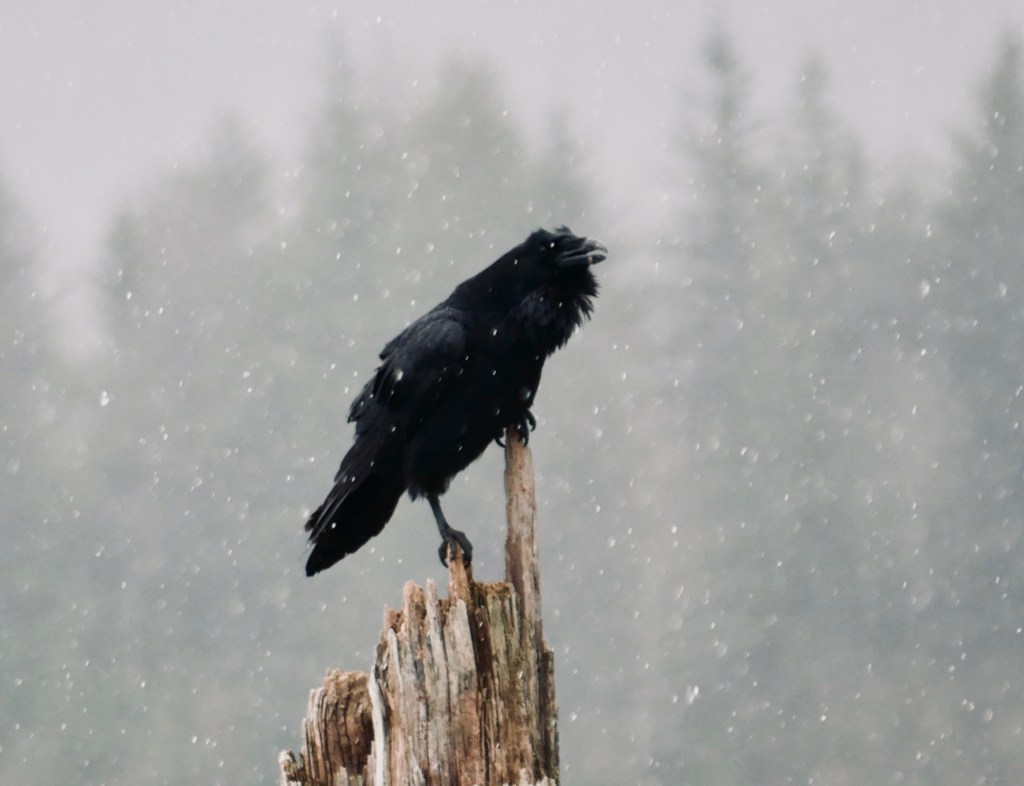
Ravens fill the Treadwell Woods with croaks, beeps, chortles, and complaints as a large family approaches. Have the big birds taken on the job of warning of the approach of the infected?  Feeling like a leper myself, I pick up Aki and move to the far side of the trail, establishing a safe space for the family to pass. 

            Given the weather, I am surprised to meet any humans here. Yesterday’s clear skies are obscured by a squall. Compact pellets of snow bounce onto the trail. I’m here for the eagles. A mated pair keep a nest in a tree overlooking the collapsed glory hole. Thanks to the noisy ravens we’ll never hear an eagle. They may also be the reason why we will never see one. 

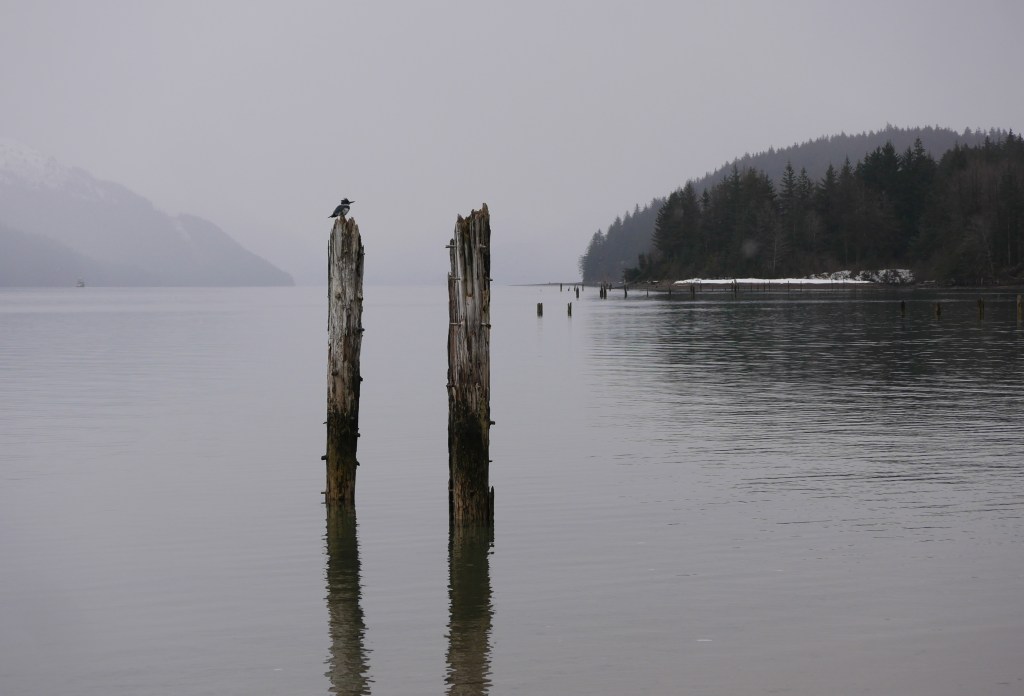
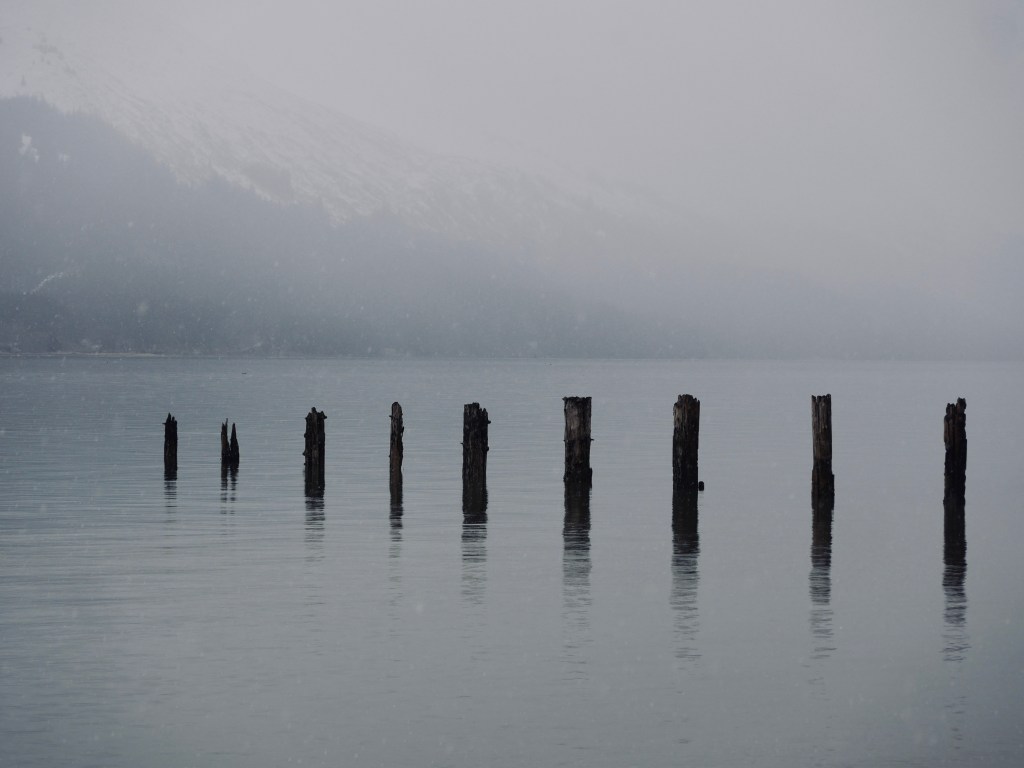
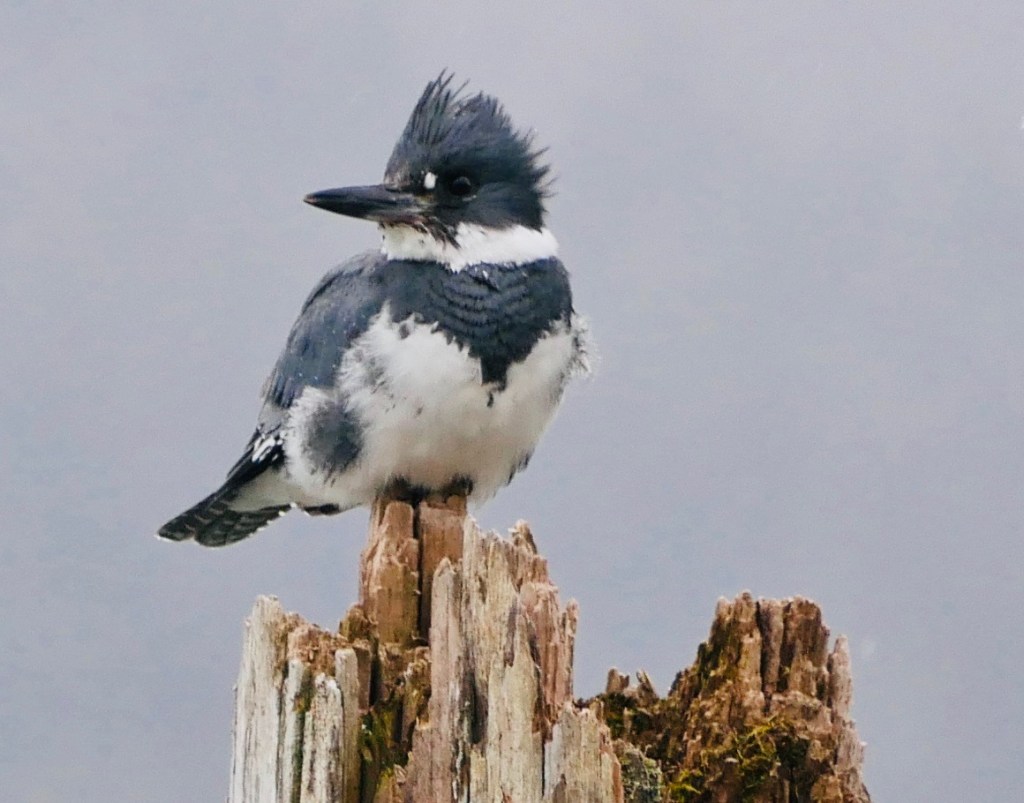
            When we drop down on it from the woods, Sandy Beach is empty except for ravens and one self-assured belted kingfisher. It lands on a nearby wharf piling as a raven dances and sings on the beach.  Raven continues the performance from the top of another wharf piling. Assuming the posture of a petitioning lover, he boxes the compass, croaking to the north, east, west, and south. Kingfisher flies off but only as far as another piling wharf from where he listens to raven finish his atonal love song. 

Another Blue Bird Day

Aki trots ahead of me on an expansive meadow. Her tiny tracks in the snow could have been left by something wild. Spring is finally winning its annual battle with winter. To be fair, the sun is the main agent of change. Its rays warm the trunks of the meadow’s pines, which radiate heat to melt the surrounding snow, forming concave-shaped pots for each tree. 

            Aki’s path parallels that of a deer now hiding in clump of trees. It must be cheering on the sun. I’m cheering on an eagle that glides above the meadow. It sings as it circles. I’ve never heard the song before.  It’s their time for mating. Maybe this guy is looking for some action. 

This would be a perfect place to watch eagles mate. Nothing would block our view of them locking talons and tumbling towards the meadow as they do their business. They almost always break their embrace before hitting the ground. My eagle stops singing, adjusts its meter-long wings, and glides east. Without even one wing flap it holds its angle of descent as if attached to a flying fox (zip line). I feel a warm flutter of infatuation. Aki, am I crushing on an eagle? The little dog acts like my ridiculous question is not worthy of a response. 

            Just before we leave the meadow, I pick bog cranberries from a snowless patch of muskeg. Like the deer and the eagle, the berries survived a very snowy winter. Wondering if they will be sweeter for it, I pop them into my mouth. But winter’s bitterness has replaced their autumn sweetness.  

Nothing to Going Bother Her Today

Timing is important during these days of freeze and thaw. The little dog and I need to be on the moraine just as the strengthening sun softens the trail ice into something I can walk without slipping. That same sun will eventually weaken the snow crust. When that happens my boots will make six-inch-deep holes with every step. 

This morning we might be a tad early. I’m slipping on trail ice every fifth step. The lighter, more compact dog has no problems. Recent snow fall and a series of cold nights have opened up areas of the moraine we rarely visit. I plan on taking advantage of this after we take the traditional dog walking trail to the Mendenhall River. I’d face a mutiny if I veered off the normal path now. 

            You’d think we in a dog park the way Aki is dashing around. But we have not seen so much as a cockapoo on the trail. The little poodle-mix has always valued personal encounters with dogs higher than a chance to sniff their pee. Today, she is all about the nose.

            Aki shows no reluctance to follow me off the trail and onto Moose Lake. It’s the first time in years that I’ve chanced it. Just last year swans and ducks feed on its waters in early April. Now we are walking across it. It’s as trilling as sneaking onto a baseball diamond when the stadium is closed. The trail has softened while we were on the lake. Aki and I take the spur of it that leads to Mendenhall River.  I’m occasionally breaking through the crust but we still make good progress. 

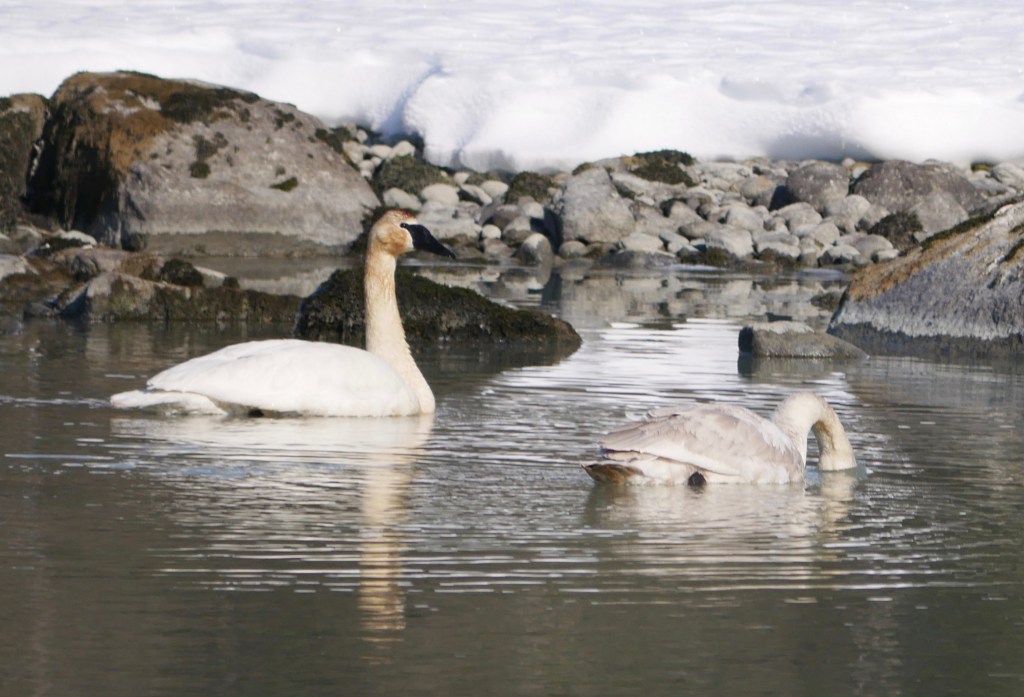
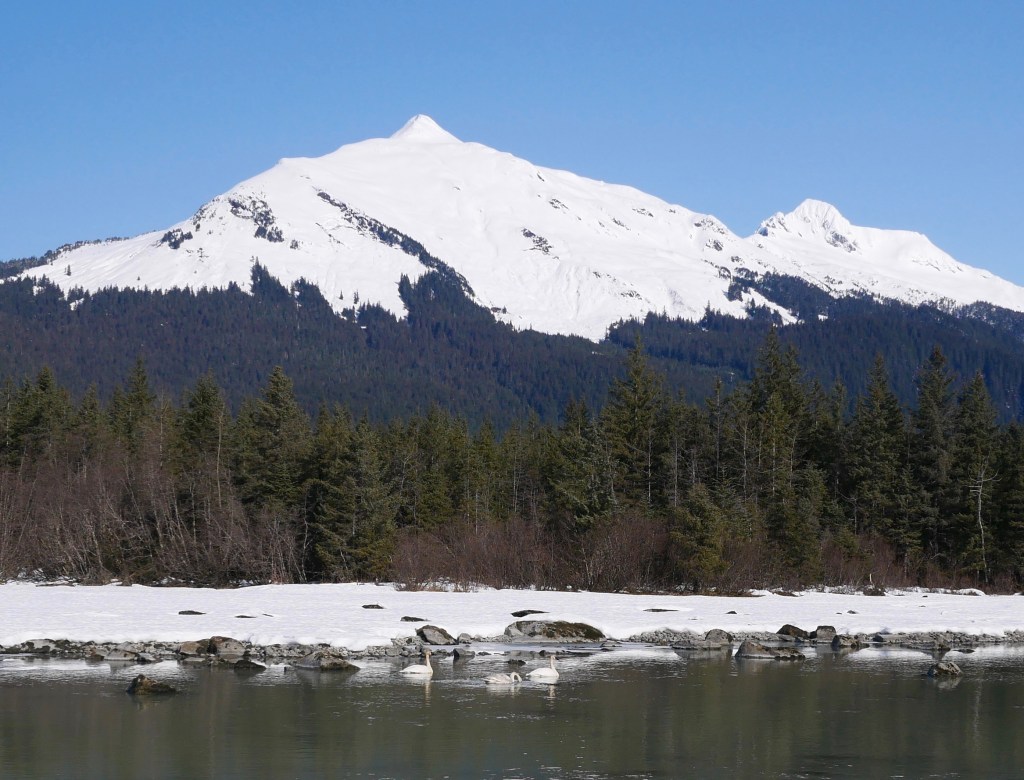
After admiring the reflection of Mt. McGinnis in a river eddy, I walk up stream to a spot that offers a good glacier view. A trumpeter swan family watches our approach. They are the same swans we saw on previous cross-country ski trips down the opposite side of the river. Mellow birds, the swans soon return to their feeding.

We turn around and head back to the car. Rather than dig her little paws in the snow when I walk past the trail we took to get here, she dashes in front me as I continue down a large, snow-covered gravel bar. A few meters ahead, she dives onto a patch of sun softened snow and squirms, a ridiculous smile on her face.