Category Archives: Southeast Alaska

Invading the Privacy of Crows

1

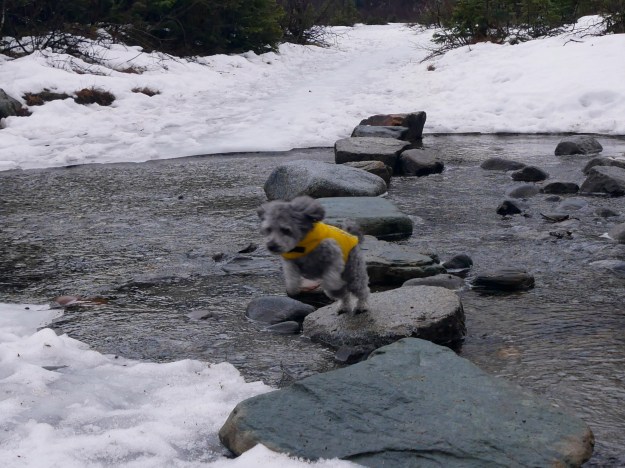
We were talking politics when I slipped on shale and cut my hand (discussing politics with a human friend, not Aki). That was the second mistake. The first was attempting to round False Outer Point after the incoming tide had already covered the easy beach path.

1

The point provides us with a windbreak and no rain falls from the sky. But otherwise, the walk offers little but low-level risk and enough crows to satisfy Alfred Hitchcock.

2

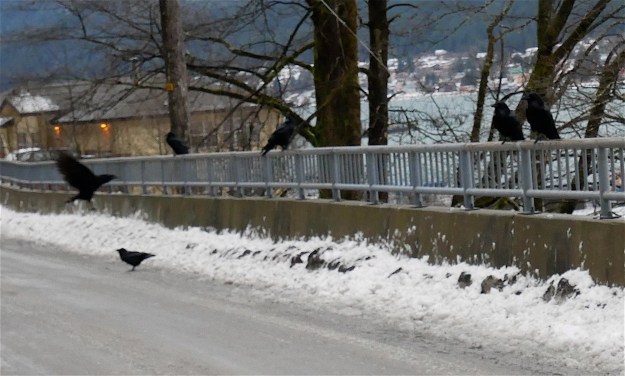
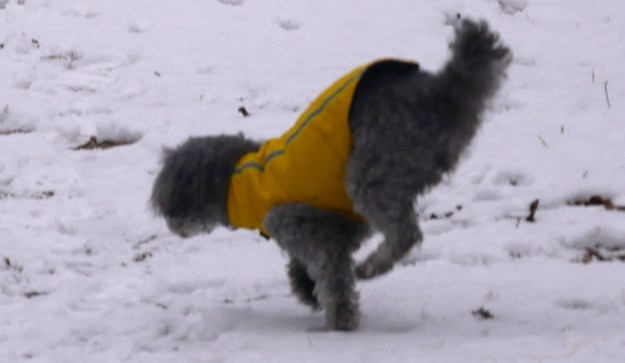
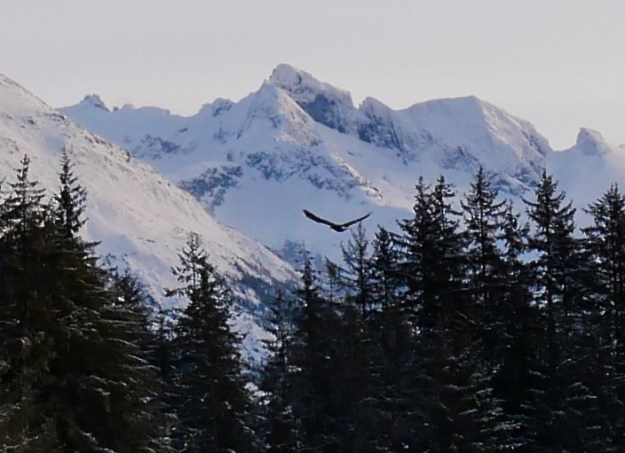
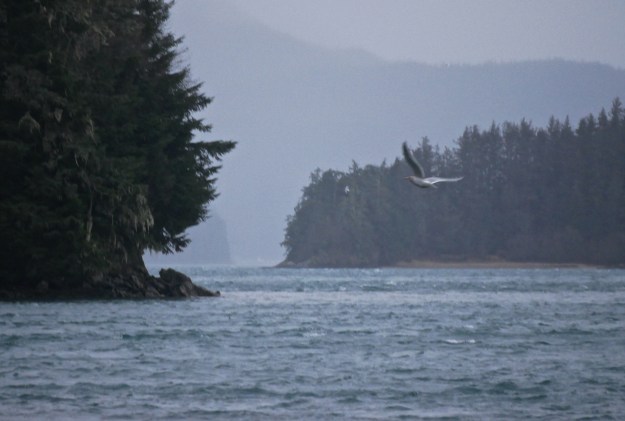
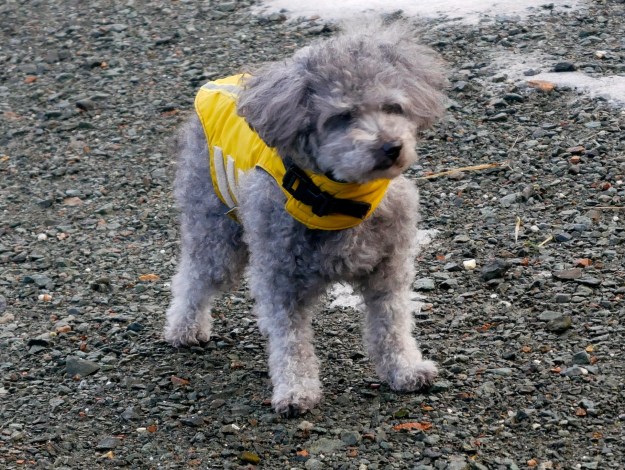
I don’t realize I’m bleeding until three crimson drops hit Aki’s yellow wrap. I elevate my injured hand and squeeze it closed to slow the flow. Overhead two bald eagles fly out over the channel and return to their spruce roosts. Crows darken the beach just ahead of us. When we cross their privacy line, they explode into the air. Are we invading the privacy they have come to expect each time the tide rises high enough to block human access to their beach? Maybe because my little dog looks so much like a stuffed animal I wonder if we have stumbled on the equivalent of a teddy bears’ picnic.
Timing or Luck?

3

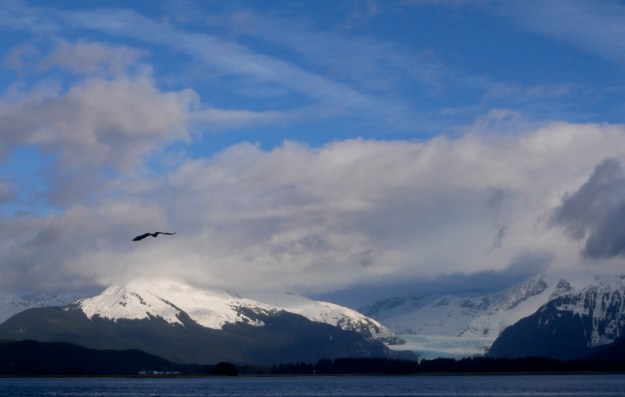
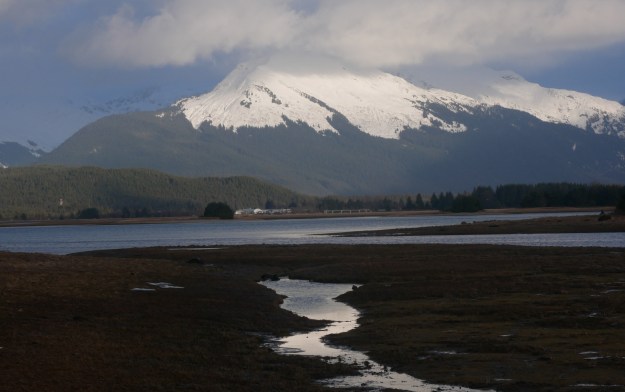
Aki and I just rounded the spit that forms the western jaw of Fish Creek’s mouth. In five minutes the path will be closed by the incoming tide. A strong wind blows down the creek, appearing to come from a break in the clouds hanging over the Douglas Island ridge. For the brief moments that the break will last, sunlight reaches the glacier and the lower flanks of the mountains that surround it.

2

A slim, white eagle feather spirals down, distracting me long enough for me to miss the flight of a mature bald eagle over our heads and into a screen of spruce trees. Ducks, spooked by the eagle fly off before I can photograph them against the face of the glacier. Bad timing, little dog. She gives me what looks like a “think it through dummy” stare. She probably just wants to escape the wind but my brief anthropomorphic moment makes me wonder whether opportunities to witness the wonderful or beautiful in nature is controlled more by luck than timing.

4

It was in part good timing that placed us here during the brief storm break illuminating the glacier. Such things tend to happen just as the sun first reaches mountain peaks. Knowledge of tide tables allowed us to sneak past the headland just before being cut off by the flooding tide. But the rest was a matter of uncontrollable luck.

1

Art Appreciation

1.jpg

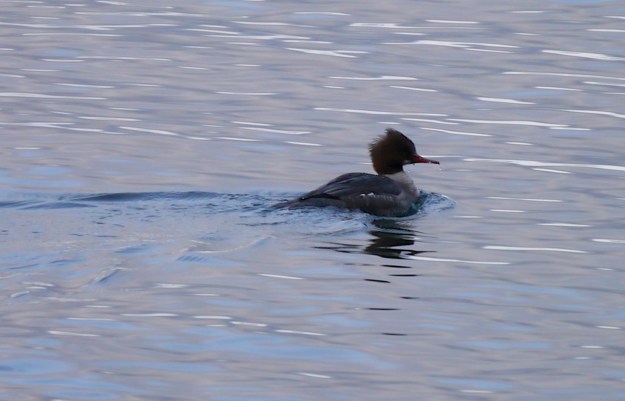
I’m without a camera on this North Douglas walk. Nothing filters my views of the forest trail or the beach it leads to. The need to fiddle with focus or the light settings won’t prevent me from seeing the coordinated dive of two mergansers or the way their feathers cowlick behind their heads when they surface.

1

I think of something I read this morning in an essay by the former Alaska poet laureate John Haines:

The secret of creativity is not to be discovered in the laboratory or in abstract theory…but in attention to the world and for me that means primarily attention to the natural world… in the reflection of trees in standing pools, the light of the sun on leaves and water…can be found those primarily patterns of creative order.” (“The Creative Spirit in Art and Literature).

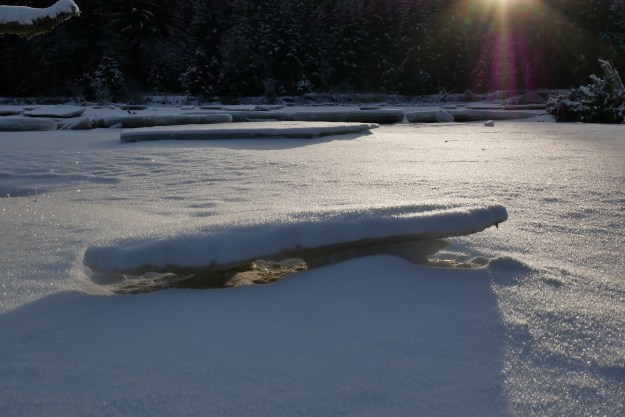
I think of the forest pond, white, opaque ice covered with clear snowmelt that reflected a sun-bursting-through-storm-clouds event overlaid by bare alder trees. Then I realize that unlike Mr. Haines, I am still at the “I know it when I see it” stage of art appreciation. Seeing the pond water reflection made me feel like I did seeing The Burghers of Calais for the first time or parking myself before any Rembrandt painting—awe, then humility, then acceptance that I can’t take the beauty home or even capture it with a camera.

2

Dog Day

2

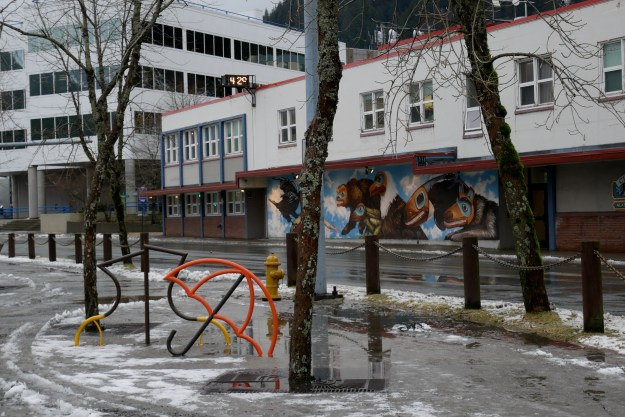
It’s a smear of slush kind of day in Downtown Juneau. Aki and I approach a parliament of ravens and pigeons feeding on some scattered grain. The ravens’ “y” shaped tracks dapple the disappearing snow. Beyond the birds, I can see empty cruise shop docks and the Tee Shirt and Jewelry shops that form the tourist trap line of summer. Guys building yet another cruise ship dock fill the air with industrial sounds. The melting snow and ice reveal trapped smells that hold Aki’s focus. It’s a good day to be a dog.

1

Would-be god

3

Again, I’m on the beach in front of Treadwell, looking to Aki like I am worshiping a raven. This one lands on the splintered top of an old piling that had been driven into the seabed over a hundred years ago. Then, the tough column of wood formed part of the Mexican Mine wharf. I’m on my knees trying to frame the purple-black bird against the flank of Mt. Roberts. Last spring I assumed a similar supplicating posture in front of a raven on this beach for the same reason. I felt like a fool then as I do now.

1

Aki trots over to the piling and barks. The raven croaks back. I struggle to take the bird’s portrait while they converse. Minutes after we leave the beach for the woods that have grown up around the mining ruins, the same raven lands nearby. It struts at an oblique angle that allows it to keep one of its hard little eyes on me as it approaches. Since there is nothing for him to scavenge nearby, he must be seeking attention, not food. No, attention is the wrong word to describe his motivation. It’s admiration he is after. Aki is having none of it. The little dog wanders away from the bird who-would-be-a-god, nose down, tail up, trying to set a good example for me.

2

Dupont

1

The trail to Dupont leads to a World War II ruin, not to heaven. But I still feel like a soul in purgatory. Cursed looking tree roots try to catch my feet as I maneuver around hemlock trees that cling to a precipitous slope. Super-slick patches of ice lay between the roots. Aki has no problem with either of these challenges. She scampers up or under or around the hazards and waits patiently for me to work my way through each danger zone.

2

A mile in we enter a zone of windblown trees, each ripped out by the roots. Rocks that the tree roots had formed around remain stranded in their root wads. It’s been at least five years since we last walked to Dupont. Then, this section of the forest offered a peaceful place to rest and enjoy a filtered view of Gastineau Channel. Now, it is a metaphor for the devastation of war, which makes a kind of sense given where the trail through upheaval ends. Dupont once served as a depository for bombs and other munitions. Today alder trees crowd the ruins of bomb cribs and the old loading wharf that is no longer useable. We catch Dolly Varden trout in the stream that once provided water for the war workers. Aki loves to chase her Frisbee on the flat beach where they staged explosives for loading. If I didn’t know that we would have to pass back through the blow-down zone, I could almost forget that parts of the world are at war.

3

Winter Quiet

2

Aki and I leave Chicken Ridge early, before the scheduled start of the Women’s March. In a half-an-hour our escape route down Main Street will be blocked. The sun crowns above Pt. Salisbury, infusing wispy clouds above the channel with Easter-egg colors. It’s cold and windy but the little dog and I are dressed for it and the colder temperature we will have along the Eagle River.

3

The big meadow that feeds migratory birds Spring and Fall wears a new covering of snow, untracked except for those left by a cross country skier and a clutch of snowshoe hares. One bald eagle skulks near the meadows edge where it searches the riverbanks for food. Small lines of surf roll up river and the incoming tide lifts and cracks new ice. We have to take a long detour around the normally dry meadow channel because chucks of heavy ice now slosh against each other on tidal water.

1

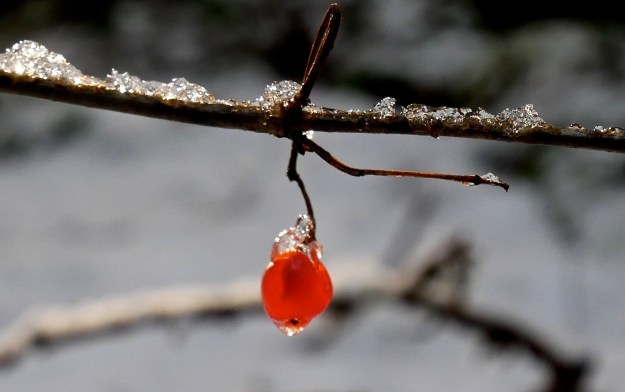
This early (It’s sunrise) I expect solitude but we meet a group of young woman chattering and sliding over the new snow on skis. They fill the air with something like tropical bird song, a impression reinforced by the flash and color of their hi-tech clothes. Soon winter-quiet returns. The sun breaks over a forested hill to sparkle the new snow and the great blocks of river ice stranded on the meadow by the tide. In the forest I find a single high bush cranberry set to glowing by a streak of sunlight that managed to penetrate the old growth. Made sweet by the winter freeze, it tastes as good as it looks.

1

Snain

4

We were going to take a wooded trail but the glacier chose today to wear its bluest cloak. Lets just sneak down to the lake, take a few shots of the thing, and slip onto the East Glacier Trail. Aki, who considers either path equally rich in dog sign, trots along without complaint.

1

Tendrils of fog form on the ice to draw me closer and closer to the glacial until we are practically at the falls. When the fog dissipated we turn towards our first choice.

3

Snain, a nasty combination of snow and rain, thickened as we complete the backtrack to the East Glacier trail head but Aki still darts onto the trail. Crusty snow and ice make travel for me difficult and I miss the views we had near the lake. But for what the forest lacks in drama, it makes up for with quiet and solitude. We cross beneath the Slide Creek Falls, which each summer resists attempts from sockeye salmon to leap into upstream spawning waters. Black bears chomp down salmon discouraged by the falls.

2

Tne forest is littered with glacial erratics: large granite rocks dropped by the retreating glacier. Most have thick moss capes. Today all are covered with snow. If I had spent my childhood within easy bicycle reach of this forest, I would have spent my free time wandering and building forts with what it offered.

Low Battery

1

My camera battery ran out of juice. But it doesn’t matter much on this flat-light day when almost all the usual users of the sheep creek delta are elsewhere. The sun just tried to burn the clouds off of Mt. Roberts but gave up after I used the last of my battery power photographing its effort.

2

Now I stand, camera battery in my armpit, enjoying an impressionist’s reflection of Roberts in a tidal pond. A rising wind threatens to render the image too abstract for the camera. Aki stands by my side, sniffing the wind for promising smells. Nearby the creek makes it brief transit to Gastineau Channel where mergansers wait for it to deliver food. Just before the wind ruins the reflection, I slip the battery back into the camera, raise it to my eye and read in the viewfinder, “low battery.” The creek mumbles calm sounding words in a language I can’t understand. I listen to the moving waters, image a pre-symphony crowd full of cautious optimism as the house lights dim.

Herring Gulls

2

As the second Pacific storm in as many days shakes the car, I drive Aki out to the old Auk Village site. It offers a trail through old growth large enough to protect us from wind-driven rain. Ducks—Barrow goldeneyes and harlequins—fish waters just off the crescent-shaped beach. We spot no eagles or ravens but herring gulls fill the air. They seem to ride the strengthening currents for recreation, not for advantage. Graceful in flight, they plunk onto the water when they land, wings half folded, as if they misjudged their approach. Many of the gulls land on the beach and gather where a fresh water stream erodes the beach gravel. Some flutter in the stream, splashing the water like children in a municipal pool. Others look for bits of food dislodged it or the small surf pushed onshore by the storm.

1