Category Archives: Southeast Alaska

Hell for the Hungover

2

While planning where to hike this morning, I look out at the garden where heavy raindrops make the tough kale leaves bounce. No wind blows them off course. Already the storm is soaking the old growth canopy. But the little dog and I still head to the Outer Point Trailhead.1
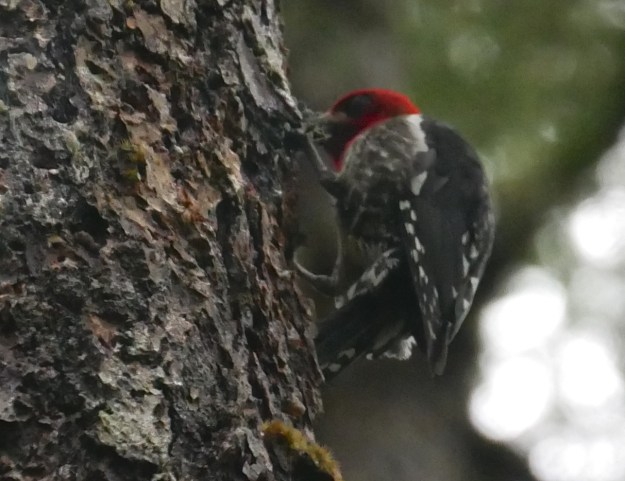
I am not surprised to find the parking lot empty and pleased that nothing falls from the sky. Ironically, inside the forest that usually protects us from the worst of storms, it is raining. Fat drops drip from the canopy of spruce and hemlock. Storm light, more pearl than gray in color, reaches into the forest and turns the surface of a beaver pond into a fairy tale mirror. It might tell Aki that she is the fairest dog in the forest. That wouldn’t be a lie since the place is empty except for local residents like the red-breasted sapsucker hammering into a 100 year old hemlock. The overdressed bird grips an imperfection in the bark with one foot, which in my mind, makes it look desperate, as it pounds yet another hole into the hemlock. Hell for the hungover must be full of such unrelenting woodpeckers.3
Auk Bay

1

Islands protect this crescent-shaped bay. It’s the perfect spot to house people who make their living on the sea. Once it did. The Auk people lived here before the offer of mining jobs ten miles away in Juneau seduced them to move into town. The bay’s graduated gravel beach would still offer easy access to the sea for the Auk people’ big cedar canoes. Now thimbleberry thickets cover ground where they stored their canoes in winter. They left behind a totem pole. But, the happy cries of their children have been replaced by robin songs and thrush trills.3

Aki and I are the only ones here to listen to the birds. The beach is empty of people, dogs, and even sea birds. Only the fins of Dahl porpoise mar the bay’s flat-calm surface. In winter harlequin ducks and scoters will fish the bay close to the shore. Gulls will bicker on the beach. But they have no need of shelter today. They are out chasing feed or in the gulls’ case, haunting salmon streams.2

Today the ban on king salmon fishing ends. Men around Juneau will troll for what salmon that haven’t already entered their spawning streams. The commercial guys will haul their catches to a processing plant two bays south of here. A white cloud of sea gulls will form over each boat as it unloads kings. In Southeast Alaska, where we still rely on nature directly or indirectly to feed our families, such scenes at a fish plant are metaphors for joy.

Anorexic Pines

2

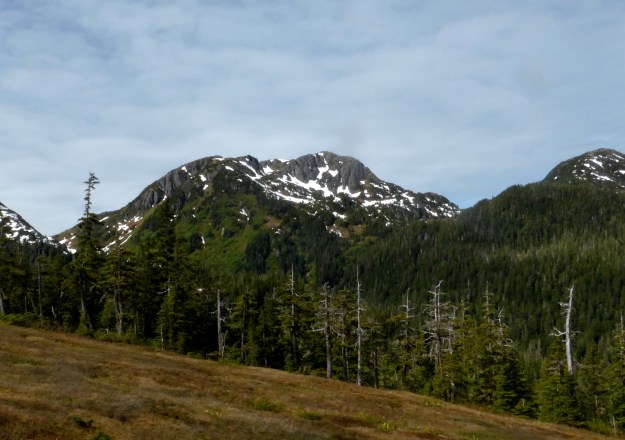
Aki and I have climbed this gravel road in all seasons, winter through fall. The calendar tells me it is still spring but I recognize the green of high summer when I see it. The showy summer plants have all leafed out and now crowd the road, turning it into a green tunnel. Feeling slightly claustrophobic, I speed up to reach the proper trail to Gastineau Meadows.3

As usual, Aki is all about the smells. She drags her tiny feet to buy time for sniffing. I watch her closely as she smells a fresh explosion of bear scat, ready to grab her if she starts to roll in it. She is fully capable of rubbing her shoulders into the foul stuff as her face relaxes into ecstasy. Today she only gives it a cursory sniff before moving onto the meadow.1

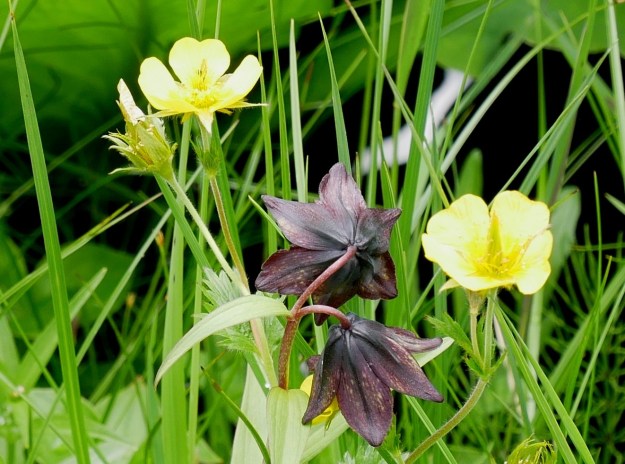
Here the time of magenta flowers has passed. With the exception of a scattering of chocolate lilies and yellow blossoms I can’t identify, white flowers dominate the meadow. Around dying pine trees, sorrels bloom as do the tasty Labrador tea plants. The lush greenness of the day emphasizes the dead nature of the countless pine skeletons that crowd together on wet sections of meadow. They lived like anorectics on the shallow, poorly drained ground, while meters away Sitka Spruce thrive on better fare.

Ravens in the Rain

1

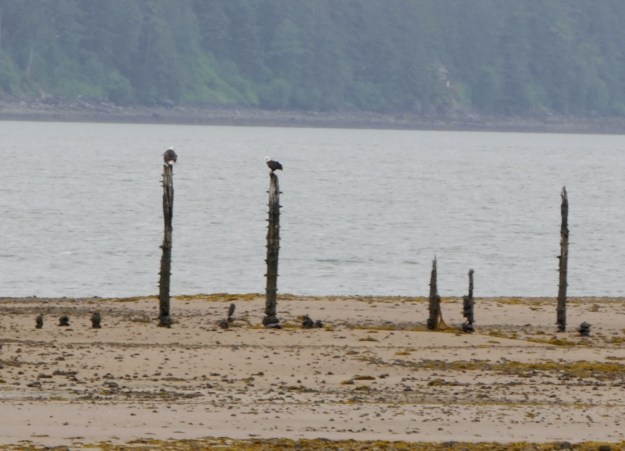
Rain or boredom seems to have depressed the Treadwell eagles this morning. Even though it is low tide and therefore the best time to find food or carrion, two mature bald eagles are glued to the tops of splintered pilings. Two more hunker on the beach near the water. The inclement weather doesn’t seem to have bothered the ravens. They fly back and forth over the glory hole, harassing first the piling plunked eagles and then returning to the beach occupied by those squatting on the sand.2

Aki finds a cache of dog kibble that has been sprinkled on the top of a foot-high piling. Someone, perhaps the sprinkler, placed a flat stone over the kibble but Aki manages to tongue out a morsels before I convince her to stop. Two ravens land on nearby pilings to watch. I have little doubt that they will have the stone off and the kibble down their beaks before we make it back to the car.3

Tern Redoubt

3

Information posted on a government sign made Aki and I cut short our planned visit to the moraine. It warned of the presence of a black bear sow with two cubs. The bear had lost its patience with dogs and their humans. No one had been hurt, but I didn’t want to put the bear in danger of assassination if it attacked my little dog or I. Instead we head over to the glacier visitor’s center and walk toward Nugget Falls. This turned out to be a good decision.1

The glacier this time of year is usually a place to be avoided. Industrial tourism buses rumble to and fro, picking up and dropping off cruise ship tourists. Seasonable government employees work crowd control. You can still see the big river of ice but somehow it seems diminished when viewed from within a crowd. This morning it is too early for the buses or the government minders. Even the wind is absent. Without it to ruffle the water, Mendenhall Lake is a giant mirror. Arctic terns temporality shatter the glacier’s reflection when they slam into the lake’s surface after salmon smolt.4

I’m surprised to see the sharp tailed birds. Last week a glacial dam broke, raising the lake to flood stage. In years past, similar floods have covered the tern’s sandy nesting area. But this morning, a half-a-dozen birds fish for young in the lake. The chitty conversation of the terns can be heard over the Nugget Falls’ roar, robin’s sweet song, and the off-key whistle of a territorial thrush.2

Catching The Bottom

3

All fishing trips start early in the morning, many before the breakfast caffeine can clear the mind. This one begins at the relatively late hour of 7 A.M. Aki remains home, looking forward, not doubt, to a planned visit with one of her best dog friends. If fishing was the only point of the trip, I should stay home. Thanks to a dramatic fall off in the local king salmon returns, that fishery is closed. With better weather we would make the one hour run to Lizard Head, where King fishing is legal. But neither the sky nor the weatherman gives much hope of calm seas.2

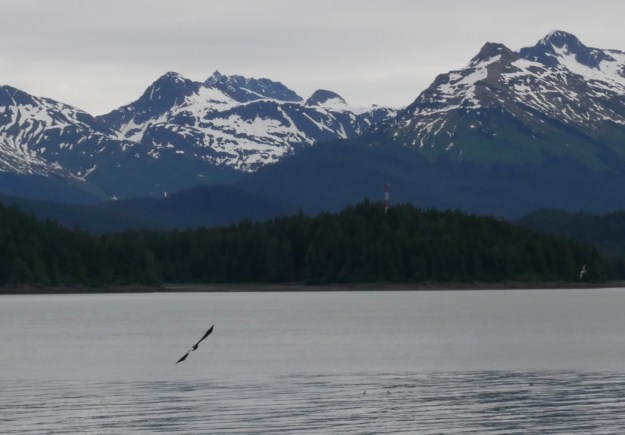
In a normal year, the waters of the bay we fish out of would be full of king salmon fisherman, human and sea lion, as well as the occasional whale. But today, I only spot two eagles. One roosts on top of a commercial salmon troller, confident that it won’t put to sea until after they reopen the fishery. The other eagle, still acquiring its species’ trademark white head and tail, stands at the water’s edge, looking at its reflection as if basking in his beauty.1

Later we will try for halibut by dropping weighted line onto a reef off of Hump Island. Humpback whales and Dahl Porpoise will fatten in the herring-rich waters. An adult bald eagle will pluck a bait herring off the water close to our boat. We will catch only the ocean’s bottom with our hooks. But we really won’t be there for the fishing.

A Complex of Clouds

2

Aki and I walk on the spine of a long, gray gravel snake stretched out on the forest floor. On either side, the white flowers of food plants—crab apple, high bush cranberry, and Labrador tea—break the monopoly of forest greens. The snake will lead us to a beach where white gulls harass eagles away from food exposed by the ebbing tide. But my eye will be drawn to Lynn Canal where a complex of clouds, from white to dark gray, water the sea.1

Hot Mountain Dog

1

Instead of the promised rain, Aki and I have unfettered sun. Feeling a little like Obi Wan Kenobi from Star Wars, I am wearing a heavy sweatshirt with hood pulled up so it covered my ears and neck. Yet I still feel comfortable. Another Jedi mind trick. We are climbing a gravel road that transverses a small mountain bowl. When the road crests we have fine views of Ben Stewart and other mountains in the Douglas Island ridge.2

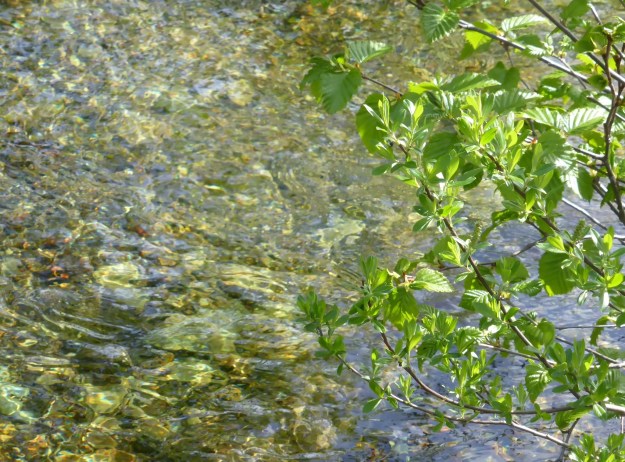
Aki is panting in the heat, looking for a water source. She finds it in a small, fast moving stream. Willows choke the stream banks except where a small gravel beach has formed. Aki wandering into the creek chest-deep and sips from the stream.3


Rounding False Outer Point

2

It’s the seventy-third anniversary of the Normandy invasion that eventually led to the end of World War II. Aki and I are rounding False Outer Point during an outgoing tide. Nothing about the scene inspires memories of D Day except the eagles that make my little dog nervous. During our approach to the point, an adult bald eagle, white head bold against the spruce where it roosts, dives toward the water with talons extended in the fishing position. But it carries nothing back to its roost. Aki gives me her “are you crazy?” look but still follows me around the point.3

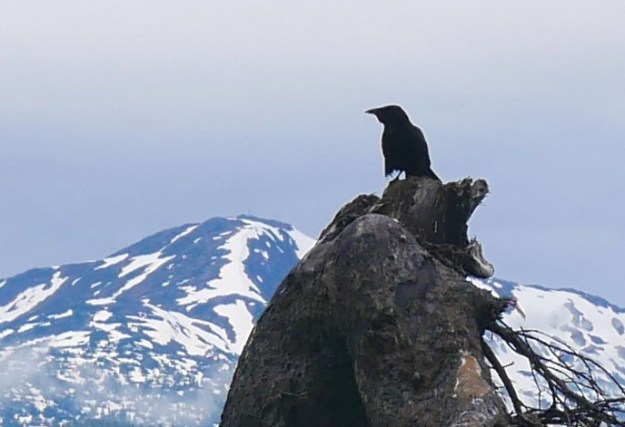
A flood tide forced us to rock climb around each headland the last time we made this trip. That day ended for me at the local urgent care facility where a doc-in-a-box stitched closed a cut I received after slipping on razor sharp shale. Today, with the tide on the ebb, we have an easy passage. Four eagles make lazy circles above the beach after the point but Aki doesn’t seem to notice. The resident crows notice us. One takes up station on the top of a driftwood root wad and polices our passage back into the woods.1

False Finds

3

Reunited after my stint at the Skagway writer’s school. Aki and I patrol Downtown Juneau. The little dog is all business, but doesn’t seem to hold a grudge about my absence. We walk in soft drizzle that dampens the morning’s color. A noisy raven, angry that one of his kind hold a tasty stick of something in its beak, lets us approach within a few feet. When he flies off, it is only to an alder a meter away where he continues to monitor the greed of his neighbor.1

The lucky raven seems more stressed than the one with an empty beak. After trying to squawk with food in its mouth, it stops feeding and shifts his prize to one of his claws. The other grips the wet skin of a Chevrolet pickup. Down on South Franklin Street, where the docks are empty and the stores are closed, three women of commercial beauty have been pasted to the side of a cruise ship perfumery. The brunette in the center declares her’s an ageless society. But soon, even her beauty will fade, victim of rain and sun.

2