Category Archives: Juneau

Ending Their Lives in Beauty


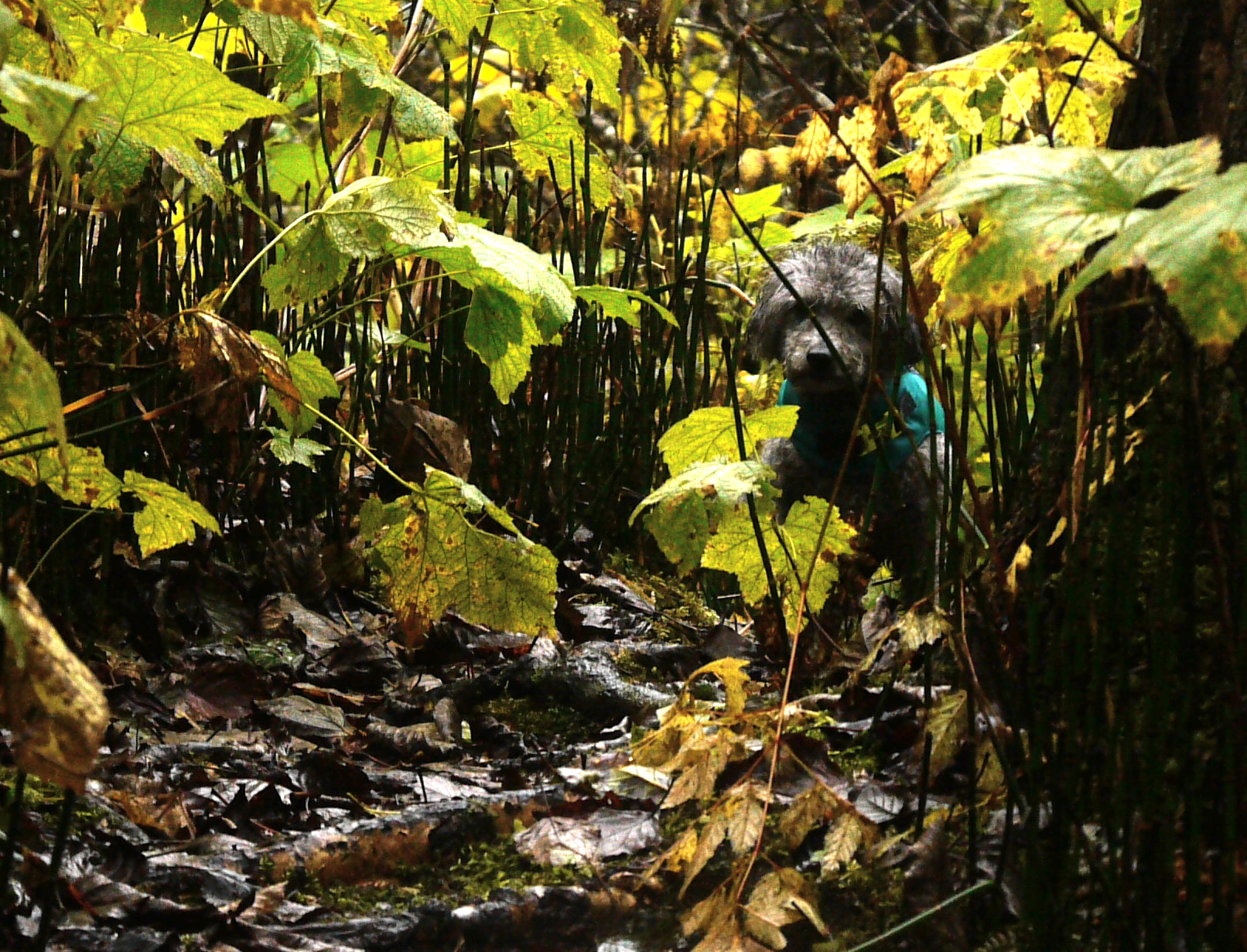
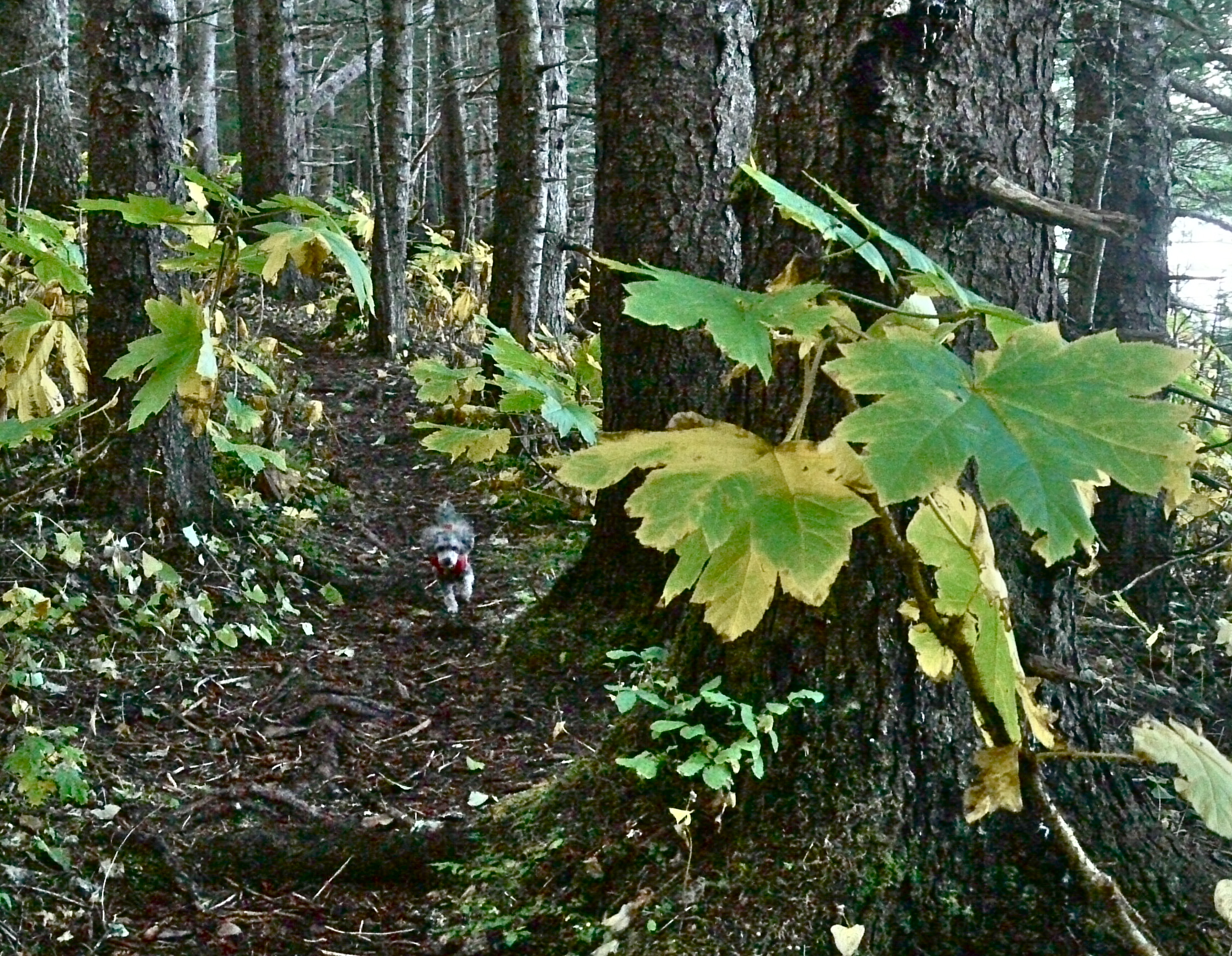
If not born in this rain forest, Aki has spent most of her life in it.  Nose to ground, tail wagging, she charges up this sodden trail into wind blown rain. I follow, enjoying her enthusiastic display and the new shapes being revealed by dropping leaves.

We climb from Chicken Ridge to the Basin Road Trestle Bridge and then along the steep side of Gold Creek canyon, toward the old glory hole in Perseverance Basin.  On Monday reconstruction work will close the bridge and trail until mid-winter. This is our last chance to catch the fall here.

Deciduous trees, like the muscular Balsam Popular reclaimed this land so recently destroyed by hydraulic mining.  Now bare of leaves, the exposed popular limbs mimic arm flexing muscle builders. Benefiting from the pioneering work of their leafy cousins, spruce and hemlock grow on the hill sides, forcing their roots into cracks between small boulders and bedrock.

On this wet grey day the evergreens provide a monochromatic background for  plants making a weak attempt at displaying fall colors.  Nameless waterfalls, fully charged by rain break over the lip of surrounding ridges to drop hundreds of feet into the forest below.

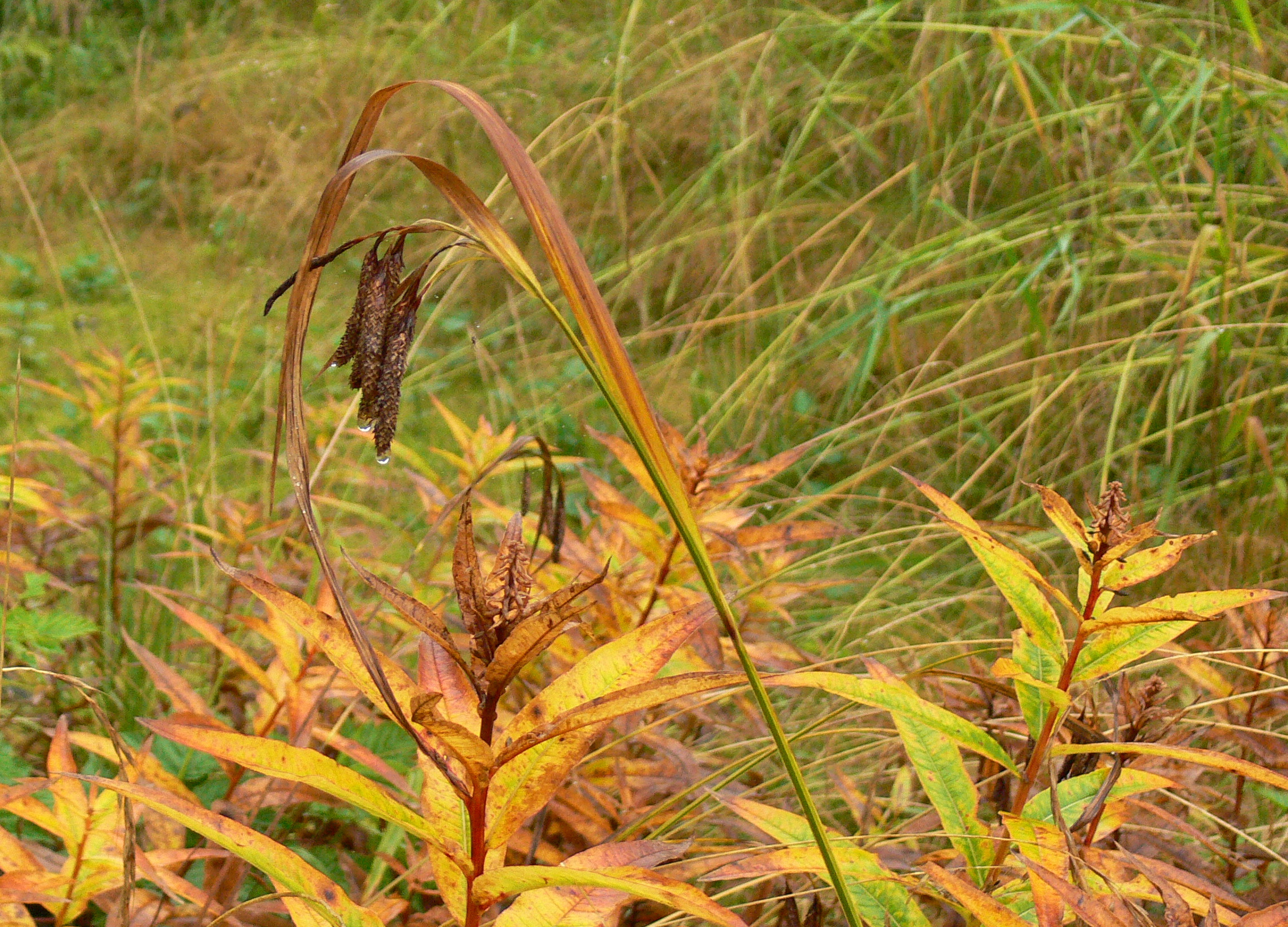
We follow a seldom used path, now carpeted with rotting leaves to where Gold Creek threatens to wash away the forest ground. Here a shrubby maple grows between two large poplars. Yellow with cranberry red streaking, the maple leaves display great beauty at the end of their life. Sunshine would reveal some of their beauty but it would not rival that escaping through the lens of rain coating each leaf and from a prism drop hanging from this now naked leaf stem.    

I wish Gussie Fink-Nottle was here

I wish Gussie Fink-Nottle was here in this rainy swamp. We need a newt expert. Somewhere in this flooded grass land the rough-skinned newt lurks, skin charged with toxin (watch out Aki).  None lay exposed to the rain that rapidly soaks my coat and cap. I haven’t a clue how to flush one out.

My brief fixation with newts started yesterday at the barber shop where I killed waiting time reading a book on our local plants and animals. There, seeded in rich soil was an article on the rough-skinned newts that thrive here at the Northern end of their range. Now I am cursing the author and P.G. Wodehouse, who planted the idea of newts in his Jeeves and Worster stories. If Fink-Nottle could find newts, so can I.

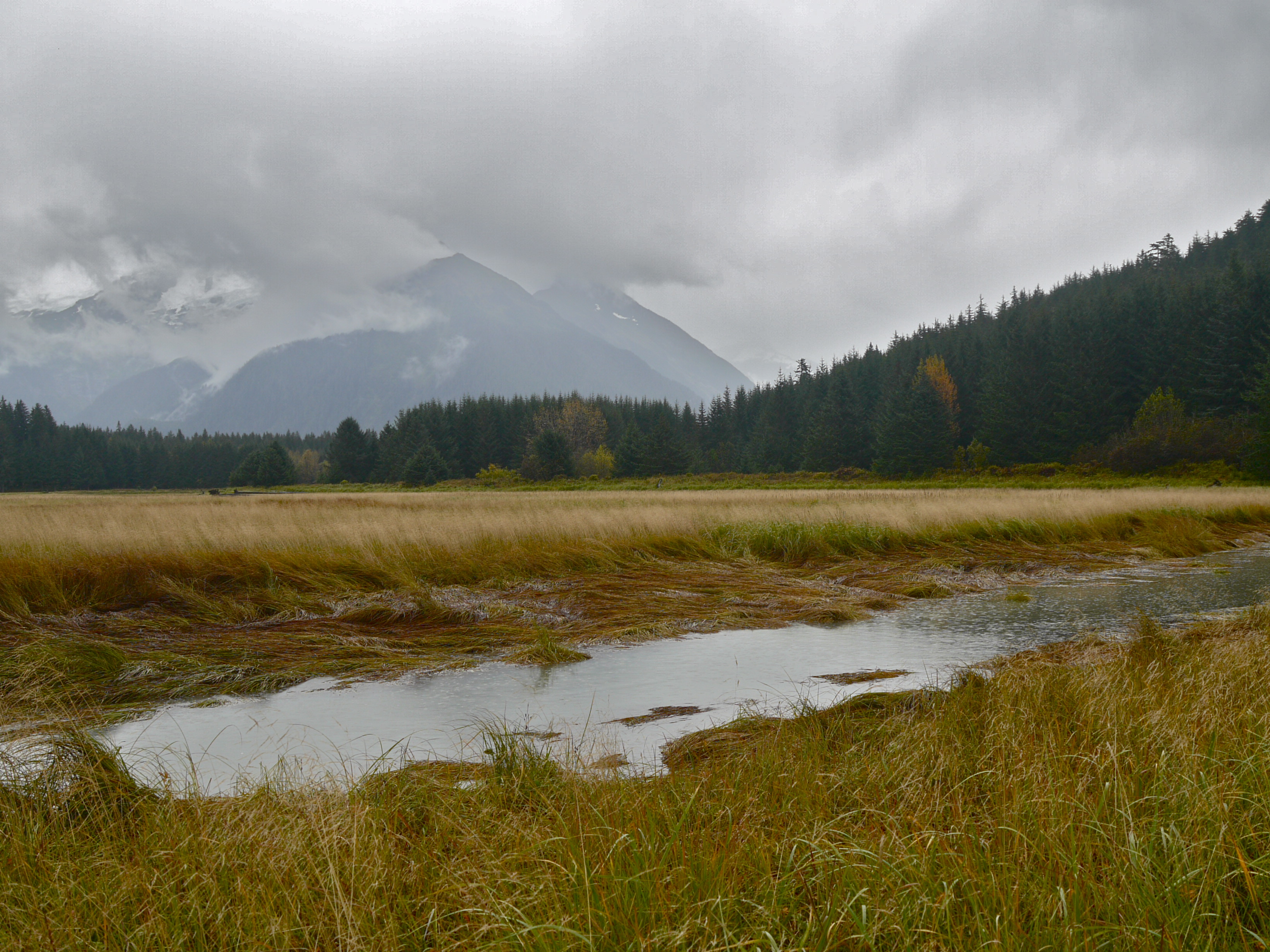
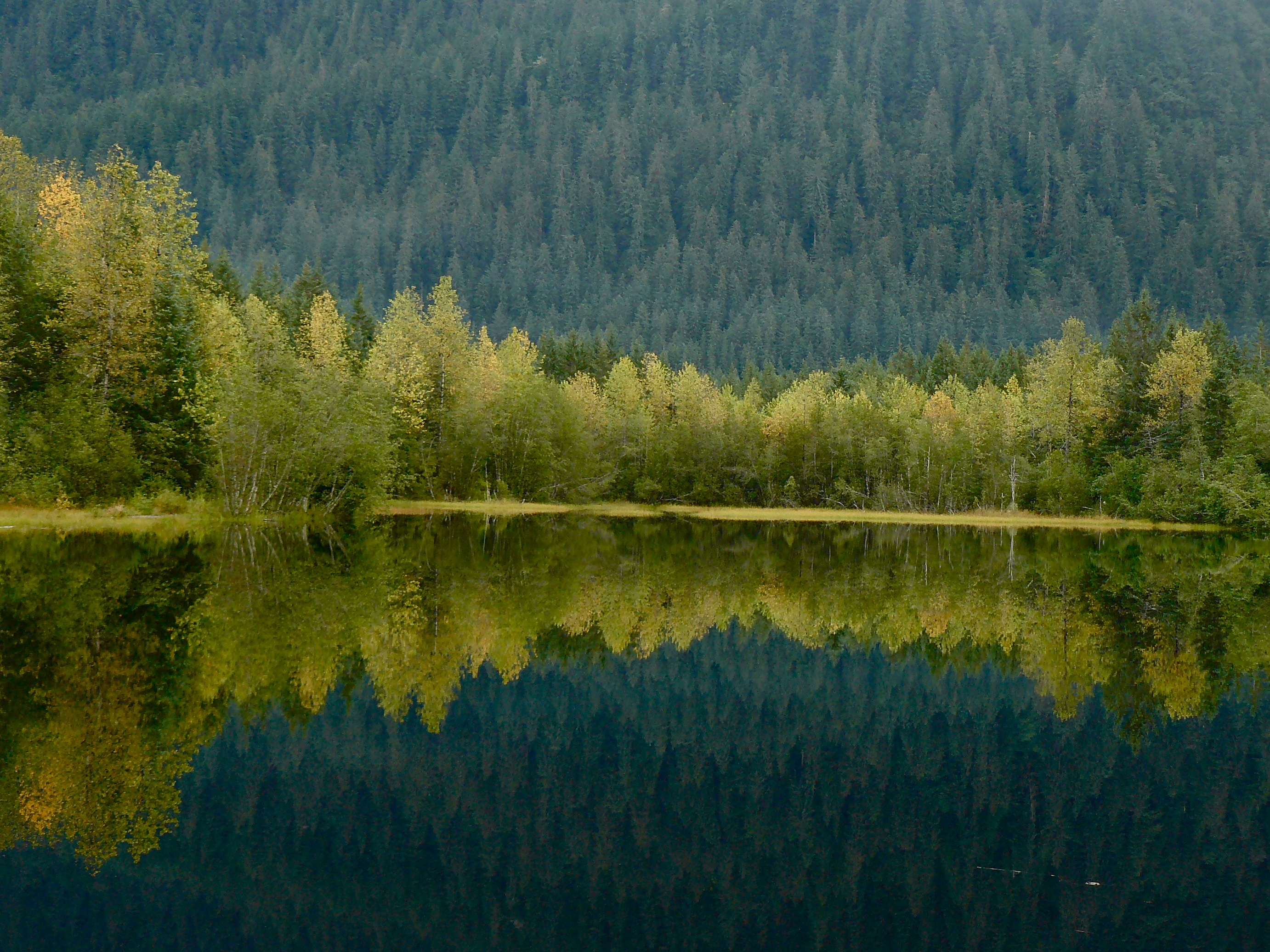
Half an hour later I leave the swamp with no pictures of newts but a greater respect for Gussie Fink-Nottle. Traveling along Eagle River toward its mouth we reach a large meadow dominated by tall grass now gone yellow dry.  No farmer would have left this hay uncut. Next spring a great collection of geese will hunt the field for seeds and fertilize what they miss with their scat. Today it provides a tan counterpoint to gray sky and the dead green of spruce islands that appear to float on this wealth of unharvested grass.

Sunlight on a Flooded Forest Floor

Even after many Alaskan winters I am still a creature that needs light. This morning the view down channel from Chicken Ridge offers little hope for sunshine. Last night’s hard rain has slowed to a depressing drizzle so we drive to a trail that presents well under wet gray skies.

Few cars share the road with us out to the trail head and none is parked there. Too bad. Their drivers are missing a mixed blue and white sky brightened by the rising sun. The trail leads through old growth forest to beach where we should receive the full benefit of the sunny morning. First we pass through a grove of alders on a trail covered with their dried fallen leaves. Aki does one of her gymnastic hand stand pees here, raising her hind quarters skyward as she makes water until her tails wags high in the air. (The picture only captures the beginning of the performance.)  

Brash bluejays and an industrious wood pecker dominate the old growth spruce forest. When we catch one of the jays resting on a partially submerged skunk cabbage leaf it flies to a nearby spruce limb and complains about our rudeness. The presence of the jay on a floating leaf is not as surprising as the shallow lake that now floods over this skunk cabbage hollow. Last night’s rain can’t explain it so I suspect beavers, who haven’t colonized this area before. Later we use transit a boardwalk trail that appears from a distance to float over a new shallow lake dominated by spreading skunk cabbage leaves. 

Light flooding from open beach into the forest draws out into the open where we find blue skies and sunlit clouds but only one gull that stands atop an off shore rock. In winter hundreds of waterfowl and gulls shelter here. Other times we spot seals or whales just offshore. Today we leave all this open beauty to the sentry gull and return to the forest and a trail that meanders along the airy strip of trees that bordering forest and beach. 

(As I finishing writing, a bald eagle slowly flies above our neighbor’s house. From here it appears to arc over the computer monitor.)

Sneaking Through the Bear’s Bedroom

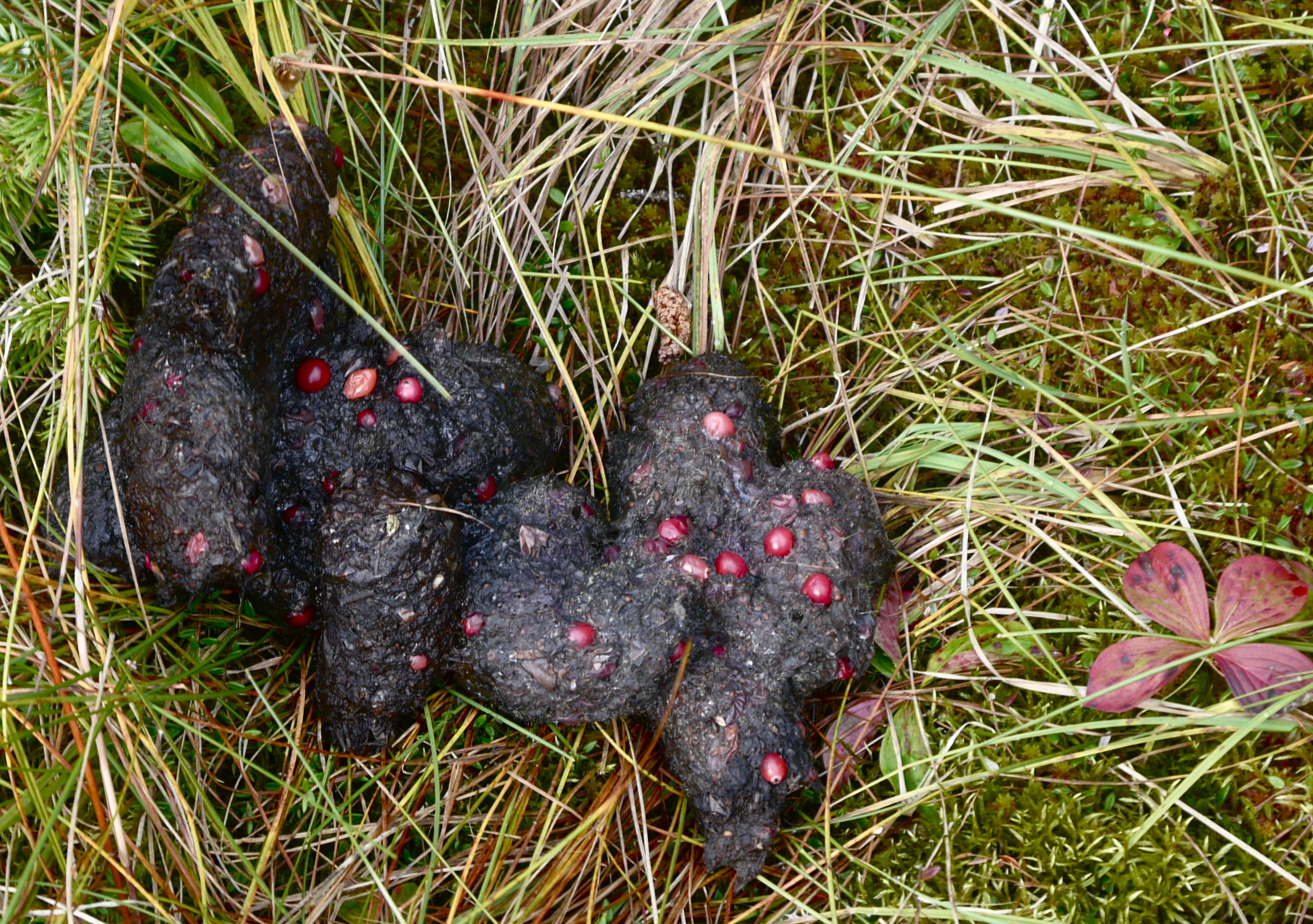
I start this meadow walk wondering why I am not afraid. Aki’s caution making machinery is working. She keeps just behind me as we move along trails made by bears. We pass many sections of grass depressed flat by their now large bodies.  We take inventory of one’s recent meal on display in a large pile of black bear scat. 

A bear could be digging roots behind this high wall of ferns or sleeping in that grass covered swale yet all I feel is peace. It’s nuts.

Steep angle shafts of sunlight saturate everything with rich color that confuses my digital camera but pleases the eye. We scare a raft of ducks to flight from a meadow side slough. Their frantic flight takes them seaward while a disturbed great blue heron rises slowly then flies a few hundred paces up the slough. So much power for little noticeable effort. Herons can’t be hurried.

Beyond the meadow a small hill stands between us and Favorite Channel. We take the gentle trail offered past a Marmot den, now quiet. Last Summer we watched a big male whistle out a warning and then keep watch until the kits dived into an opening at the base of a tree. Marmots (gray Alaskan guinea pigs) could audition for a part in Wind in the Willows.   The big males exude bravery as they expose themselves to eagles until their young reach safety.  Water Rat could do worse for a friend. 

After the marmot den the trail leads to a series of pocket beaches ringed with high bush cranberry brush and something similar to the domesticated burning bush plant. Some of the cranberry bushes manage a decent display of red but all the rest show rouge fading to brown. We aren’t in for a repeat of last fall’s spectacular display of color.

Pushing past a bush that last year screamed out “red” to the sun, Aki and drop onto a plain of flat topped boulders to watch the sea. No sun shafts can make it through the thickening marine layer. Last year we watched two seals move into the tiny bay below us but none appear today. On past visits I spotted the tight white cones of whale spume rise out of the sea and then dissipate into a weak dying cloud. Not today.

This has been a day for the unseen — the bear that slept through our visit, the denned up marmots, the absent whales and seals, the reds that would be browns.

Rapid on Set of Fall

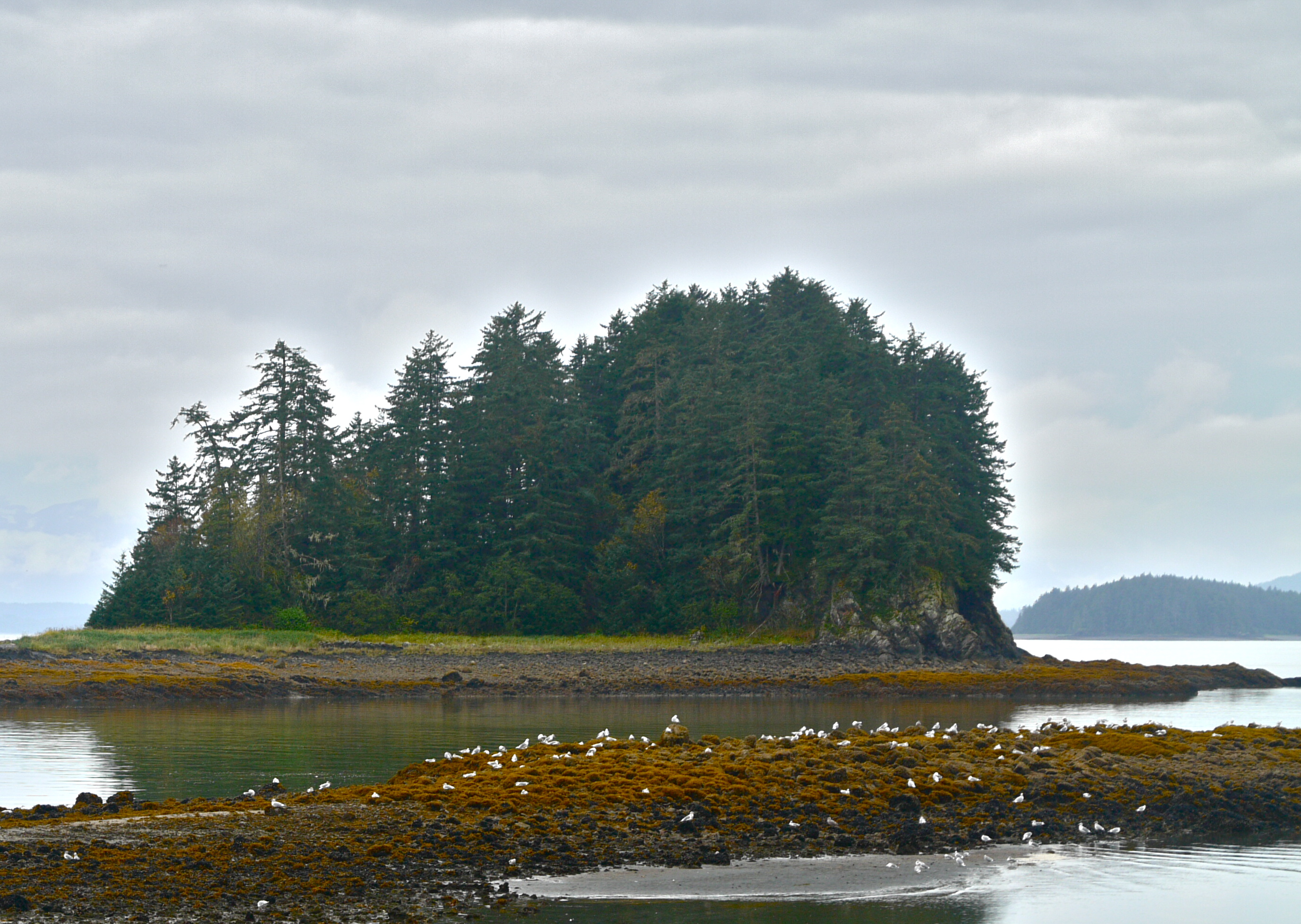
I should be writing but an unexpected shaft of sunlight striking the lush green meadows of Douglas Island won’t let me. Even when the light strike fades I am distracted by a pale blue sky showing through breaks in the marine layer of clouds. It wasn’t like this this morning when Aki and I viewed Shaman Island hunkering beneath a Paynes Gray sky. The yellows of dying beach grass and oranges of seaweed drifts provided the only relief from the gloom. Aki doesn’t miss the sun for she is all about the scent. I’ve grown to find comfort in days dominated by fog and cloud as long the rain and wind hold off. They offer calm if you accept it.

Later we meet friends from Sitka at the mushroom hunter’s house for an Italian midday meal. The Sitka folk took the ferry here for the shopping and companionship. After dinner and conversation we head over the moraine country for a hike.

In their usual preparation for winter the beavers have once again flooded out many of our favorite moraine trails so we returned to the troll woods and a trail decorated with recently deposited bear scat. A sign near the trailhead warns of a bear showing aggression toward dogs. We have three with us, including Aki.

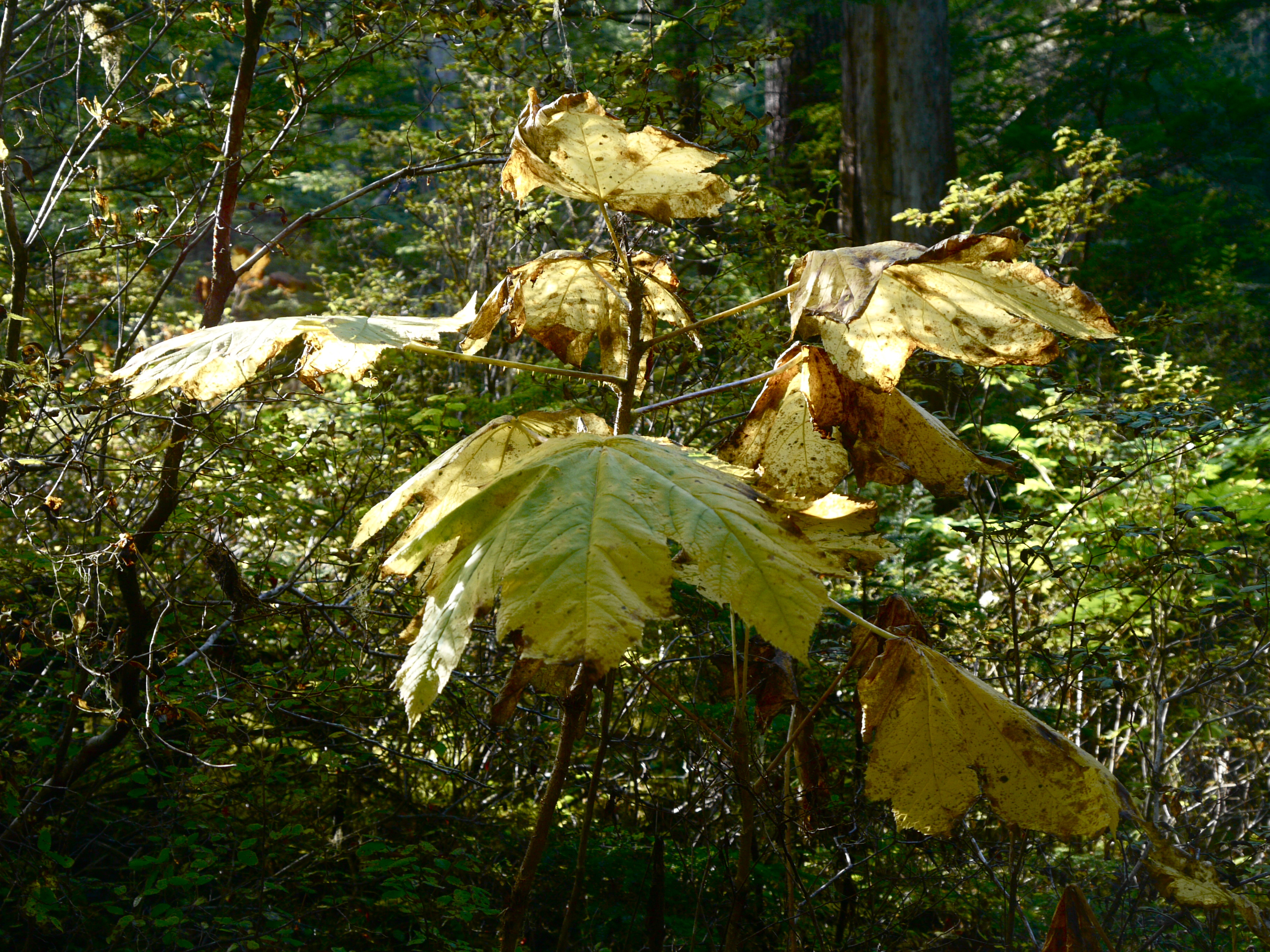
Believing the bears to be at a nearby salmon stream, we transit through the woods where yellowing devil’s club leaves provided a nice counterpoint for the thick yellow-green moss. We find mushrooms aplenty but none choice for eating. We also find lakes lined with yellowing cottonwoods. These trees were in summer green just days ago. 

Now, while looking down channel from our house on Chicken Ridge I can almost see the snow fields growing toward sea level on the shoulders of Douglas Island. It makes me smile.

Northern Harrier

My choice of direction at the start of today’s hike confuses Aki. She knows this trail well and probably has favorite pee sites identified. When I turn right rather than left on it she gives me her, “are you crazy” look and watches me disappear around the first corner. In seconds she’s by my side, having made the necessary adjustments to her expectations.Together we follow Eagle River on its last mile to the sea.

The trail takes us through a forest dominated by moss encrusted cottonwood trees with furrowed trunk that run over a 30 meters to the canopy. Their yellowing tear drop shaped leaves decorate this gravel trail, the berry brush and wide devil’s club leaves that make up the bulk of the understory garden.  Everything in this forest that can is heading toward the false death of autumn— a death that releases a red and yellow beauty.

We are minutes away from an informal trail to a wide gravel bar exposed now at low tide. Aki breaks ahead, bearing to the left of a water filled ditch while I stay to the right of it. A large immature eagle with a couple of missing wing feathers flies toward me from the gravel bar followed by four large dogs that head for Aki. Showing no aggression they surround her, sniffing with curiosity.  She breaks for the ditch separating us and, for the first time in her 6 years of life, swims across a water course.

After the big dogs trot away Aki and I walk to the gravel bar and check out a long finger of water leading in from the river. Salmon rest in this slough before continuing up river to their spawning grounds. They bring the birds and sometimes the bears.

Figuring not to find any predators along the slough after it had been visited by all those big dogs, I lead Aki toward it across a field of yellowing grass. The smell of salmon death hangs heavy. We take care not to step on rotting carcasses scattered everywhere by the incoming tides. Far down the meadow an unfamiliar eagle like call sounds as a large brown and white bird rises into the air on a course that takes it right over our heads.  It’s a Northern Harrier flying close enough for me to see its owl like face.

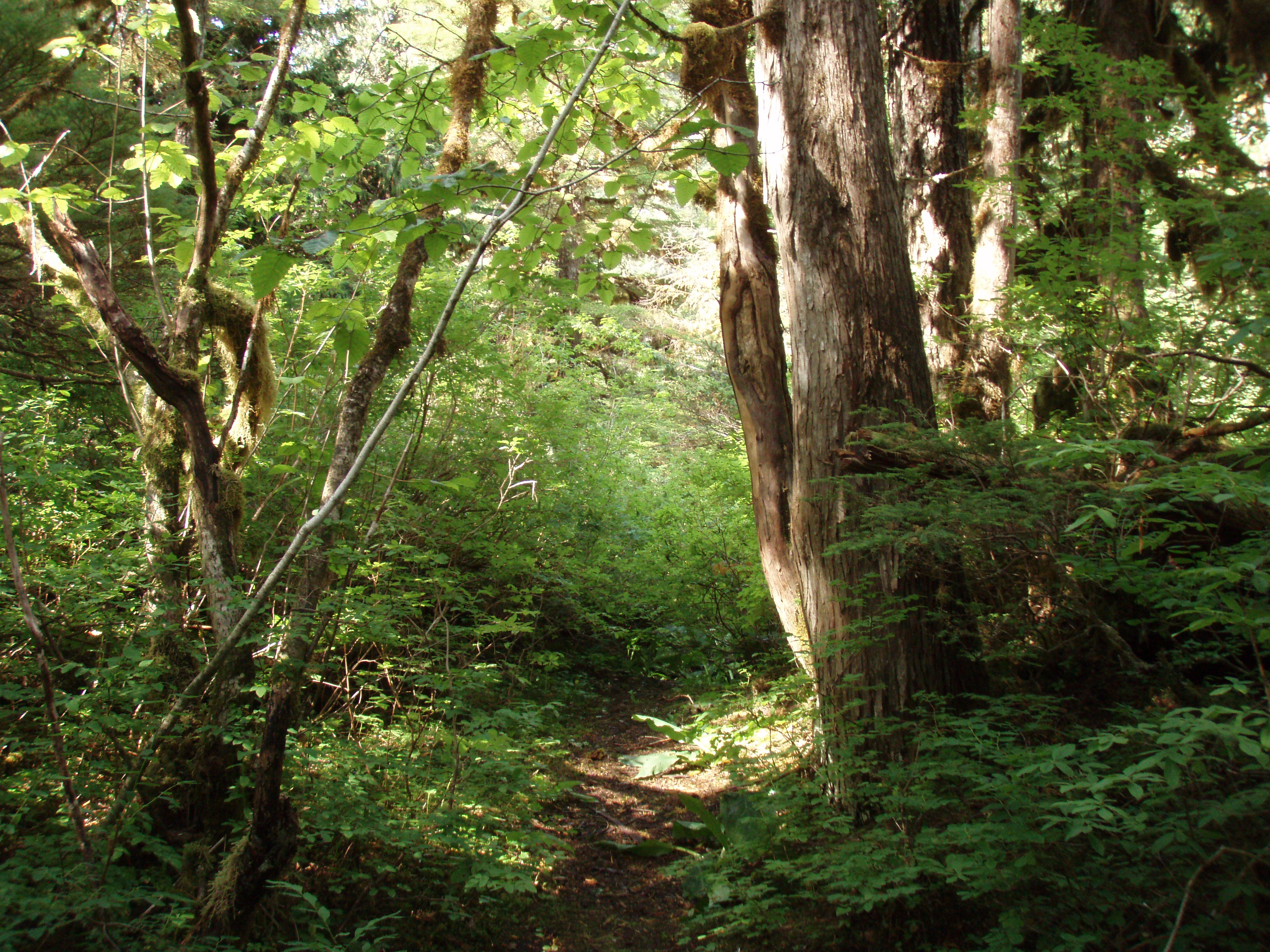
This is my first sighting of a harrier and memories of its close pass over head keeps me occupied until we reach the road and cross over it to where the hiking trail will continue in a few hundred meters. We enter the forest, rather than stay on the road with a plan to wander around in it until we find the trail back to the car. Here, just meters from the road we find a rich pocket of old growth forest formed by large spruce trees. Many kinds of mushrooms, some bright red dot the ground spaces between trees, high bush cranberry brush and red huckleberry bushes. A path formed by wild animals leads us back to the man made path to home.

Too Late for Tears in the Fog

Aki waits where a low growing alder reaches out over the rocky beach. We both hear the low mutterings of a nearby raft of ducks. The noise of my transit through brush sends more than a hundred ducks to flight. They are across the narrow river by the time I disentangle myself from the alder.

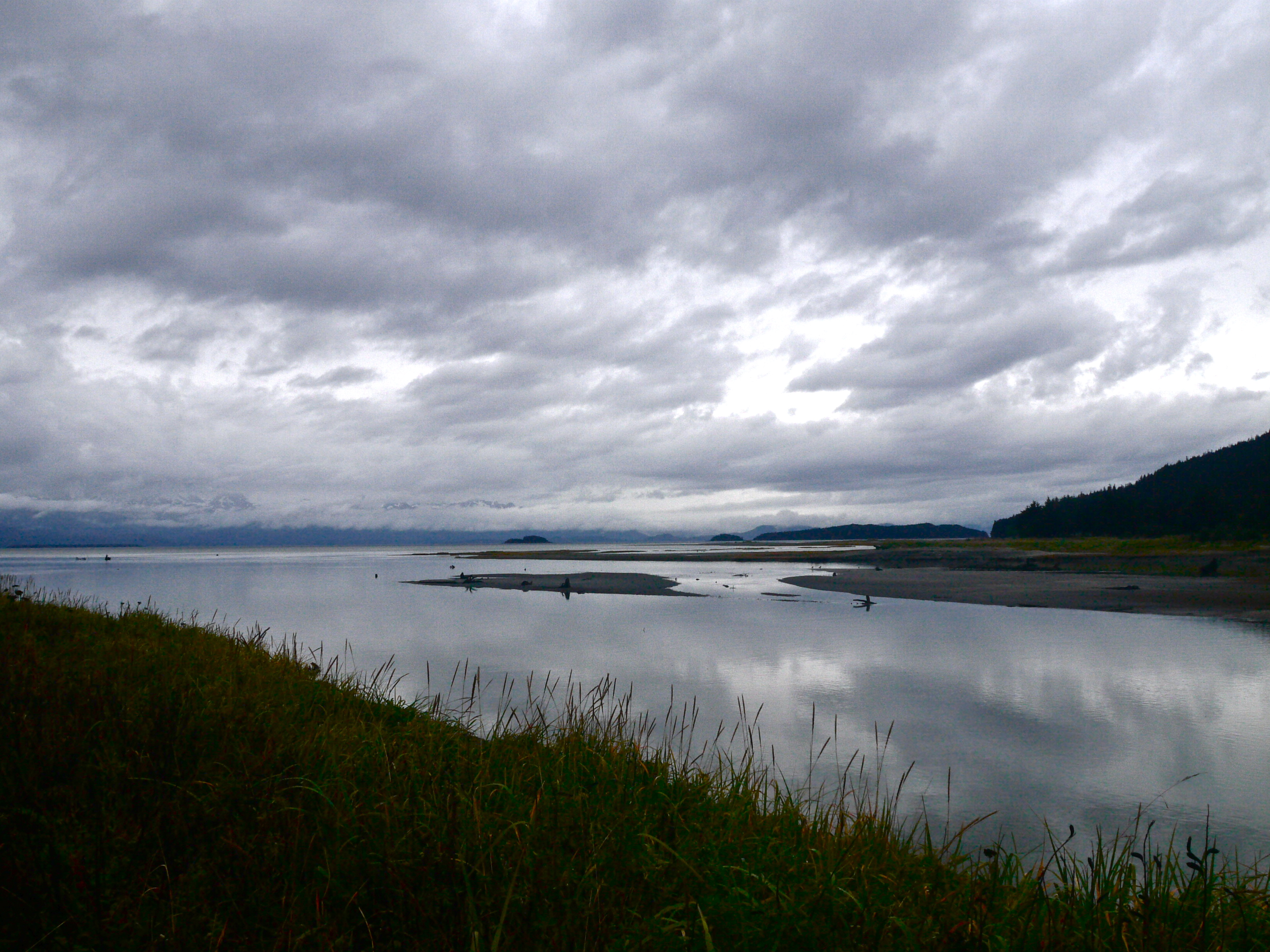
“Oh well,” I tell Aki, “We came for the fog not the birds.” A drop in wind and rain last night allowed a snake of fog to form over Gasteneau Channel and the Mendenhall River. I hoped to see the beauty of its destruction by the warming day. Defeated by the self indulgence (a lie in with extra cups of tea) I am too late to see the first tears form in the fog to reveal spruce trees marching up the southern  side of the channel. Now this side is cleared of the fog, the remnants of which had formed a soft scarf around Shaman Island.  Looking down I see that a rope of golden brown sea weed fills our usual path through beach grass forcing us to walk on the soaked beach sand. 

“Oh well,” I tell Aki, “At least it is not raining.” This, of course, brings on a shower. We walk into the wet wall and head to where the river meets the sea. Eagles rest on the wall of tall spruce on our right. One by one, they drop to within 10 feet of beach and then with the air of a dignified hunter denied prey by our presence languidly fly down the river. Aki and I barely notice the first eagle fly off. Are we so spoiled by wildlife that we treat eagles like sparrows?  After the third eagle drops and departs I get out the camera. It and the other three to follow deserve at least that much attention.

The ebb tide quickly expands the beach on our side of the river and reveals the sandy wetland that forms the river’s other shore. There our ducks and many gulls search for food. They are on an island now but when the tide drops a little more it will become a peninsula offering a predator path to the birds.

Keeping to the edge of the spruce forest we come to a step rock cliff. What appears to be a well crafted rock wall starts at one end of the cliff, bows slightly onto the beach and then circles back to the cliff.  While puzzling how such a structure could be formed by rocks falling from the cliff I hear a disturbance across the river and turn to see a cloud of ducks lift off from the opposite shore following the boom of a far off shotgun blast.

Hunting the Porcini on the Glacier Moraine

A human friend joins us today in the Troll Woods. Invited for companionship. he repays with a mushroom hunter’s knowledge. Born in America of Sicilian immigrants, he brings an enthusiast’s excitement to the gathering of wild food.

We hadn’t started on a mushroom hunt but rather a morning walk under the newly appeared sun. Water backed up from a growing beaver dam flooded our chosen trail to force us into the Troll Woods where he discovers a Porcini mushroom (Boletus edulis) standing above the mossy ground.  Nearby we find tipped over Porcini look a likes that have gills that mark them as a different genus. Another hunter passed this way before us to grab the choicest mushrooms.

With a strong morning sun muscling its way to the forest floor I decide to take my friend home over a trackless section of the woods.  We can’t get lost as long as we keep the sun in our faces.

We move slowly over the soft moss covered ground, sometimes following faint deer trails or the heavy worn paths made by beavers. Other times its a ballet over and around tree trunks and branches. Aki stays with the mushroom hunter to show him the way when I move out of his sight. A gentleman, he thanks her each time.

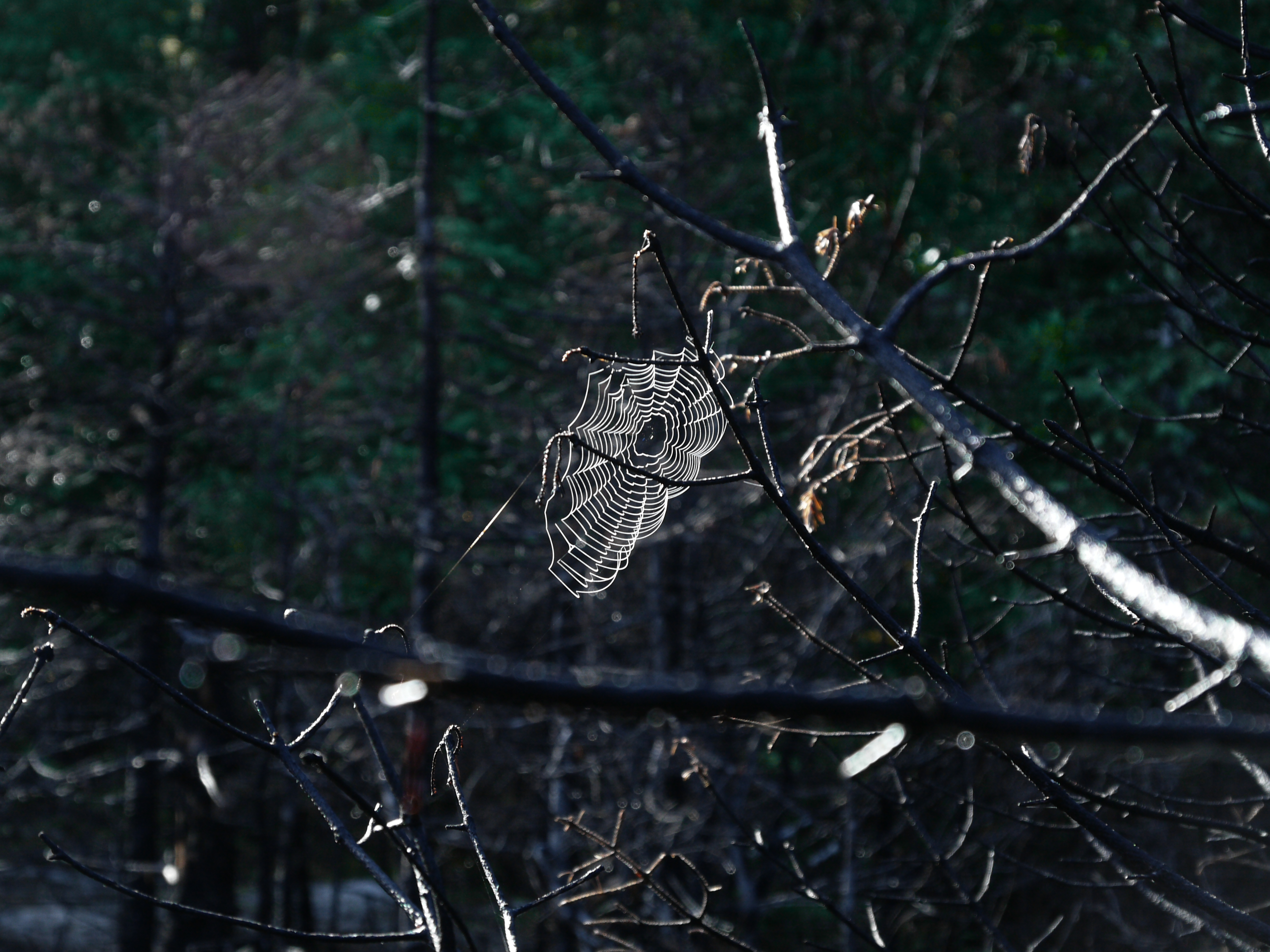
It’s a slow, peace bringing task to follow the sun through these thick woods. We pass an indentation in the moss still steaming from the heat of the deer that just left it. This brings stories from my friend of other hikes and shared kayak trips.  An hour and more passes without notice until we regain the man made trail. It takes us to a burned area where a spider web of sinister beauty, backlit by the climbing sun, is the sole decoration in a fire blackened alder tree.  Nearby two huge Russula mushrooms, encouraged by the warming sun, push skyward. One wears a mossy cap.

Here we also find more Boletus mushrooms — enough for a lunch— and gather them up. Arriving at my friend’s home, we examine our find and discover blue dots forming in the mushroom flesh. They aren’t the delectable Porcini after all but a cousin not worth cooking. He shrugs and delivers a salad rich in fresh greens, olives and tomatoes. Tall bottles of oil and vinegar arrive next along with chunks of hard Italian cheese and a thin dried salami. Then he brings us thick brown hard bread. I smile for now there is no room on the table or stomachs for mushrooms.

Nagoonberries and the Smell of Death

The smell of death dominates this forest walk. That’s how it is along this river at the end of the salmon spawn. Just there, through that patch of river side spruce trees lie the rotting bodies of dog salmon as well as the gulls, ravens and eagles that feast on them.  Aki goes on alert when we hear a splash following by a new chorus of gull complaints—- all signs of a bear working the river shallows for late arriving salmon. We stay to the forest today not wanting a repeat of last year where Aki chased a fishing black bear up a tree and then into the forest.

This morning the grey rain of late August gave way to sun, which now backlights tree moss and understory foliage. While green dominates the forest my eye is drawn to the rare patches of reds and yellows produced by dying leaves. Leaving the usual trail we turn to an area of the forest where the Nagoonberry grows. A legend in the berry picker’s world, the segments of this dark red fruit are said to exceed all other berries in flavor.  I’ve tried in past summers to taste one but someone always manages to hoover them all up before I can find a ripe one. Today I pick two and find them too tart and without must after taste. Even this Highbush Cranberry, yet to be brought to peak flavor by a heavy frost, tastes better.

While the forest opens up to reveal a mountain of true beauty I puzzle on the worth of the common blueberry and the rare Nagoon.  The Nagoonberry, like gold and diamonds, is made valuable by its relative scarcity and the willing belief of the consumer.  The blueberry just tastes good.

Portaging to Tenakee Inlet

This morning a heavy fog blocks our view. Sunrise begins its demise.  Drinking morning coffee on the cabin deck the Captain and I are just able to make out the yearling brown bear fishing at the salmon stream mouth. Two of his elders, both making him look tiny, stir from makeshift beds in the stream side meadow and walk sluggishly into the woods. A small cloud of gulls forms around the young one, which at this early hour, annoys him. After a few half hearted attempts at grabbing a salmon he passes down the beach in front of the cabin and disappears into the fog.

Today we take the portage from Port Frederick to Tenakee Inlet. A friend ran into three habituated brown bears at the portage when he made this trip last May.  It was only with great effort that he and his two companions were able to keep the bears away from their food laden kayaks. In May bears spend much time grazing on beach grass at places like the portage. Little should keep them there this late into the salmon spawn. On this hope we push aside fear, pack the kayak and leave for the portage an hour before high tide.

It takes a 14 to 15 foot high tide in order to paddle all the way to the actual portage trail. Today we will only have 11 feet and expect to spend a long time moving the kayak and gear just to get to the trail.
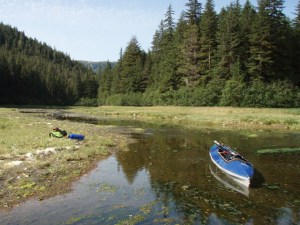
In full sun we wind our way through a serpentine channel at the foot of Port Frederick. It leads us to a narrow tidal stream now too shallow to float the kayak with us in it. We line the boat for a few more minutes until it goes completely aground in the stream far from the portage. The stream braids into three channels. The Captain and I explore each until settling on one leading into a small pond. At its head a rough trail, marked with a metal diamond, leads into the woods. We unload the boat and I start carrying the food and gear along a bear trail stomped into the muddy grass lining the pond. While I make multiple trips from gear pile to trail head the Captain lines the kayak, its keel dragging in foul smelling black mud until he reaches the head of the pond. 

We pass through a section of blue berry bushes still laden with water from last night’s fog. This means no bears have recently passed this way.  In minutes the trail crests and we see through the woods a green meadow rather than the sparkle of salt water.  Pushing on we reach the meadow and walk across it to where a small stream enters another mud bottom pond. In a few days, when the high tide would crest at over 16 feet we could have easily paddled up the stream and across the pond to the actual portage trail.
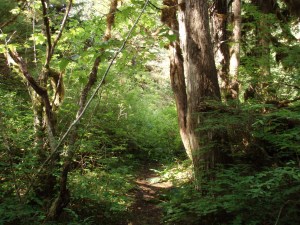
We are both tired but aware that the more time spent making the portage the greater chance of an uncomfortable encounter with bears. I hang the food in a nearby spruce tree and find that it is surrounded by tall yellow cedars. Their pretty majesty  can’t delay our efforts so I grab some dry bags and hike with the Captain up the trail calling out a gentle warning to any bears that might be ahead. They hate nothing more than being surprised.


After dropping our load at the pond’s edge we start back for more, passing holes recently dug by bears hungary for the rice like roots of Chocolate Lilly plants. Hurrying on we make the several trips necessary to move the kayak and other gear to the pond, which is not deep enough to float us and the gear. The captain again has to line the boat along the pond shore while I use a paddle to keep it from grounding in the muddy pond side grass.
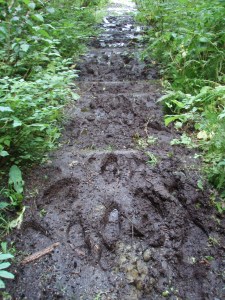
It’s been three hours now since the kayak went aground and we still have to move gear, food and boat over another land portage to Tenakee Inlet. The trail is short but muddy and in 90 minutes we are eating a delayed lunch along side a mountain lined fjord. Across the inlet we spot an island with a small stream nearby. We paddle to it with plans to make it our camp.  Tall tree covered domes rise from the inlet. To our right we can look into an intriguing wet land at the head of the inlet. Tomorrow, if the good weather continues we will explore it before starting the paddle up Inlet to the Tenakee Springs ferry terminal.