Category Archives: Kwethluk

Nature

Putting Up Fish

1

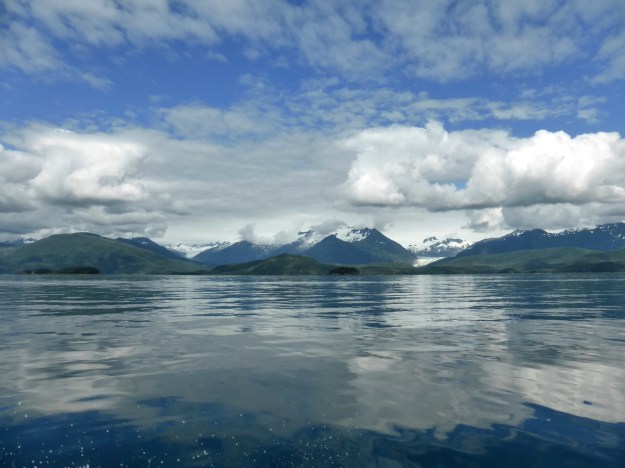
It wasn’t supposed to be sunny today, but it is. I’m on my friend’s boat heading toward the Auk Bay fuel dock. Aki is home, hopefully stretched out on a sun-warmed section of the floor. Painfully bright light bounces off Favorite Passage and a bank of quick-moving fog. It’s a beautiful monster that could cause the boat to crash onto the rocks if it doesn’t lift. It does. We gas up and head out to the place that has always provided us with salmon for the winter.2
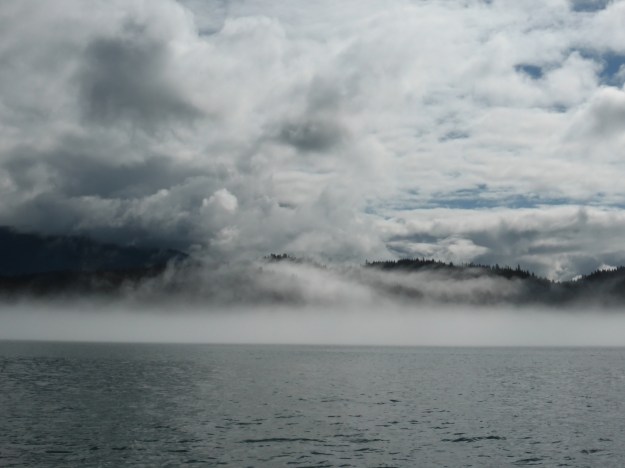
The pass is almost empty of other boats and, as we will soon find out, empty of silver salmon. There are whales—three humpbacks that cruise along the surface feeding on the small fry that usually attract salmon.4
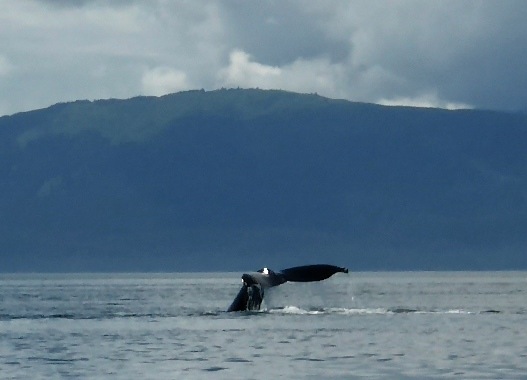
Taking advantage of calm seas, we pull up our gear and motor over to the eastern shore of Admiralty Island where we fall into a line of charter boats trolling for salmon. They are catching lots of pink salmon for their clients. We want to put up the more desirable silvers and drop our trolling lines deep in hopes of getting below the pinks. This works. When we run out of bait we have in the boat four silver-bright silvers that together weigh more than thirty pounds—a good start.3
Smart Little Dog

1

The recent heavy rain has swollen Gold Creek. It charges under the Christopher Trail Bridge. Aki trots on the bridge behind me, seemly oblivious to the rushing stream. She had refused to cross it every other time we used the trail, even when the stream was silenced by ice. I want to search her soaked face for an explanation but she slips by me when we reach solid ground. She trots on, probably drawn forward by an interesting smell. She is a smart little dog, smart enough to let me lead on the overgrown sections of the trail so my pants, not her fur, soaks up the water that clung to the trailside plants.2

Picking and Tossing

1

Seconds ago, Aki dropped her orange Frisbee at my feet. Now she barks—her way of asking me to send the toy flying so she can chase it. I want to ignore her and continue picking blueberries. It’s past mid-summer and this is the first time I’ve had to put up berries for the winter.2

When I pick up the Frisbee, Aki charges down the trail in the direction I have already thrown the thing five times. I wait until she is well on her way before tossing it another direction. Now I’ll have some time to pick while she searches for her precious.3

Bears have already gone over this patch of bushes—cubs judging from the size of their scat. They high-graded: tromping over the lower lying fruit to tongue fat, sweet berries from the topmost branches. It would be very bad to startle the mother of the hungry cubs that wreaked all the damage. Thanks to Aki’s barking, there is no chance of that.

Blues and Grays

1

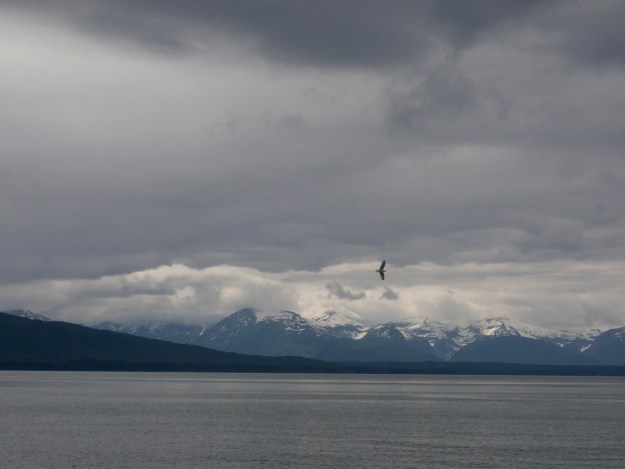
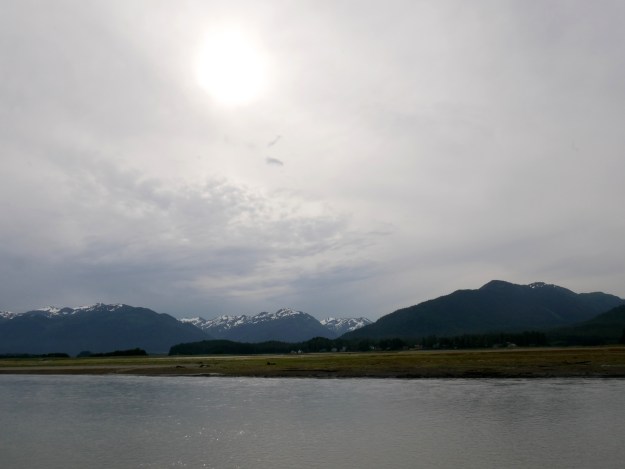
One of the big Princess cruise ships moves up Gastineau Channel while we drive over the bridge that connects Juneau to the island of Douglas. A gentle rain falls on the boat and those passengers who ventured on deck to watch the docking. Down channel, only a small oval of blue skies survives a complex of gray clouds that is delivering rain. Are the passengers excited by the challenging weather or crushed? Will they hike up Juneau’s European-narrow streets to the Basin Road trail system or sulk in the Franklin Street tee shirt shops? Aki and I won’t see any of them wandering the Treadwell mining ruins.2

It stops raining before we have passed through the forested ruins and stepped onto a beach made of crushed mine tailing. A resident pair of ravens watch Aki and I from atop jagged-topped wharf pilings. The one with a white spot on its wing bows toward my little dog when she trots up to its piling. After Aki follows me over to the collapsed glory hole for a visit with the belted kingfisher, the two ravens fly off down the beach, turning their backs on a battle taking place near the southern tip of Douglas Island between blue sky and rain-charged clouds.3

Back in the Rainforest

2

Aki looked happy when we met yesterday at the Juneau Airport. I was. Today, on a morning that promises sunlight, we might be the first of the day to walk the Rainforest Trail. Just minutes ago, a brindle-coated marmot dashed across the road, making me wonder whether the act was a sign of good or bad luck. Aki gave no opinion. Now, while she surveys the grounded smells, I notice how far summer has progressed since I left for writer’s school.1

All the remaining blueberries are either ripe or close to that goal. Insects have sculptured the leaves of the other understory plants. Those stressed or damaged are already fading from summer green to fall yellow. On the beach, purple beach pea blossoms dominate now that the lupines are setting seeds. Tall cow parsnip plants, having already flowered, are drying into brown skeletons. Sparrows burst in and out of the wild parsnips, collecting food for fall.3

Red Salmon

2

Hoping that there really is strength in numbers, I ride with another guy along single- track trails that winds through a paper birch forest. We are heading toward the red salmon spawning reids of Campbell Creek. I am comforted by the lack of fresh bear scat on the trail but worried by the absence of human activity in the area. We will be alone when we reach the stream.4

I sing a Bob Dylan song badly as we weave around trees and up tiny rises in the trail. No one has ever reported enticing the approach of a brown bear with a Dylan song so I figure my performance will encourage the privacy-loving bears to scatter. No bears wait for us at the stream. Maybe my signing worked or maybe the bears are all down stream to intercept salmon moving upstream.3

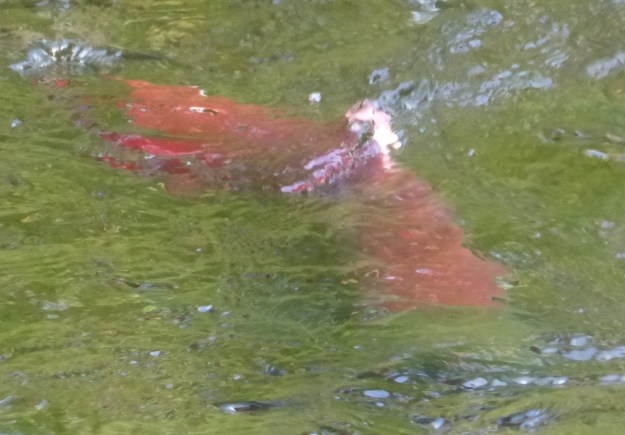
The difficult transition from salt to fresh water robs most species of salmon of their beauty. They enter their home streams fat and ocean-bright silver. By time they spawn, all have faded to mottled colors. The males form battle faces—nasty teeth and hooked noses. But red salmon change into lovely red and green creatures, showing off colors that sparkle when touched by forest light.1

Oh Momma

1

Pearly-gray has replaced blue as the prominent color in Anchorage skies today. I ride away from the Inlet toward the Campbell Creek trail system, vowing to keep away from the salmon spawning stream because it draws brown bears this time of year. At first I ride against the flow of morning commuter traffic on Elmore and then swing into the woods. A single-track trail allows me to meander among white-trunked paper birch that might be hiding moose. If they do, none of the big, horse-like guys show themselves.2

I take another trail that offers more open views and spot, a half-a-mile ahead, something that looks like a wobbly billboard. As I approach it resolves itself into a young male moose with tiny antlers covered in velvet. When I stop, he stares for a second and walks elegantly toward the woods. I will have to pass him if I continue down the trail. I’ll see how it goes. Remounting, I ride closer, which causes him to freeze again. I remember my dad’s warning amount never approaching a deer or elk while they are in velvet and stop again. The moose resumes his walk toward the woods. When he reaches the forest edge, leaving a good chunk of land between him and the trail, I restart my ride.3

Wow, my first moose of the year. I didn’t see any during last summer’ writer’s school residency.

The trail brings me back to Elmore where I watch a late-model Corvette speed by before crossing over to the bike lane. I briefly ponder whether a moose or sports car would cause me the most damage and am thankful to the government that funded this ride-alone bike path.

4A mile down Elmore, a cow moose and two calves feed next to the road. Workers listening to talk radio or silently planning a pattern of attack at work wiz by the family scene. Honey, stop gorging yourself and look after your babies, I think. While the mom turns her butt to the road, her two calves dance along the verge. The aggressive one bucks like a bareback bronc and drives its sibling away from food and mom. In running away, shy one almost enters the rushing traffic stream. I’m close enough to see the startled look in the shy moose’s eyes when it freezes just before it would have been crushed by a northbound SUV. Unable to watch any more, I ride back to campus.
5

Lucky Day

1

This has to be a lucky day—-the seventh day of the seventh month of the seventeenth year. We count ourselves lucky to be alone on the Mendenhall Peninsula trail on this dry, if gray morning. Bald eagles complain while we plunge down though old growth forest to the Mendenhall River. More eagles sulk in the riverside spruce trees.4

Diminished by the low tide, the river is empty of waterfowl. Only a seal head breaks the surface. Even though they should be out foraging on the exposed tidal flats, a mob of bald eagles sulk in the riverside spruce, some two to a tree. Even though it hasn’t rained for a couple of days, an immature eagle stretches out its mix-brown wings to dry. He must have crashed into the river trying to pull free a salmon. He was lucky to find one.3

This time of year, the river should be filling up with pink and chum salmon but we see no fins, no impatient leaps of salmon returning to their spawning grounds. I pray that they are just late in arriving. With the king salmon return being so small, bears and eagles are going to need lots of chums and pinks to get through the winter.2

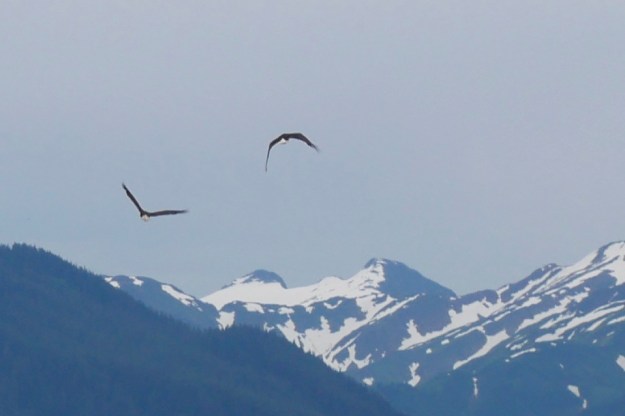
While I start to feel sorry for the birds and bears and myself, three eagles whoosh over my head, so close that the wind sound of their wings startles me. One veers off while the other two fly toward each other with talons in attack position. But they are not serious about doing battle. Were they serious about snatching away Aki? Apparently unaware of any danger, the little dog stood relaxed at my side during the event. I guess seven must be your lucky number poodle-mix.5

Wet Bird

1

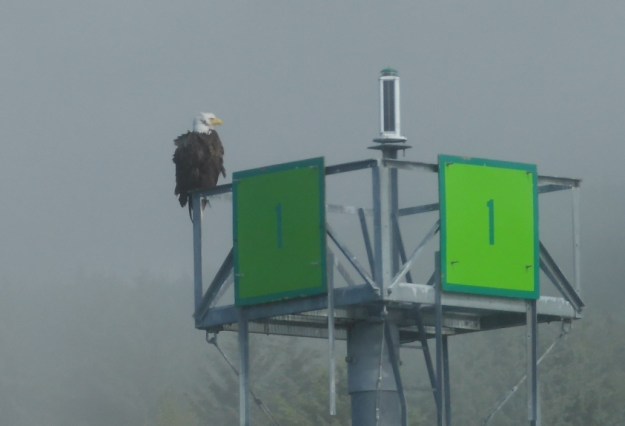
This eagle tells you everything you need to know about today’s weather. He squats in the top of a hemlock tree, rain-soaked wings spread out to dry. He will hold that pose for the ten minutes that Aki and I explore the false outer point beach. I poke at a spray of purple beach pea flowers, snap a photograph of them, pet the dog, and look up at the eagle. He holds the same pose. I talk with Aki’s human sister, watch her skim stones on the calm water, pet Aki, and look up at the eagle. I smile at a brown junco with the nerve to land on a drift wood log a few feet away and stare at us. I squint out toward Shaman Island at the head of a curious seal, apparently wondering why we linger on the beach. The eagle still hasn’t moved. That’s how hard it rained today.P1050913

Yin and Yang

1

The dogs looked miserable even though they reclined at the feet of doting owners next to bowls full of food or water. In the sidewalk seating area of an Oregon brewpub, they coped with 100-degree heat by sleeping. Tired from a morning bike ride along the Pacific and full of pub food, I felt like joining the pups. Aki, who even though she likes to sleep next to a heating vent in winter wouldn’t know what to do about the heat.2

The next morning, while getting in one last bike ride before our return to Alaska, I thought about the flexibility of man and dog. In urban Oregon, dogs stay home while their owners ride crowded public transport to inside jobs. Each must look forward to the nightly reunion. They have many walks in the rain and some in snow. But one sniff of the tea roses perfuming the bike paths and you know that they have a gentler climate than Juneau. They have shopping, wineries, fancy beer parlors, and quality cell phone coverage. We have Costco, a hometown brewery, and ready access to the woods and sea. Orcas chase salmon and sea lions in front of Juneau. What predators work the streets of Portland?3

This morning, back in Juneau, I join Aki for a walk on the Rainforest Trail. Soft rain collects on the path-side plants. It soaks my pants when they brush against the cow parsnips leading over the trail. How nice, little dog, to be soaked by rain rather than sweat, to walk through air cool enough for comforting fleece. Aki, who rarely has to pant, would probably agree.4