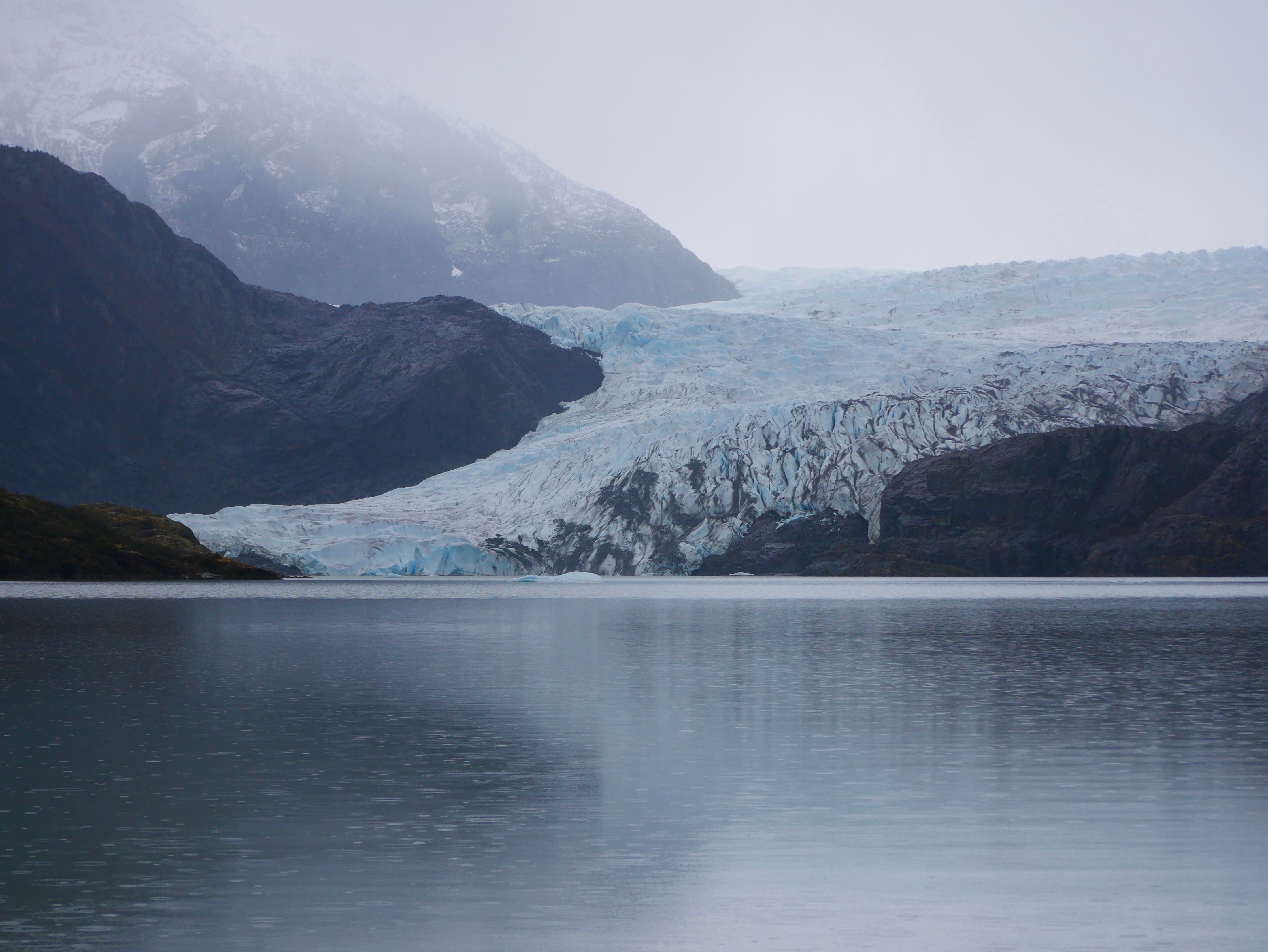
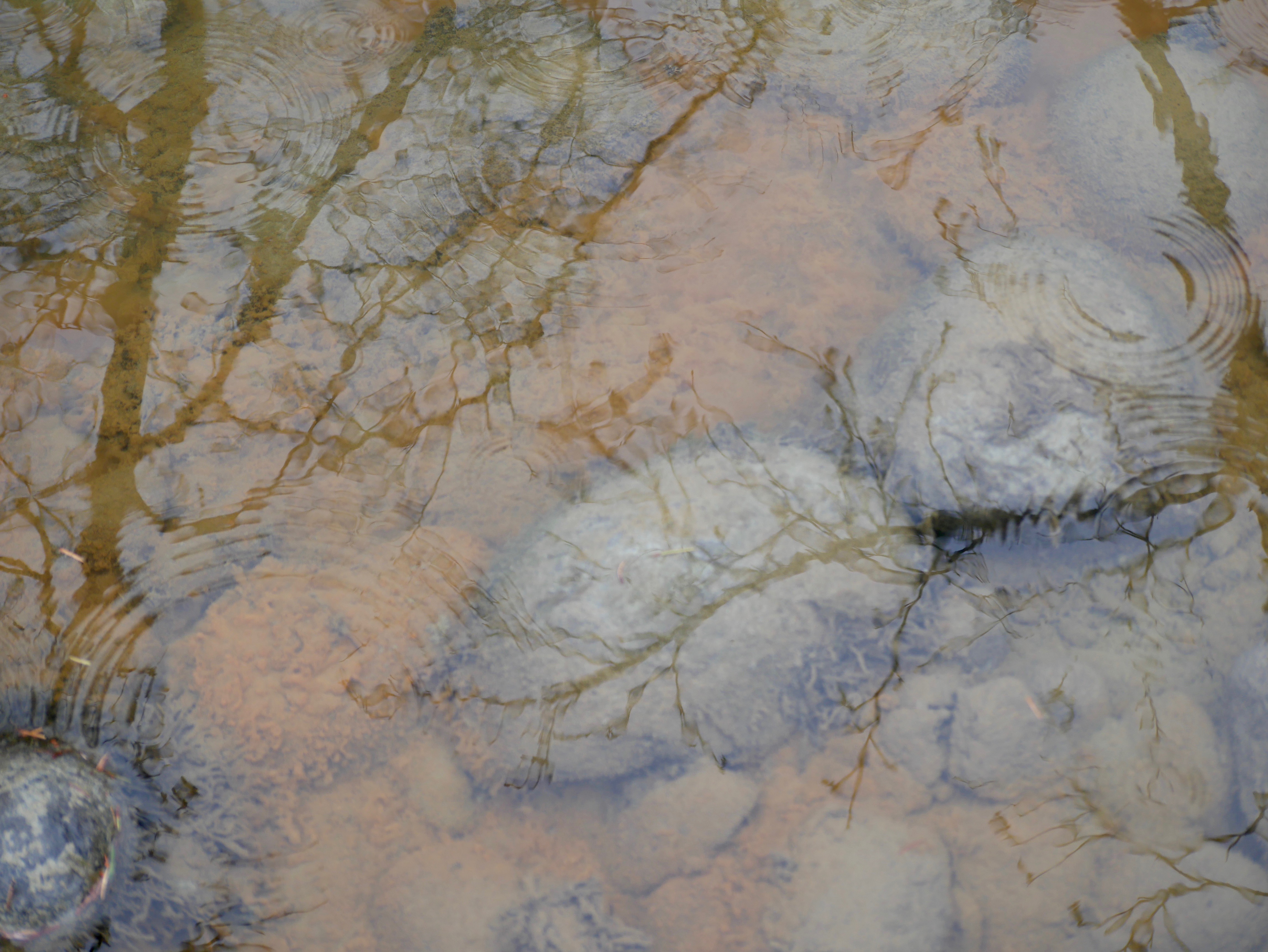
Rain pockmarks the surface of Mendenhall Lake and softens the handful of icebergs that migrated away from the glacier after the lake thawed. Across the lake kittiwakes reoccupy their traditional nesting sites. They don’t seem bothered by the persistent precipitation.
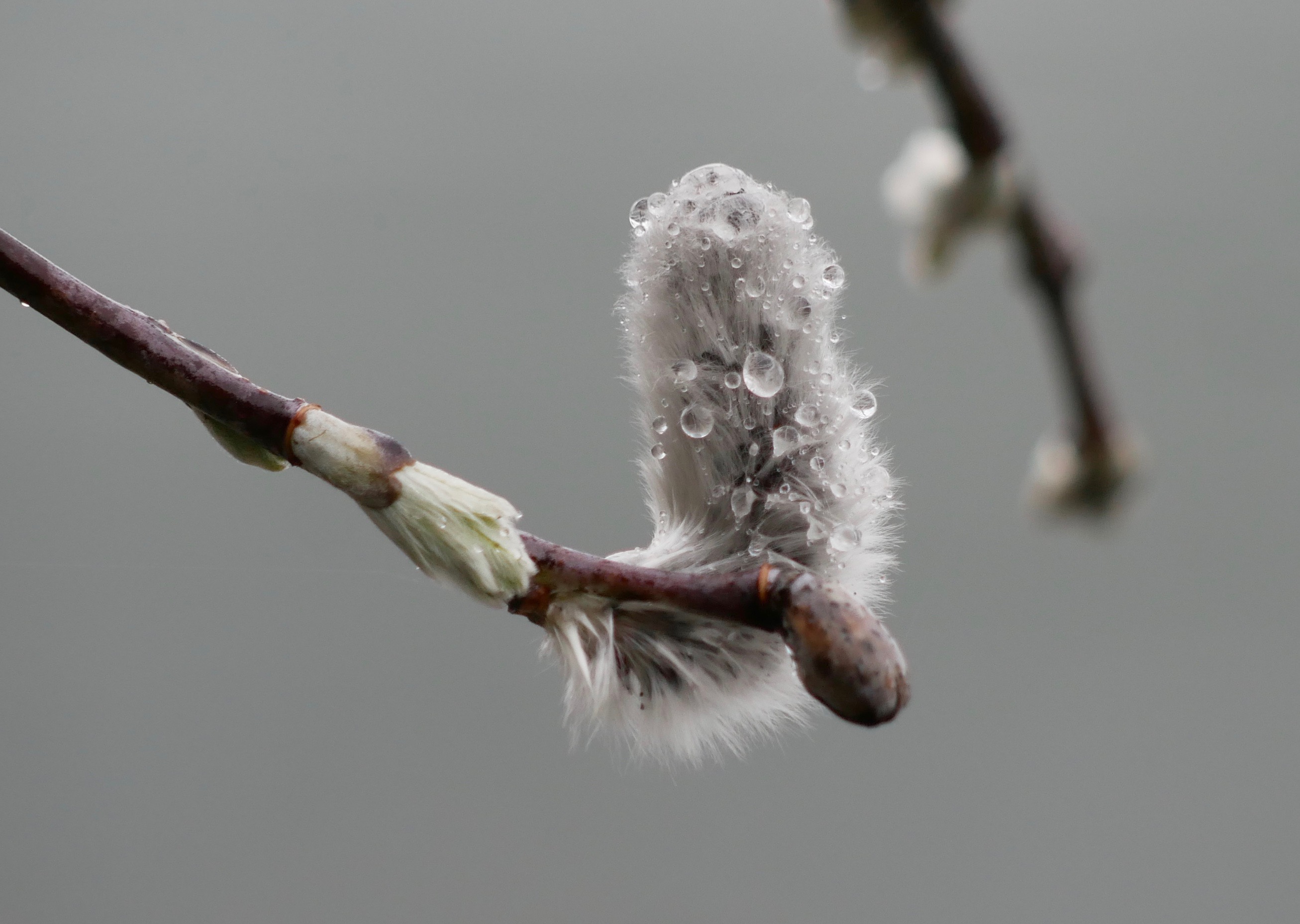
I like the rain for the way it leaves sparkling bags of water on the willow catkins and makes the forest moss sparkle. It also might be responsible for the welcomed absence of other trail users. We have the lakeshore and moraine to ourselves. We also enjoy an absence of human-made noise. Planes can’t fly thanks to the low cloud ceiling. The roar of the supercharged Nugget Falls masks the other intrusive sounds. I can only hear the pat, pat, pat of rain on my rain parka and the sharp cries of the nesting kittiwakes.
For the past few weeks robins have been a regular feature of our walks. Before today, they just trotted along in front of us as if to lead the little dog and I away from their young. But they didn’t sing. The robins infesting the forest near Fish Creek Pond this morning have switched into nesting mode—singing territorial songs and escaping into a surrounding tree when we approach. Black-capped chickadees harmonize with the robins as they move nervously through the forest canopy.
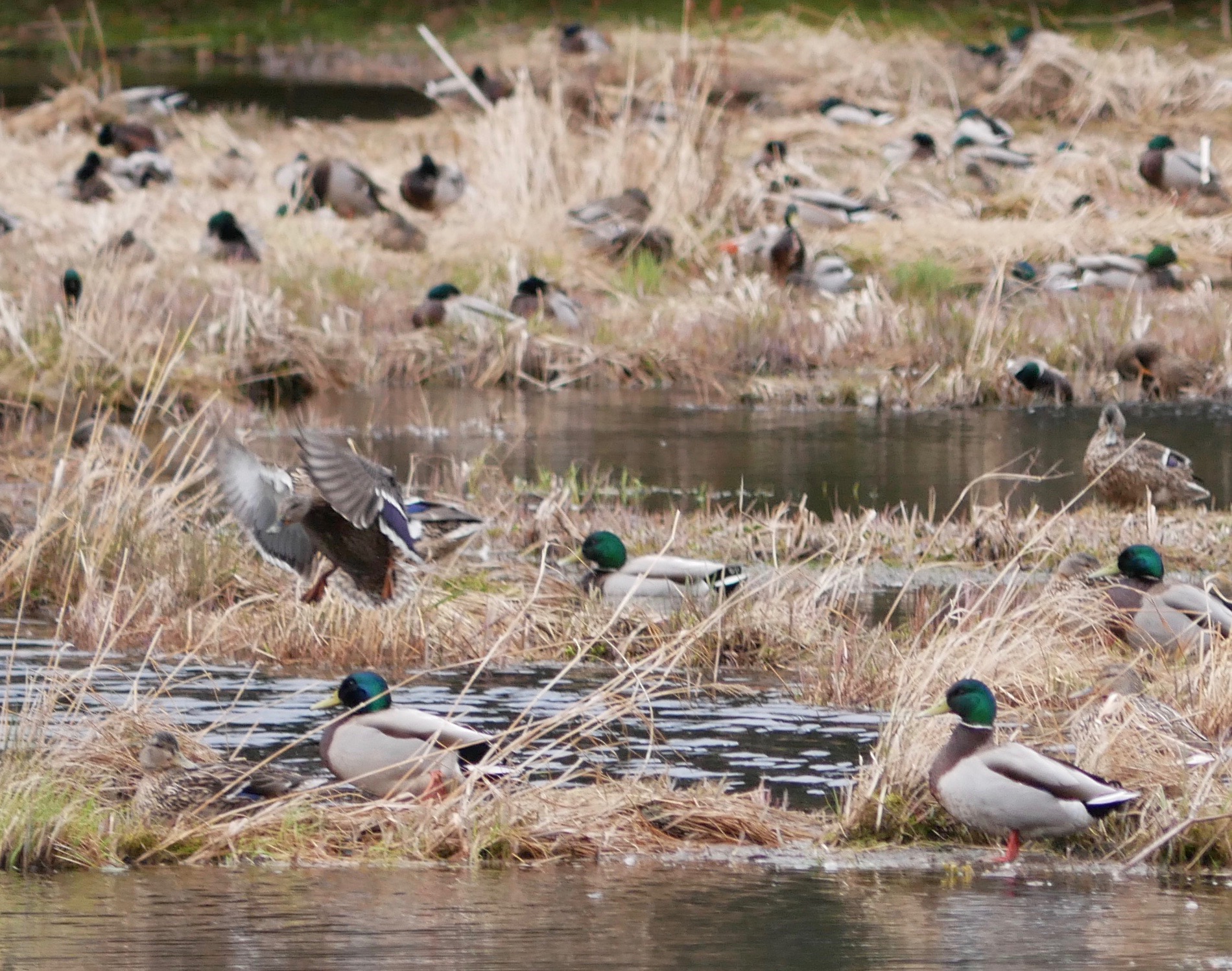
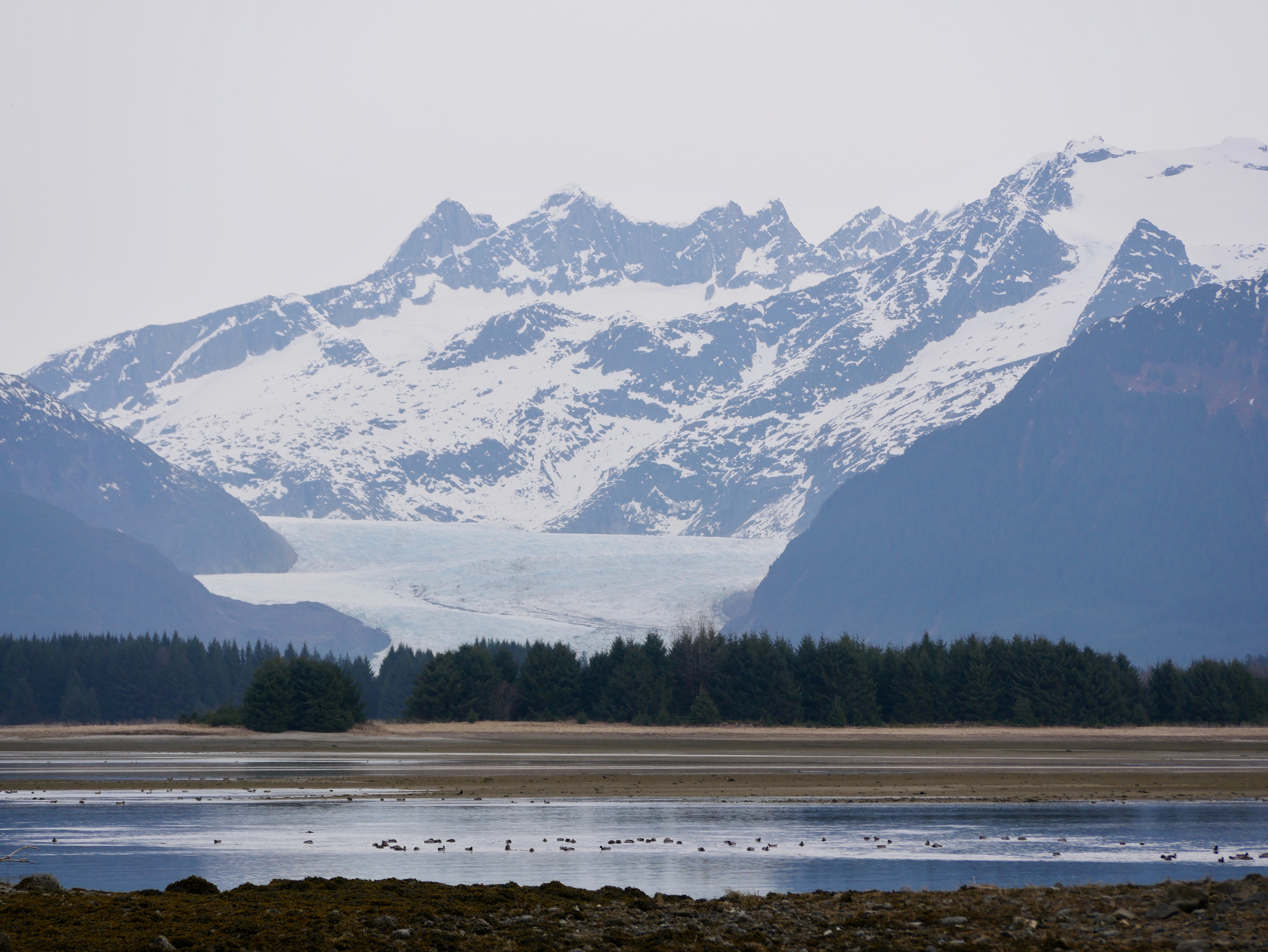
Aki ignores the noisy birds. One of her other humans has brought along a Frisbee for the little dog to chase. While she is busy with her toy, I sneak off the trail to look at ducks gathered on a swampy meadow. At least one hundred mallards crowd on a series of tiny lakes. A northern pintail and several American widgeons wander among the mallards. Every minute two or three more ducks join the crowd.
The wind, which has being growing in strength since we left the car, can’t reach the ducks in their inland preserve. Nothing blocks it from whipping down the glacier, across Gastineau Channel, and over the Fish Creek Delta. Only crows use this open space. They toss themselves into the air, pop around like kites, and drop back onto the beach.
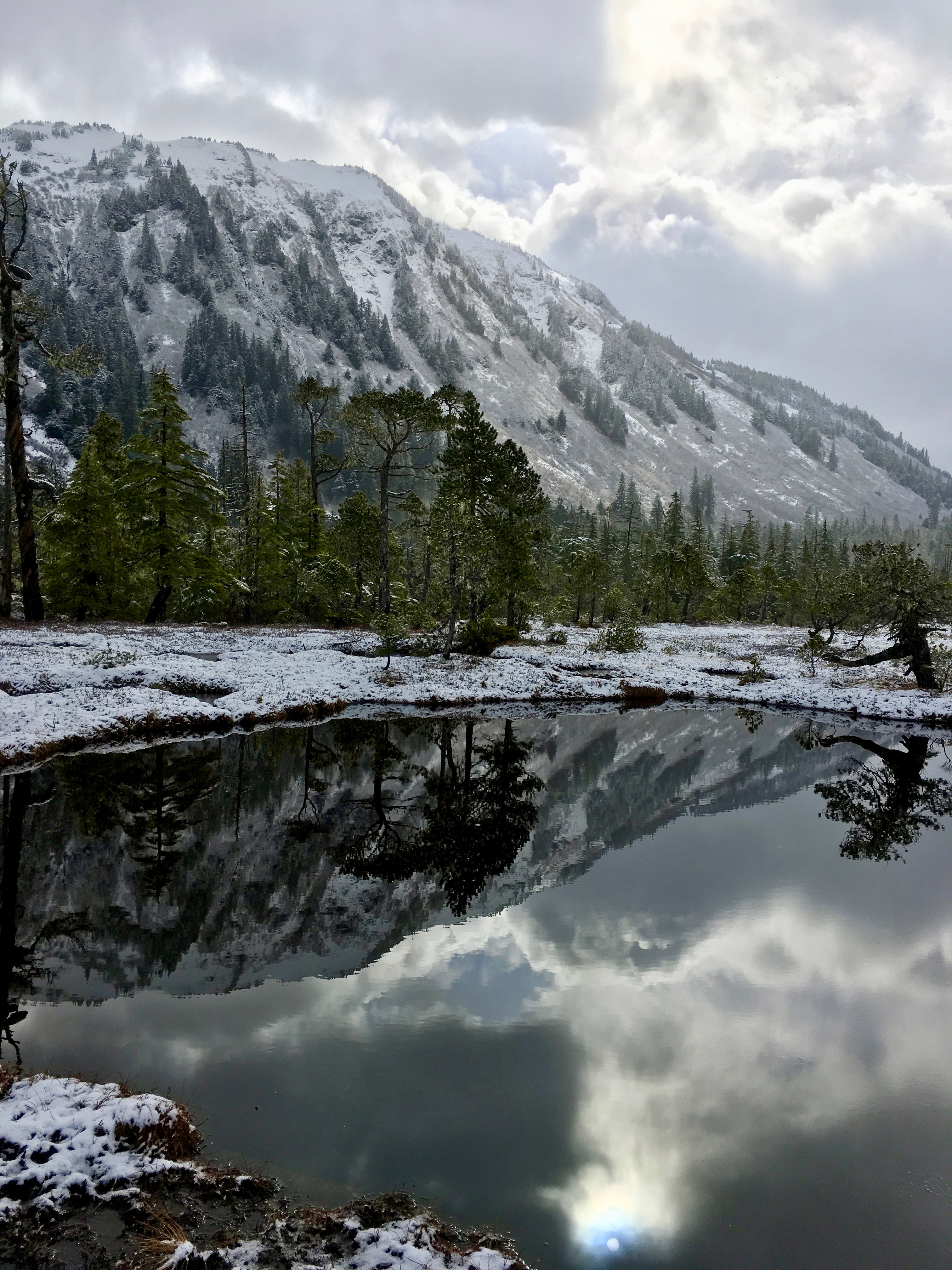
I was in the kitchen, making coffee, thinking about using some sheltered beach for this morning’s walk when unexpected sunshine lit up Dan Moller Basin. The sun reflected intense light off the freshly fallen snow that flocked the basin’s spruce trees. I had to squint even though the basin is across the channel from our house and at least a kilometer away from our kitchen window.
Hey little dog, we’re heading to the mountains. Aki, who was stilled curled up on the bed, didn’t stirred. Thinking only of winter’s beauty and not the cold baggage that accompanies it, I dressed Aki in a light wrap and chose rain gear for myself. We drove to Eagle Crest, Juneau’s closed-for-the-season ski area. The temperature dropped as we gained altitude until it was just above freezing. Our car tires wobbled slightly on the snowy road.
Two inches of new snow covered the trailhead parking area. More was falling as we started down the trail. I wished that I had brought gloves. The little dog looked like she would rather be some place else. Neither of us was prepared for this late attempt by winter to reclaim the mountains.
By doddling behind and stopping each time I turned to check on her, Aki made her wishes clear. When I gave up and turned to join her she raised her tail to its happy position and dashed back toward the car. The snow stopped and sunshine began to leak through the cloud layer. In seconds the snow caught by the meadow’s trees melted. That covering the trail shrank, exposing bare gravel and puddles of melt water.
High winds rattled our house windows this morning. But Aki was still willing to head out for a walk. Last night she met me at the airport after a ten-day separation. I wondered, as I walked off he plane, whether she would be happy to see me. While we were gone, she spent every day with neighbors who took her on walks. Her nights were spent with family. She had it made. When I neared, the little poodle-mix raised her nose toward me, not in derision but to gather in my scent. It seemed to please her.
This morning we drive out to North Douglas Island and use the False Outer Point Trail to become reacquainted. At first Aki ignored me as she catalogued smells and cues left behind by other dogs. She caught up with me at the beaver pond, where we had watched a bevy of swans before I left for California. The swans were gone but two mallard drakes floated in the rain.
The rain slacked off but not the wind. We listened to the pulsing gusts bend the treetops, sounding like high surf along a California beach. The forest sheltered the beach and bays that border it from the wind. Hundreds of goldeneye ducks puttered over calm water. When I took a break from watching them, I spotted Aki, watching with patience concern—a loving parent ready to protect her sometimes-foolish charge.
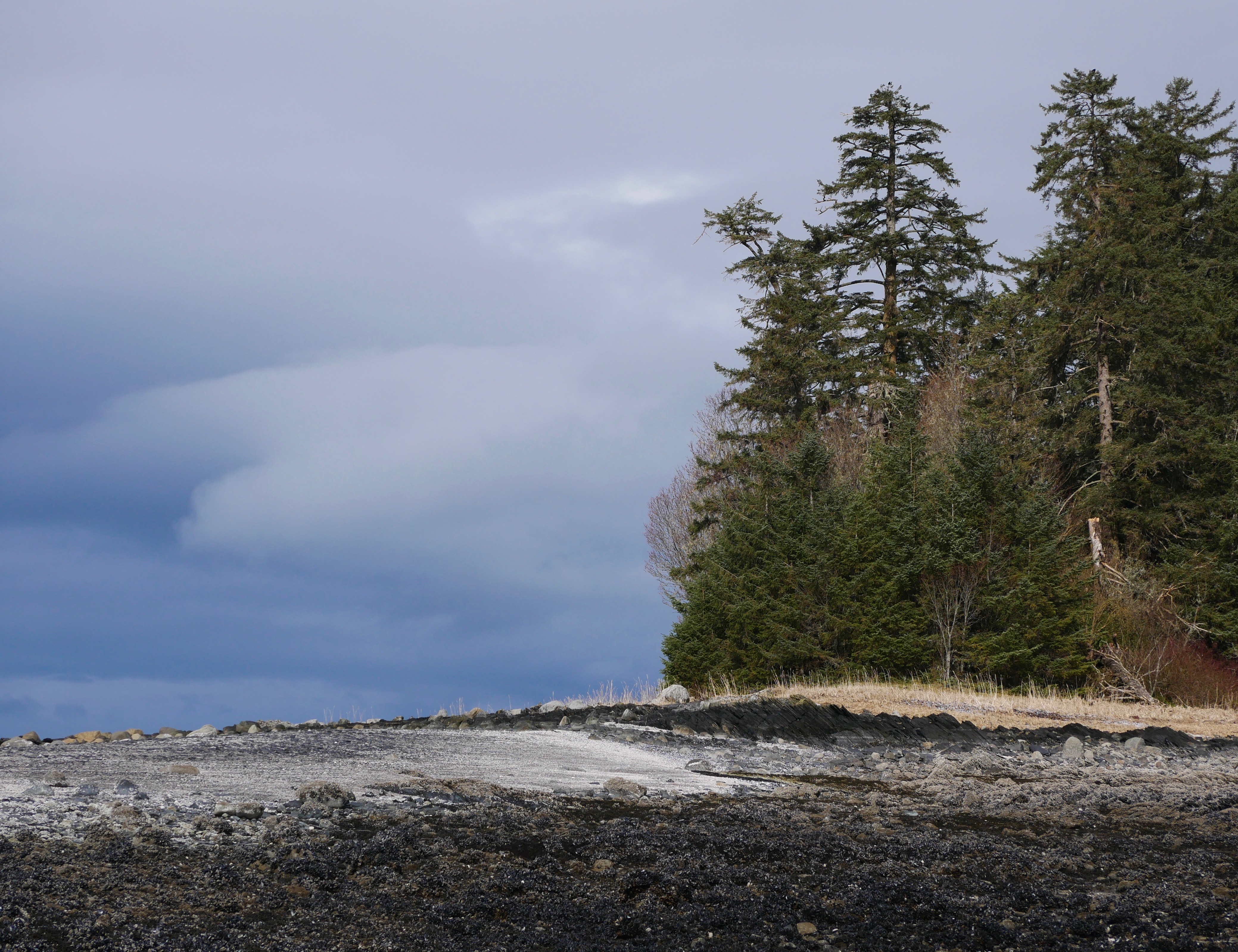
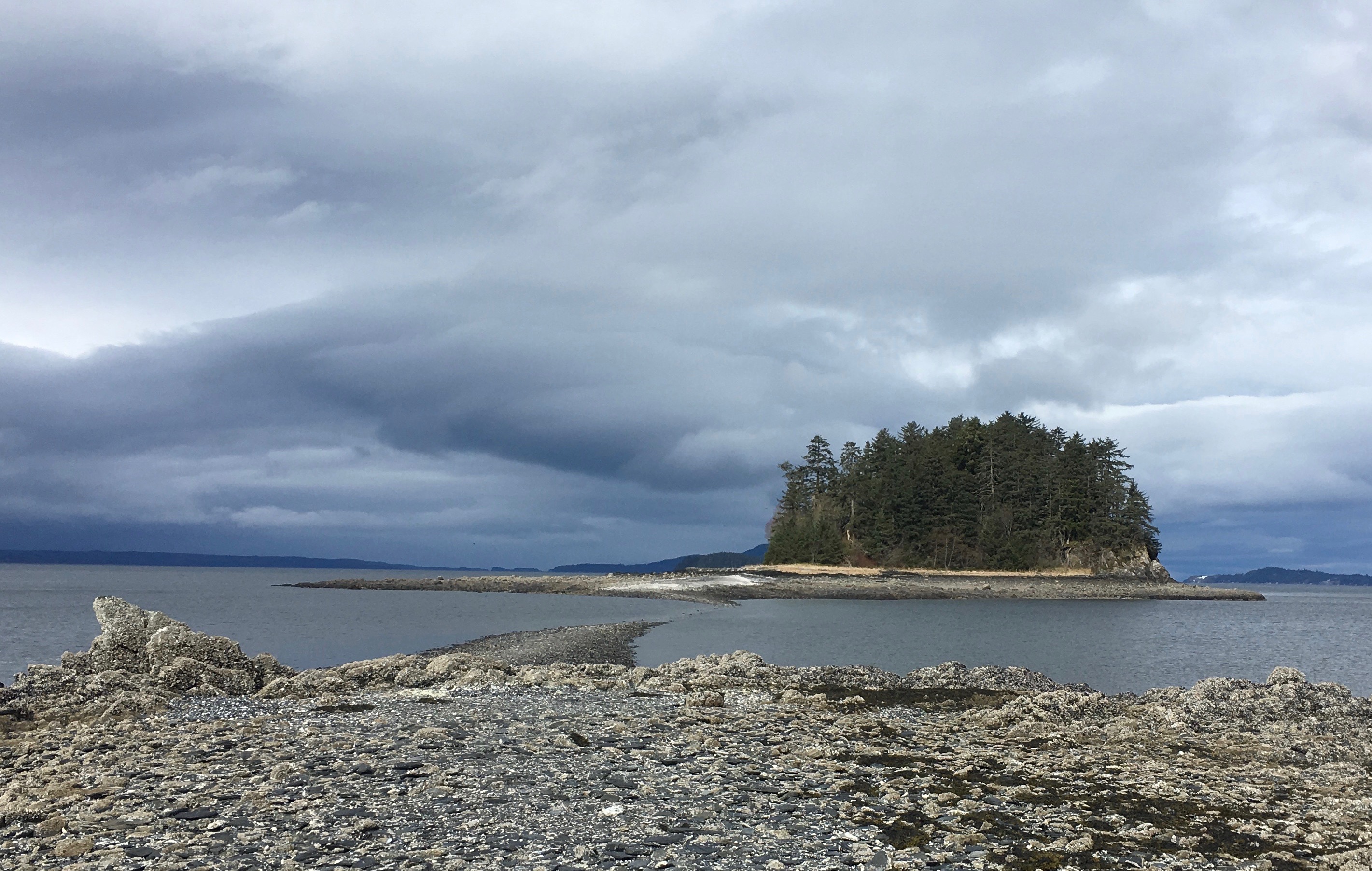
I knew that the tide would be low when we reached this North Douglas beach. But I didn’t expect to see the causeway to Shaman Island exposed. I decided to walk across it and return before the tide turned. Aki wouldn’t follow me so I’d had to carry her. To reach the path we had to cross a stretch of open beach frequently flown over by eagles. Fear of them causes the little dog to hug the forest’s edge whenever we walk up this beach at low tide.
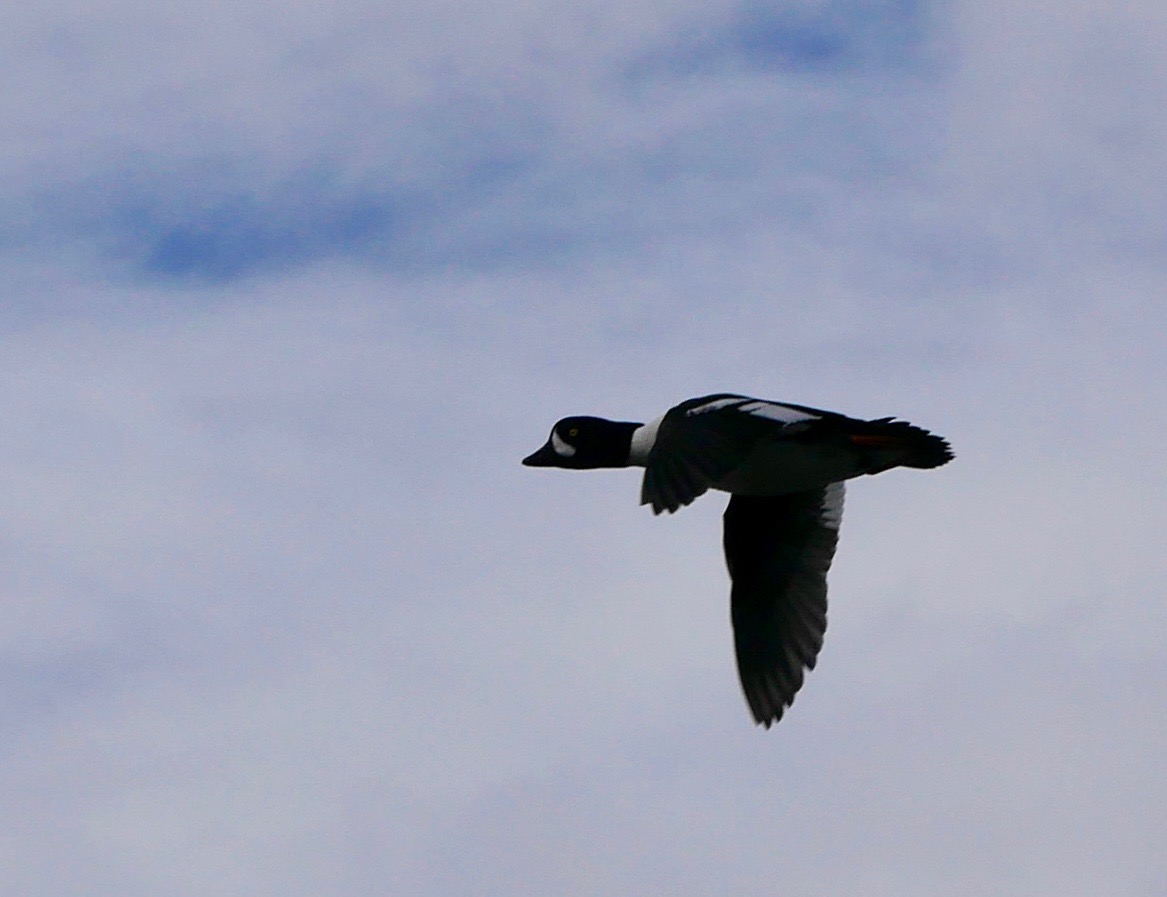
Holding the poodle-mix with one arm and my camera in the other I walked to the causeway. We met a couple of hikers coming back from the island. They managed to spot two oystercatchers on the spit. The little dog and I didn’t. There were the usual crows and gulls and harlequin docks, but no oystercatchers. A pair of common goldeneye ducks flew low over our heads, offering me a hunter’s eye view of their chests.
The sun climbed above the clouds as we started back across the causeway. I had to carry Aki again, this time because part of the path was already under water. Minutes after we returned to the beach the causeway became impassable.
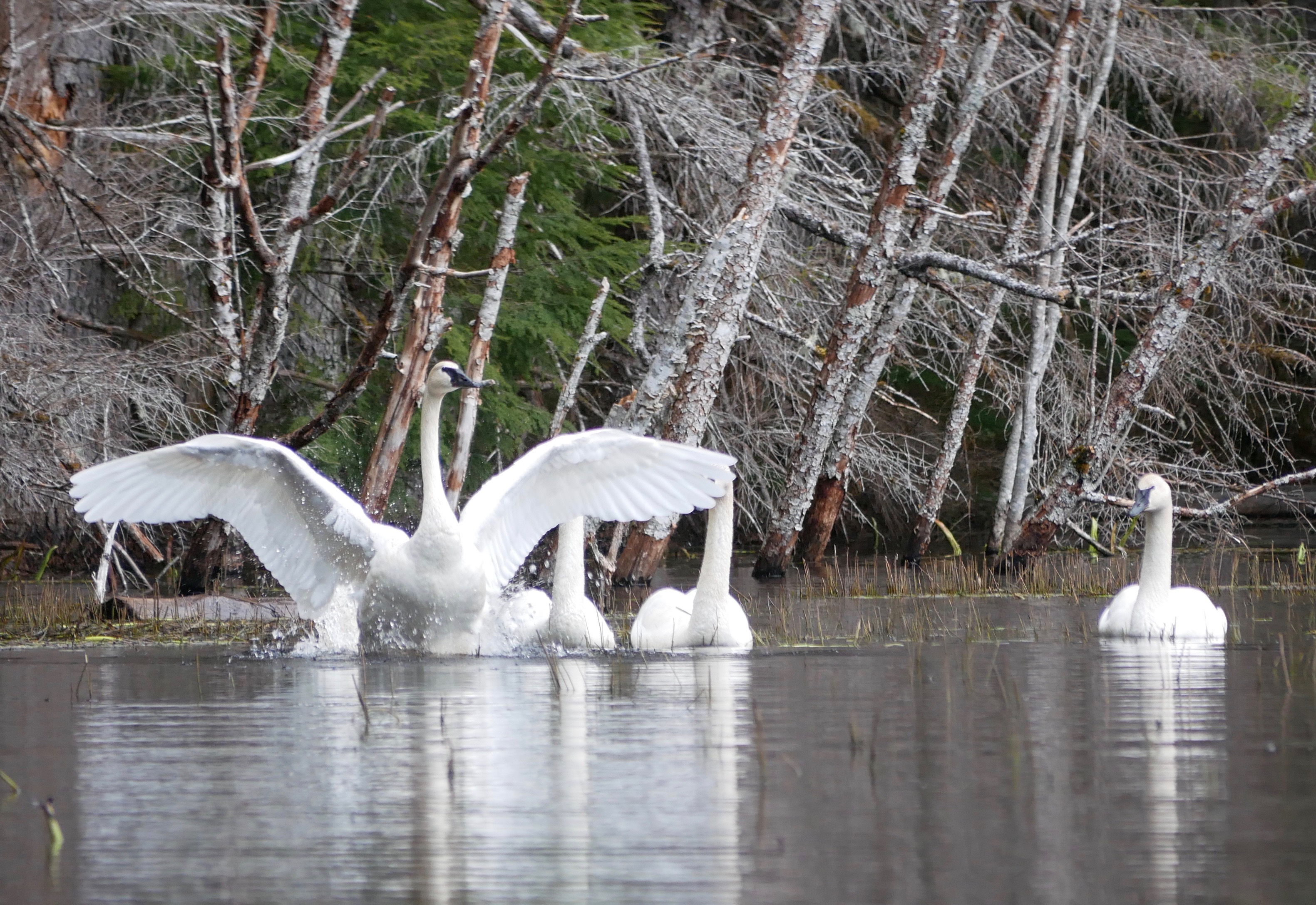
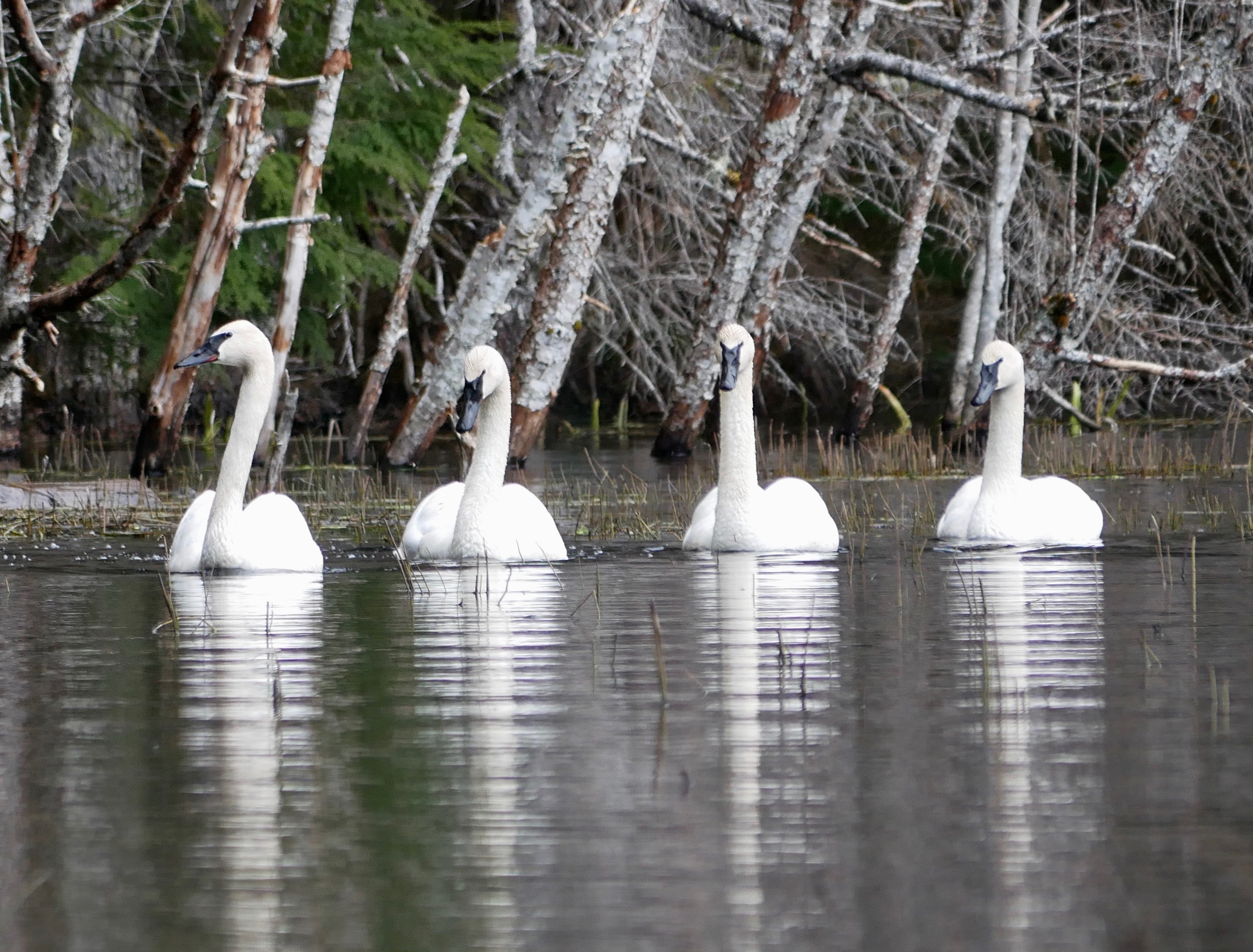
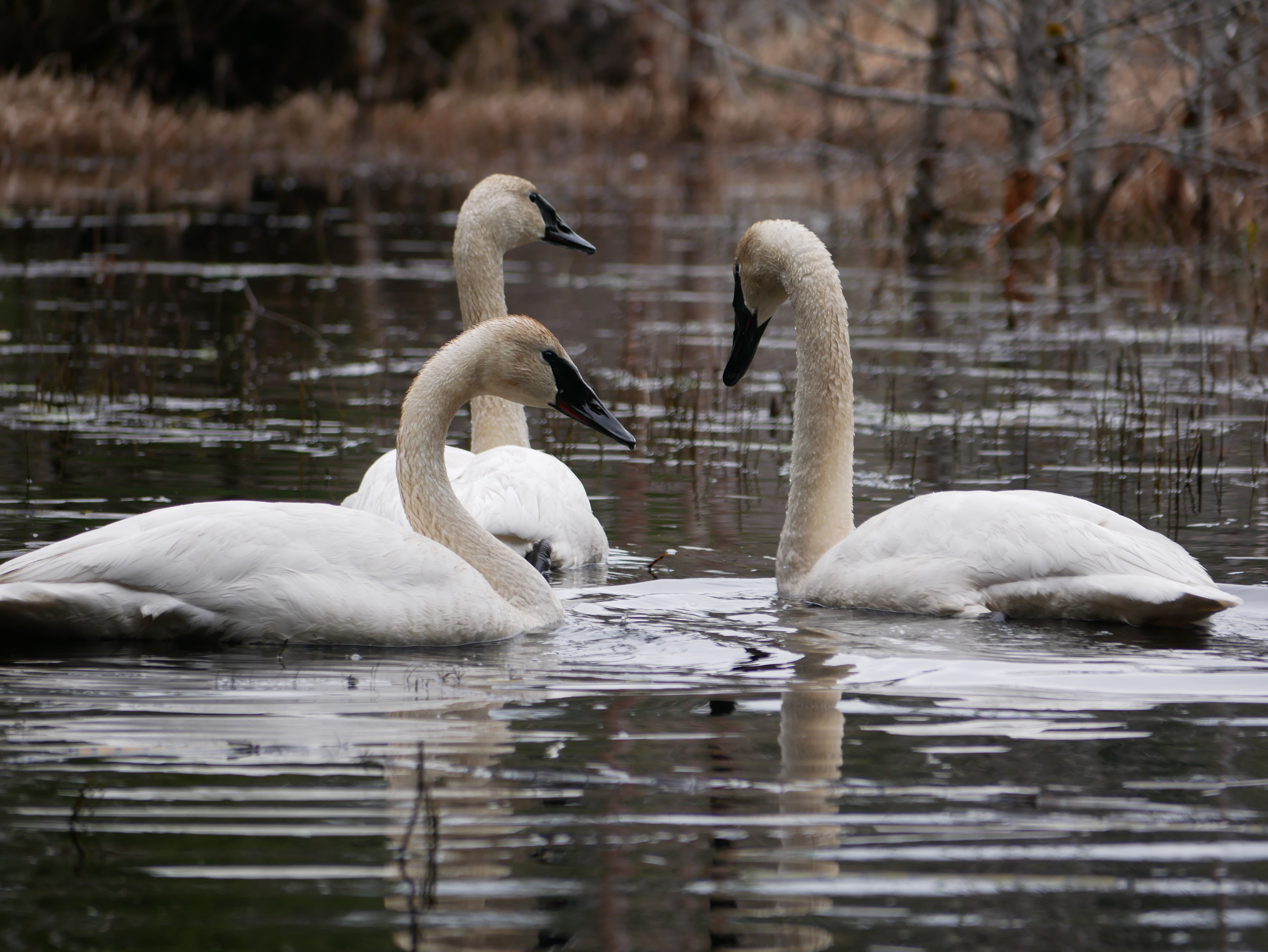
Continuing on to the car, we passed the beaver pond where we had seen the swans a few days ago. At first I only spotted three of the big white birds. Then I noticed another two in a brush-choked portion of the pond. A fight broke out when the two isolated guys tried to rejoin the rest of the bevy. Two of the swans rose up their heads and beat their wings at each other. Then, the apparent loser sulked off to the weeds. The remaining four floated past the little dog and I, long necks straight, looking like a naval squadron on parade.
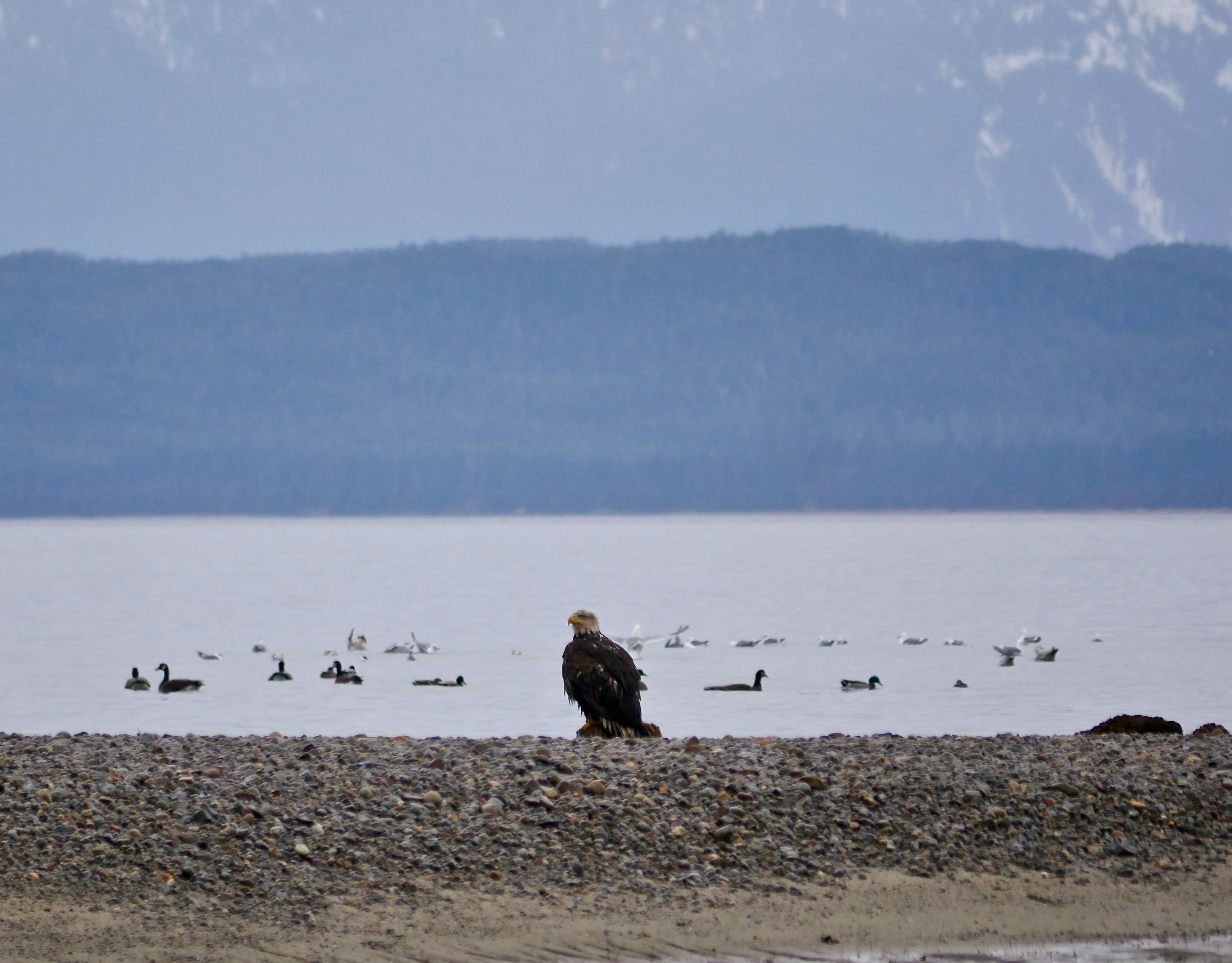
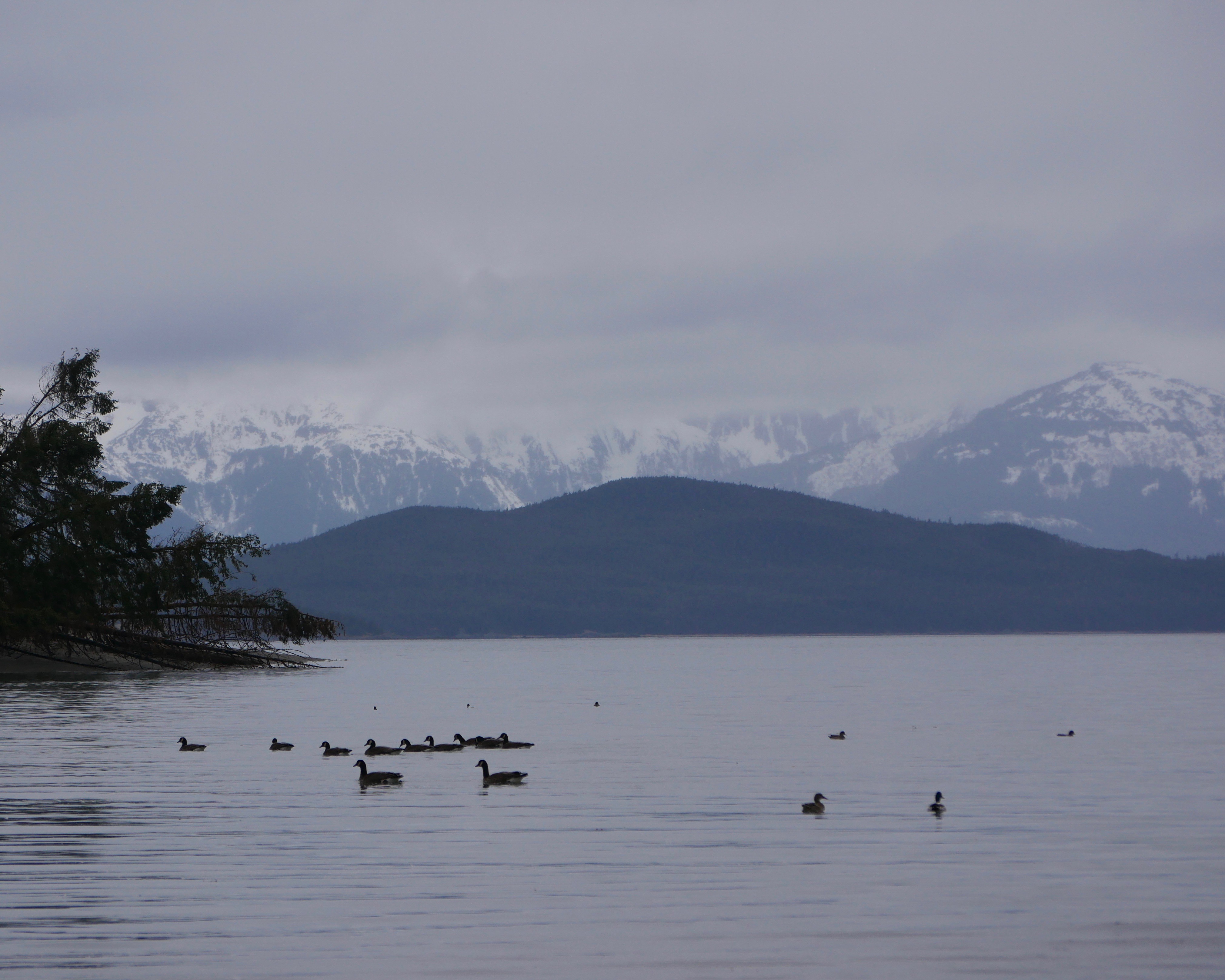
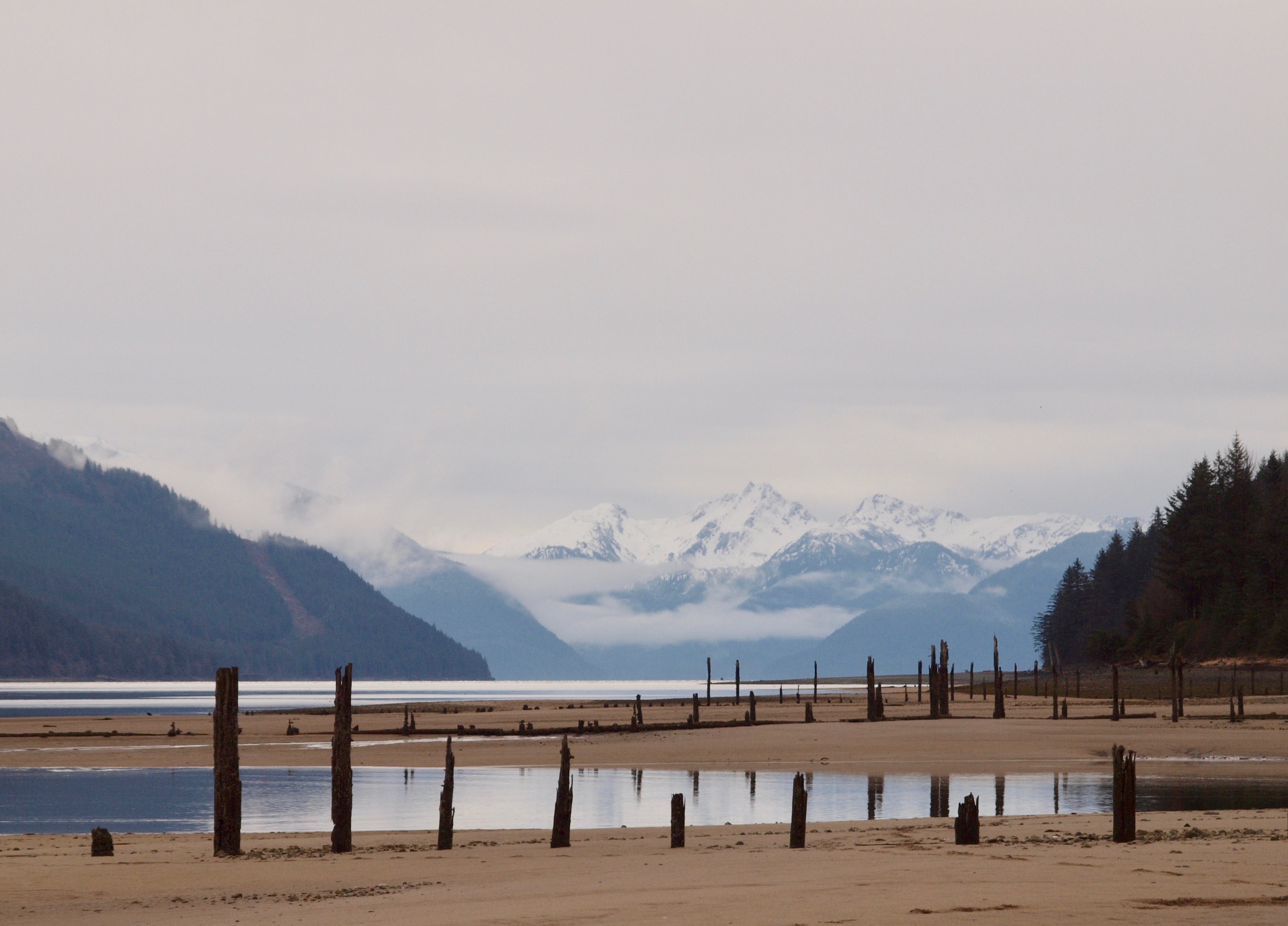
I am not as disappointed with today’s rain as this miserable looking bald eagle. It has perched itself on a rise of gravel just feet from the edge of Lynn Canal. its hunched posture and rain soaked feathers make it look miserable. Worse, the eagle is going through the transition into adulthood so splotches of white feathers pock its chestnut chest like acne on a teenager’s face. Behind it, Canada geese, mallards, and gulls, unfazed by the weather, patrol the water offshore for food.
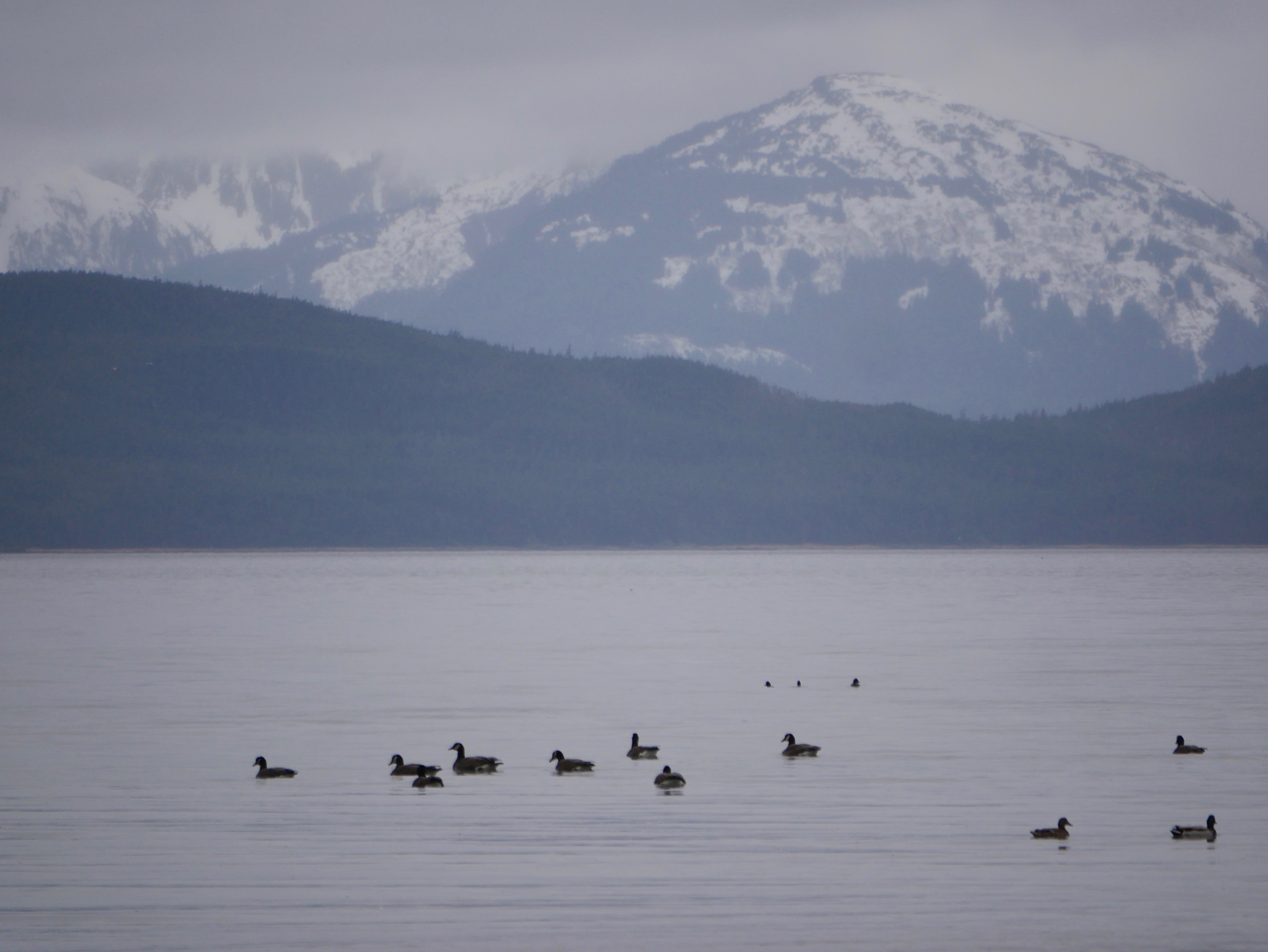
Only the lower flanks of the Chilkat Mountains show beneath the marine layer. Perhaps the eagle misses his mountain view. The water birds look as comfortable as tourists on a hot Rivera beach. They don’t need fancy raincoats or even hats. The eagle’s mood might be enhanced by a little something from Patagonia.
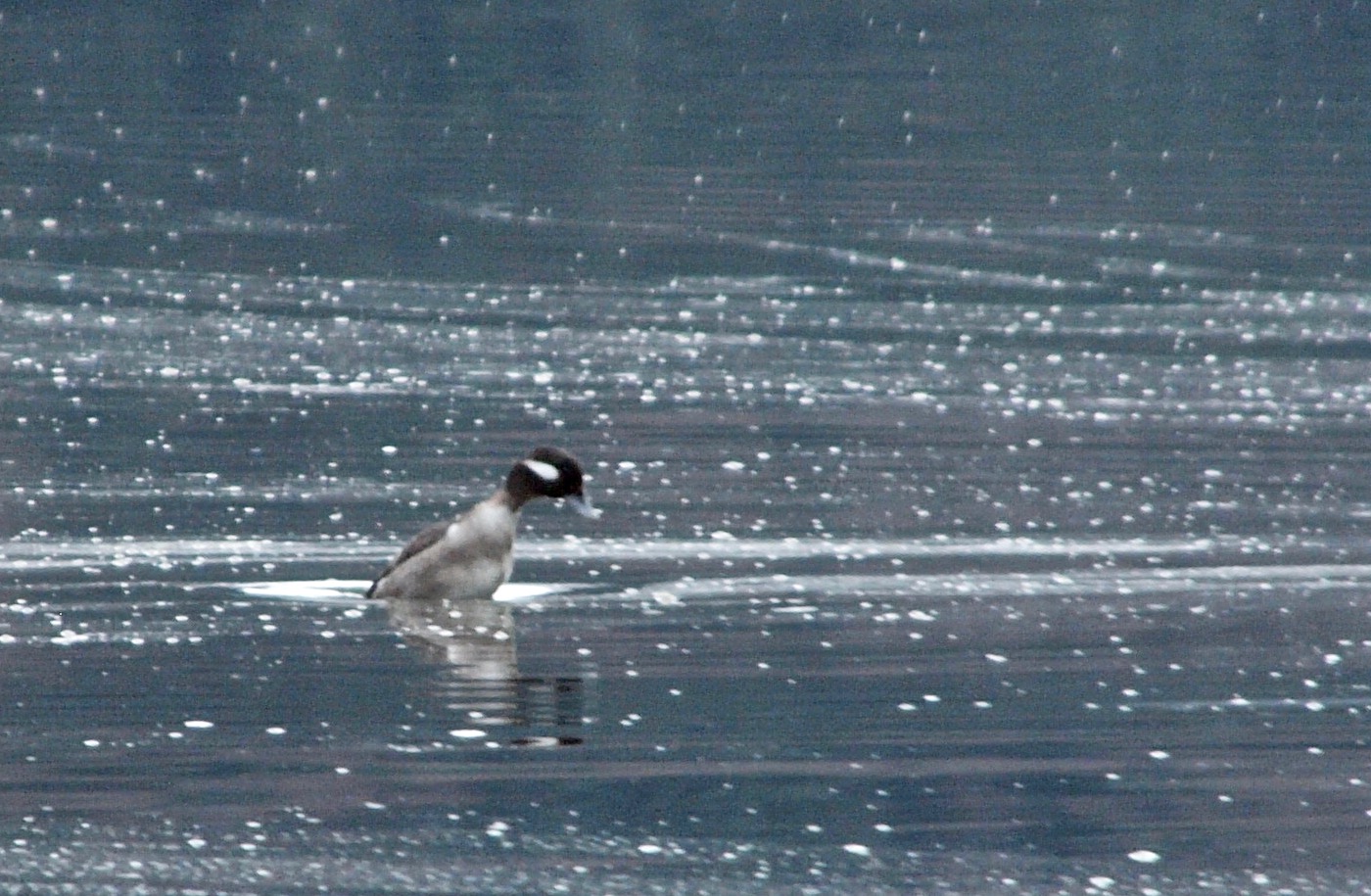
We have just walked down Eagle River and across exposed tidal flats to the canal, passing a drake Bufflehead duck and two hens. The drake did a barrel roll while the ladies watched. The little dog and I have seen ducks plop forward in a dive or plunge their heads straight into the water until their feet and tail feathers are sticking straight into the air. We have never seen one roll over and over while in the water. Is this an innovation spawned by love?
We hadn’t planned on hiking the False Outer Point Trail on this overcast day. But the parking lot for our targeted trail was jammed full of mini-vans. I drive on to the Outer Point trailhead, park, and follow Aki into the old growth forest. Only the blurry song of a varied thrush breaks the silence. As the little dog splashes through streams of water leaking from the beaver dam, I spot three white blobs floating on the far side of pond. A long, white neck rises from the water and I realize that they are trumpeter swans.
I’d like to linger and watch but Aki seems in a hurry to reach the beach. She wins out, as usual, and we both walk quickly to the beach. Only a handful of mallards drift off shore. Low clouds reduce the view of the Chilkat Mountains on the other side of Lynn Canal. Nothing too exciting. At least we saw the swans.
The trail takes us back into the woods and then onto another beach. Here we watch harlequin ducks ride a light swell. In better light we could have made out their bright party colors. I still enjoy watching them dive under the water and pop back up with food.
Aki doesn’t like to linger on the beach so we are soon back in the woods, taking the return trail to the car. The little dog doesn’t object when I turn onto a little-used path that ends up at the beaver pond. The swans are feeding near the beaver dam when we arrive.
There are six swans, not three in the bevy. One stands watch while the other five plunge their long necks under the water in search of food. They don’t seem to notice me squatted down on the beaver dam until another group of hikers arrives. I am not sure if the big birds would have reacted to them if one of the hikers hadn’t tried to do a poor impersonation of a swan honk. The guard swan stares at me until I move up the trail. It had already returned feeding by the time I turn back for one last look. I feel guilty for distracting them, even for a moment, from feeding. They still have a long way to fly before reaching their northern breeding grounds.
When we reach the border of the Treadwell Woods and Sandy Beach Aki leaps onto the sand and charges up to a brace of Bernese mountain dogs. The dogs and their masters are kind so I am not worried. Aki squeals and runs circles around the big dogs trying to entice them into a game of tag. They stand like stunned statutes rather than accept my little poodle-mix’s invitation.
OLYMPUS DIGITAL CAMERA
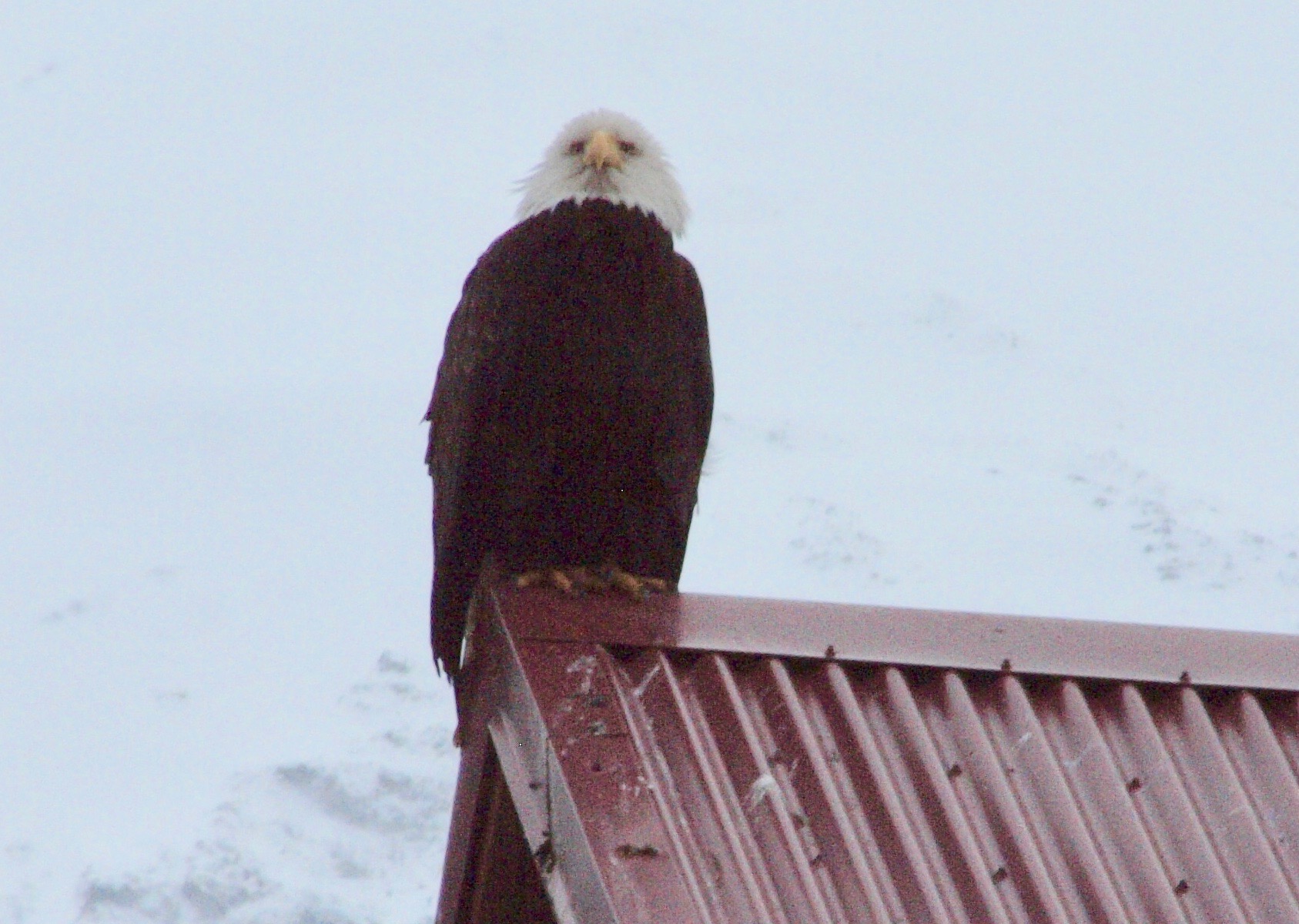
Fifty meters away an adult bald eagle watches the show from atop the old mine ventilation shaft. A minus ebb tide has exposed much of the beach and emptied the little moat that usually isolates the ventilation shaft from the rest of the breach. I expect the eagle to fly off when the little dog and I approach. But it just looks down with apparent distain on its face. Its mate roosts nearby on a barnacle-covered anchor. Even though the anchored bird is more exposed than the one on the ventilation shaft, it shows even less interest in me.
OLYMPUS DIGITAL CAMERA
After watching the eagles for a moment I look down, expecting to see Aki giving me a bored look. The little dog is twenty meters away standing near driftwood that would offer her a hiding place if things went bad with the eagles.
OLYMPUS DIGITAL CAMERA
We walk parallel courses down the beach until forced to return to the woods by the little cove formed by the collapse of a mining tunnel. While watching a golden eye hen launching itself into a dive, Aki appears at my feet. She gives me one of her “you are not going to do something stupid” looks, like she thinks I am going to try to cross the deep cove. No trust, little dog, no trust.
After 17 dry days the rain has returned to Southeast Alaska. You can almost hear the forest sigh with relief. I am doing the same. The rain has washed away a thin layer of glacier silt that covered the downtown streets and sidewalks. The rain may have discouraged other hikers from using the Dredge Lakes trail system. Alone, Aki and I move up a trail that parallels the Mendenhall River. On a clear day the trail offer views of the glacier and surrounding mountains. This morning only a sliver of the river of ice appears above the river.
Thanks to the recent stint of dry weather, a tributary normally too deep for us to cross has been reduced to a trickle. I take advantage and lead the little dog up a side slough to a section of the river we can rarely reach. Today it’s a hang out for mallards and merganser ducks. As we approach they fly off the beach in twos or threes and land a short ways off in the river. Soon the whole raft follows them.
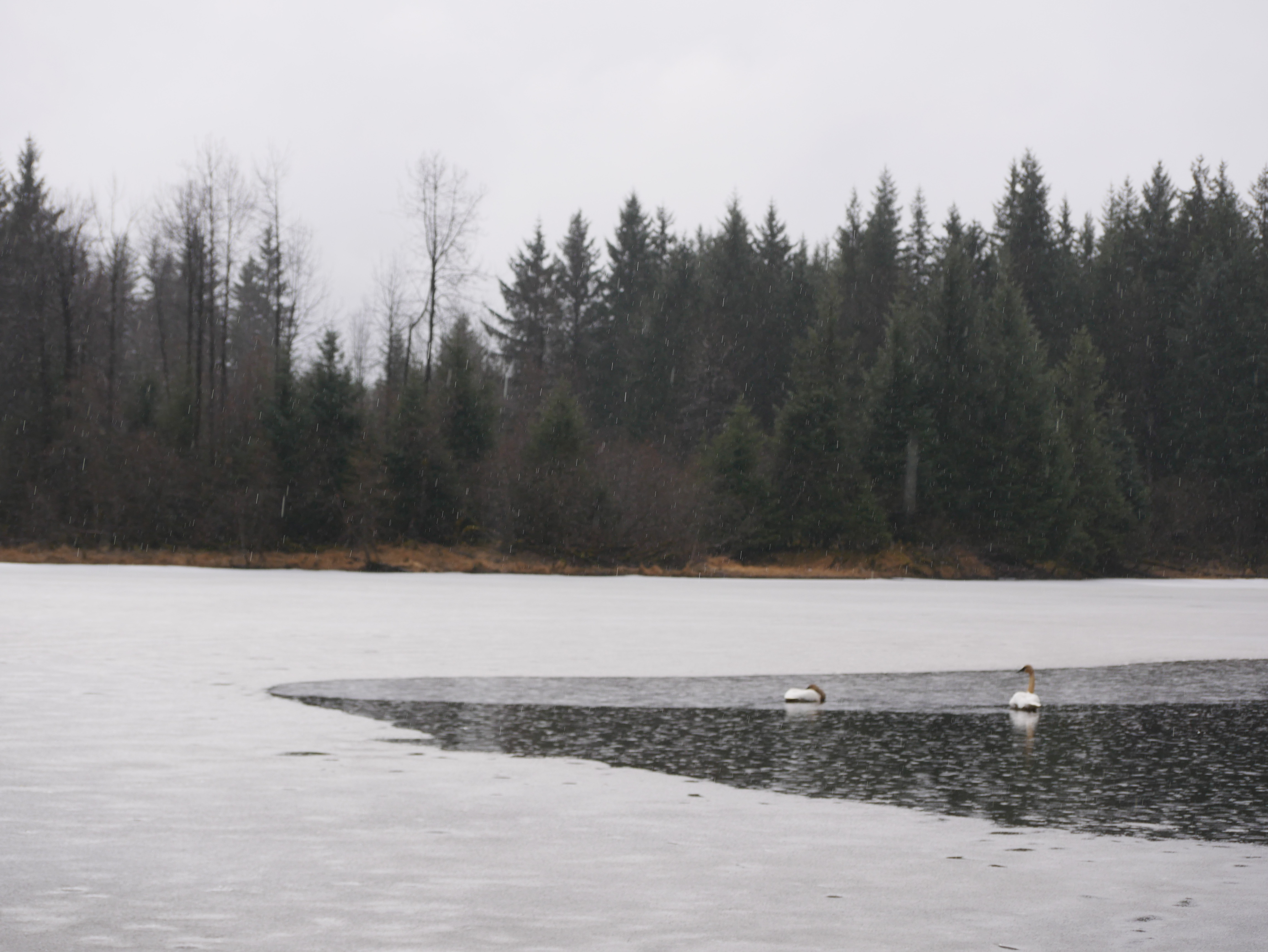
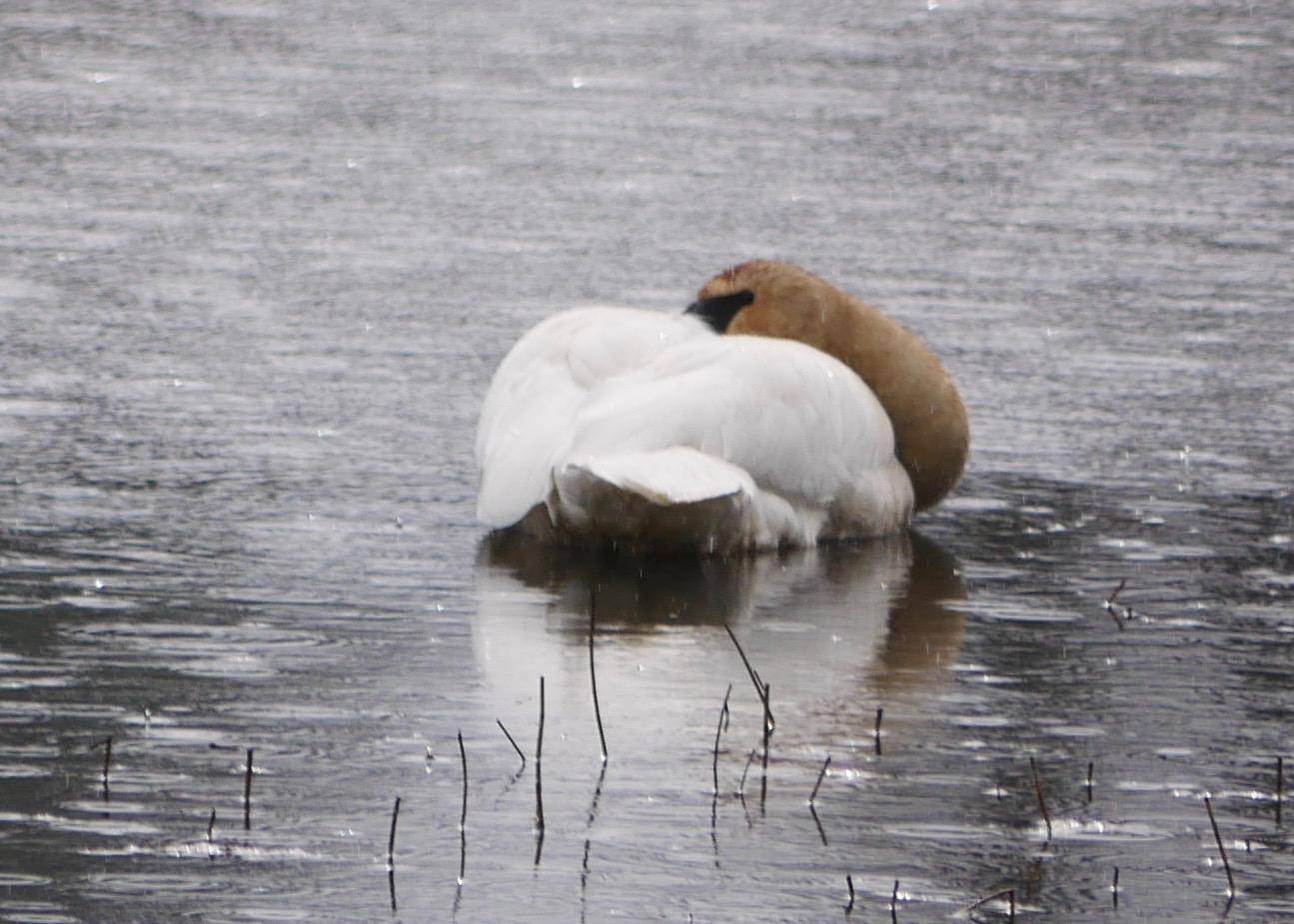
After circling a large beaver den, we cut back through the woods to Moose Lake. While Aki rolls and rubs her face in a soft patch of trail snow I hear a bird with a powerful voice call “ko-hoh.” We move on, after an unsuccessful attempt to locate the caller,and reach the lake. Ice still covers most it. Two trumpeter swans float in a small patch of open water, their long necks stained brown by the muskeg water in which they recently fed. Now they sleep with their black beaks tucked into their back feathers.
One of the swans wakes up when my foot slips on some gravel. It looks at the little dog and me, then resumes its nap. I assume that they have just finished a leg of their northward migration. Now they must rest and feed before resuming their flight to the summer breeding grounds.
Aki and I meet two humans and their three dogs on our walk back to the car. When I mention the swans, they tell me that two swans were feeding on the lake last week. I wonder if our swans are the same birds, still recovering from the long flight or a newly arrived pair.
I feel like Ulysses, Aki—Joyce’s Bloom, not Homer’s hero. The poodle-mix, who has never shown any interest in literature, ignores me. Two rambunctious Labrador retrievers, rather than the Cyclops force us to take a more circuitous route to the mouth of Fish Creek, sending us on an extended odyssey.
Our slow road takes us past a huge beaver dam and around a small, landlocked pond. Two bufflehead ducks and a tiny raft of mallards paddle nervously across the pond’s surface. One of the beavers pops up and crash dives when I look in its direction. Overhead two kingfishers battle for ownership of the pond. The victorious kingfisher roosts on a limb in the grove of dead spruce trees that surround the beaver’s den.
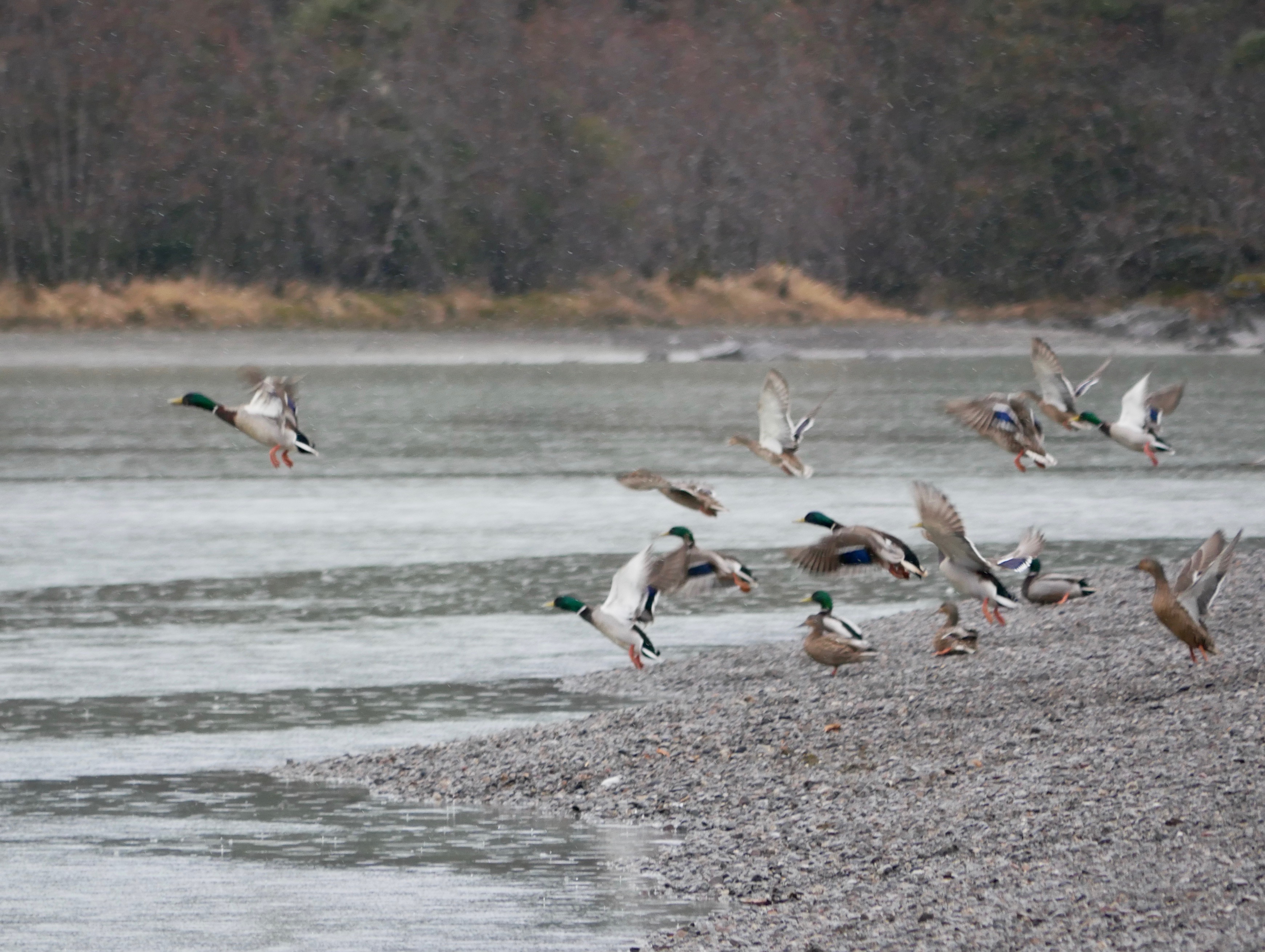
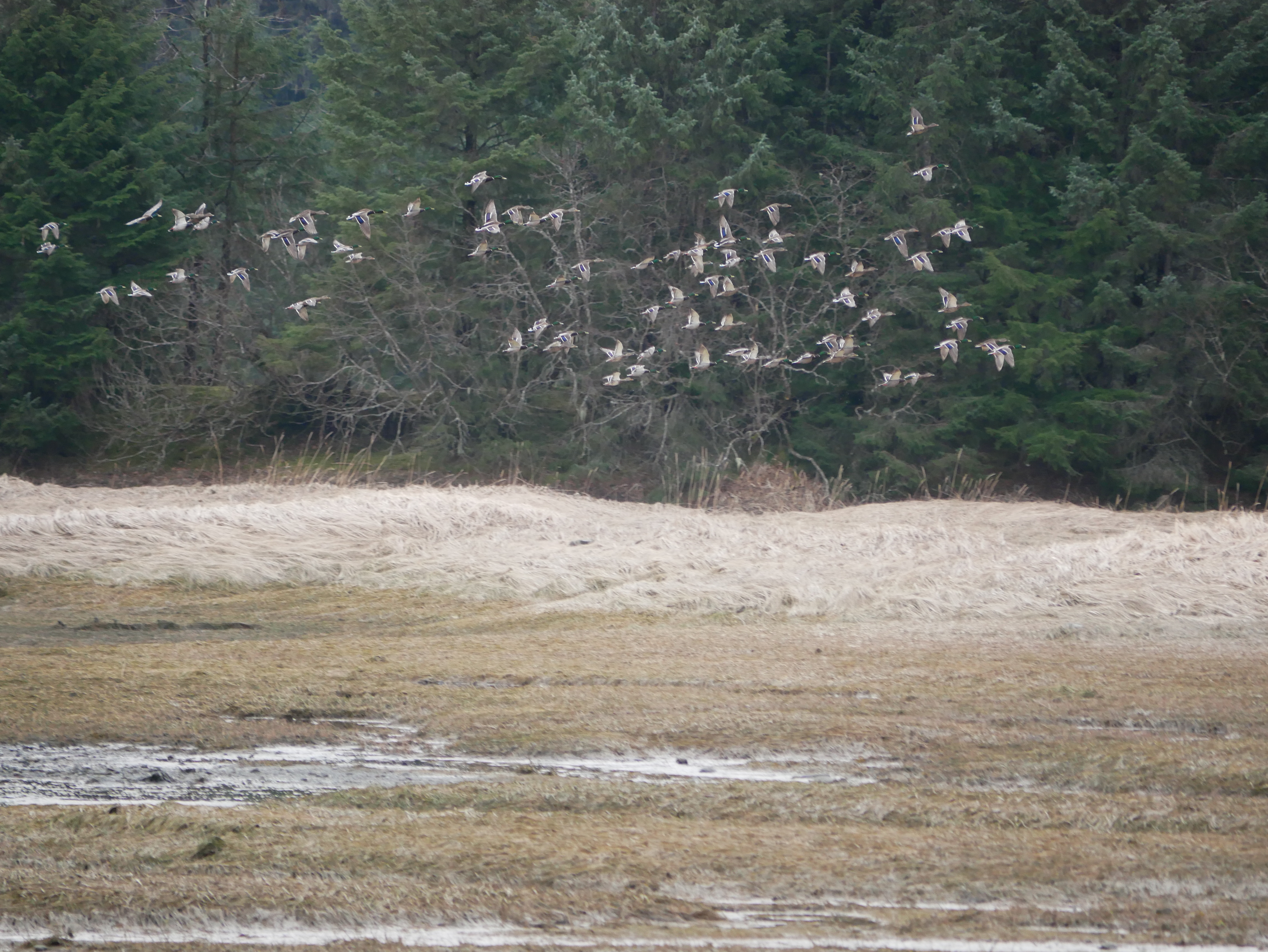
After circumnavigating the kingfisher’s pond, we take the proper path around Fish Creek pond and down to the creek mouth. Hundreds of mallards loaf on the beach and nearby waters. Near the little dog and I, a semipalmated plover darts from rock to rock and then takes flight. Since my attention is on the little plover, I miss an eagle’s attempt to snatch a mallard from the creek mouth. The predator only manages to flush the mallards into flight. In seconds the ducks form a tight cloud that twists and turns in the air over the creek like a school of mackerel. Seconds later, the mallards are back at the creek mouth listening to the eagle’s lament.