
Aki,
Does God
send this rich light
across mountains and seas
to bring us beauty?
Man who fills my bowl,
No,
it crosses the seas
and forces its way
through this thick forest
to sting my eyes.
Aki,
Does God
send this rich light
across mountains and seas
to bring us beauty?
Man who fills my bowl,
No,
it crosses the seas
and forces its way
through this thick forest
to sting my eyes.
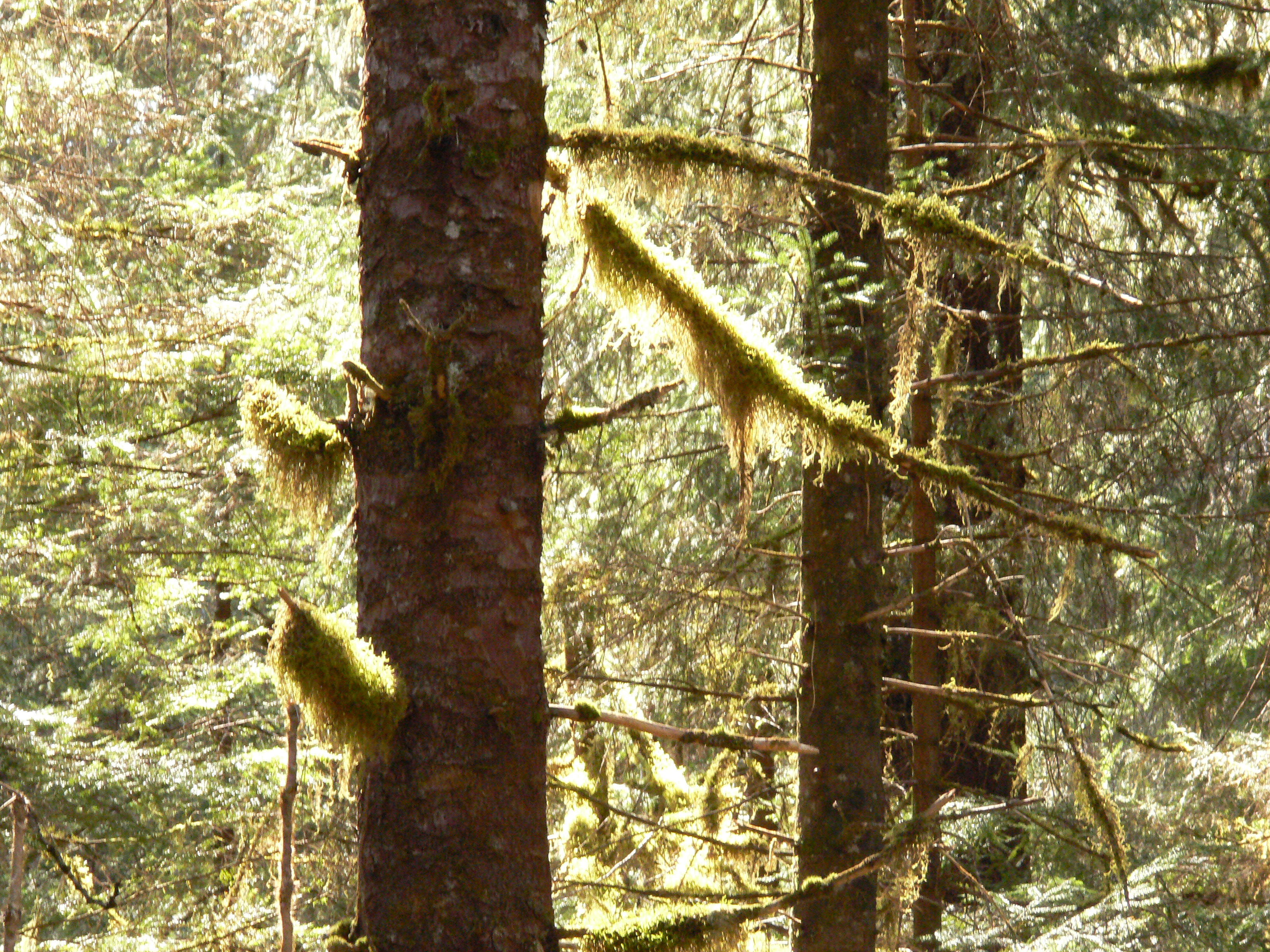
I wanted to write about the moss wrapping trees in the deepest forest with a burning green fire. Backlit by the morning sun, it seemed the most important thing.
Aki and I rediscovered these moss covered trees after abandoning the old river trail. It will soon be made impassible by spreading devil’s club leaves. On this trail, only the river matters with its gravel bars jammed with stacks of drift wood, some whole trees with roots attached. These give evidence of the power of flooding torrents. Such proof is needed today, when the current raises barely a ripple on the river’s surface.
After the moss, came the geese, seen not heard this time, as they searched the river meadowlands for safety. While heading there I was diverted by sun and shadow playing on the still white mountains rising out of the spruce forest. A line of bare branched alders formed an imperfect screen across the base of one peak. Aki and I admire the winter above mix with spring below and return to town. 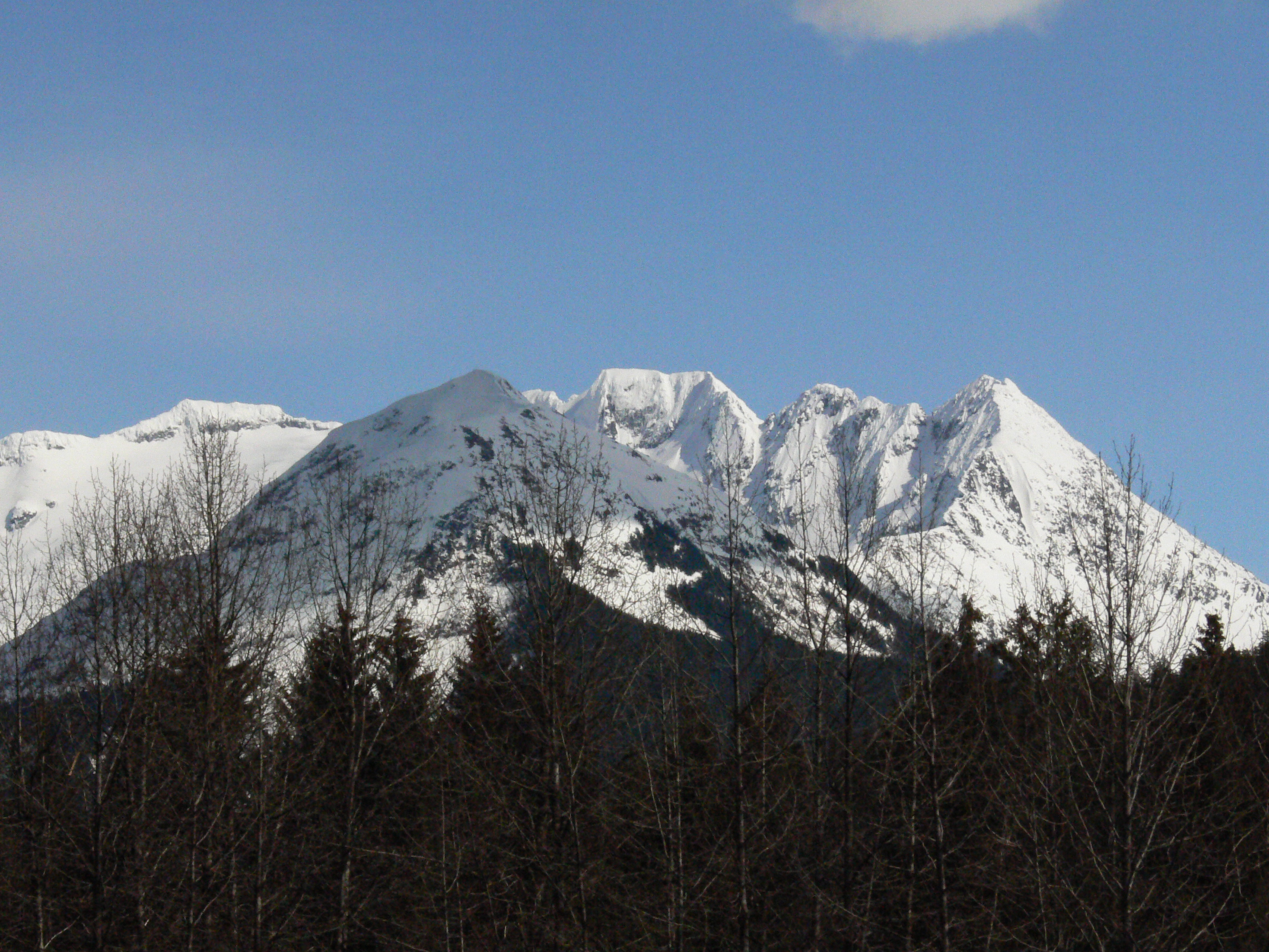
 Aki and I attempt again the ascent to Cropley Lake. This time we bring reinforcements and a map that promises an easier route than the shear wall of snow we faced on our last try. The other human in Aki’s daily life joins us after packing a picnic, which I gladly carry in a day pack.
Keeping Fish Creek on our left we follow the track of a skier that crashed down through this thick forest to the ski area parking lot. He or she had skills for we find no blood on the snow. Near where the trail breaks out onto a rolling mountain meadow we flush a pure white ptarmigan. At this time of year, flushing means stirring the bird into a slow strutting walk.
I think of Bethel friend Franz for together we once hunted these tasty birds from the seats of snow machines. This one looks fat and would probably yield nice stew meat. It also looks beautiful, striking an erect rooster pose, head slight aback to monitor danger.
An hour and half on snow shoes brings up to the lake. The surrounding mountain walls are closer that I remembered. Deep snow still covers all. Hundreds of small avalanche tracks marks the steep mountain walls, promising danger to anyone foolish enough to pass under them.
We had full sun when we started but now dark clouds fill half the sky. The stubborn sun still shines through a sucker hole to fill one of the mountain bowls with pure white light.
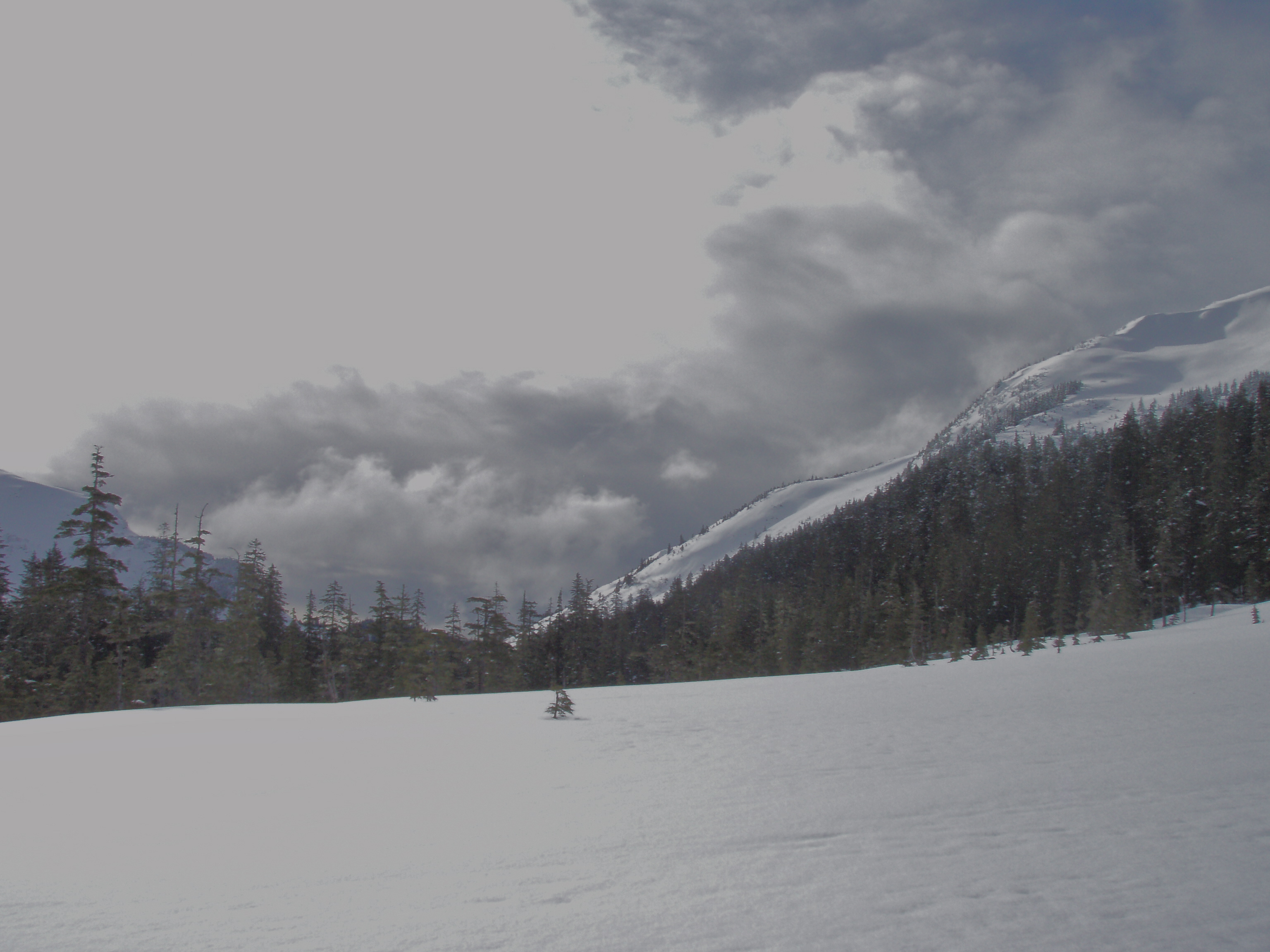
On the trail to Cropley Lake you gain 1000 feet elevation distance before reaching the little cirque. There the forest give way to an alpine meadow bending up the mountain ridge that wraps around the tiny like. Cropley sits as if in the cupped hand of some mountain giant. More than two-thirds of the elevation is gained in the first half mile. We are at that spot when I discovered the absence of my camera. There is nothing for it. We have to go back.
Aki hadn’t minded the steep climb on soft snow but the thought of having to climb it twice on snow shoes near breaks my heart. With hope of finding the camera a few feet away we slip and slide down the slope to the base where the little silver box still lies on the snow.
From here a saddle overlooking Hilda Creek is only a half hour slog across steep ski bowls broken by stripes of spruce forest. The sun escapes from a wall of clouds to send bright light onto the saddle, enticing us away from the steeper Cropley Lake trail.
Sunlight softens the trail to slow our pace but we reach the saddle before it disappears into a dark swirl of storm clouds that even now chokes the Hilda Creek valley below. Aki, who had worn herself off dashing after smells on the wide ski bowls, rests quietly as I take in 360 degrees of mountains shining white in the morning sunshine. All is dark below. Fog fills the Fish Creek valley and Gasteneau Valley to the east as a storm swallows the lower lands to the west.
We don’t often climb to these high places for there is much beauty in the rich forest lands below. But sharing sunlight with a circle of mountains as the rest of world is darkened by clouds is something to savour. Aki shatters the moment by barking toward a nearby ridge, which returns the favor with a mocking echo. She barks again. A echo follows. Bark/Echo/Bark/Echo. Aki and her alpine twin.
Driving through curtains of snow, we find a pocket of good weather at the northern tip of Douglas Island. We also find solitude. Most of the other trail users are pinned down at home by moisture.
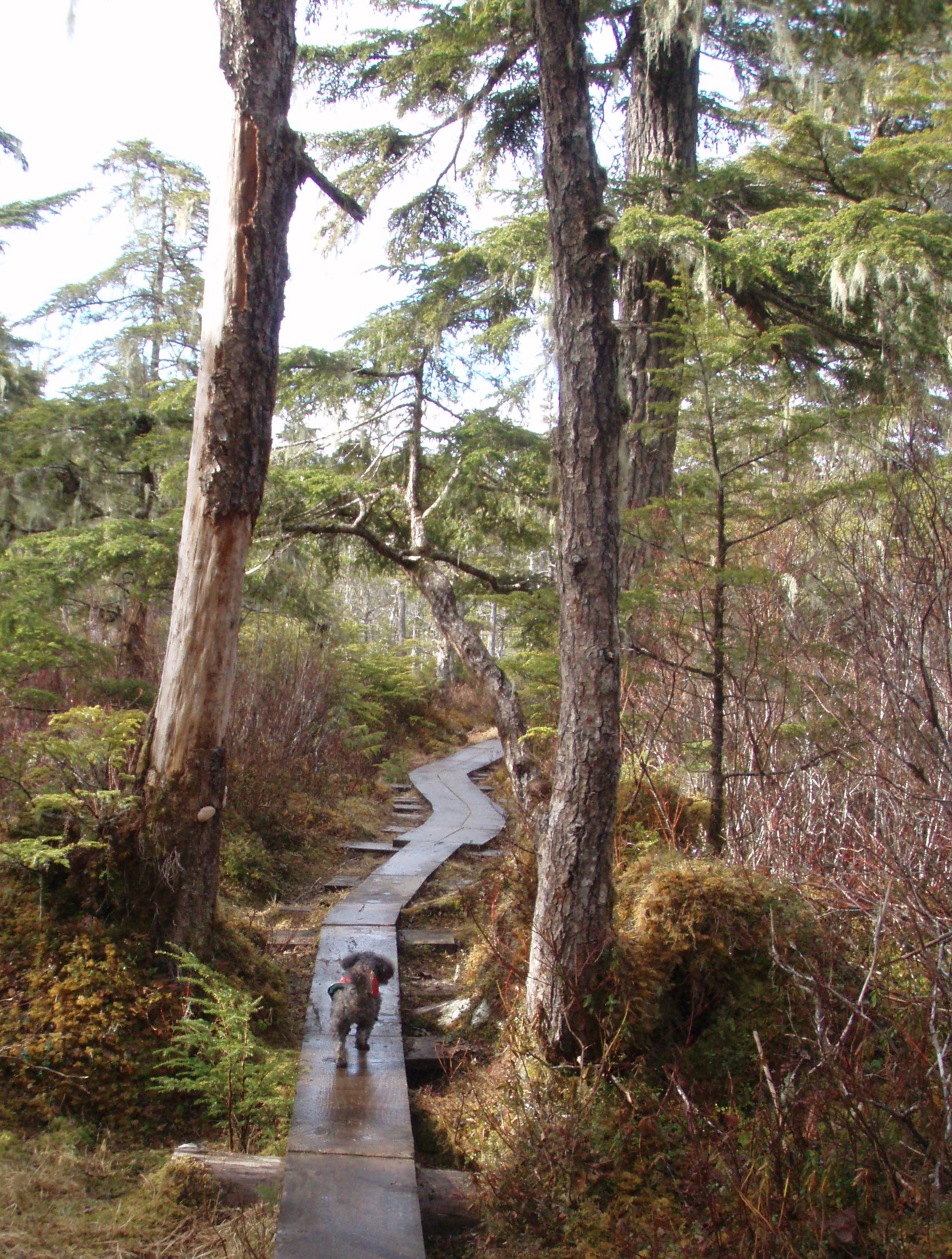
The trail starts off on moist ground where only hardwoods and blue berry bushes thrive. We usually pass quickly this marginal ground and plunge on through the old growth forest to the beach. Today I stop to watch early morning sun backlight Spanish moss and bare blue berry brush, now swollen and red by spring’s upwelling of nutrients. Little sacks of rain clinging to the undersides of moss and branches sparkle with light.
No skunk cabbage shoots break the ground’s surface here. Since these rich yellow green shoots confirm the presence of true spring we hurry down the trial to a bog usually full of them. This pleases Aki, who enjoys movement through the mossy woods above all things. I enjoy the way her ears flop out a rhythm when she runs.
Snow and ice still cover most of the bog’s surface. The rest is mud except from two skunk cabbage shoots with blacked tips. They misjudged the change of seasons and unfurled their leaves during the last false spring. All summer their misshapen leaves will mark them as fools or brave pioneers. Always a thin line there.
I don’t expect great beauty on this moist grey day. The remnants of a Bering Sea storm threw a mix of rain and snow against our house all night. This morning it’s just steady rain on Chicken Ridge and out near the glacier, gentle spring snow falls.
I don’t expect beauty for clouds obscure glacier and peaks and what snow that’s left is darkened by the detritus of winter. A howl, pitched several octaves too high for a wolf repeats over and over as we pass into the thicker forest. When it stops I ask, “Aki, are the best poems written with a knife rather than a pen?” She pees in response. Perhaps I should invite a human along next time.
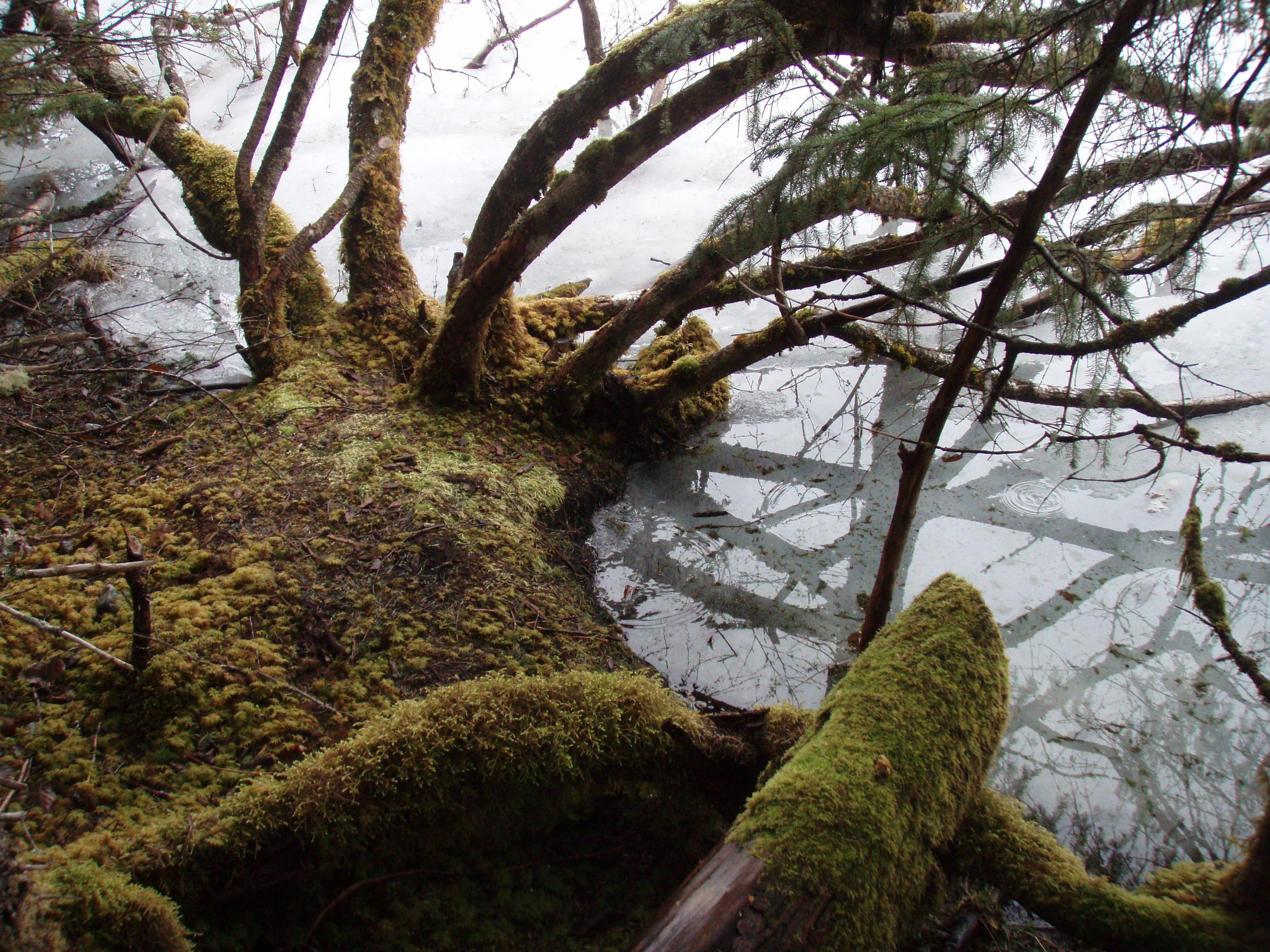
One bird’s song reaches us across a cashew shaped lake. It’s our the first true song of spring this year. Beneath the unseen soloist’s perch we find a beauty of unexpected richness. Ugly things have combined here to form loveliness: old ice, winter bare branches, rotting logs being devoured by moss, all reflected in melt water.
Later we find the track of a wolf and then of a deer. The deer just passed into the woods but I can’t see her.
Near where I parked the car, we break out of the woods onto a bike path where a man with his infant son is about to ride by. The child sits on a carrier fastened cleverly to the bike’s handlebars so he can share with his father in real time. I pick up Aki and hear the father say, look that man is warming his dog. The child looks up with wonder as if his father has conjured us up for his entertainment. They ride on, chattering with love, until lost behind a wet wall of snow flakes.
On this wet windy afternoon we find an almost empty parking lot at the trail head. In minutes we pass the only other people on the trail heading back to the their car. Aki has to content her self with the smells of animals that have gone before while the two humans in her life concentrate on safe passage of the icy trail.
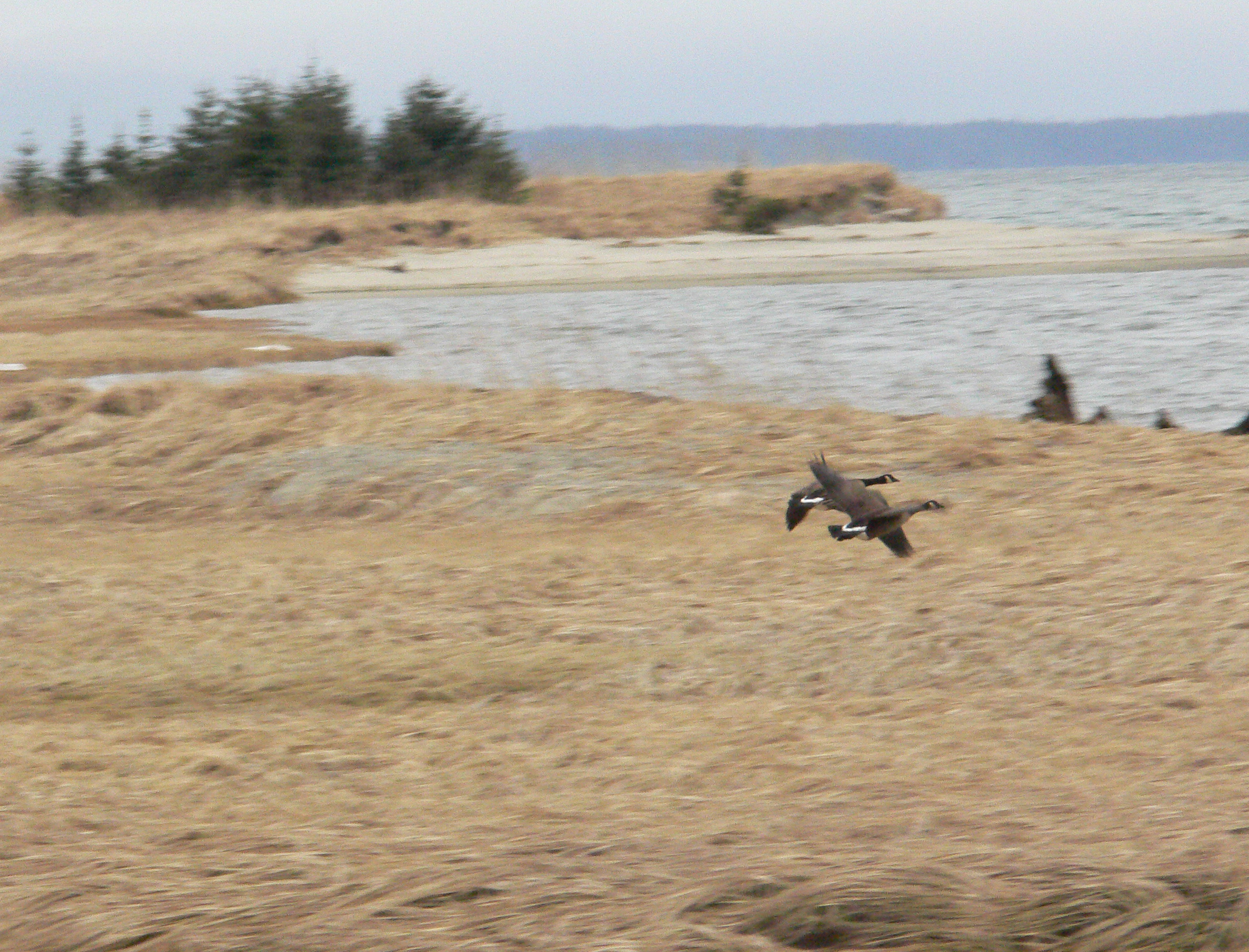
There are sounds; the river gorged by a rising tide and winter wren song — a long monochromatic trill blown by an unskilled bosun. We see robins but they are too busy gathering nest material to sing. Nearer the beach, a nervous mass of Canada geese honk loud warnings across the river to each other that reach us when still in the woods. We watch then gather into tight groups on a dead tidal meadow and then, for no apparent reason, burst by twos into the air.
To her credit Aki ignores the geese and presses her paws into the back of my legs when I take too long framing a photograph of the big birds. Comical on the ground, the geese can overload your heart with beauty when in flight. I’d watch for hours but for Aki’s impatience and the biting wind. Seeking the shelter of a nearby second growth forest, we find a dark windless corridor of green leading to the beach. When the forest opens into a snowy meadow Aki crisscrosses it with tracks as she dances after her orange frisbee to the non-ending chorus of geese song.
We reach the beach where two kingfishers scold us from an overhanging tree. On this chilled grey day the belted birds are one of the few promises of true spring.

Something like spring arrived last weekend bringing warm sunny days that softened the snow on this long meadow. A three day rain storm followed to wash much of it away. Today I’m left with an unstable snow machine track for skiing. Last year winter held on to the meadow until Mid-April to offer fine days of skiing. Tomorrow I either head for mountain trails or hang up the skis.
How can I break it to Aki, who is sitting out this trip? She who loves any expanse of snow. She’d be soaked by now on this thawing trail. That would not stop her from checking out these fresh tracks of a newly risen bear. I appreciate Aki’s absence when spotting my first robin of the season. Oh why don’t you sing plump bird with red breast? it won’t be true spring until you do.

Two rectangular towers rise at the edge of Douglas’ Sandy Beach. Islands during high tide, these silent campaniles once provided air for men working the long tunnels of gold that ran beneath Gasteneau Channel. That was before April 1917, when a big spring tide broke through and flooded the mine.
Two thousand men worked the mine, owned by John Treadwell. None of them died in the collapse. The mine once fed 900 stamp mines that ran 24 hours of day, reducing gold bearing ore to useable rubble. What wasn’t smelted was spread to form Sandy Beach.
Stamp mill noise filled the air of Treadwell town where his 2000 miners lived. Today the house lined streets of Douglas and an alder forest have all but erased Treadwell. Aki and I are wandering the ruins.
We expect to find these cast iron ruins — this ore car marooned in an alder grove and a large electric motor emerging from snow. The thick timber walls of the old stamp mill are a surprise. Even today they resist their still living cousins’ attempts to colonize.
Aki finds little of interest but I indulge a fascination, made worse by imagination, with well made machinery. What giant dropped this ore car so far from a place it could be used? Did this huge iron gear fall from his watch when he smashed it on Mt. Jumbo?
There are no giants here or even rabbits to grab Aki’s interest. We only find birds singing in an alder forest scattered with ruins.

Aki is spending the weekend with friend Zoe so the human couple in her life grabed an early ferry for Skagway, Juneau’s closest portal on to the North American road system. From there we drive up the dramatic White Pass and stop for a ski near the Yukon/British Columbia border.
The road took us past avalanche zones that recently deposited great amounts of snow on the highway. The “Do Not Stop Avalanche Zone” signs confirm that it may soon happen again.
It’s above freezing and sunny when we climb into the skis and cross the White Pass Railway right of way to a ski trail undulating through a Lodgepole Pine forest. Plaster white mountain domes appear above the forest on every horizon.
We turn back after reaching a long flat valley seasoned with scattered pines. It reminds me of Juneau’s own high pine meadows, framed as they are with rugged white mountains.
Skiing farther would take us to the ruins of the winter community formed by the thosands of men that rushed to the Klondike gold fields over one hundred years ago. After hauling thousands of pounds over the Chilcoot Pass they spent the winter of 1898 here sawing Ponderosa Pines like these into rough lumber for rafts or boats. When the ice broke on nearby Lake Bennett they loaded a year’s worth of gear into makeshift vessels and floated down to the Yukon River and then on to the Dawson.
From this meadow’s edge in 98 we could have heard these anxious men struggle with axe and whip saw. Today it is all a sun drenched snowy silence

