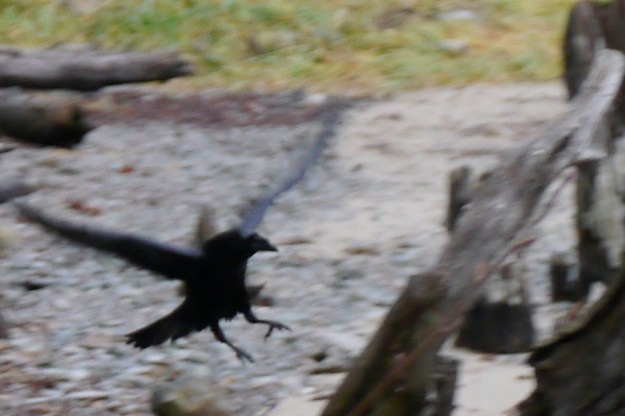
Like the ravens that are hunting for carrion on Sandy Beach, I am attracted by rotting things in the Treadwell woods, the corrosion eaten cast iron survivors of the Mexican Mine and deteriorating yellow and brown devil’s club leaves.

Like the ravens that are hunting for carrion on Sandy Beach, I am attracted by rotting things in the Treadwell woods, the corrosion eaten cast iron survivors of the Mexican Mine and deteriorating yellow and brown devil’s club leaves.

A raven, feathers fluffed up against the cold rain, stands exposed on a Gold Street light post. The pole has been scared so many times by climbing utility men that it looks as scruffy as the raven. I risk rain spattering my glasses to take several pictures of the bedraggled bird, wishing I had disabled the camera’s feature that announces each shutter snap with a beep. Raven stops preening itself and lets out a series of sounds that mimic my camera’s annoying beep.

Aki drags me towards Gastineau Street. She is on fire to check out something carried on the wind. She remains engaged during the rest of the walk, taking extra care when patrolling the field of food shacks near the docks that are now closed for the season. While she searches the plot recently occupied by Little Manila, I try to photograph a sculpture of raven partially obscured by reddish maple leaves. Even though this raven is just a line drawing rendered in ribboned steel, then bolted to a parking garage, I wait for it to imitate the sound of someone welding together pieces of the new cruise ship dock.
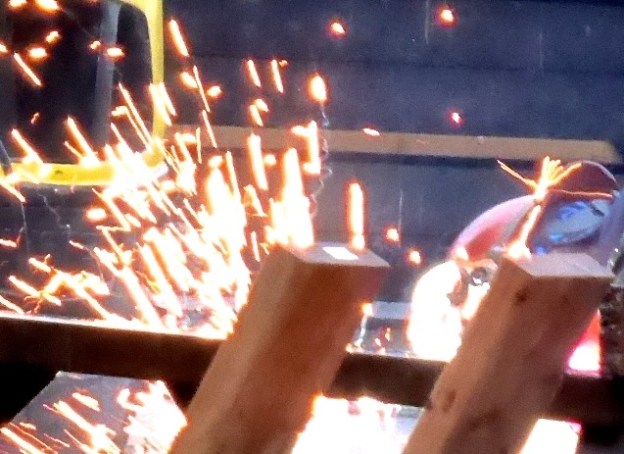
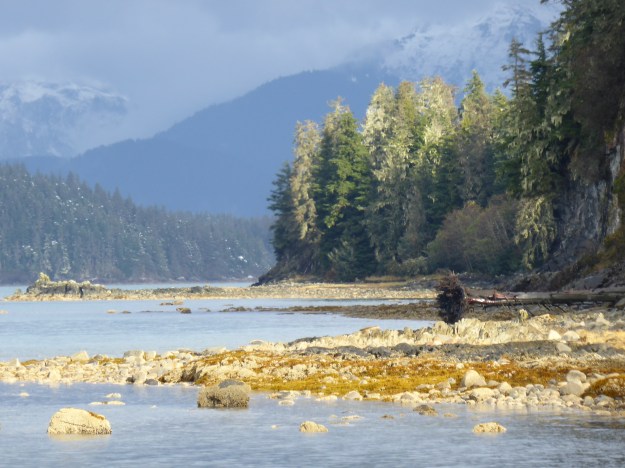
Photo bombed by Leaf
Last weekend’s snow caught out the berry bushes along Outer Point Trail. This morning some, weighed down with snow, partially block our way to the beach. Seeing crisp, green leaves entombed in frozen snow and the oranges and yellows of turning foliage emerging through cold, white clumps, I wonder if nature is struggling to adapt to our changing climate.

Aki stops to sniff at a fresh set of deer tracks when sunlight suddenly brightens the muskeg meadow we pass through. It also reaches out into Lynn Canal, exciting a rainbow into existence. The bow arcs over Shaman Island and ends in a wall of gray clouds. Back home I will question ever seeing the rainbow as it appears as a faint smear of colors in the photos I took of the island.

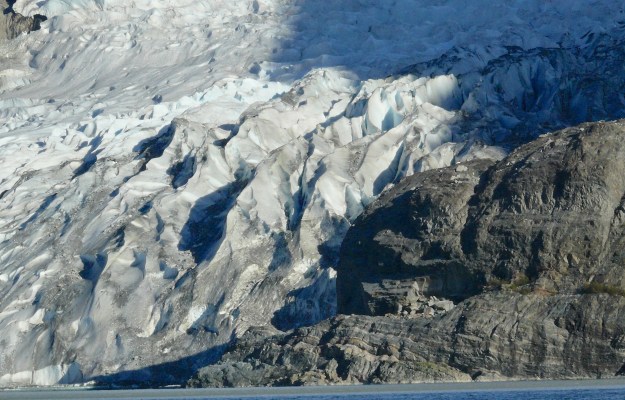
We find the other end of the rainbow when I stop on the way home to wrack seaweed at the North Douglas Island boat ramp. It slices across the face of Mendenhall Glacier and into Fritz Cove. I remember God’s promise to Noah never again to inundate the world with water. The recent accords on climate change may help God keep his promise. But even through the rainbow, I can see evidence of the glacier’s melting retreat.

October snows drive some Alaskans south to the sun belt. Others retrieve their skis from storage. Either way, these first snows have power and if you believe, magic. Aki acts like a believer. This morning she patrols the Sheep Creek delta during a shower of wet October snow.
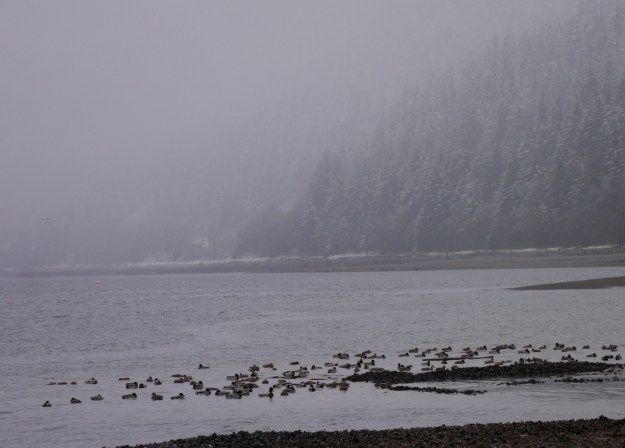
I should have taken the little dog to a mountain meadow where five inches of white must cover the ground. She loves to slide her face through soft snow, emerging with the same blissful smile she displays while rolling in beaver scent or bear poo. But last night’s high tide has washed the delta clean of snow. She makes do with scents left on a few patches of high ground by passing dogs.
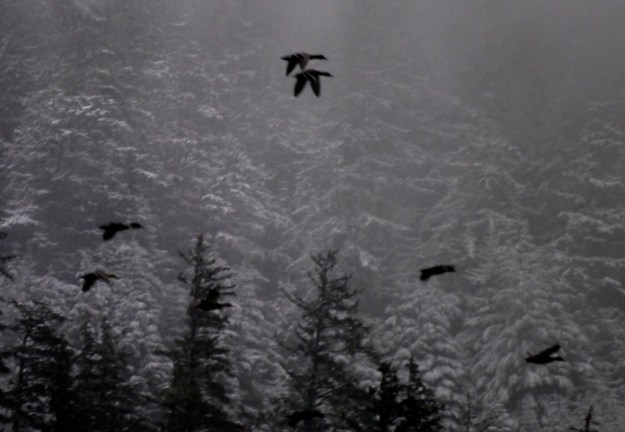
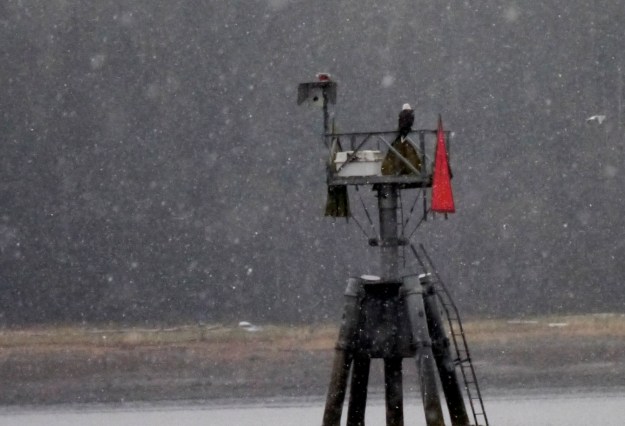
On a channel marker, a bald eagle stares through the snow at Douglas Island. Behind her a large raft of mallards crowds against the shore while a seal prowls nearby waters. The seal has no chance of duck for breakfast but it still watches for an opportunity. Aki and I walk towards the creek mouth where another raft of ducks hunt for food. When the sky behind us fills with mallards, I look for the dog walker that must have spooked them. But the beach is empty so the seal must have made a play.
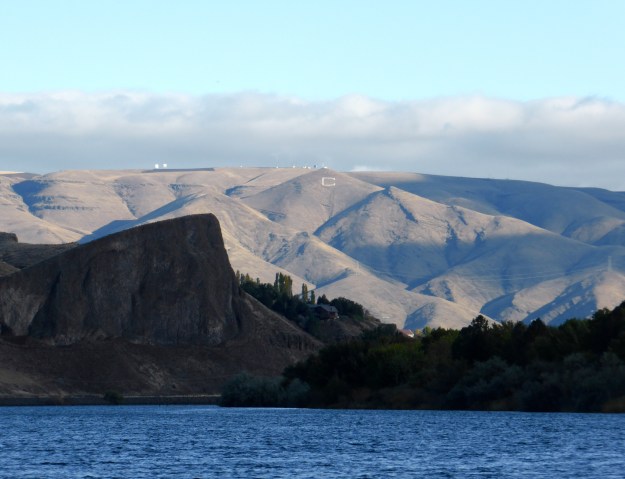
I’ve just returned from a week visiting family in a semi-arid section of Northern Idaho. It’s usually a place rich in sun, where the Snake River and its tributaries irrigate farms and provide a course home for salmon. The Snake ran high but it rained off and on during the visit. Meanwhile, Aki enjoyed a rare string of crisp, sunny days in Juneau. Now I’m back in the rain forest and it’s snowing.
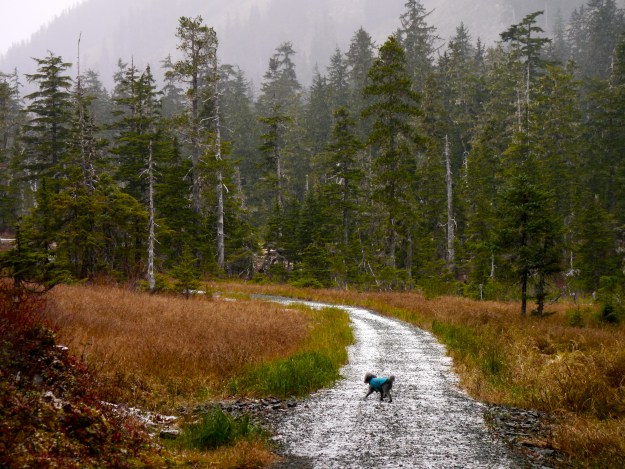
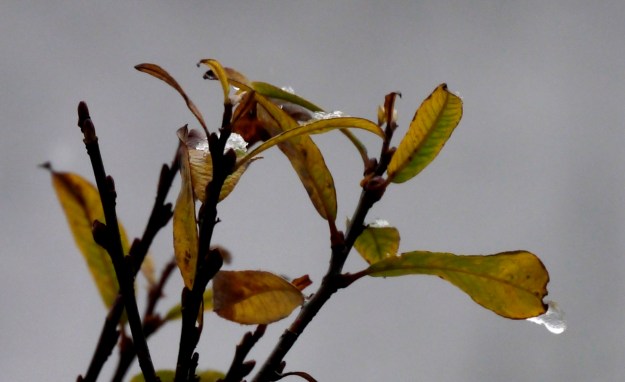
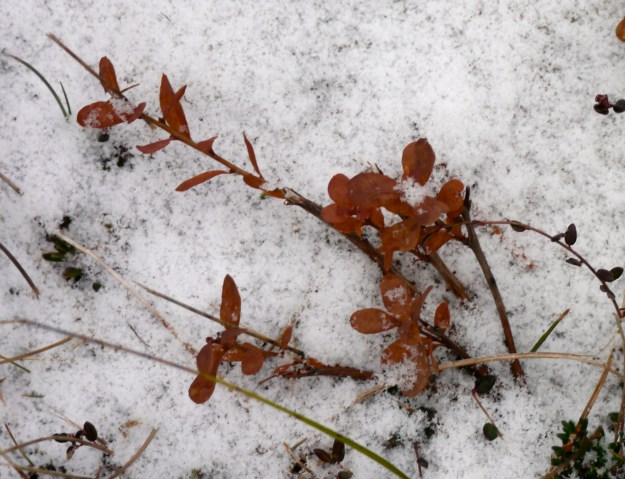
In Idaho the rain cleansed the sky so that sunny mornings after a storm had a rich, Mediterranean light. In Juneau, the snow softens hard lines. The little dog and I check out a string of mountain meadows and find plants already surrendered to winter and others that still put up a fight. The leaves of most of the skunk cabbages lay limp and brown on the muskeg, providing a place for snow to drift. But, several of the plants have sent out spikes of new growth. Stranger are the ponds. Some remain ice-free while the lily pads in others lie trapped in new ice. An inch and a half of ice covers one pond. The muskeg is firm near the icy ponds and summer-soft around the others.

There are winners and losers on these meadows. Obvious losers include the trapped lily pads and few skunk cabbage plants that squandered the energy stored for next spring on doomed new growth. Those plants with leafless skeletons, like the mountain blueberries, have won.

One bridge connects Douglas Island to the town of Juneau. Aki and I stand on it, looking down on a life-sized bronze sculpture of a humpback whale. It’s bolted to a cement slab in the city’s construction yard. As Aki fidgets, I struggle to frame a photo of the whale that won’t feature stacks of scaffolding or a truck-mounted crane. Some day, the whale will breach from the center of an infinity pool nestled in a landscaped park. Tourists will walk the mile or so from their cruise ships to see the whale. But now, only trespassers on city property may close on it.
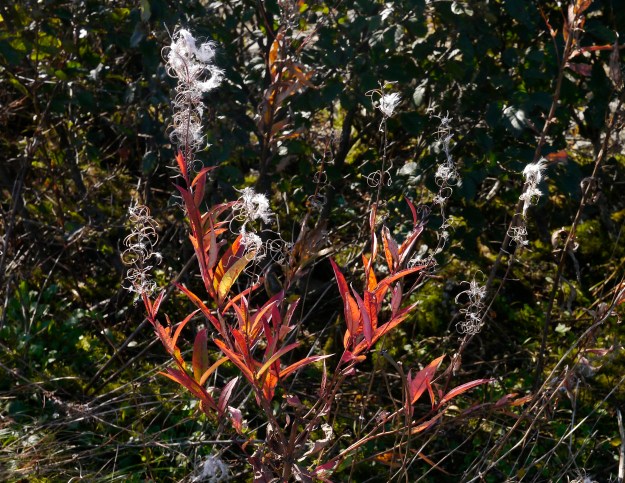
The whale looks beautiful, which is not surprising on this bright day, the kind you’d expect in sun-blessed places like Albuquerque but not in a rain forest town. The strong sun makes vivid the colors of plants in the throws of autumn die-back. Even the truck-mounted crane has some beauty.
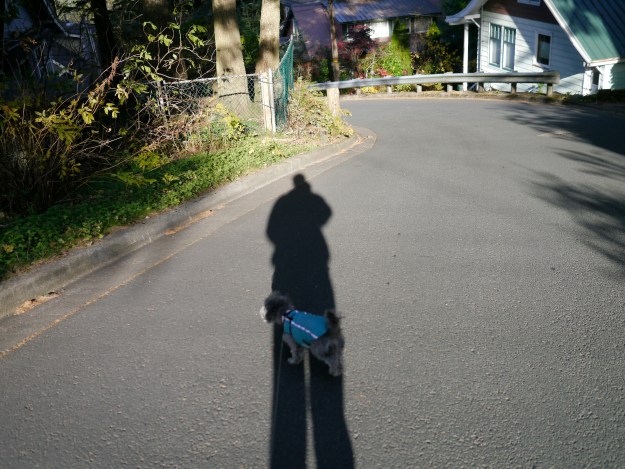
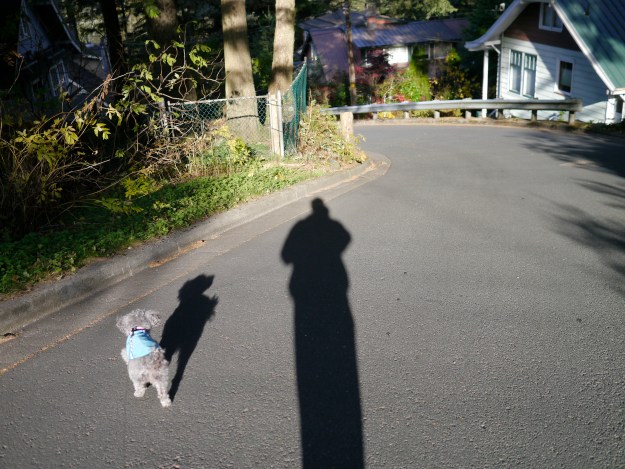
I start taking pictures of Aki and my shadows until the little dog parks herself on top of mine. Is she seeking comfort, shade or control? I wonder before she breaks for squirrel.
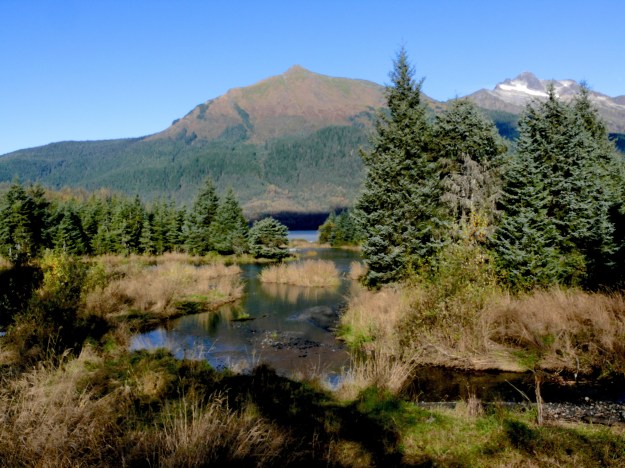
Aki runs along Mendenhall Lake like something is chasing her. I look for an enemy but only see crisp alder leaves cart-wheeling past her. Then I realize that she is chasing the leaves.
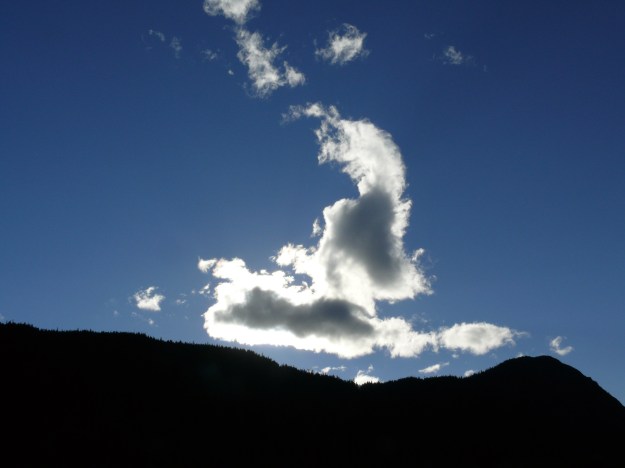
It’s a sunny day but we are in the shade of a small cloud that has taken control of the sun. Each time it changes form, the cloud directs a spotlight on a different section of the moraine. The cloud isn’t big enough to keep the sun from illuminating the glacier and Mts. McGinnis and Stroller White. But it manages to tantalize me with shafts of light that hit patches of yellow-leafed willows, Nugget Falls or a small iceberg. The light shifts each time I try to focus the camera.
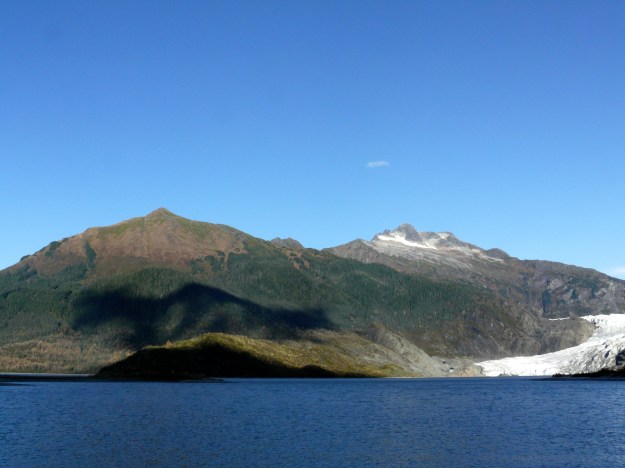
Finally I figure it out. The cloud is my tricky teacher. After learning its lesson, I put away the camera and watch the light show, and the crisp shadows the cloud throws on the mountains.
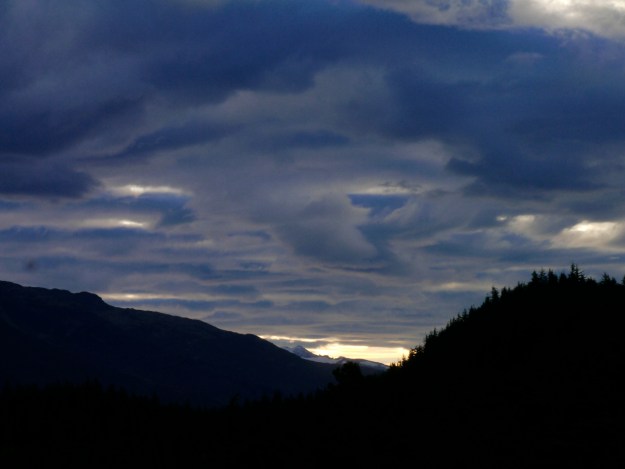
We’re climbing the short gravel road that leads Gastineau Meadows. It’s past eight in the morning but sunrise colors still show through a lamb’s wool sky. Short, but intense wind gusts rattle through the remaining alder leaves and hit Aki in her tail section. The little dog drops her rear and looks over her shoulder.
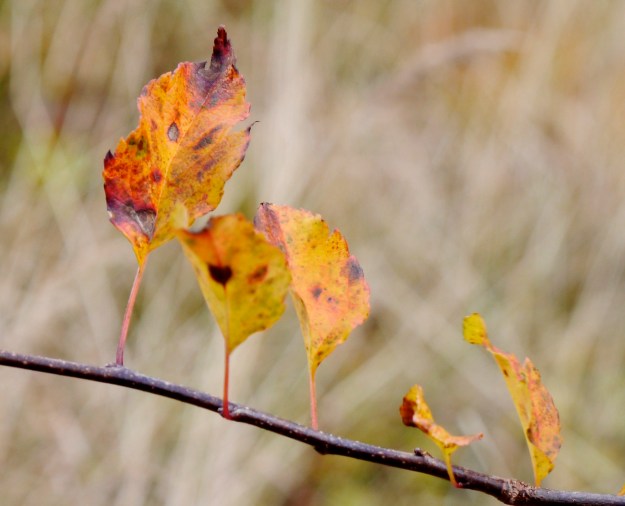
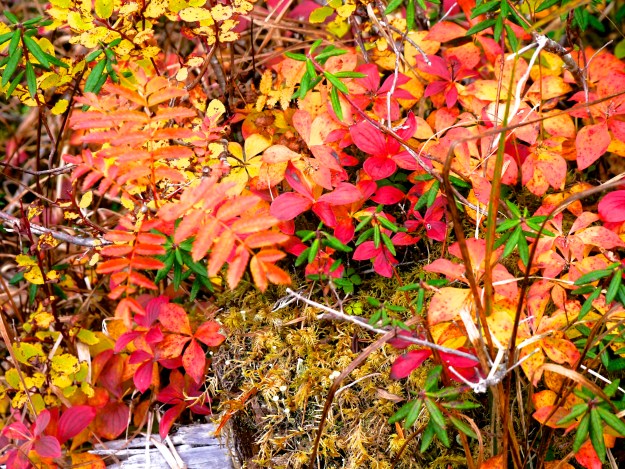
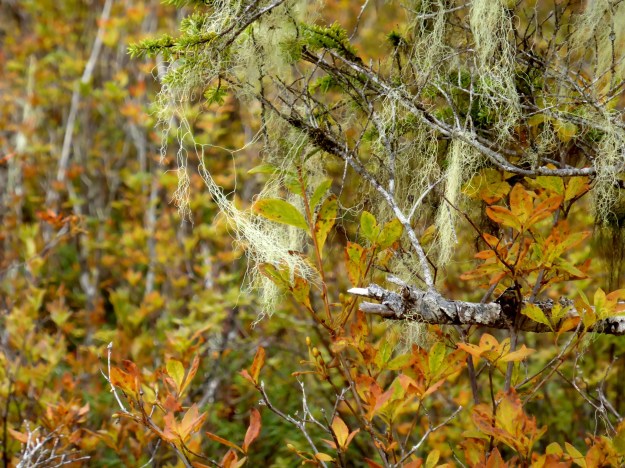
Climate change hasn’t managed to slow the sun’s yearly retreat from the north but it might be extending the meadow’s displays of fall color. Colonies of red sorrel plants circle the bases of dying bull pine trees. Dogwood, wild crabapple, and Sitka mountain ash leaves are patterned with of yellows, reds, and browns. I dawdle, hoping for sunshine to break through the marine layer to enrich the show. But Aki, who left the house before breakfast, throws me the stink eye.
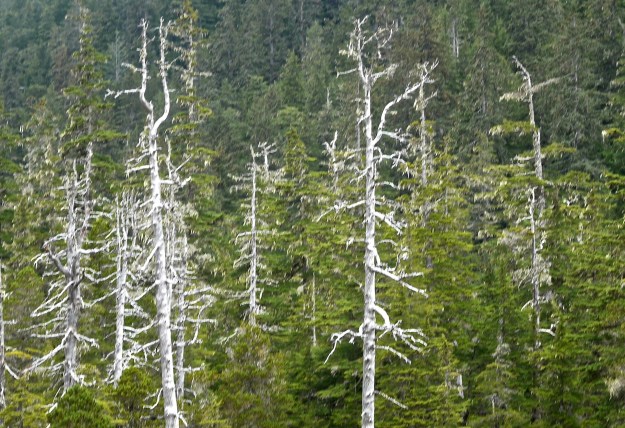
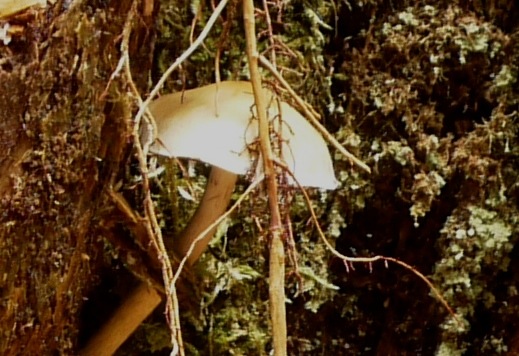
It’s Election Day in Juneau. Aki, who didn’t vote, trots down a mountain meadow trail with an “I exercised by right to vote” sticker on her head. It seems to have made her intolerant. When I stop to photograph mushrooms on a tree trunk, she whines. When I try to lead her onto the Treadwell Ditch Trail, she hesitates. When I try to engage her in a discussion about beauty, the little dog looks bored. I ignore her mood and point to a wall of dead-white hemlock snags and say, “Bugs, rain, and wind have stripped these old trees bare and they still have more beauty than the live ones that surround them.” Aki turns away, not prepared to admit that when alive, the trees’ sparse foliage hid their lovely shapes.
Aki, her other human, and I are on a gathering trip. We drive out to False Outer Point beach to fill five gallon buckets with rockweed (Bladder Wrack) for covering our garden’s perennials. The little dog chases her Frisbee as her humans fill the buckets. She should be safe as the beach is off the roadway and far from any bears.
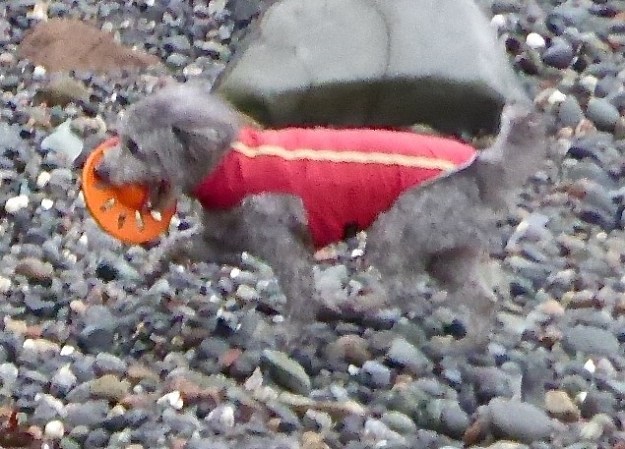 With head down, I grab clumps of the burnt sienna-colored rockweed, shake out any pebbles or sticks, and drop the handfuls into a bucket. Aki interrupts often with demands that I throw her Frisbee. Without looking up I toss it toward the water and return to work. When I take a break to stretch, three bald eagles are flying low over the beach from where, seconds earlier, Aki retrieved her Frisbee. Maybe the big birds dove on a washed-up salmon carcass. Maybe they want to chase the Frisbee. Maybe they want to see how a ten-pound poodle tastes.

We move quickly to fill the remaining buckets and haul them to the car. In minutes we start phase two—lingonberry picking. Many years before Aki, we lived in a tundra town in Western Alaska. Each autumn, we’d pick gallons of lingonberries for jams, bake goods, liqueur, and only once—catsup. The plants grow here in the rainforest but until this year, we have rarely seen them produce berries. Last week I stumbled on this muskeg meadow with clumps of wine-red berries pulling their diminutive plants into meadow moss. The hard little spheres plunk when they hit the bottom of my berry bucket—a cut down, half-gallon soy sauce container. After an hour of picking the plunking stops as berries already in the bucket cushion the newly harvested ones.

Picking the low growing berries keeps out noses near the fragrant ground where we can smell the spicy smell of Labrador tea. Biting into a lingonberry releases the same smell, whether harvested on a rainforest bog meadow or on the tundra. None of the rain forest blue berries taste like a tundra berry. But the lingonberries we harvest today deliver the same flavor and smell as those I remember harvesting from a Kuskokwim River bluff after the first frost.

