Category Archives: rain

Ravens in the Rain

1

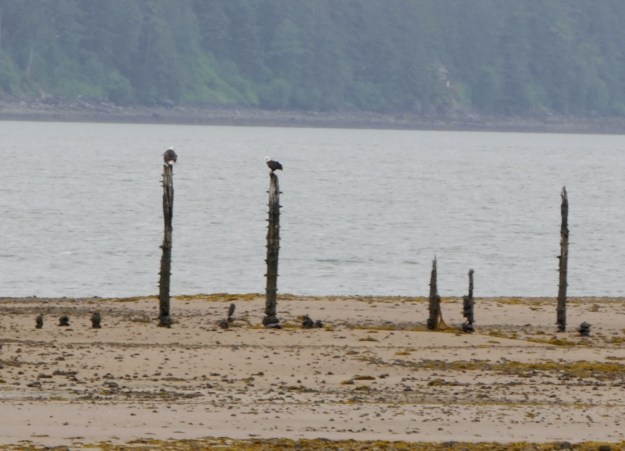
Rain or boredom seems to have depressed the Treadwell eagles this morning. Even though it is low tide and therefore the best time to find food or carrion, two mature bald eagles are glued to the tops of splintered pilings. Two more hunker on the beach near the water. The inclement weather doesn’t seem to have bothered the ravens. They fly back and forth over the glory hole, harassing first the piling plunked eagles and then returning to the beach occupied by those squatting on the sand.2

Aki finds a cache of dog kibble that has been sprinkled on the top of a foot-high piling. Someone, perhaps the sprinkler, placed a flat stone over the kibble but Aki manages to tongue out a morsels before I convince her to stop. Two ravens land on nearby pilings to watch. I have little doubt that they will have the stone off and the kibble down their beaks before we make it back to the car.3

Laughton Glacier


6It’s the last day of writer’s school in Skagway. Students and teachers, including Paul Theroux are in a White Pass narrow gauge railway carriage that rattles toward the Laughton Glacier trailhead. The conductor has stuffed all the writers into one carriage where the sound of thirty or forty conversations competes with the grumbles of the old carriage and the disembodied voice of a tour guide giving the railroad’s history.  5
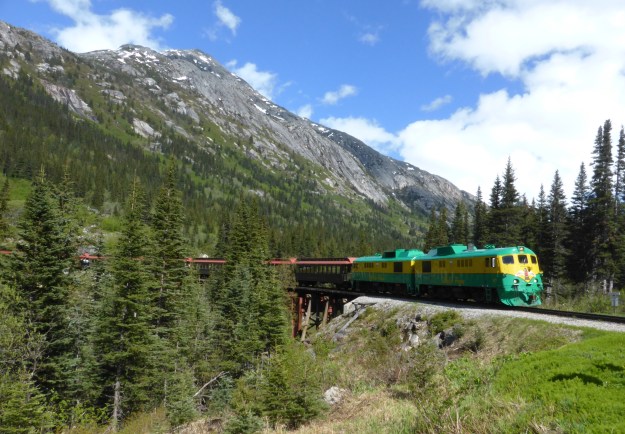
Last night rain soaked the trailside forest but now we have to squint to the morning’s sunshine while disembarking. Conversations began on the train continue as teachers and students start up the trail, joined by a couple from Galway who decided to follow us to the glacier rather than continue on the train to it’s terminus at Fraiser, British Columbia.1

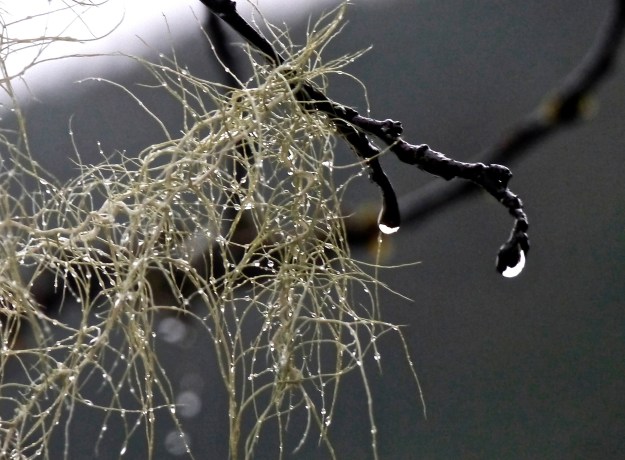
I hang back, letting everyone pass, until all conversation is being drowned out by a glacial river in a hurry to reach saltwater. The river also blocks out all birdsong. If a raven is scolding me, I can’t hear it. The forest plants aren’t steaming in the sun. That time has passed. But fat raindrops still cling to plantain plants and dead-brown foliage of last year’s bracken glows.2

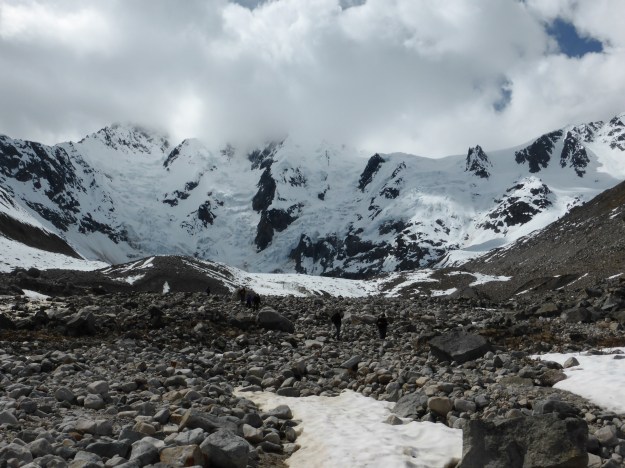
After a mile the trail leaves the river and leads me up through wind-stunted spruce and cottonwood plants. Still alone, I follow it onto a flat valley formed by twin walls of naked moraine. Only tough plants grow here. Ahead the Laughton Glacier curves up into clouds that obscure a mountain ridge. The clouds also block my sun. Ahead one of the writers, in long skit and windblown hair, walks towards toward the glacier with the help of a tall trekking pole. She turns the scene into a black and white photo of a pilgrim approaching her ashram.

1I’ll pass the pilgrim and climb onto the shrinking toe of the glacier. The sun will return. I will hold sharp edged rocks just being released from glacial ice that carried them from mountaintop to my feet. “Look at these rocks,” I will shout to a much younger writer wearing heart-shaped sunglasses. But magic will be in their history, not their appearance so she will probably thinks me weird. Higher up the toe, I will fall into a conversation about wolverines: whether the grumpy loners are magic or just thugs. “Magic” will become my favorite word for the day.4
Ease Dropping

2

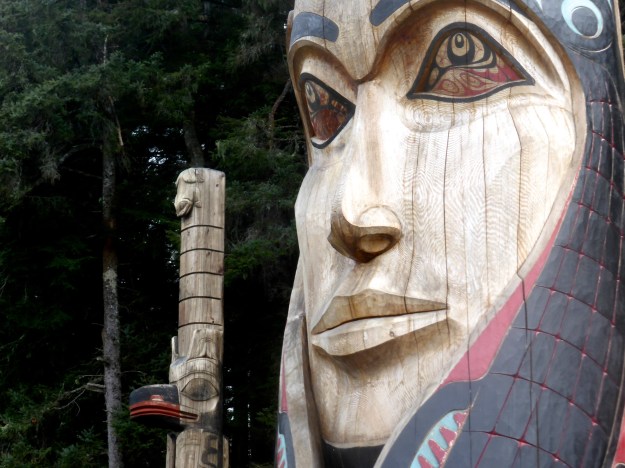
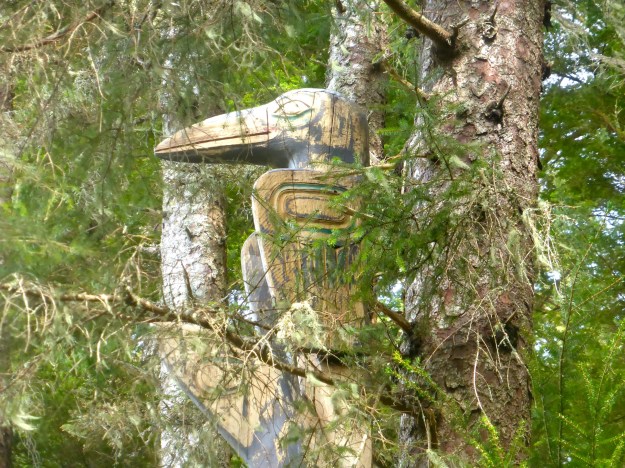
Still in Sitka, Aki and I walk down a forest trail near the mouth of Indian River. Totem poles line the trail like mile markers. There are no cruise ships in town so the forest is quiet enough to ease drop on the conversations of eagles and ravens.3

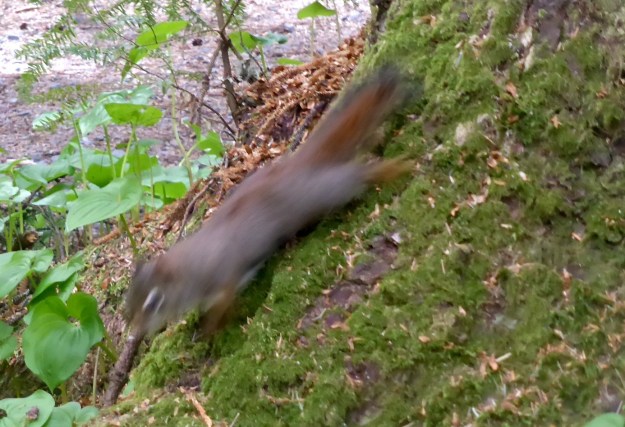
The eagle conversation appears one sided, a scolding really, that leaves me as embarrassed as a person caught listening in on domestic dispute. The ravens take turns delivering animated speeches. Each sets up a punch line that you would find funny if you had a raven’s skepticism. A squirrel chits in what sounds like a complaint and scrabbles downs his host tree, apparently so preoccupied with raven’s story that he almost runs into my little dog.1

Folk Wisdom

2

In like a lion, out like a lamb. So much for folk wisdom. This March, which started with a wind whipping snowstorm ends today with a dump of rain. No fleecy air caresses Aki and I as we walk through snow slop on the Treadwell ruins trails. The little dog minces along, cringing each time a paw punches through wet snow and into the melt water pooling beneath. Robins shake water from their wings in parts of Juneau where dark eyed juncos search in packs for food. But today, the Treadwell forest is a bird-barren place.

1

There is more action on the beach, now exposed by a very low tide. A handful of gulls gabble along the steam that drains the collapsed glory hole. But it’s the trio of mallard ducks that attract my attention. I usually see their kind floating together, even in shallow water. Today two hens and a drake stroll together along the bottom of a shallow rivulet, as if this were a fine spring day, as if to prove the truth of another piece of folk wisdom: rain makes lovely weather for ducks.

3

Surrendering to the Rain

2

I used to think that a willingness to lean into the winter wind was the primary requisite for surviving an Alaskan winter. After today, I wonder if you really need is the capacity to surrender.

1

Aki and I slip and slide over the paths through the Mendenhall Campground. It’s raining, like it has rained for a couple of days. Before that we had heavy, wet snow. My jacket is already soaked through and water drips off Aki’s fur. We don’t turn back to the car, just take extra care not to slip on the water-skimmed ice. We surrender to the rain.

1

This must be what it would be like post apocalypse if you and I were the sole survivors little dog. We are alone, maybe even a little lonely. No one comes out of the bathrooms or carries firewood to their campsite. No children play, no dogs bark, no cars purr as their driver looks for the perfect campsite. With this weather, we have no reason to expect help or even company.

4

Winter Orcas

3

While I’m checking out a spruce tree that now leans over the trail thanks to the last windstorm, Aki darts down the trail and out of view. When she squeaks, I trot around the corner and see her groveling before a matched pair of Australian shepherds. The dogs’ owner apologizes but I assure him that my little poodle-mix is just inviting the shepherds to play. With that cleared up, he tells me about the orcas. “You should see the whales the minute you break through the trees,” he says, “and with that telephoto you might get good pictures of them.”

I hustle toward the beach, scan the water, but only find a small raft of ducks near the surf line. Further out, near the northern edge of Shaman Island I briefly spot a splash of white water like that caused when swells strike against a partially submerged rock. But there is no rock there so maybe it was a killer whale roiling in the water. Encouraged, I scan for the plumes formed when an orca exhales or the sail-like dorsal fin of a mature male. But wind-blown rain clouds my glasses. The wind would wipe away any ocra plumes as they formed.

2

It should be enough to know that I am close to a pod of killer whales, but I want to see them fin, maybe even spy hop.

They must be the wolf pack—the meat eaters that hunt down seals and sea lions—not the larger pod we see each summer chasing down king salmon. I’ve kayaked near the summer pod several times, never felt threatened, even when a mature female swam to within twenty feet and rolled on her side to eyeball me. But even on a calm, warm day, I wouldn’t launch my boat into waters where the wolf pack hunts other mammals.

1

Jumpy Birds

3

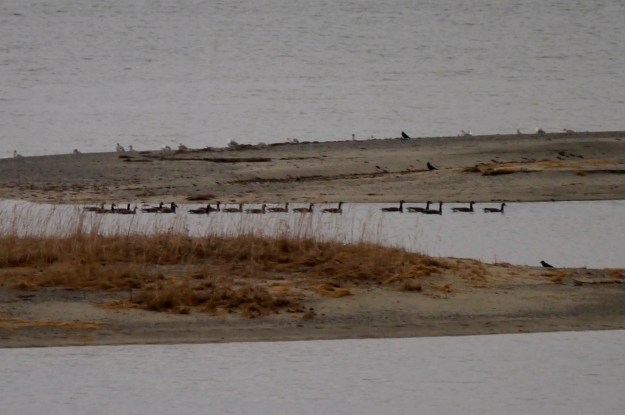
The flooding tide just displaced this murder of crows from an offshore bar. They regrouped on a lumpish rock thirty feet from where Aki and I emerge from the woods. My dog ignores the crows, as she tends to do with corvids except for our neighborhood ravens, which act like her teasing cousins. One by one the crows launch into the air. A small one keeps a look out while the rest line up like jets waiting to take off at the Seattle airport. I wonder if this organized nonchalance is designed to hide fear.

2

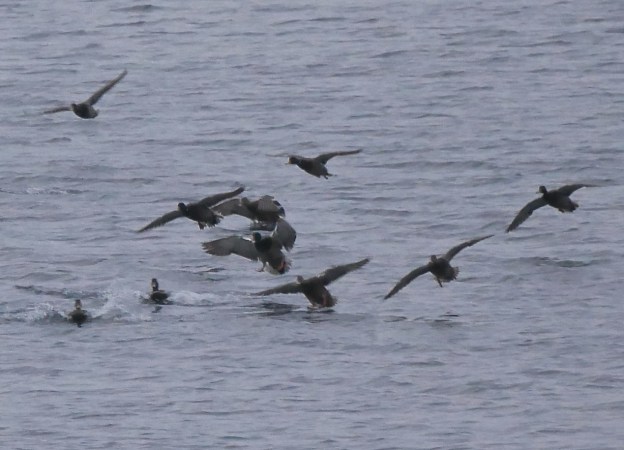
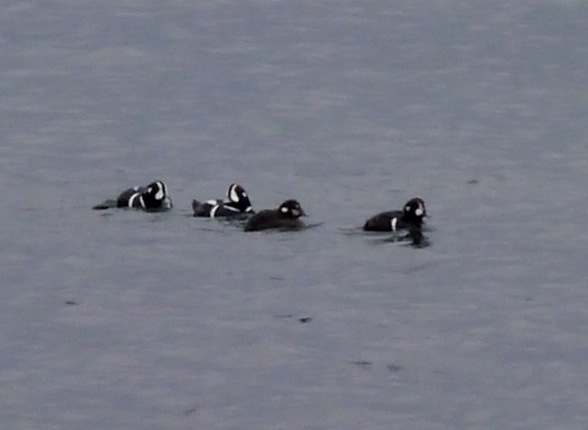
The ducks and scoters are definitely jumpy. There were two rafts of mallards when we arrived but one group panicked into a short flight to join up with the other. Now they hang close to shore while one of their number cackles in way that would suggest insanity in a human. The party colored harlequin ducks are quick to dive until driven to flight by the appearance of a bald eagle overhead. This sets some mergansers off and into the air.

1

The eagle pulls back its talons and skulks back to its spruce roost. I want to hang around and watch micro bursts of wind push small waves through the ducks’ formations but Aki whines. She has a point. It’s blowing hard, a wind that propels raindrops like missiles. I followed her into the woods where the storm hums through the canopy and we have to climb over a hemlock tree downed by the last windstorm.

4

Desert Dreams

2

I wonder if Aki ever dreams of other climates when we walk down a rain forest trail on a hard day. I do. On this wet, windy transit of a north Douglas trail, I pretend that it will soon lead onto the south rim of the Grand Canyon just as the sun rises to set off the sunset colors of layered rock and sand. But the trail will never lead me out of this land of greens and browns so subtle that they could be shades of gray. It will take me to a beach exposed by an ebbing tide.

3

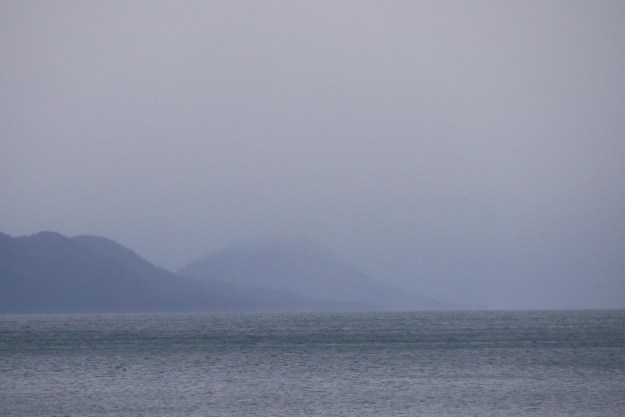
The rain stops when we reach the beach. A gang of surly looking gulls watch us as a formation of four harlequin ducks patrols offshore. Further out, white caps tromp across Lynn Canal and clouds from today’s storm obscure the mountains. Small, unexpected waves of contentment wash though me, keeping time with the ones dying on the shore. As fat drops of rain again soak her fur, Aki gives me a look that might be an accusation that I have lost my mind or a plea to book us both space on a jet to Arizona.

1

Mostly Ice

1

I hope for snow farther out the road out of Juneau that runs almost due north along Lynn Canal for forty miles. About mile 20, the roadside ditches retain a burden of snow and patches of white form abstract patterns under the tall spruce trees. A thin snow blanket covers some of the Eagle River gravel bars but only rain-slick ice covers the trail was take along the river. The tracks of an early skier have hardened into ice. I wish I had been here last week to join him.

2

Aki normally loves snow. She scoots the side of her face through it and then shake away any of the fluff that clings to her muzzle when she surfaces. Today, she avoids the white portions of the trail, trotting along behind me in a track left by one of those giant-tired bicycles. There is little life to interest the poodle-mix but she manages to entertain herself by analyzing tantalizing scents. She can’t see the seal that rode a flood tide up the river to search for late-run salmon. It squints in our direction before disappearing downriver, hardly making a splash during its exit.

3

Out the Road

2

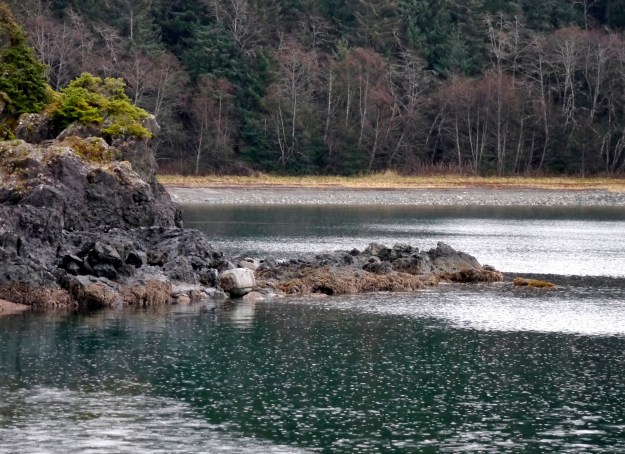
I’ve seen sea lions on these offshore rocks, but never people. The rocks form a spit that juts out from the island that will block our view of Lynn Canal during most of today’s hike. Goldeneyes, mergansers and other ducks usually feed in the channel between the mainland where Aki and I walk. Here, we have seen harbor seals, eagles, and of course, sea lions. But today only raindrops touch the water.


The trail takes us along beach tide lines and across a series of headlands until we drop down onto a pocket cove. Now we can actually see across the canal to where the Chilkat Mountains form a fuzzy line of bumps. The little dog and I take seats on top of a rocky point and let rain shower us. The two gulls break the silence by bickering over something floating in the water. It looks like driftwood with a blood-red gash.

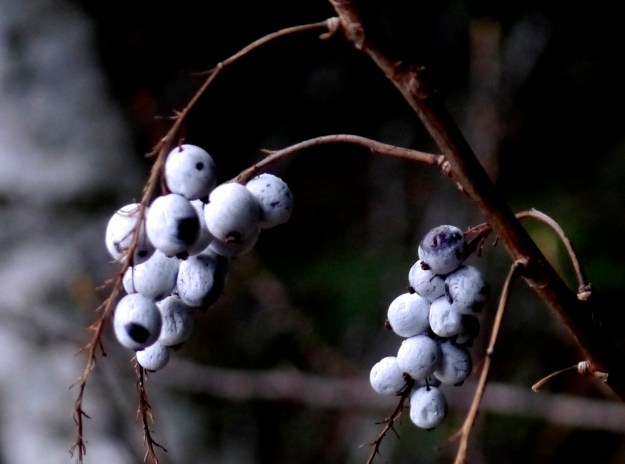
3            The little dog looks as content with the quiet isolation as I feel. I won’t recognize the driftwood for dead meat until later, when I enlarge photographs of it on the computer. Looking for the best path to the trail, I spot clumps of pale-white globes that hang on leafless branches near the beach brush line. They turn out to be stink currents, one of least desirable local fruits. But they are the brightest things in the forest.1