Category Archives: Nature

Organic Symapore

No birds bounced through the small waves that marched across the Fish Creek Pond. No eagles or herons roosted in the spruce trees. No salmon swirled the pond’s surface, no other people or dogs walked along the shore. This doesn’t bother Aki. The little dog has plenty of scents to sniff. Even though I looked forward to seeing some wildlife, the absence of it this morning doesn’t bother me either. I have the absences created—solitude.

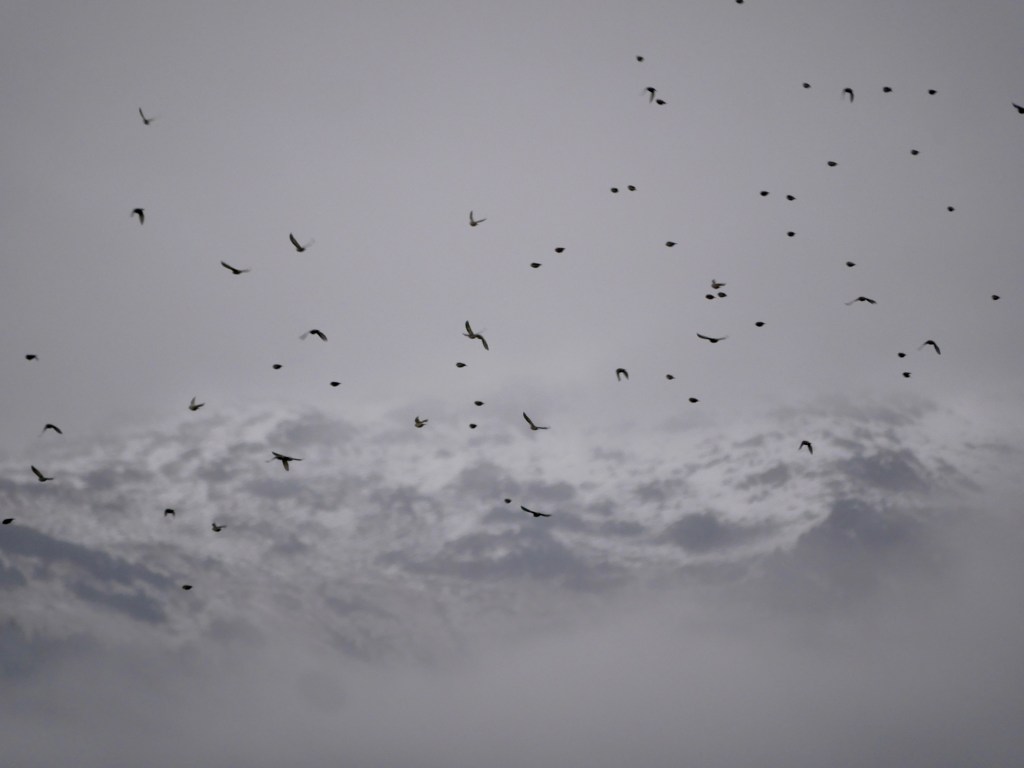
            We head out toward the mouth of Fish Creek, blown down the trail by the strengthening wind. No ducks work the close in waters of Fritz Cove. A few gulls keen and then ignore us. We are surprised by a flock of siskins feeding near the terminus of a tidal meadow. They fly into the sky above our heads, turning and diving in tight formation. At the end of each maneuver, their flock forms a different shape.  Then they disappear. 

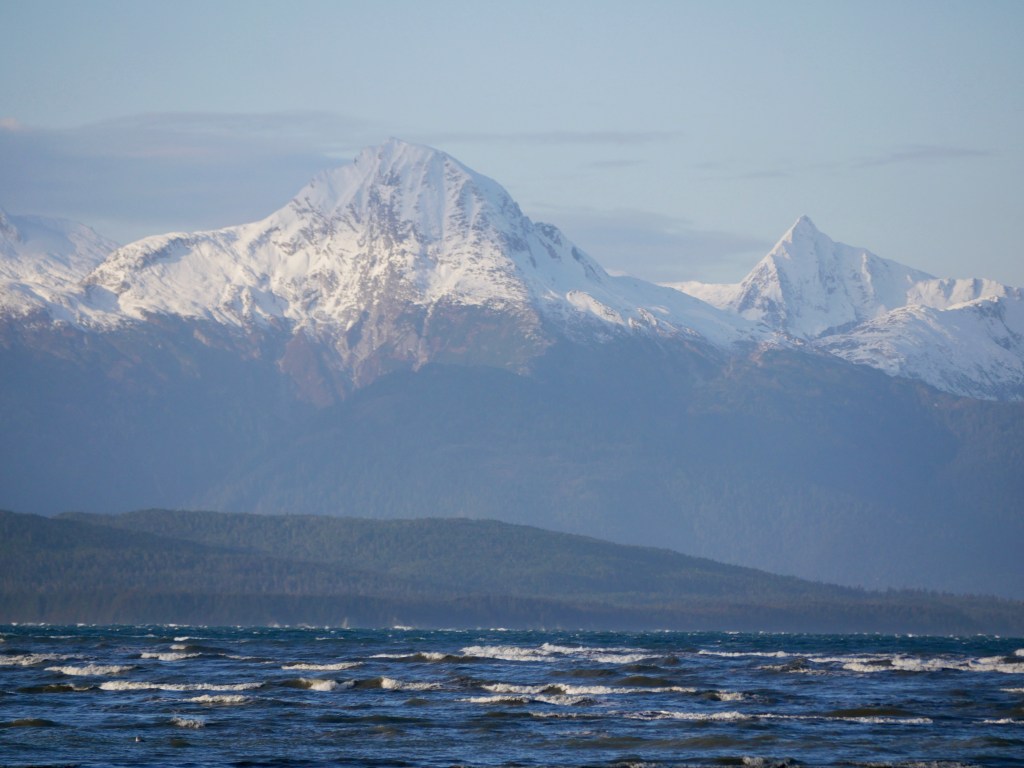
            I should just enjoy the beauty of the flock in flight, like I am enjoying the changing light on the meadow and the Mendenhall Glacier across Gastineau Channel. But I can’t help wondering if the shapes formed by siskins’ maneuvers were an attempt to communicate—an organic semaphore wasted on the ignorant.    

Tidal Family

Winter teased us with a few days of snow and cold. Now, like the fickle lover, it has left the rain forest for America’s East Coast. It’s mid-November and we are facing a week’s worth of wet storms. Aki and I suit up and head out to the Sheep Creek Delta. 

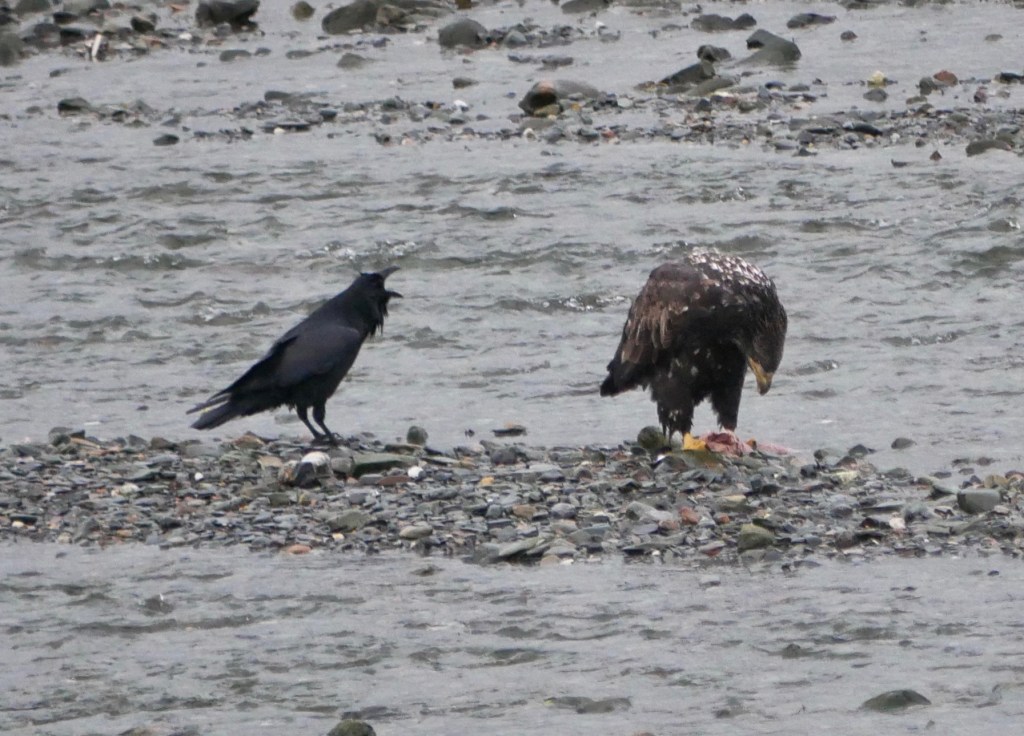
            Just a month ago we had to dodge eagles, step over salmon carcasses, but could tiptoe up to herons. The birds were there to feast on the wealth of wild food brought by the salmon spawn. Now all that has been washed into Gastineau Channel by rain and big autumn tides. This morning, only mallards and gulls remain. 

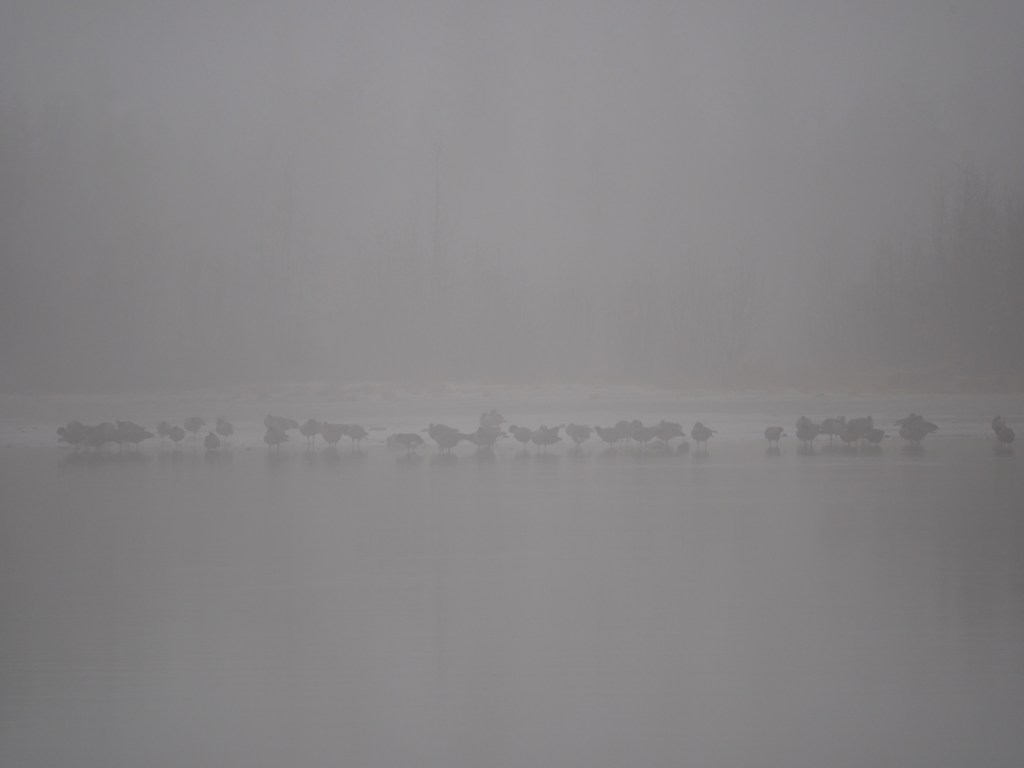
            The incoming tide shrinks the beach, creating isolated islands of gravel where the birds rest. The gulls squeal and the mallards cackle but otherwise they seem very comfortable in each other’s presence. It’s like they have formed a seasonal family for company until the salmon return. 

Cloud Walking

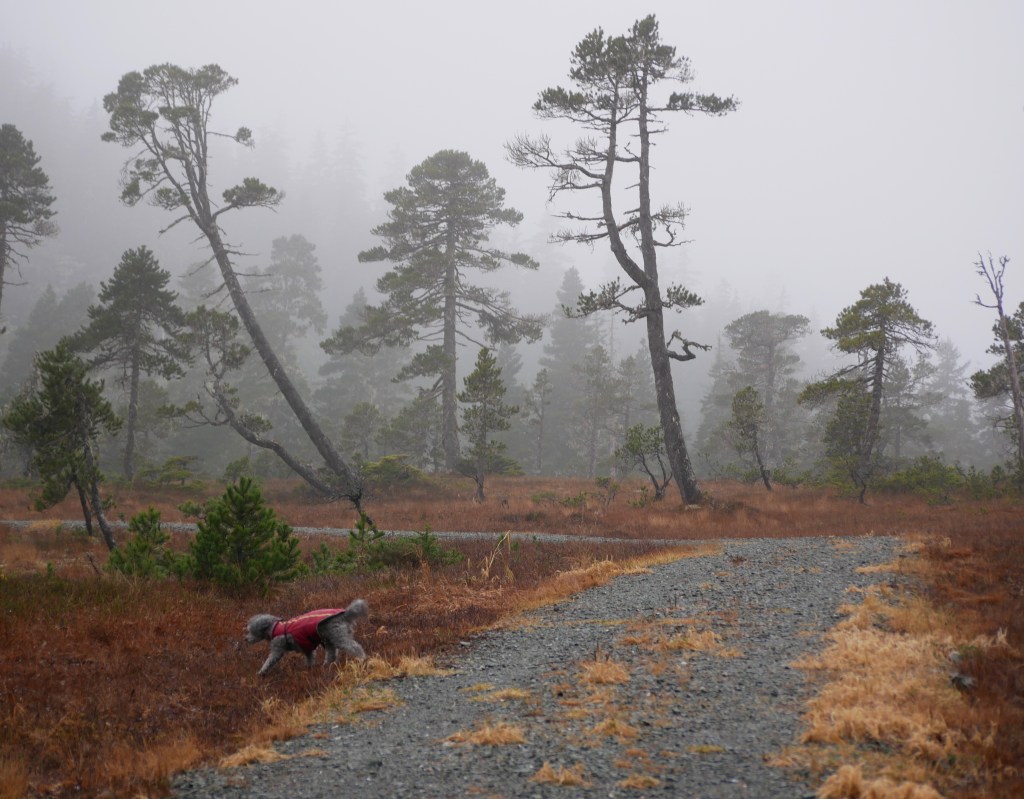
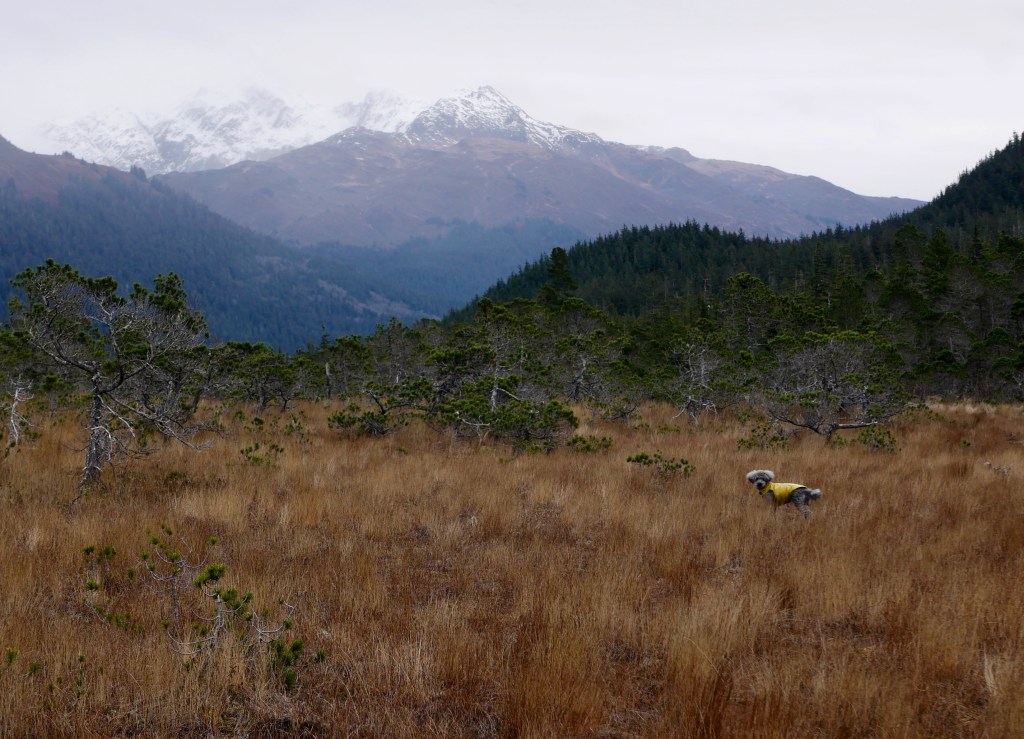
This morning, after a night of mixed snow and rain, clouds descended on this mountain meadow. Rather than curse the obscuring wall of white for hiding the surrounding mountains, I smile. Aki, this must what it is like to walk in a cloud. 

            Aki, already moist from the dewy air, trots away without responding to my romantic statement. She has no interest in spinning the day into something other than what it is—wet and gray. The little dog is nose down, her body tense with anticipation as she walks a crooked path across the muskeg. Near one of the pothole ponds she slams to a stop and buries her nose into a clump of lichen. Then she whirls around and marks the spot with urine. 

            Once again I envy Aki’s powerful nose and the excitement she feels when tracking scent left my animals she will never meet.  Bending down to harvest a few bog cranberries, I imagine sniffing out the trail left by a passing wolf, coyote or lynx. How great it would be to read nature without my eyes. But my sight is all I have so I scan the meadow for the animal that my dog just identified with her nose. All I see are the shapes of scattered pine trees made grotesque by wind and winter. 

            On the way home we stop at mile three of the North Douglas Highway. I park and watch a flock of siskins explode out of a leafless alder and fly toward the mountains on the other side of Gastineau Channel. If Aki saw the birds, she showed no interested in them. Perhaps they were too far away to smell.  

Spirit Bubbles

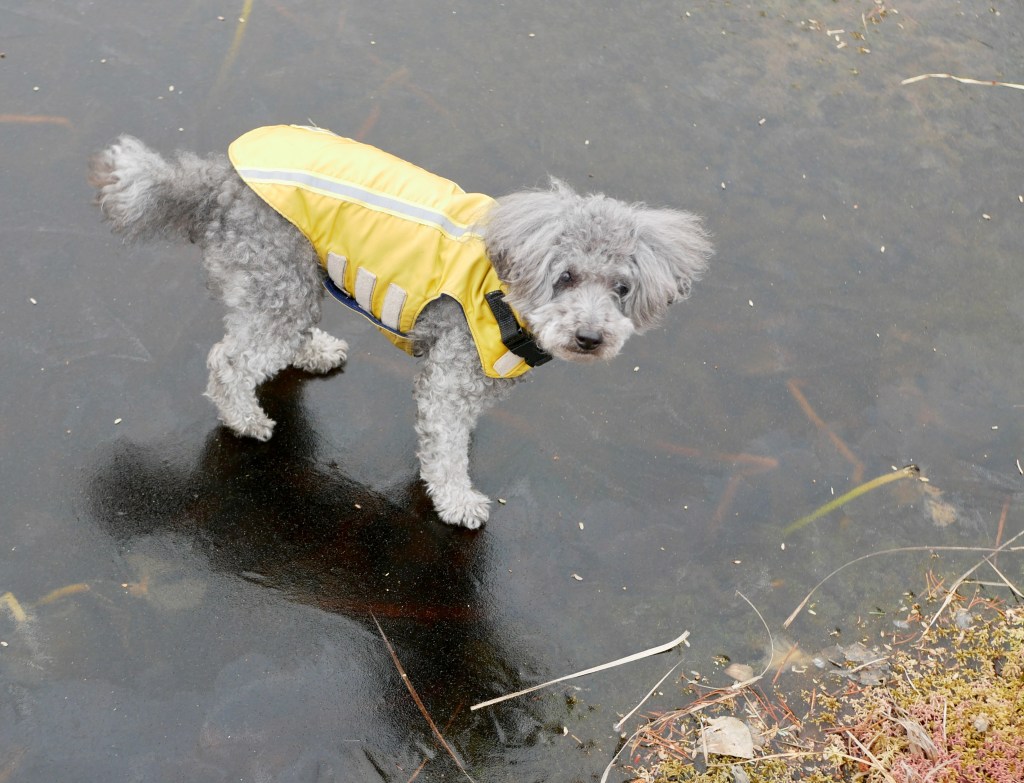
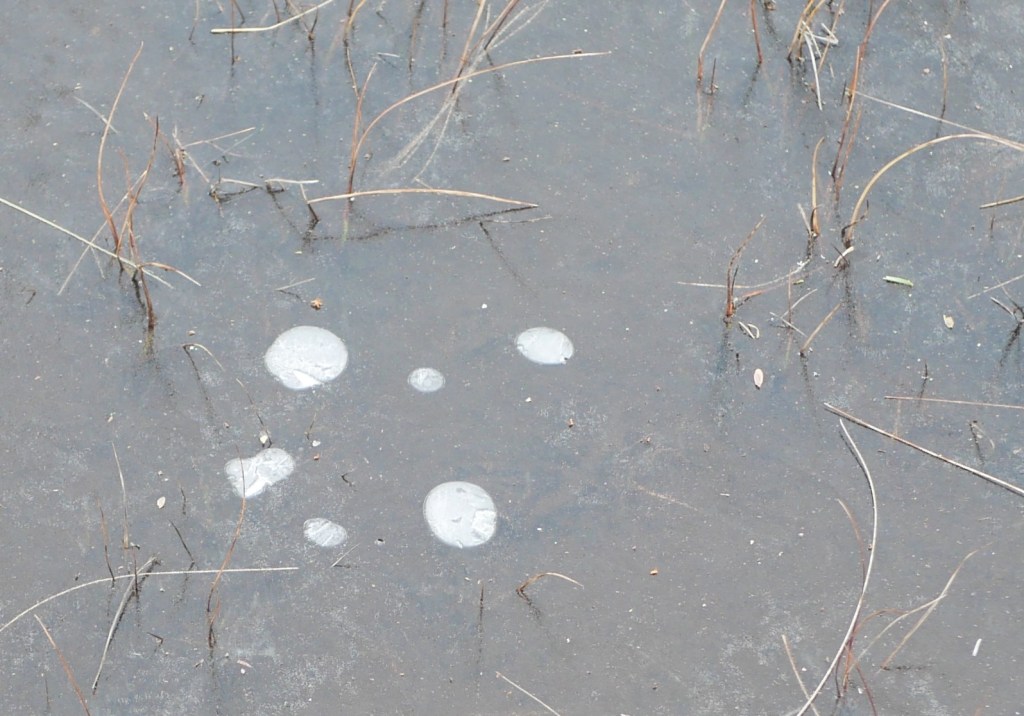
Before I can stop her, Aki steps onto newly formed ice covering a mountain pond. I expect her to break through but the thin ice holds. She is a few feet away from four air bubbles frozen in the ice. The air was captured just below the surface. If the temperature rises a few degrees the captured air will escape.

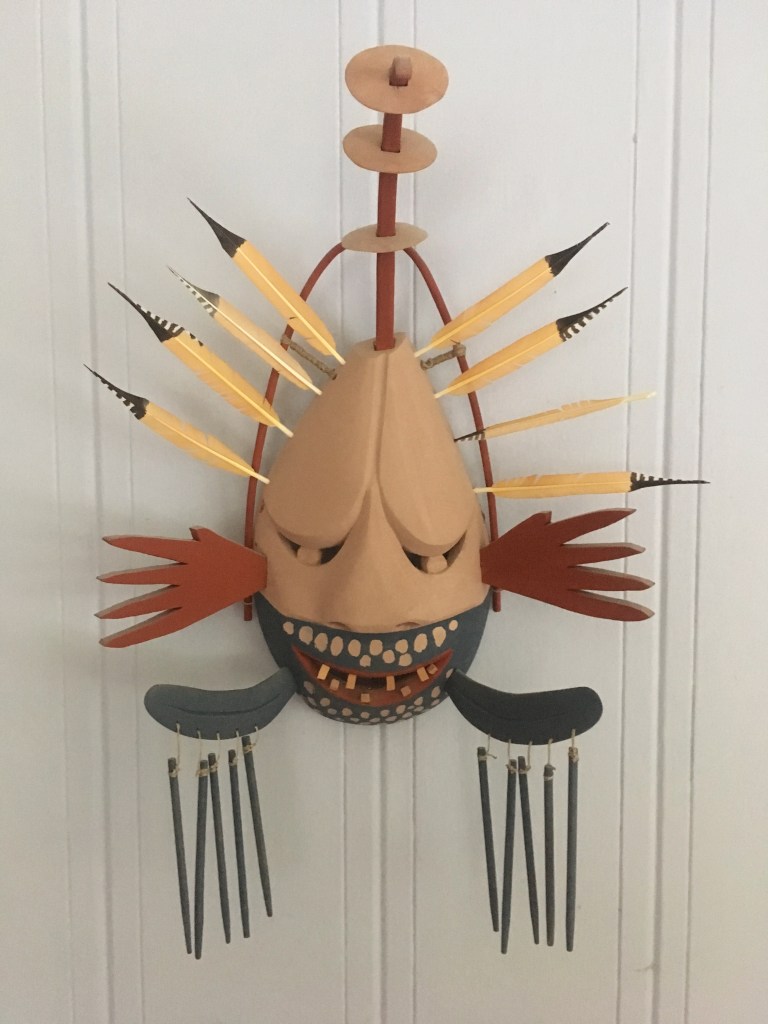
            The Yupik people of Western Alaska teach that all things have a spirit, even bubbles caught in the ice. The spirit of frozen air bubbles was honored by a mask carver a hundred years ago. His mask hangs in the Smithsonian Museum. I made a copy of it while it was on loan at the Alaska State Museum. 

            The Western culture I was raised in doesn’t consider inanimate objects worthy of having spirits. That would make it harder to exploit natural resources. The Yupik people’s belief that even ice bubbles have a spirit is understandable given their close, dependent relationship on an unforgiving environment.

Storm Surf

Last Fall, when Aki and I took this trail to Boy Scout Beach, we spooked a bear. It had been digging chocolate lily roots in a tidal meadow. We saw two other root digging bears that day. None of them bothered the little dog or I. But the memory makes me cautious as we follow Eagle River to the sea. 

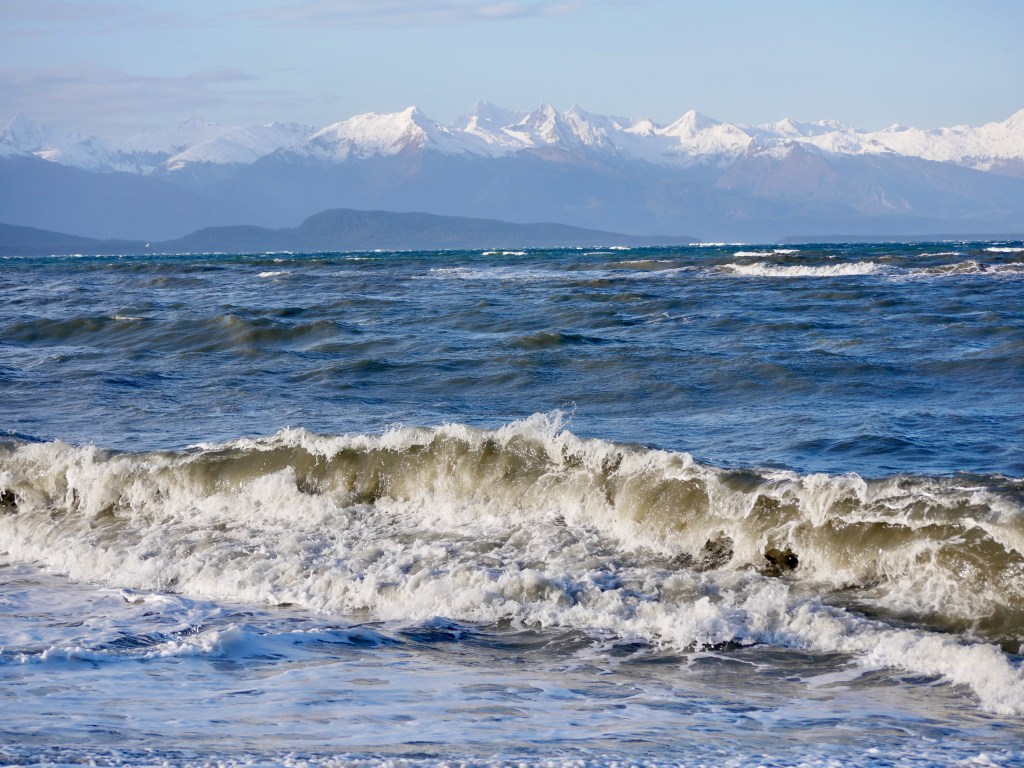
            We can hear the ocean long before we see it. Strong westerly winds have raised a surf that pounds onto Eagle Beach. Some of the waves move into the river to crash against a steep section of riverbank. Past wave erosion collapsed the prior bank, forcing crews to relocate the trail two times. Just down river living spruce trees, their roots undercut by wave action, have tumbled into the river. 

            The violent surf and strong wind forced the sea birds inland. A brace of bufflehead ducks plop into a little side slough as Aki and I walk along it. The ducks blast off the water when they spot us but only land thirty meters away. They must be tired of fighting the waves and wind. 

 A bald eagle cruises across the river to circle over my head. A little panicked, I look for the little dog and find her a few meters away. The eagle stops circling after I closed the distance to Aki. Three seals ride the river surf with their heads pointed toward the sea. They must be waiting for a last wave of salmon to arrive. 

The little dog and I are not used to dramatic surf. Up close, it sounds like a hundred Nugget Falls after a week of heavy rain. We turn our backs to it and climb a sand berm then drop onto another tidal meadow. The berm blocks the wind and dampens the sound. As we make our way back to the car I try to catalogue all the sounds that moving water makes—the plop of a water drop, hum of water moving through a culvert; water gurgling, shushing, dripping. There is enough diversity for a D.J. with time and a good ear to make a symphonic mix-tape. 

Brief Cameo Appearance

Aki must think I am crazy. All morning I’ve led her over, through, and around the Troll Woods looking for fish. She waited with patience as I made a few fruitless casts at each spot hoping to lure a fish to strike my hook. The little dog could have told me after the first three stops that the time for catching fish on the moraine is over for the year. Perhaps she is too polite. 

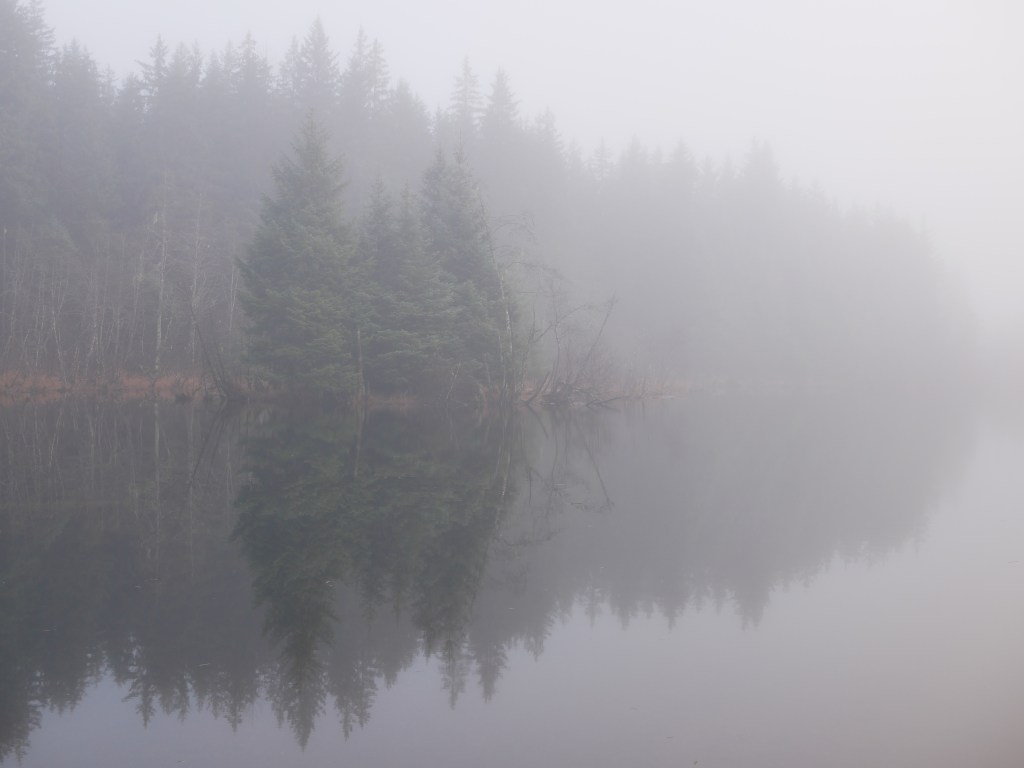
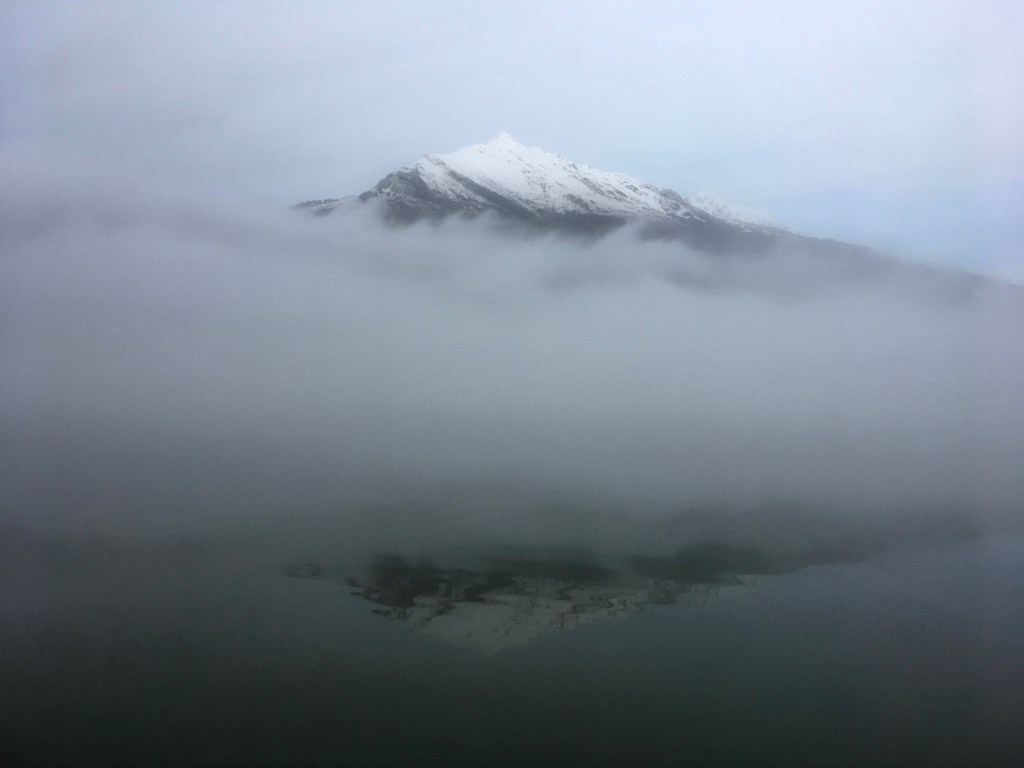
            Occluding fog reduced our view shed to fifty meters when we first arrived at the trailhead. Now the sun is burning through. The snowy peak of Mt. Stroller White suddenly appears. Dark, duck-like forms cruise in and out of the fog bank still floating over Moose Lake. 

            We move on until met by a trio of golden retrievers that show little interest in meeting Aki. She shrugs off the group rejection and follows me to a fog free Moraine Lake.  Above the lake, a circle in the clouds forms frame around the upper half of Mt. McGinnis. By the time we circle around the little lake, the fog has returned, banishing  the mountain. 

So Calm

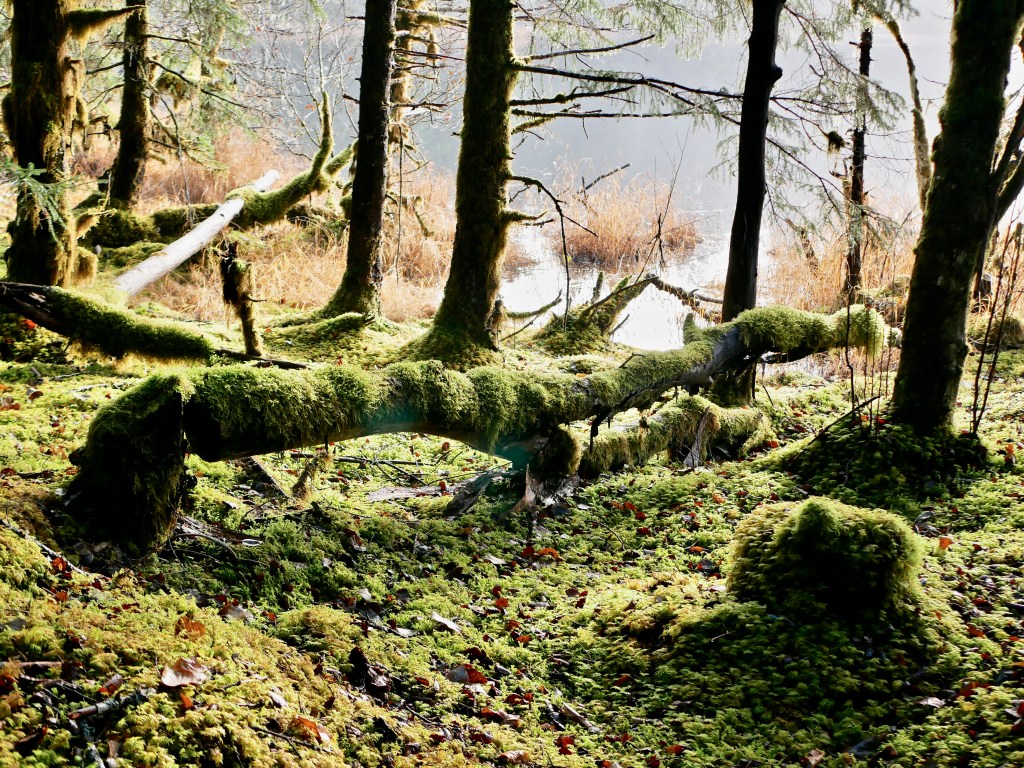
The rain forest is darker than the last time Aki and I visited. Then leaves still held their fall color. This morning it’s all bare branches and fallen leaves quickly being reduced to mush. Only the bottom hugging sorel retain color. On the drive to the trailhead I spotted two lines of sand hill cranes heading toward the forest. Now, mixed in with the noise of a passing prop plane, I can just make out their ratching calls. 

            Weeks of heavy rain have swollen the beaver pond and flooded parts of the trail.  The pond is empty of cranes or other birds. My eyes are drawn to the islands of golden-brown reflected in the pond water. Aki breaks ahead of me to circle around a submerged portion of the trail. I follow her to a beach that borders a small cove. Gulls and mallard ducks are the only things that disturb the flat-calm water. 

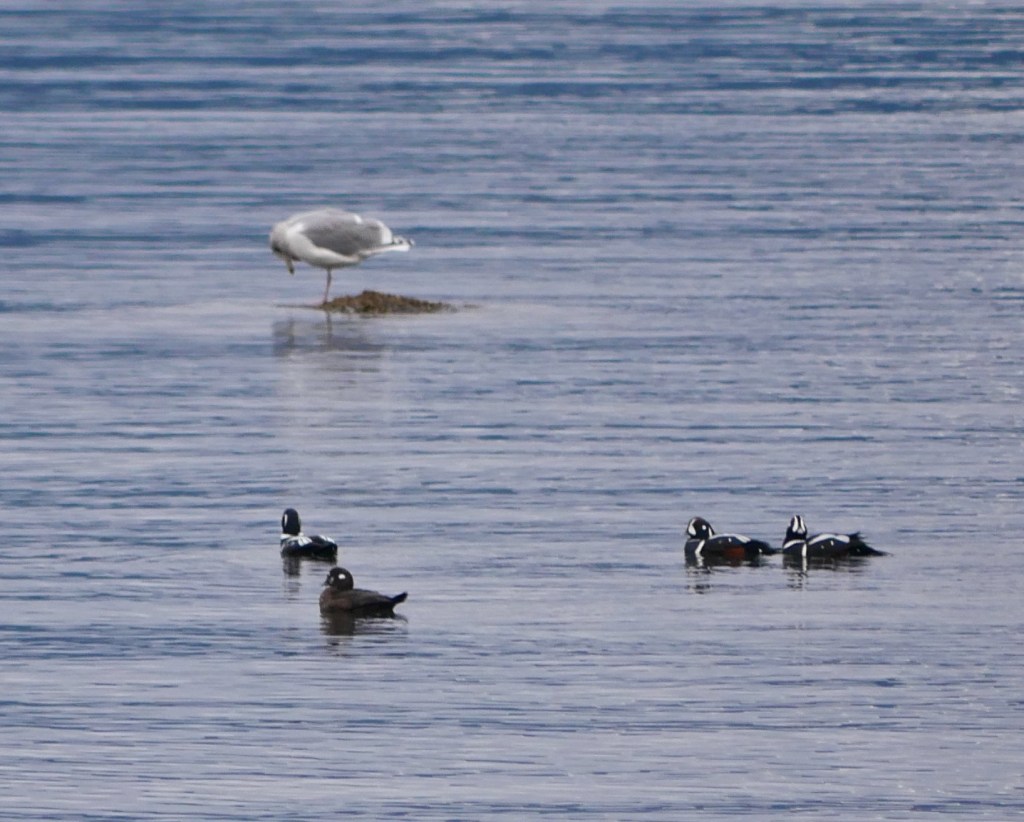
            There is something calming about an expanse of undisturbed water. If I had brought troubles or worry to this beach, they would soon be forgotten. We stroll down the beach, over a small headland, and onto another beach. Here harlequin and golden eye ducks work the water for food. The Chilkat Mountains, looking crisp with fresh snow, rise across Lynn Canal. 

Peaking Through the Fog

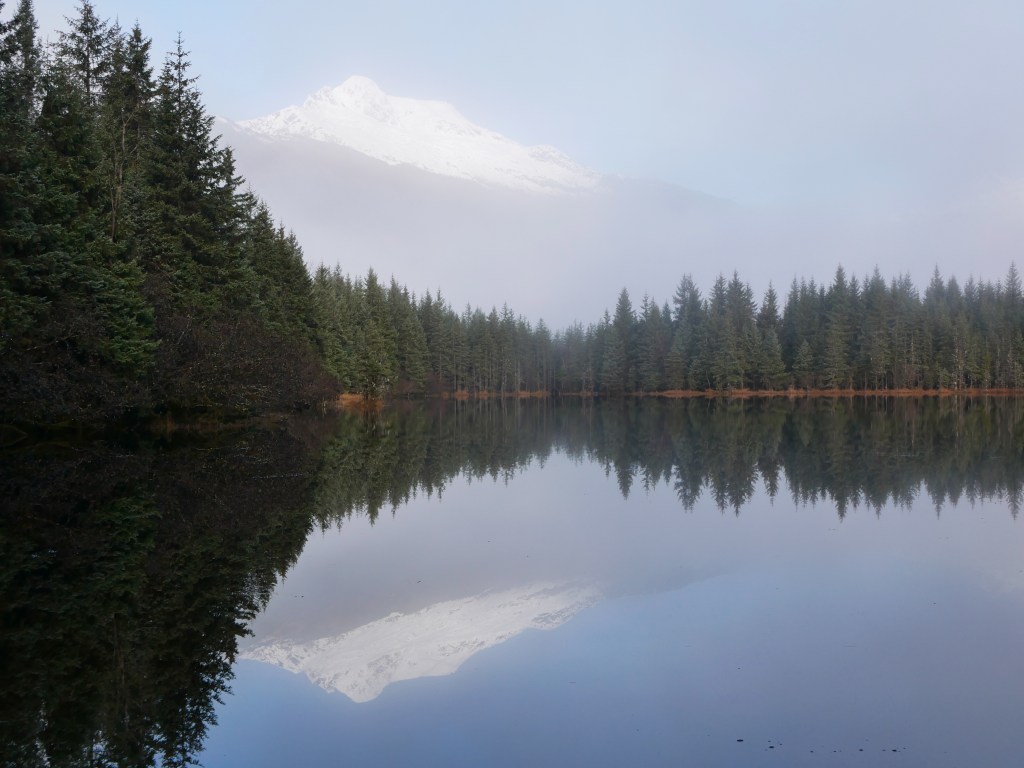
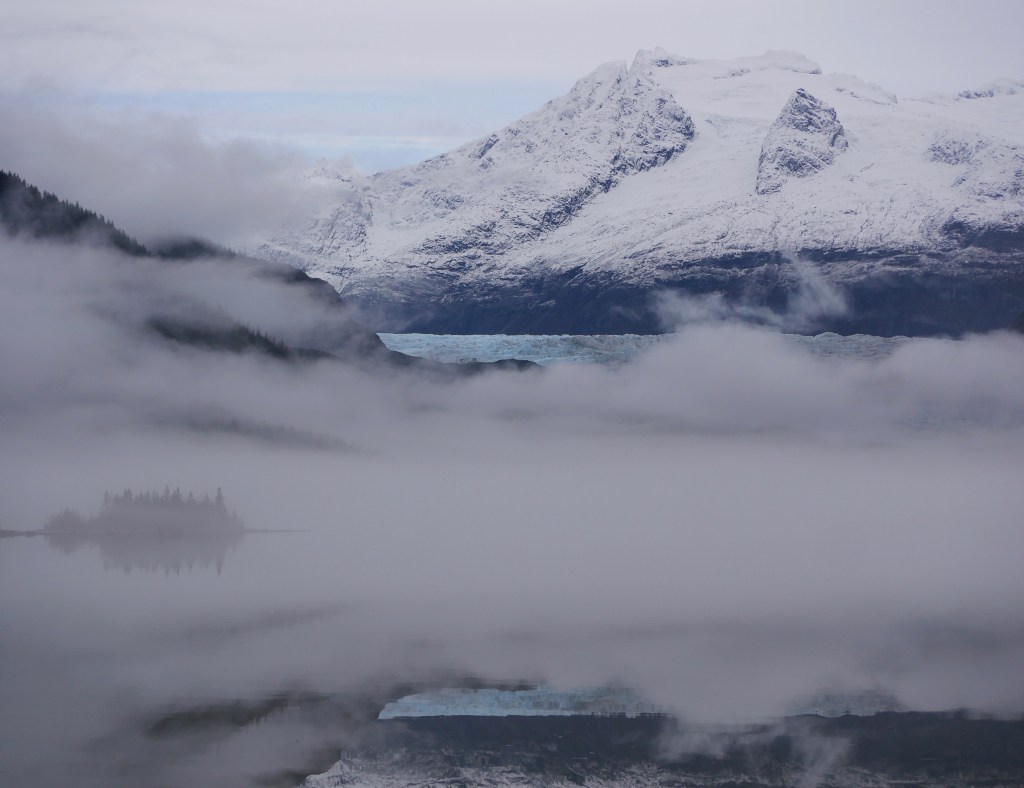
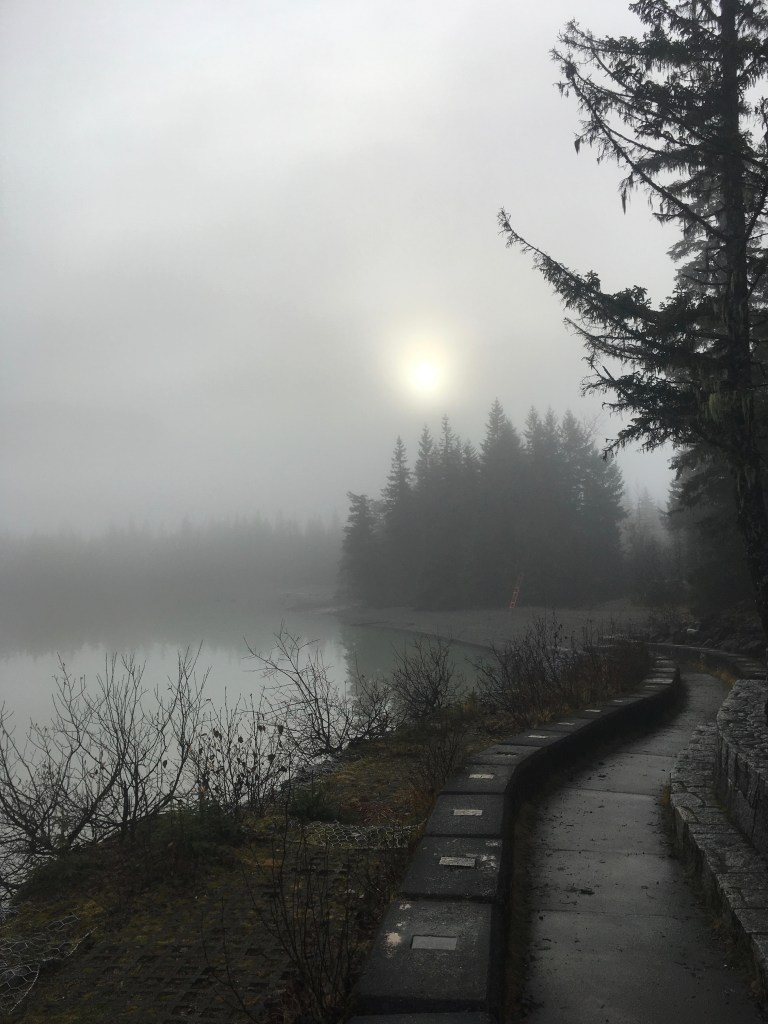
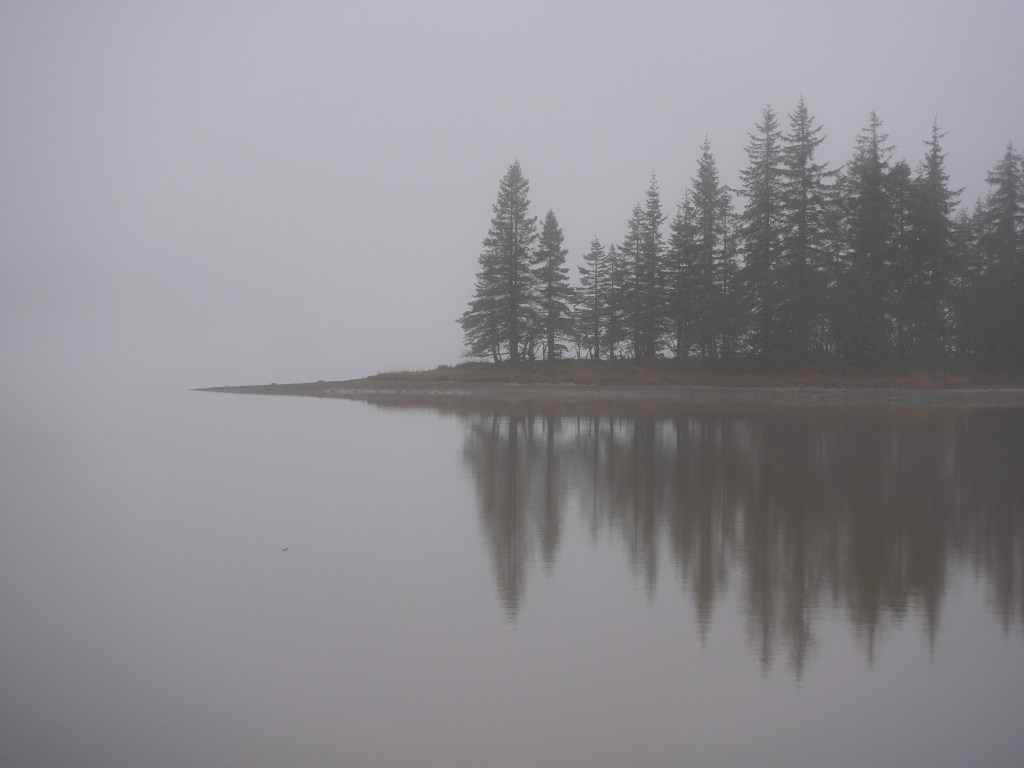
On a windless morning, Aki and I crested a small rise, which normally offers views of mountains and glaciers. Fog shrouded all these marquee things. It also framed a line of spruce trees and softened their reflection in the lake, without effort creating an impressionist scene. 

We could hear the honking of Canada geese over the roar of an invisible Nugget Falls and the scolds of a hidden Stellar’s jay. Behind us, the sun burned a silver disk in the marine layer.

Aki led me onto a small trail that paralleled the lakeshore. I didn’t try to hurry the dog, letting her linger as long as she pleased over each piece of pee mail. I was happy for the delay. It might give the fog time to part.

The little poodle-mix almost dragged me through the woods and onto the road through the campground.   When thickening clouds blocked out the sun, I stopped looking through openings in the forest for views of the glacier.

Aki spirits picked up each time we ran into another dog. She was trotting a few meters in front of me when we returned to the lake, which now reflected a blue strip of glacial ice. Soon we could see the mountains behind the glacier. Then the fog closed in again, returning us to a soft, white world. 

Rainforest Return

Aki snuffles a patch of trailside grass. After watching her beaver away, I scan the Fish Creek Pond for bird life. Only the severed leaves of cottonwood trees float on the pond’s surface. Heavy raindrops plunk down on fallen leaves covering the trail. As the little poodle-mix finishes her investigation and seals the spot with urine, I try to ignore the chilling rainwater slowly working its way through the fabric of my expensive rain parka to soak the sweatshirt underneath. 

My little dog trots down the trail, undeterred by the rain or the hypothermic temperatures. While I was soaking up sun in California and Washington State, Aki went out each day in the rain. It’s as if she has never stretched out in the sun.

            While Aki squished down empty rainforest trails, I crunched over a gravel path, passing curated maples, ginko trees, and Henry Moore bronzes. While a North Pacific storm rolled over Aki and Juneau, I strolled along the Tacoma waterfront in crisp, dry weather. When I stepped on fallen leaves, they crunched underfoot. 

            The little dog and I push on to the mouth of Fish Creek. There gulls and mallards mutter to themselves and swim slowly away from the beach. The resident eagles are elsewhere. Maybe they have already joined the thousands of their kind that assemble north of Haines each November to feed on a late arriving run of chum salmon. 

Bad Habits

Aki and I are using an elevated boardwalk near the glacier visitor center. It has heavy wire sides designed to keep the local bears safe from the tourists. During bear season you have to pass through gates to enter the boardwalk. They have been removed for the season so I assumed that it is safe for the little dog and I to use the boardwalk as a shortcut to the car. 

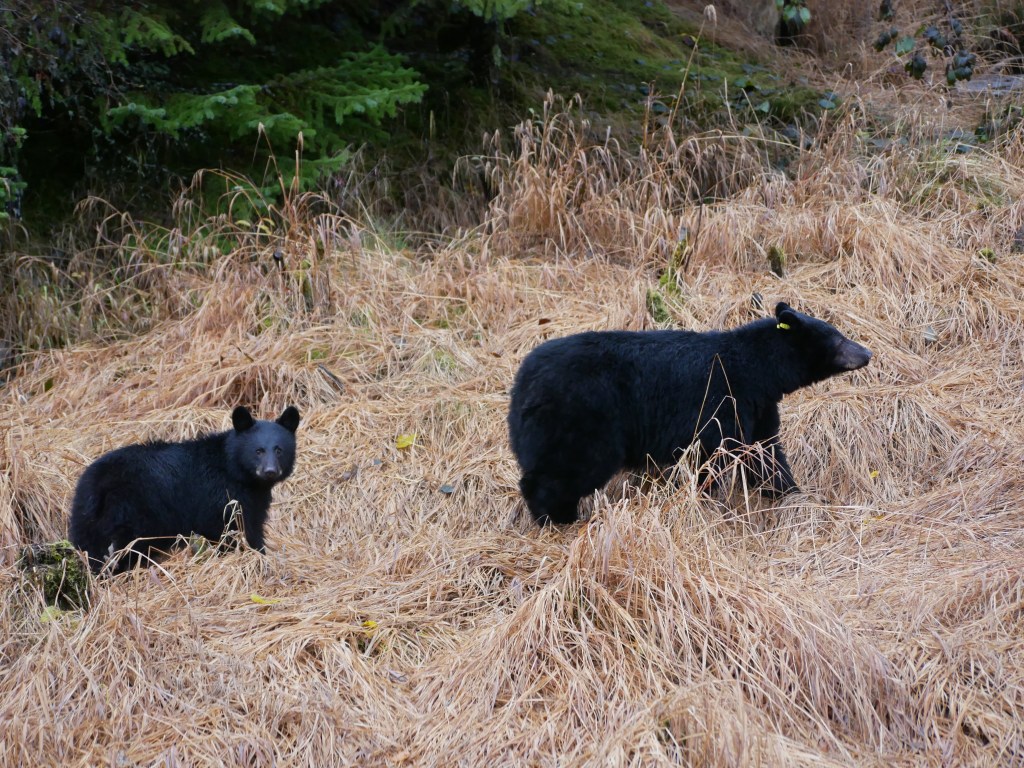
            A yearling bear cub ambles under the boardwalk. Its mother walks closely behind. I grab Aki but there is no danger for either of us. The bears are old pros as at this. All summer tourists have watched them fish for salmon in a nearby creek or dig for chocolate lily roots in the meadow. It has become their habit to ignore the smelly creatures trapped behind the boardwalk fences, which form a people zoo. 

            Two days ago I watched another habituated bear gorging itself on my neighbor’s garbage. It has learned to identity people with food. That bear now knows that it can ignore our efforts to scare it away from garbage. As much as I enjoy watching a fat bear sauntering along a salmon stream, I’d give up any chance of seeing one again if it meant that bears would never lose their distrust of humans. But now many Juneau bear have.