Category Archives: Kwethluk

Nature

Hell for the Hungover

2

While planning where to hike this morning, I look out at the garden where heavy raindrops make the tough kale leaves bounce. No wind blows them off course. Already the storm is soaking the old growth canopy. But the little dog and I still head to the Outer Point Trailhead.1
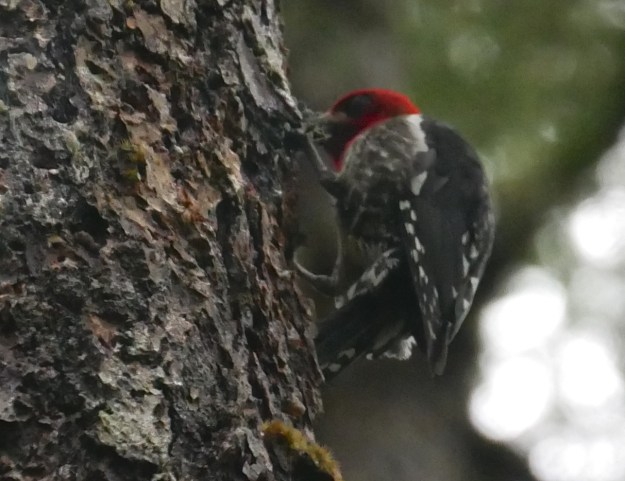
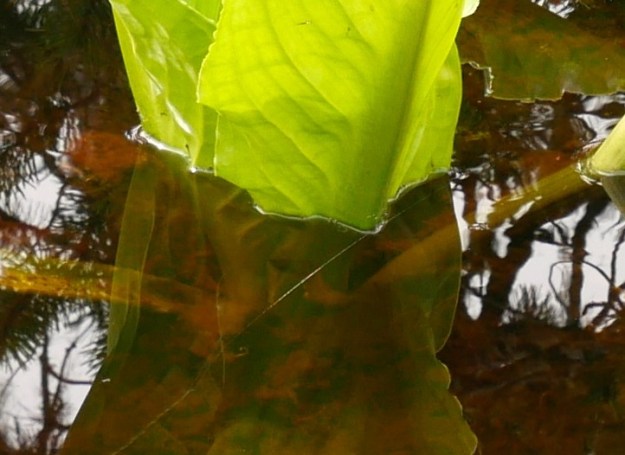
I am not surprised to find the parking lot empty and pleased that nothing falls from the sky. Ironically, inside the forest that usually protects us from the worst of storms, it is raining. Fat drops drip from the canopy of spruce and hemlock. Storm light, more pearl than gray in color, reaches into the forest and turns the surface of a beaver pond into a fairy tale mirror. It might tell Aki that she is the fairest dog in the forest. That wouldn’t be a lie since the place is empty except for local residents like the red-breasted sapsucker hammering into a 100 year old hemlock. The overdressed bird grips an imperfection in the bark with one foot, which in my mind, makes it look desperate, as it pounds yet another hole into the hemlock. Hell for the hungover must be full of such unrelenting woodpeckers.3
Auk Bay

1

Islands protect this crescent-shaped bay. It’s the perfect spot to house people who make their living on the sea. Once it did. The Auk people lived here before the offer of mining jobs ten miles away in Juneau seduced them to move into town. The bay’s graduated gravel beach would still offer easy access to the sea for the Auk people’ big cedar canoes. Now thimbleberry thickets cover ground where they stored their canoes in winter. They left behind a totem pole. But, the happy cries of their children have been replaced by robin songs and thrush trills.3

Aki and I are the only ones here to listen to the birds. The beach is empty of people, dogs, and even sea birds. Only the fins of Dahl porpoise mar the bay’s flat-calm surface. In winter harlequin ducks and scoters will fish the bay close to the shore. Gulls will bicker on the beach. But they have no need of shelter today. They are out chasing feed or in the gulls’ case, haunting salmon streams.2

Today the ban on king salmon fishing ends. Men around Juneau will troll for what salmon that haven’t already entered their spawning streams. The commercial guys will haul their catches to a processing plant two bays south of here. A white cloud of sea gulls will form over each boat as it unloads kings. In Southeast Alaska, where we still rely on nature directly or indirectly to feed our families, such scenes at a fish plant are metaphors for joy.

Ravens in the Rain

1

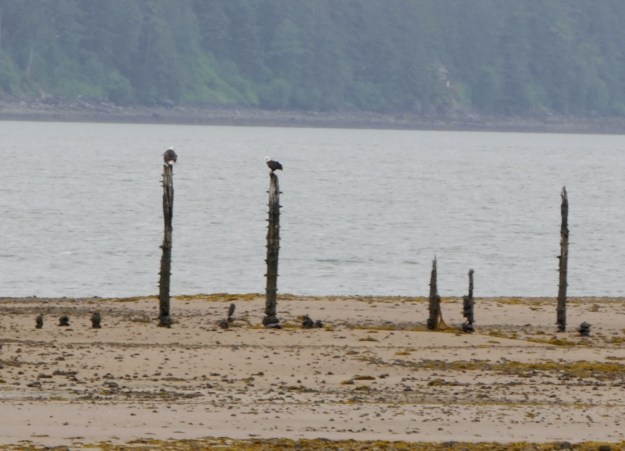
Rain or boredom seems to have depressed the Treadwell eagles this morning. Even though it is low tide and therefore the best time to find food or carrion, two mature bald eagles are glued to the tops of splintered pilings. Two more hunker on the beach near the water. The inclement weather doesn’t seem to have bothered the ravens. They fly back and forth over the glory hole, harassing first the piling plunked eagles and then returning to the beach occupied by those squatting on the sand.2

Aki finds a cache of dog kibble that has been sprinkled on the top of a foot-high piling. Someone, perhaps the sprinkler, placed a flat stone over the kibble but Aki manages to tongue out a morsels before I convince her to stop. Two ravens land on nearby pilings to watch. I have little doubt that they will have the stone off and the kibble down their beaks before we make it back to the car.3

Catching The Bottom

3

All fishing trips start early in the morning, many before the breakfast caffeine can clear the mind. This one begins at the relatively late hour of 7 A.M. Aki remains home, looking forward, not doubt, to a planned visit with one of her best dog friends. If fishing was the only point of the trip, I should stay home. Thanks to a dramatic fall off in the local king salmon returns, that fishery is closed. With better weather we would make the one hour run to Lizard Head, where King fishing is legal. But neither the sky nor the weatherman gives much hope of calm seas.2

In a normal year, the waters of the bay we fish out of would be full of king salmon fisherman, human and sea lion, as well as the occasional whale. But today, I only spot two eagles. One roosts on top of a commercial salmon troller, confident that it won’t put to sea until after they reopen the fishery. The other eagle, still acquiring its species’ trademark white head and tail, stands at the water’s edge, looking at its reflection as if basking in his beauty.1

Later we will try for halibut by dropping weighted line onto a reef off of Hump Island. Humpback whales and Dahl Porpoise will fatten in the herring-rich waters. An adult bald eagle will pluck a bait herring off the water close to our boat. We will catch only the ocean’s bottom with our hooks. But we really won’t be there for the fishing.

A Complex of Clouds

2

Aki and I walk on the spine of a long, gray gravel snake stretched out on the forest floor. On either side, the white flowers of food plants—crab apple, high bush cranberry, and Labrador tea—break the monopoly of forest greens. The snake will lead us to a beach where white gulls harass eagles away from food exposed by the ebbing tide. But my eye will be drawn to Lynn Canal where a complex of clouds, from white to dark gray, water the sea.1

False Finds

3

Reunited after my stint at the Skagway writer’s school. Aki and I patrol Downtown Juneau. The little dog is all business, but doesn’t seem to hold a grudge about my absence. We walk in soft drizzle that dampens the morning’s color. A noisy raven, angry that one of his kind hold a tasty stick of something in its beak, lets us approach within a few feet. When he flies off, it is only to an alder a meter away where he continues to monitor the greed of his neighbor.1

The lucky raven seems more stressed than the one with an empty beak. After trying to squawk with food in its mouth, it stops feeding and shifts his prize to one of his claws. The other grips the wet skin of a Chevrolet pickup. Down on South Franklin Street, where the docks are empty and the stores are closed, three women of commercial beauty have been pasted to the side of a cruise ship perfumery. The brunette in the center declares her’s an ageless society. But soon, even her beauty will fade, victim of rain and sun.

2

Laughton Glacier


6It’s the last day of writer’s school in Skagway. Students and teachers, including Paul Theroux are in a White Pass narrow gauge railway carriage that rattles toward the Laughton Glacier trailhead. The conductor has stuffed all the writers into one carriage where the sound of thirty or forty conversations competes with the grumbles of the old carriage and the disembodied voice of a tour guide giving the railroad’s history.  5
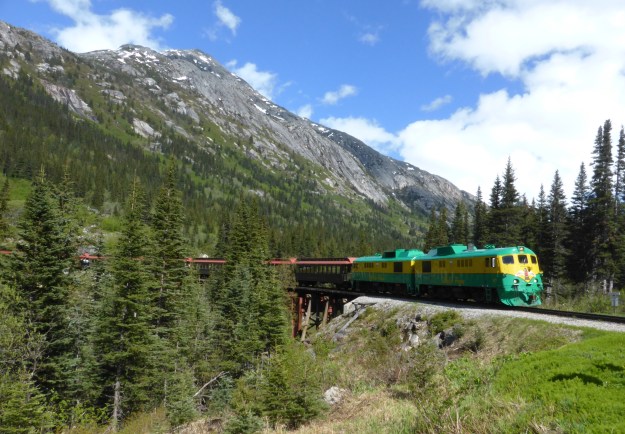
Last night rain soaked the trailside forest but now we have to squint to the morning’s sunshine while disembarking. Conversations began on the train continue as teachers and students start up the trail, joined by a couple from Galway who decided to follow us to the glacier rather than continue on the train to it’s terminus at Fraiser, British Columbia.1

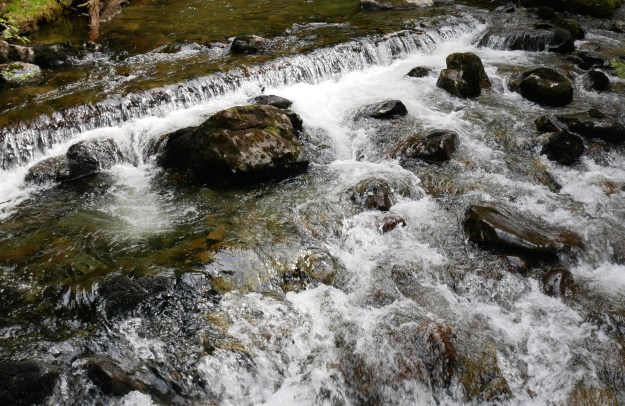
I hang back, letting everyone pass, until all conversation is being drowned out by a glacial river in a hurry to reach saltwater. The river also blocks out all birdsong. If a raven is scolding me, I can’t hear it. The forest plants aren’t steaming in the sun. That time has passed. But fat raindrops still cling to plantain plants and dead-brown foliage of last year’s bracken glows.2

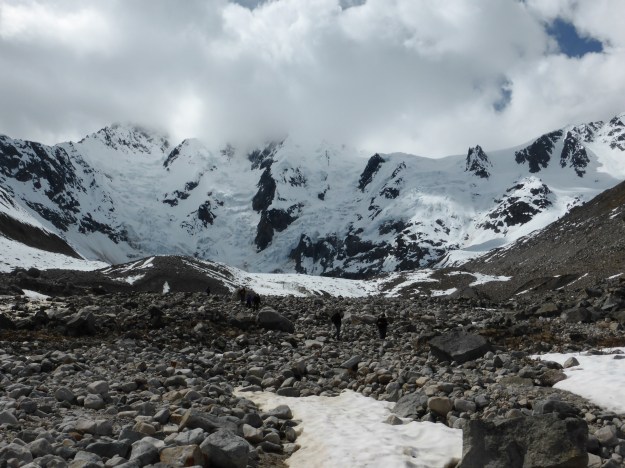
After a mile the trail leaves the river and leads me up through wind-stunted spruce and cottonwood plants. Still alone, I follow it onto a flat valley formed by twin walls of naked moraine. Only tough plants grow here. Ahead the Laughton Glacier curves up into clouds that obscure a mountain ridge. The clouds also block my sun. Ahead one of the writers, in long skit and windblown hair, walks towards toward the glacier with the help of a tall trekking pole. She turns the scene into a black and white photo of a pilgrim approaching her ashram.

1I’ll pass the pilgrim and climb onto the shrinking toe of the glacier. The sun will return. I will hold sharp edged rocks just being released from glacial ice that carried them from mountaintop to my feet. “Look at these rocks,” I will shout to a much younger writer wearing heart-shaped sunglasses. But magic will be in their history, not their appearance so she will probably thinks me weird. Higher up the toe, I will fall into a conversation about wolverines: whether the grumpy loners are magic or just thugs. “Magic” will become my favorite word for the day.4
Tidal Table

2

Tlingit elders teach that when the tide is out, the table is set. This morning, the tide is clearing the table as Aki and I walk toward the mouth of Fish Creek. From the sounds being made by eagles, crows, and gulls, last call is too early. Across Fritz Cove, a noisy cloud of white forms over Mendenhall River as displaced gulls and kittiwakes rise from an inundated sand bar. The cloud rises, falls, swoops, and settles on a still dry section of the wetlands.1

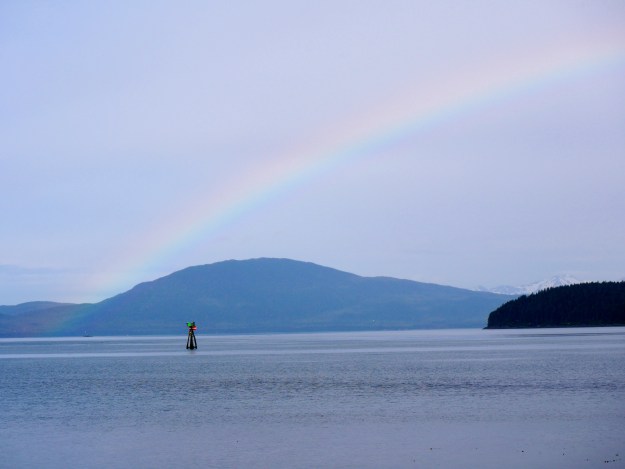
Rain falls through sunshine. In the American South, they would say that the devil must be beating his wife this morning.  A rainbow appears in the skies above Admiralty Island. The wetland bird noise drops. Perhaps they accept the bow as a manifestation of the tide’s promise to withdraw from the wetlands after the crest.

The rainbow has no affect on the crows and eagles. Inside the spruced island near the creek mouth, they bicker like kids on the playground. Bald eagles glide in and out of the forest, some to fish over the cove, others to perch on a mid-channel navigation aid.

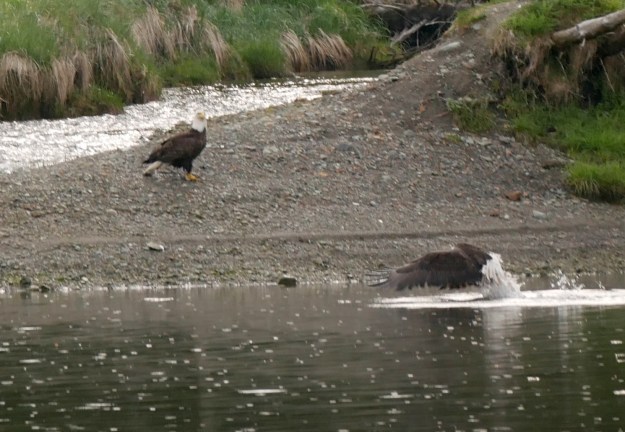
3Two eagles, one wet, the other dry, sulk on the point separating fish creek from its pond. A minute earlier, one had crashed, talons first, into the pond water, struggled with something that appeared to pull it underwater. The then wet eagle released its prey and used its wings to lift out of the water for a short flight to the beach. Somewhere in pond, a sore backed king salmon drops into deeper water. .4
Back in High School

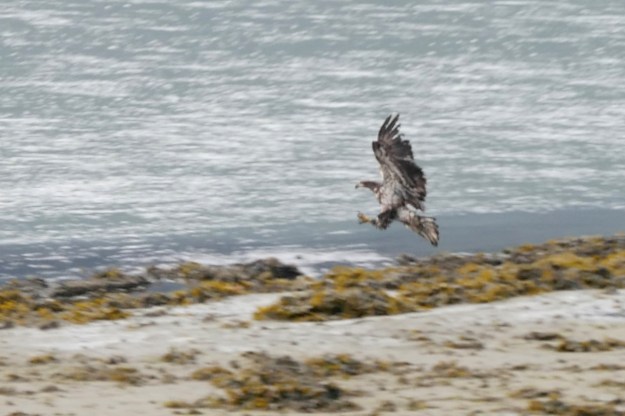
4It’s hard not to feel derided by the ravens and crows infesting the spruce forest that edges the Mendenhall River. The mere presence of Aki and me seems to put them in a foul mood. I experience emotions not felt since visiting a neighbor bar when in college. (Image me in school sweatshirt and jeans walking past a table of shipyard workers in machine-oil-stained overalls). The corvid choir takes me further back to the time of high school dances with their rigid hieratical order. The other birds along the river reinforce my feelings.3A sole, immature bald eagle was exiled on our side of the river when Aki and I first broke out of the forest. Across the way, on a bar exposed by a minus four low tide, the big men and women on campus—a gang of mature bald eagles—reigned. Gulls, crows and ravens kept a respectful distance.1
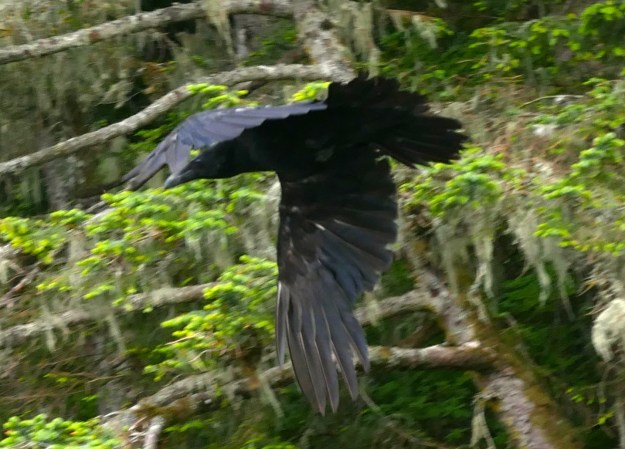
We learned the crows’ true social status when a single gull drove them off the bar, across the river, and into the trees where they now hurl insults at my little dog and me. As is the case of the high school dance status, in the bird world size does not guarantee dominance.

2I’ve seen a sole arctic tern drive off a mature bald eagle and a raven do the same. I’ve watched a crow harass a raven into leaving a tasty morsel of food. Today, the Mendenhall River crows, having been embarrassed by a diminutive gull, are putting us in our low place.
Time Traveling

2

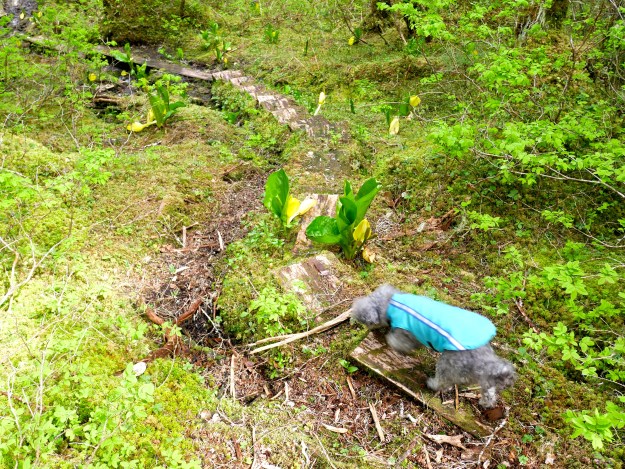
Aki and I are time traveling. The mountain meadow where we started this walk is nearing high summer. Bog rosemary plants have formed magenta islands on the muskeg. The early bloomers have already gone to seed. We heard the banshee-like call of a red tail hawk after a mail plane flew over the meadow. Slipping off the meadow and its handicap accessible trail, we follow an old plank trail to the Fish Creek crossing. This involves only a short travel in time.1

A craftsman made the trail of hand-split spruce, setting each board in a graceful step pattern. If he used metal nails to secure the plank steps, I can’t find them. But each step holds firm when I descend with Aki to a modern bridge across the creek. From there we follow the Treadwell ditch trail toward Mt. Jumbo and spring.3

Along the ditch, blue berry bushes are just setting blossoms. Some of the ferns slowly relax their tight spiral heads to spread their lacy leaves to the sun. Using imagination, I travel back 100 years to the time when Chinese laborers built this ten-mile long flume to carry water for the Treadwell gold mills. It’s quiet enough to hear their ghosts cursing in Mandarin as their phantom whipsaws rip through trailside spruce.4