Category Archives: Kwethluk

Nature

Early Season Canoe Trip

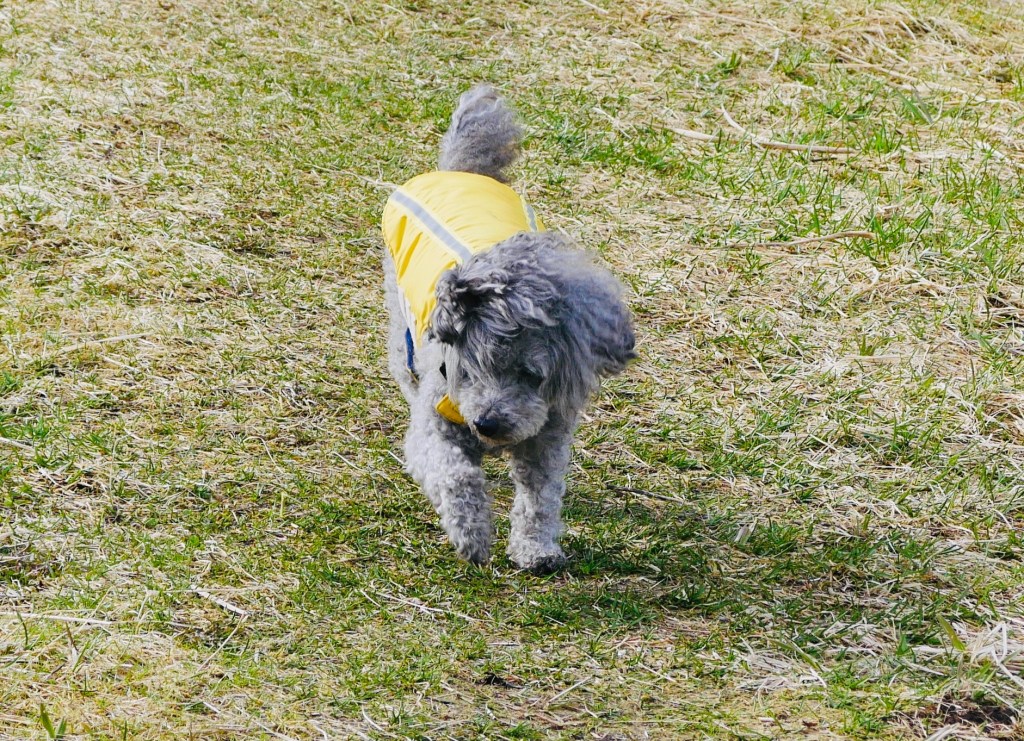
Aki watches her people tie on masks outside the grocery store. She squeals in fear, not that we will be arrested while robbing the store. She squeals in fear that we will take precious outdoor time shopping in the store. She had better calm down. After searching the store for flour and tahini we are heading to the end of the road. Aki is in for a wait. 

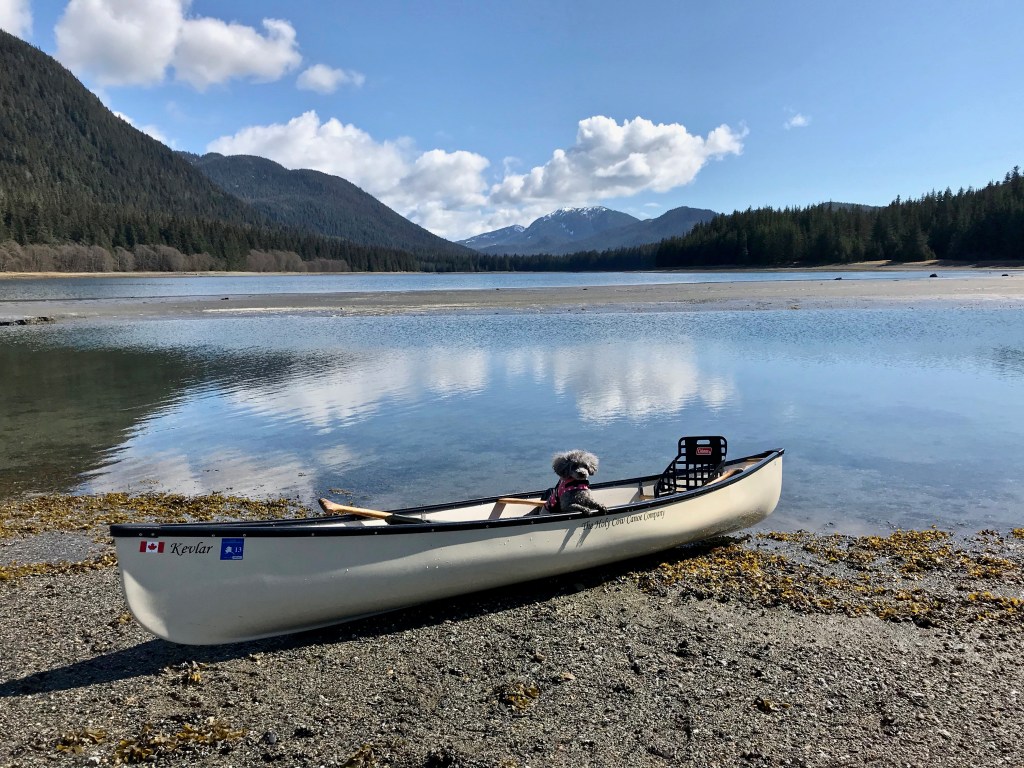
            The store is out of flour but we are able to buy tahini and a bag of dog treats for the poodle-mix. Keeping the treat a surprise we drive 30 miles to the north end of the Juneau road system and launch our canoe in Echo Cove. Fighting a head wind, Aki’s humans make slow progress toward our destination—a large sandbar that narrows the mouth of the cove.

            This early in spring, the cove’s birds act tame. Two marble murrelets paddle without haste a few meters from our canoe. A line of Bonaparte gulls let us get within a few meters before moving off. A single murre pays us no attention. Other gulls scream and hover over a ball of herring or hooligan. They are all here to feed on young salmon, herring, or hooligan, called candle fish for their high fat content.             

Aki makes us carry her from the canoe after we land on the sand bar. Once she feels sand beneath her paws, she tears around in circles. She’ll make many more circles in the sand before we use the canoe to return to the car. The little dog will sleep in the car and have just enough energy to mooch rice from her human’s dinner. It was a good day, except the lack of flour.   
Pocket Wilderness

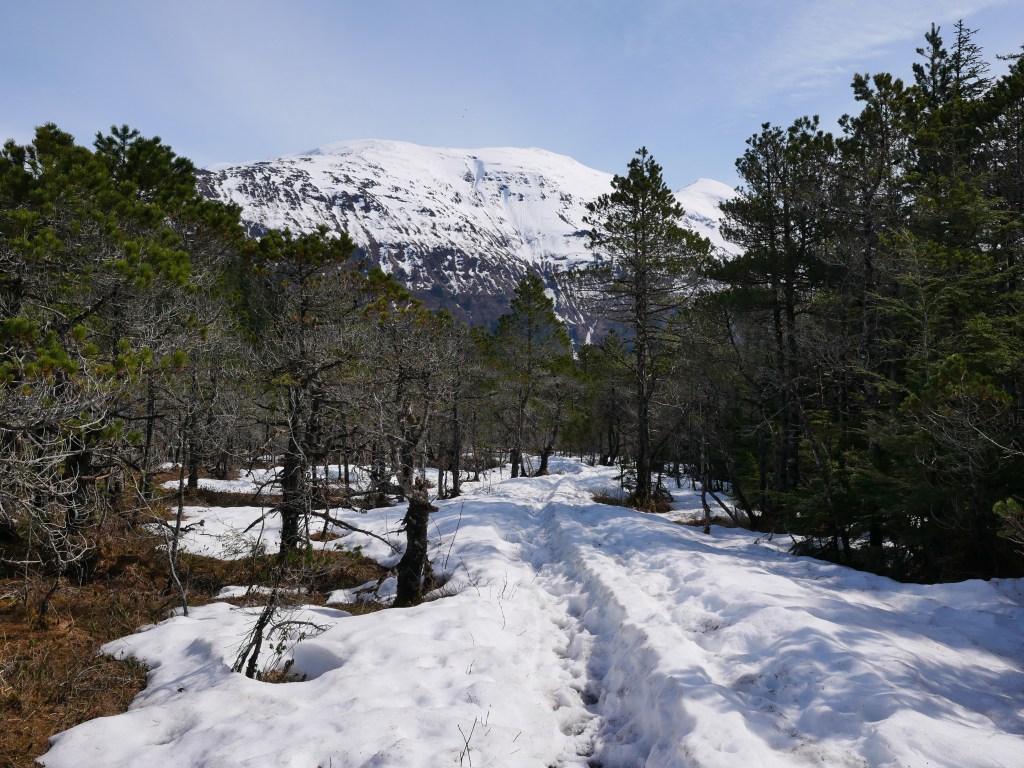
I expected a grey but dry day when we set out for Gastineau Meadow. Then the sun surprised us. Like most rain forest dwellers, I’ve learned to find beauty in soft, wet days. I even appreciate the power of storms. But that shell cracks when warmed by unexpected sunshine.

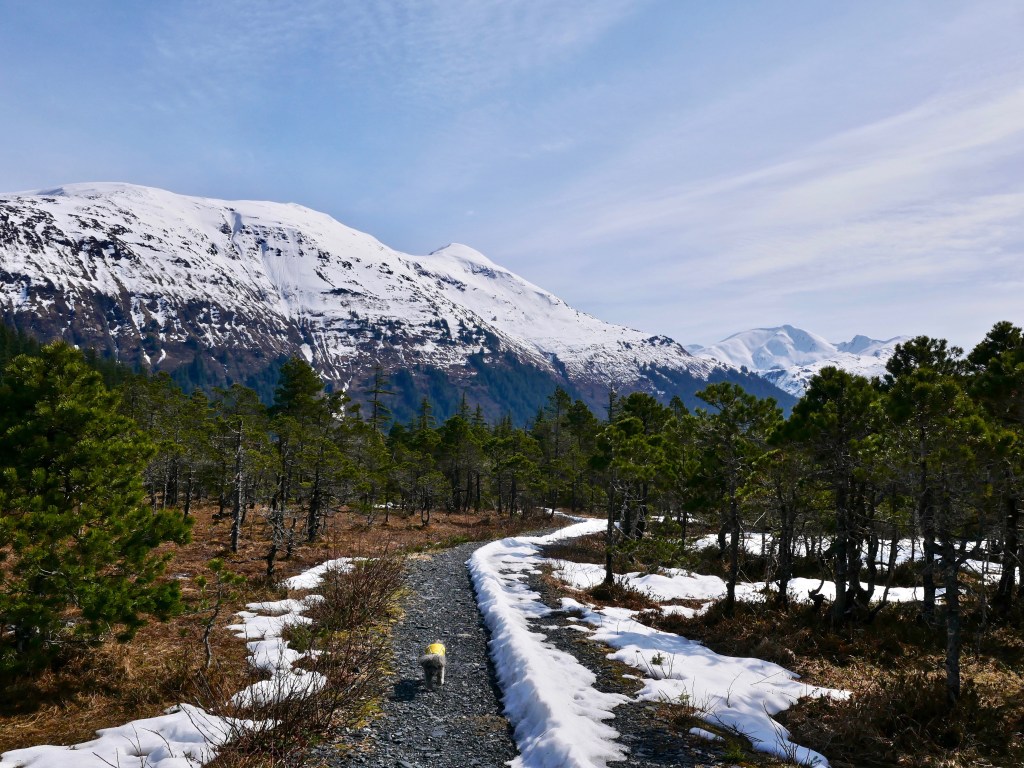
            Snow still covers part of the meadow trail. A sharply defined line of it stands in the middle of the trail, like the third rail of the D.C. Metro. The snow forming the line was compressed tight by many winter-boot prints. It will be the last to melt.

            Robins sing and Stellar’s jay scold from the branches of Douglas pines. I wish the jays would let the robins perform. After a winter of silence on the meadow, spring bird sounds are very welcome. 

            I coax Aki off the main trail and follow a deteriorating one onto the meadow.  Without meaning to, we flush a flock of dark eyed junkos off the snow. Some carry bits of dried grass in their beaks. They will fledge two crops of chicks in their meadow nests before the snow returns. 

            Even though Aki and I enjoy the warmth of this spring day, we will miss the snow. When it finally melts away, the still frozen meadow beneath it will thaw, making it a mess for walking. We won’t see the wildflower blossoms turn pink or yellow or watch the fruit of ground hugging berry plants plump and color. Those things will be for the birds, deer, bears, wolves, and coyotes on this pocket wilderness. 

Silence

Wind-driven rain slammed into the car as we drove out to the northern end of Douglas Island. The rain but not the wind stopped when we arrived at the trailhead. When a few minutes down the trail we flushed a varied thrush from the trail. It landed on a nearby alder branch and gave the little dog and I a hard stare. That’s when I notice the total absence of bird song. On our last visit, varied thrush, like the one looking at us, filled the air with their blurry whistles. Wrens and kinglets added their signature songs. This morning, not one bird, or even a squirrel tried to be heard over the sound of the wind.  I normally savor silence. It’s hard to come by, even in the rain forest. But this absence of bird song is chilling. Trying not to think about Carson’s Silent Spring, I follow Aki down the switchback trail that leads the beach. 

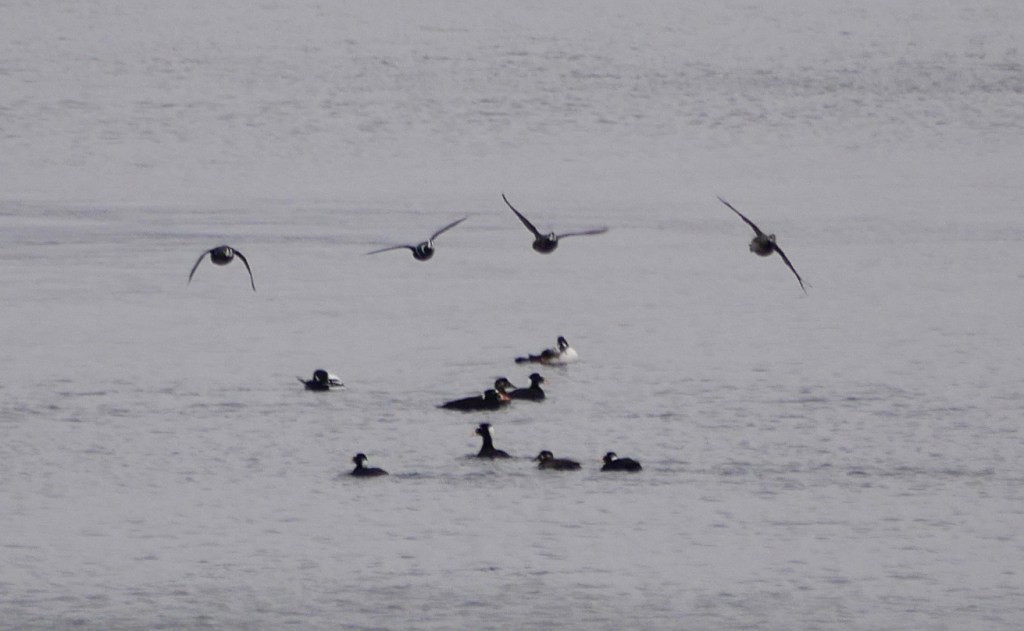
            At forest’s edge, we hear a thrush whistle and then the sweet song of a robin. The resident rafts of golden eye ducks and surf scoters work the offshore waters. Two eagles fly interlocking circles over Shaman Island. A song sparrow searches clumps of greening beach grass for food. Another sparrow sings out from inside an alder thicket. 

            Everything seems normal on the beach until a red breasted sap sucker lands on an exposed alder trunk. With jerky movements it moves up the tree, not stopping to hammer it with its powerful beak. It’s the first time I’ve seen any woodpecker land on an alder, let alone one so exposed. 

Salmon and Birds

An adult bald eagle circles over the meadow where Aki and I stand. I check to make sure that the little dog is too close to me to be eagle bait and then turn to watch the eagle. Low angle sunshine lights up the eagle’s white head and enriches the chestnut tones of its wing feathers. Taking advantage of its two-meter wingspan, it lets the wind carry it higher over our heads. 

 When the eagle’s mate calls out from a nearby spruce top, it glides toward a nearby one, hovers for a second over its apex, and lands, talons first on a thin branch. The tree top sways with the eagle’s sudden weight, rocking the big bird back and forth until it settles. Once stable, the eagle watches a yellow legs sandpiper quick stepping across the shallows of a small pond.  

Earlier in the walk we watched two guys from the hatchery installing net pens for holding king salmon smolt. While the we watch the eagle watch the sandpiper, we can hear the sound of salmon smolt being pumped from a tanker truck into the pens. After four months in the pens, the smolt will be released. They will make their way down stream to the ocean. 

Adult king salmon, released from the pens over four years ago, will pass the smolt as they swim upstream to the pond. The big salmon, some weighing more than ten kilos, will wander around the pond, trying to find a way to satisfy their instinctual urge to spawn. A few might follow silver salmon upstream to their spawning gravel. Most will be caught by fishermen or bears. 

Return to the Troll Woods

It’s been a long time since Aki and I last walked through the Troll Woods. The trails, pounded out by beaver feet, see few humans. The disintegrating chassis of a VW Beetle is the only sign of our civilization. Proof of beaver presence is everywhere. Every few meters the little dog and I have to step over the trunks of beaver-fallen cottonwood trees stripped each bare of bark.  

            Still standing cottonwoods bear heavy loads of moss that drips rain water onto the mossy forest floor. Colonies of leaf-shaped lichen cling to the sides of spruce trees like swamp orchids. Moss covers every surface not treaded on by beavers, even glacier erratics—those granite boulders scatter over the moraine by the retreating Mendenhall Glacier. 

            The blurry whistles of nest building thrush mix with the sweeter tunes of other song birds as we approach a pocket lake. Ice covers all but a tiny portion of the lake’ surface. A brace of bufflehead ducks float on this lake within a lake. Even though we are on the opposite side of the lake, the male duck seems more interested in us than a discordant squeal coming from deeper into the forest. While I try to guess what kind of bird is making the noise, I hear the tinkle of tiny bells. Someone is making a first crossing of the woods on their mountain bike while a dog wearing bear bells patrols ahead.  

Nothing is Wasted

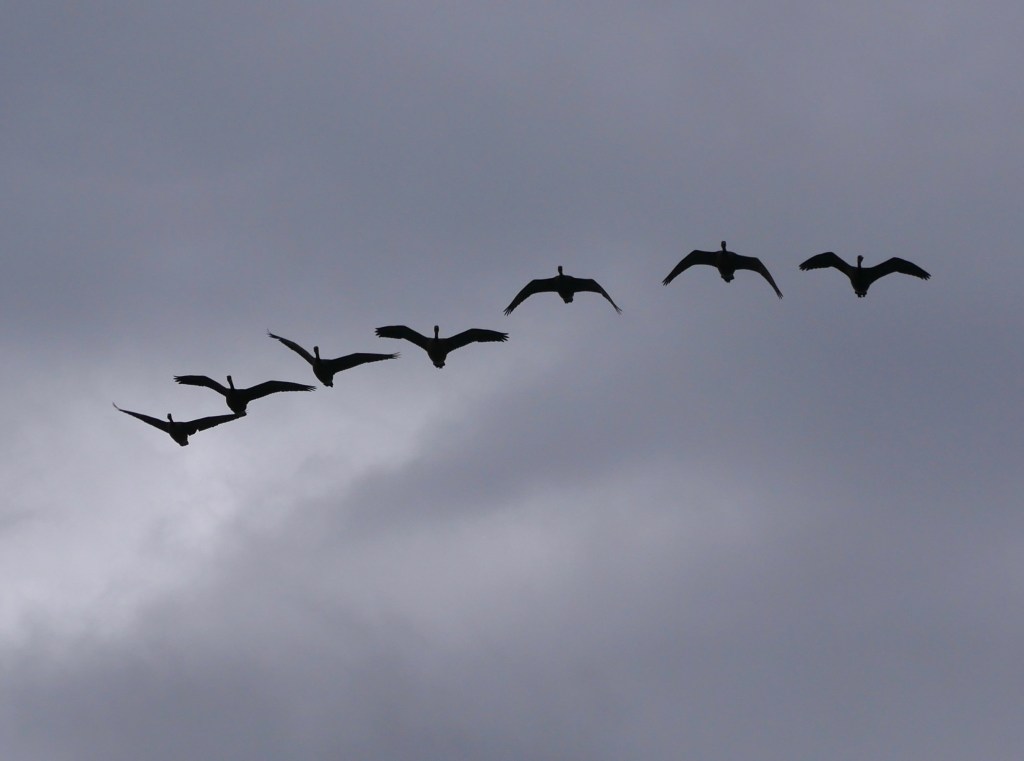
Several hundred Canada geese are chowing down along Eagle River. The biggest concentration is on a large tidal meadow. I have to take care not to step on their scat as Aki and I skirt the meadow.  

A smaller group of poke around for food on mud flats now exposed at low tide. Mallards waddle around them until an eagle flies over, flushing the ducks to flight. The geese ignore the eagle as they jab their beaks into the mud. What are they eating, little dog? Aki never heard my question. She’s turned a sand bar into her own race track, running circles around its parameter for the sheer joy of it.

 Near the river mouth, wave erosion has destroyed part of the trail and halved the size of a small copse of spruce trees. Because they root in glacial silt and sand, the spruce trees have smooth, straight roots. Tlingit weavers have come all the way from Ketchikan to harvest the roots, which they use to strengthen strands of their weaving wool. I wonder where they will find replacement roots when erosion finally wipes away this little forest.

After walking on the beach, I lead Aki across a grass-covered dune and stumble upon the esophagus of a Canada goose. The thick-sided, opaque tube is crammed with small, pink-colored shells. Other shells and a crab claw have spilled out of one end of the esophagus. This not the scene of the crime, which would be marked by a scattering of bones and feathers. I suspect that a raven or eagle was attacked by another scavenger bird while carrying the esophagus in its talons. The prize fell onto dune while the birds continued to scrap. They flew away, allowing slugs to finish what remains.

Mellow Swans

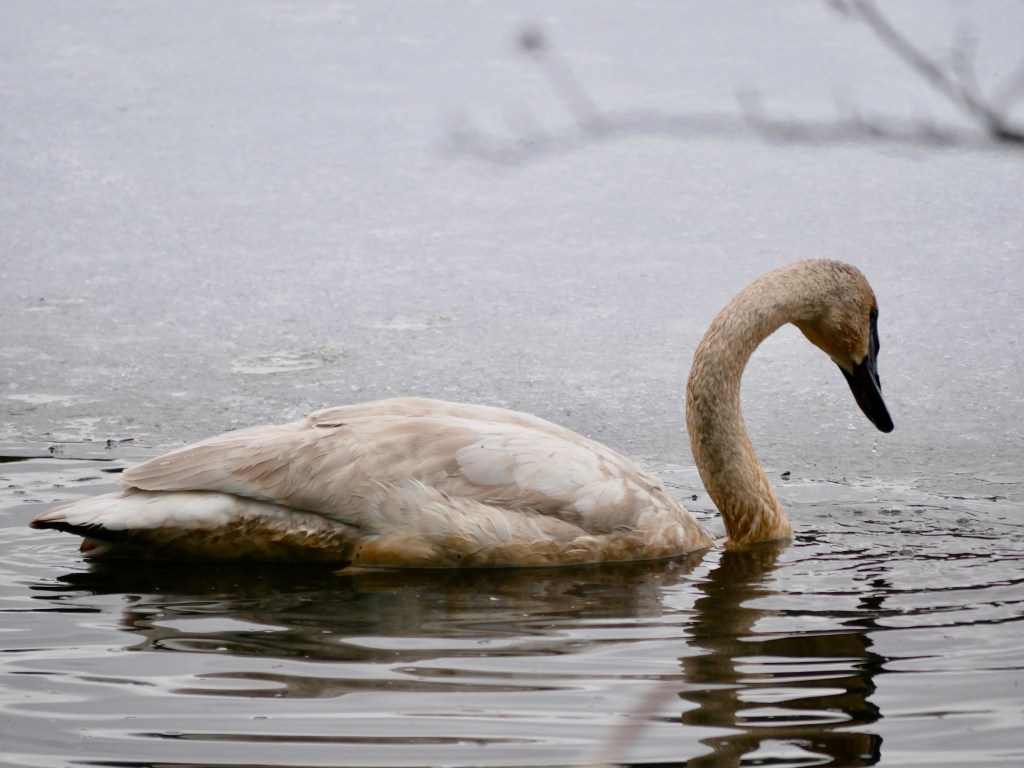
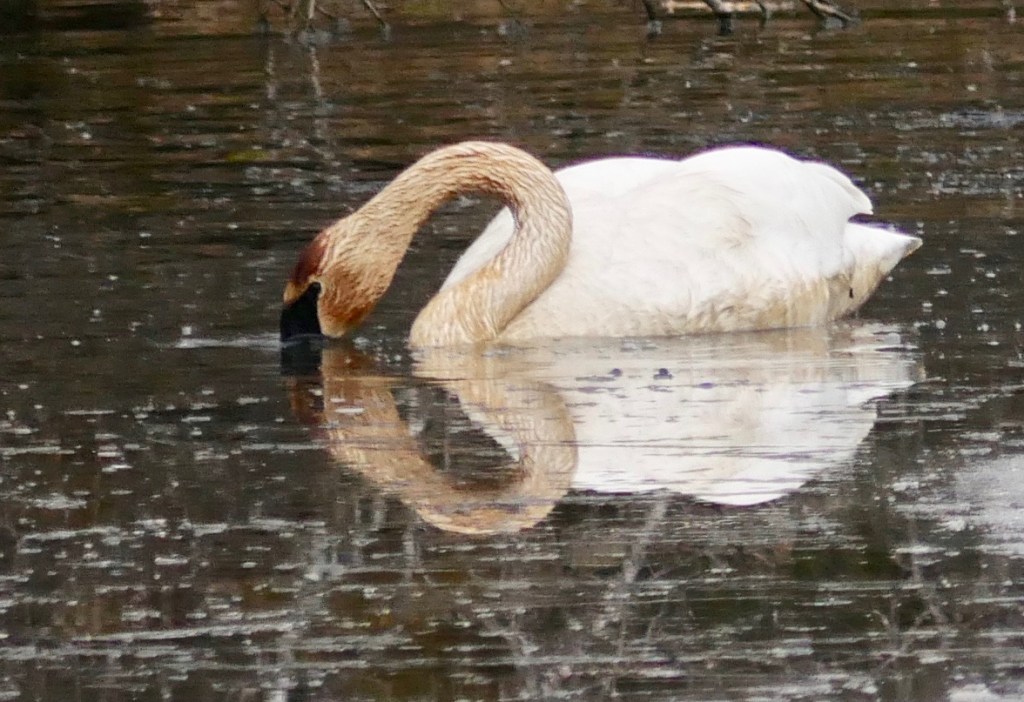
Aki stands staring at two trumpeter swans that feed in a sliver of open water on Moose Lake. Her tail is up but she doesn’t bark. The swans, only a meter away from her, continue to search for food in the calm manner they showed when we first spotted them.

            A screen of alders prevented me from seeing Aki approach the swans or I would never have let her go so close to the tired looking birds. I would have kept closer tabs on the little poodle-mix if not distracted by a stream of water drops pouring off the beak of a third swan that swam a few meters away from Aki’s brace.  

            Because of their massive size, few animals prey on swans. Trumpeters are the largest waterfowl in North America. Their wingspan exceeds two meters. Humans could bring them down with a well-aimed shotgun but that would break federal law. This might explain why the much-hunted mallards usually fly off in a panic when we approach but swans just ignore us. 

            This morning a brace of mallards paddle tight circles around one of the feeding swans. The mallard hen gives me a hard stare, then returns her attention to the swan. The ducks must be feeding on scraps that fall from the swans’ beaks or eating food stirred up as the swans dredge the lake bottom with their massive beaks. 

One Last Ski to the River

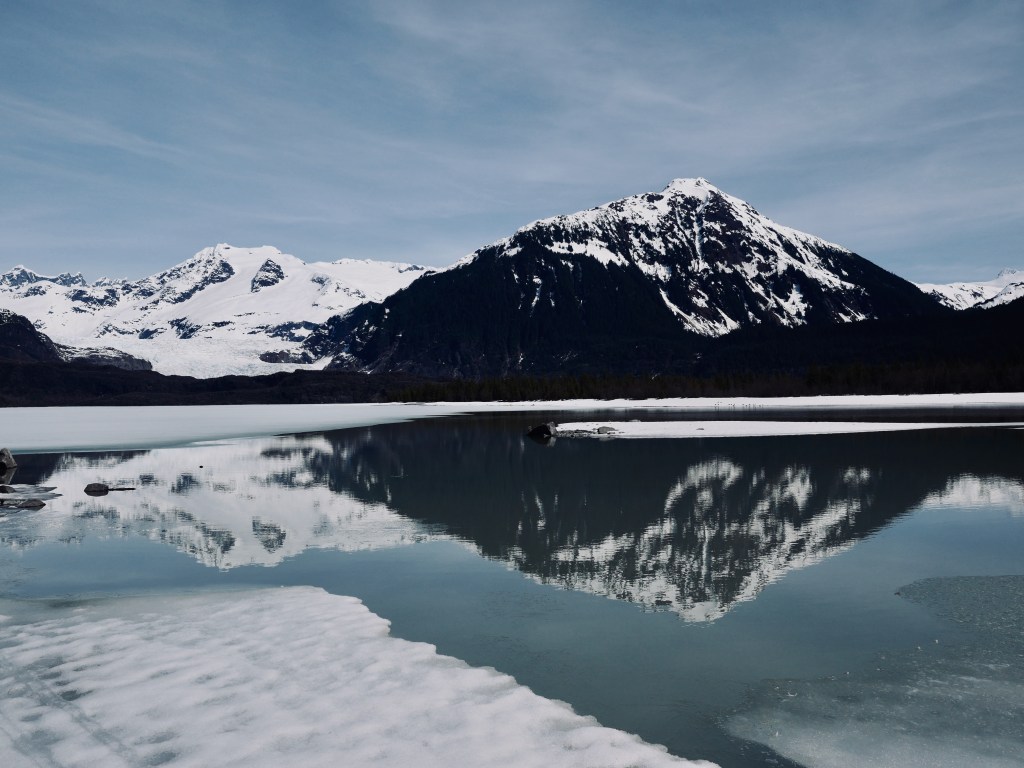
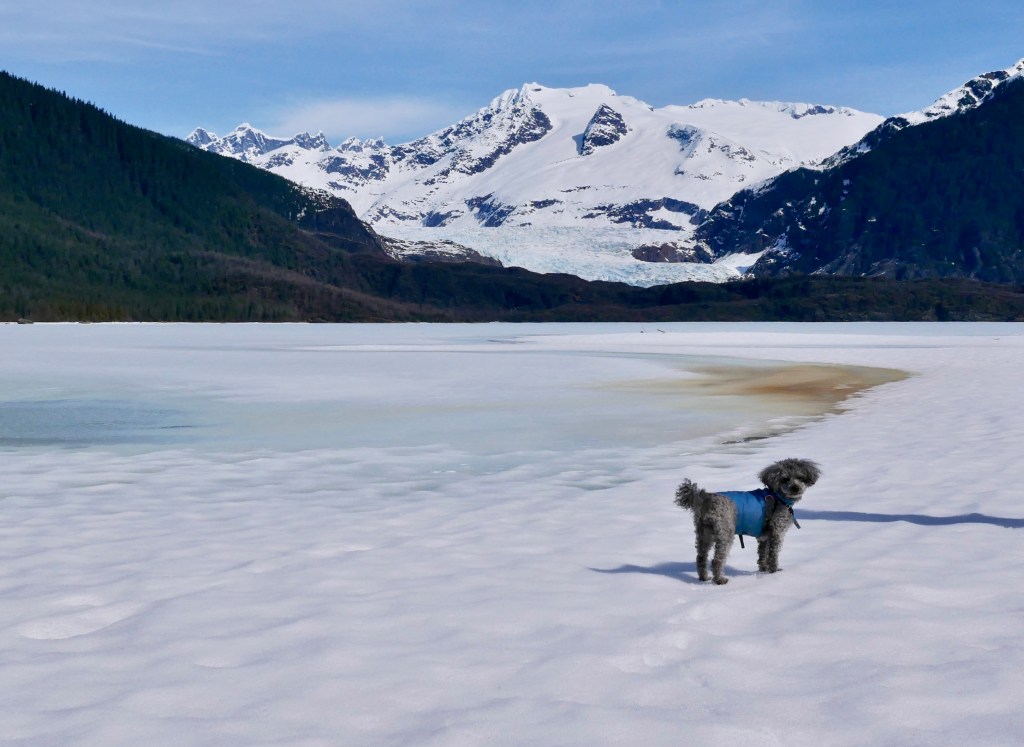
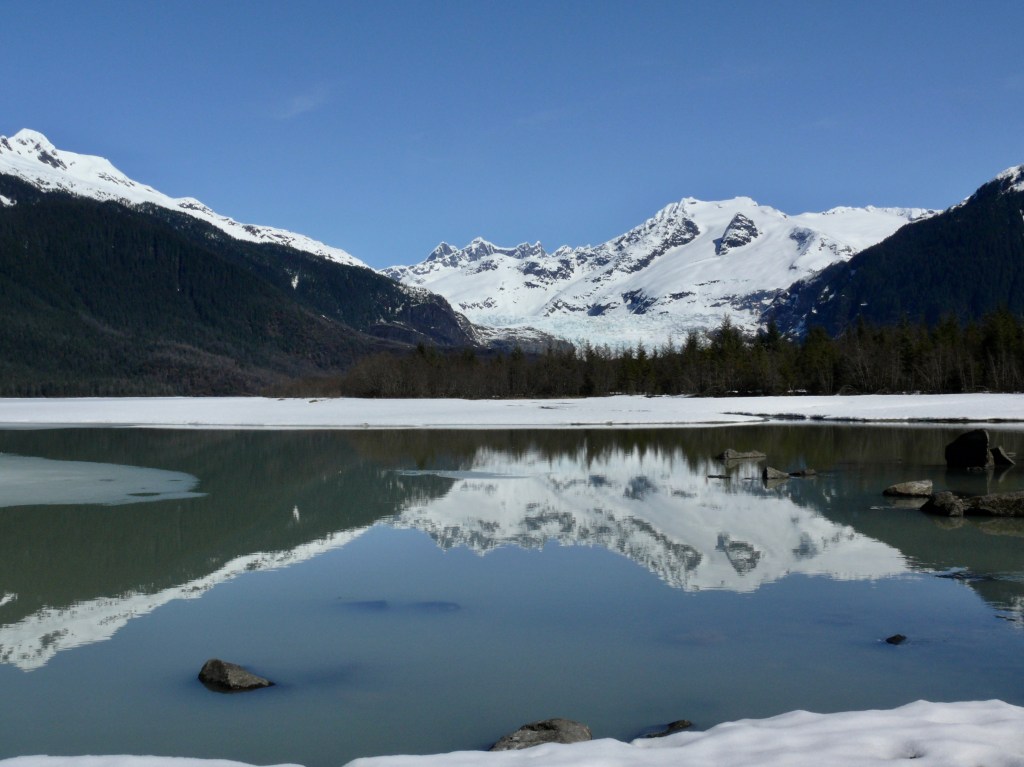
Wondering if we can ski all the way to the river, I lead Aki past Skater’s Cabin and onto the still-snow-covered beach of Mendenhall Lake. The snow is softer than yesterday but still firm enough for skiing. Like yesterday, we have the place to ourselves. 

            Aki rolls in the snow and then plants her face in it. Holding a handful of the coarse-grained stuff is like holding a handful of cold sand. Crush it and you have an ice cube rather than a snow ball. 

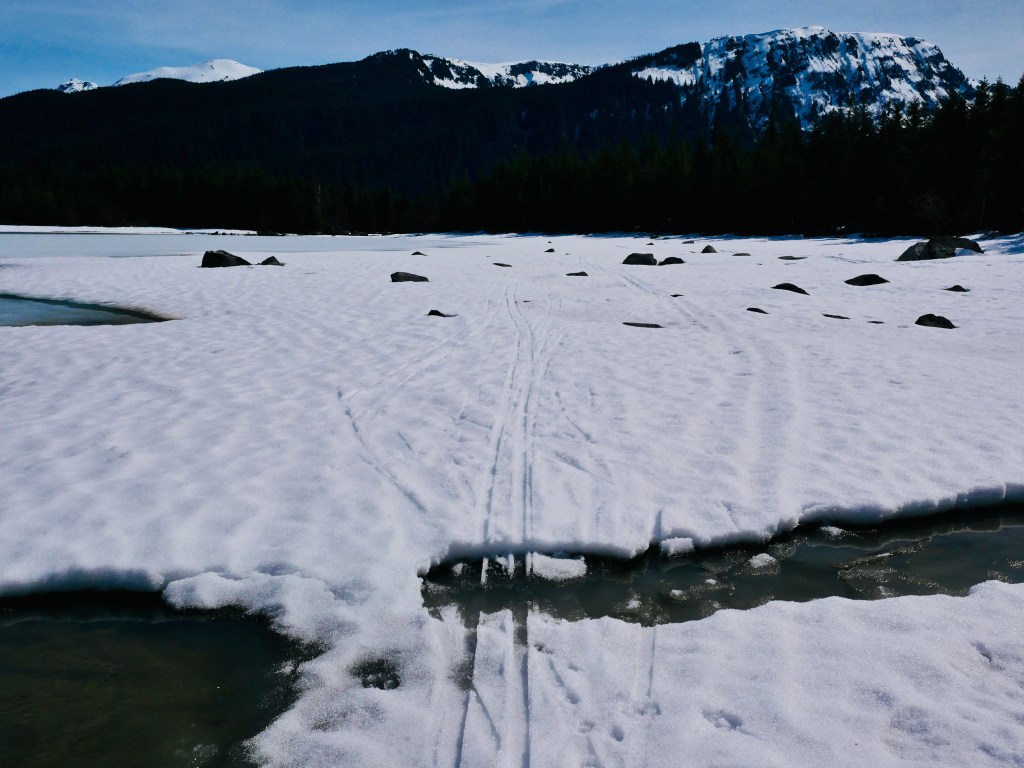
            I ski parallel to yesterday’s tracks, surprised to see the tops of rocks poking up through them. On the way to the river, my skis break through a snow bridge over a narrow stream. Thanks to expanding bare spots along the river, I will have to carry my skis a longer distance than yesterday.  

            We pass divots in the snow formed by light, fallen objects rather than rocks. Sun heated things leaves, feathers, and tangles of tree lichen have melted the snow where they came to rest. I remember visit I made this time of year to Grayling on the Alaskan portion of the Yukon River. An Athabaskan man was scattering wood stove ash onto a bulldozer sized patch of snow. When I asked him why, he dug down until he struck the yellow-colored cab of a small Caterpillar earth mover. 

Safe Social Distancing

It’s already 10 degrees Celsius and the sun’s been up for hours. Good thing I can hike in these ski boots, little dog. Aki, who knows she will get in a walk one way or another, doesn’t care what kind of boots I pull on this morning. After securing her in the car and fasten skis and poles on the roof top carrier, I drive out to Mendenhall Lake.  A lot of snow covered the shore two days ago. Maybe we can still ski along the beach. 

            The warm, sunny weather has drawn people away from their home shelters. Cars fill the Fred Meyers parking lot. More head out Glacier Highway to drive thirty miles to the end of the road system and return. I expect to find the lake shore crowded with people escaping quarantine. But the Skater’s Cabin lot is empty as is the lake. This is almost as surprising as trail conditions. The temperature dropped below freezing last night long enough for a thick crust to form on the beach snow. 

            The little dog trots behind as I sneak onto the lake ice to skirt a bare spot in the beach. It holds, even offers good skiing. I think, for a few seconds, of leaving the safe, solid shore for the freedom offered on the lake ice. We could ski all the way to the glacier free from people and virus worries—establishing a social distance of six kilometers rather than the two meters we must struggle to maintain at the grocery store. But breaking through the lake ice far from help could create a social distance I could not close without becoming a ghost. 

            We return to shore and ski again to the river where mallards sunbathe on the snowy banks. Some fly further downstream when we approach. Most just ignore the little dog and I. The even ignore the martial sound of an avalanche crashing down the flank of Bullard Mountain.

Soft Beauty

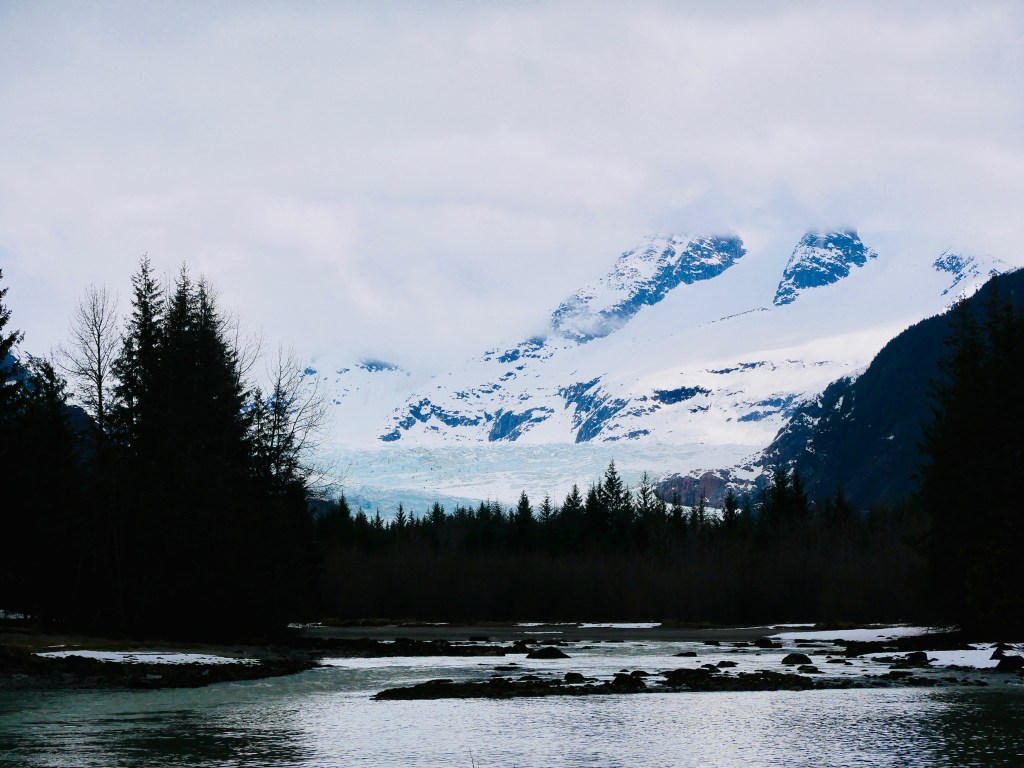
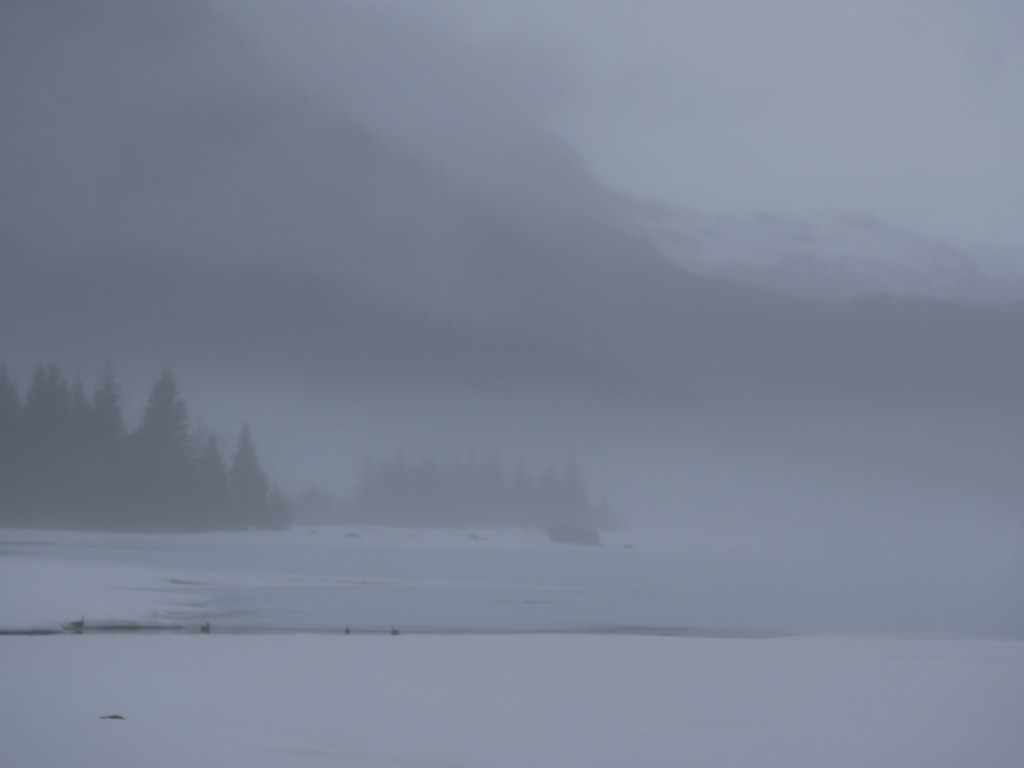
Wanting at least one more chance to ski, I drive through the rain to Mendenhall Lake. We have it to ourselves. Fog and clouds obscure the glacier and mountains. Spruce covered peninsulas appear and disappear in the moving gloam. Aki breaks through the snow crust every fourth step while my skis keep me on top of it. For the first time all winter, I have it easier than the little dog. 

            At first, I am disappointed with the views. Then the glacier ghosts into view for a moment. The ice color deepens then fades. The glacier disappears. I can briefly make out the silhouette of a Canada goose and those of a raft of Canada geese. Then the soft power of the day returns. 

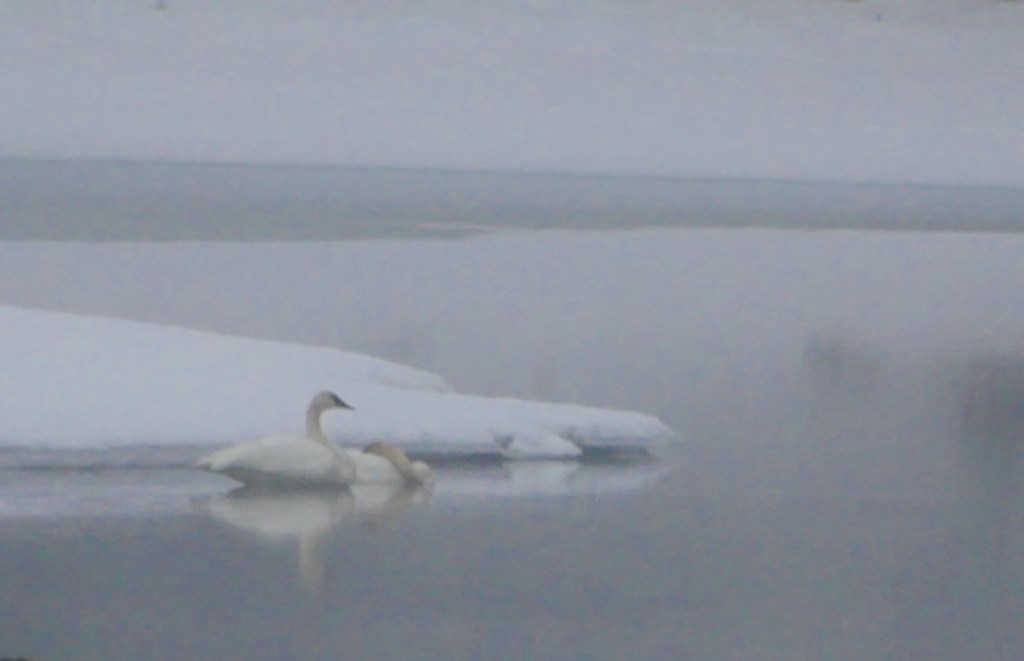
            We ski over to the river and follow it to a section broken into channels by rocky islands. It’s a place of eddies that trap food for mallards and swans. I count 9 trumpeter and (I think) 2 tundra swans.  They must be new arrivals, taking a break from their northern migration. The trumpeters have formed a community on one of the islands. Resident mallard ducks crowd up close to them. Downriver, the two tundra swans cuddle off a snowy point.