Aki and I are racing through the Troll Woods, pursued by mosquitos. Six or eight of the pests buzz around the little dog’s face each time she stops to sniff or pee. She shows no sign of being bit. I wish I could say the same. I have a rosary of bites across my forehead. It’s not surprising, then, that we have the woods almost to ourselves.
The place is full of birds. Robins dare Aki to chase her. She is no mood for the game today. Song birds belt out their nesting tunes in the canopy. Most are hidden in the leaves. But a winter wren settles on an exposed branch and belts out its signature song.
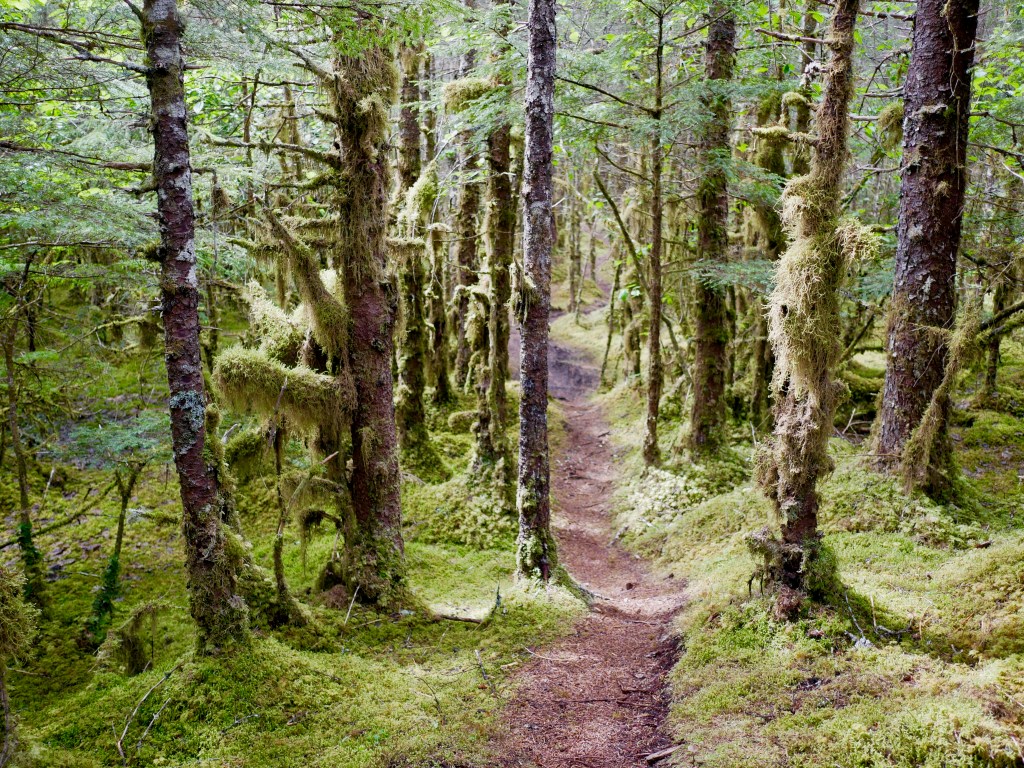
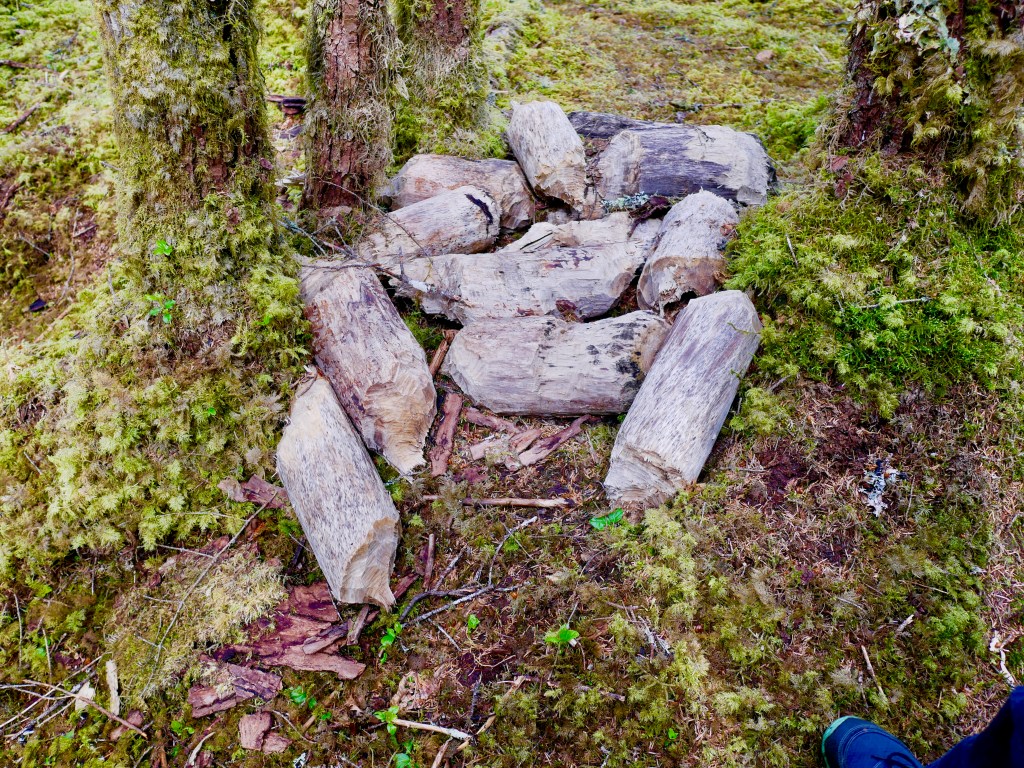
We leave the gravel paths and follow trails in the mossy floor that were pioneered by beavers. They are night workers so none appear outside their log-covered dens. But evidence of their presence is everywhere. Sticks stripped of their bark float in the lakes. Similarly denuded cottonwood tree trucks lie on the forest floor. We even find a wood pile of foot-long logs that were cut up by the beaver’s sharp front teeth, not a saw. I wonder if the beavers are preparing wood for a mid-summer bon fire.
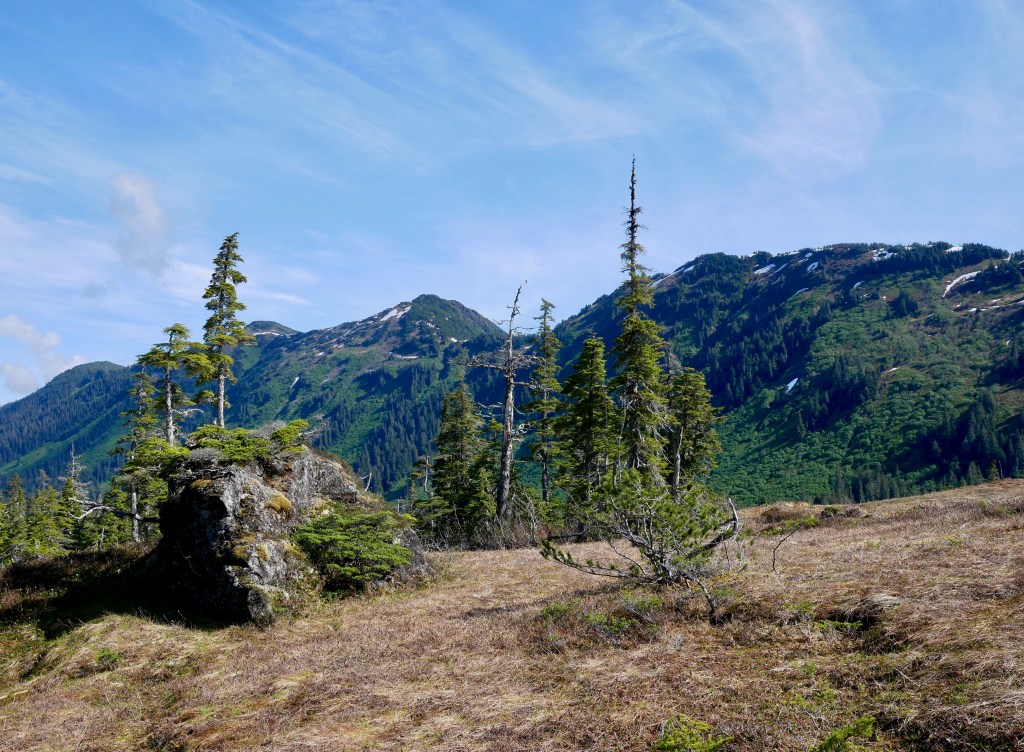
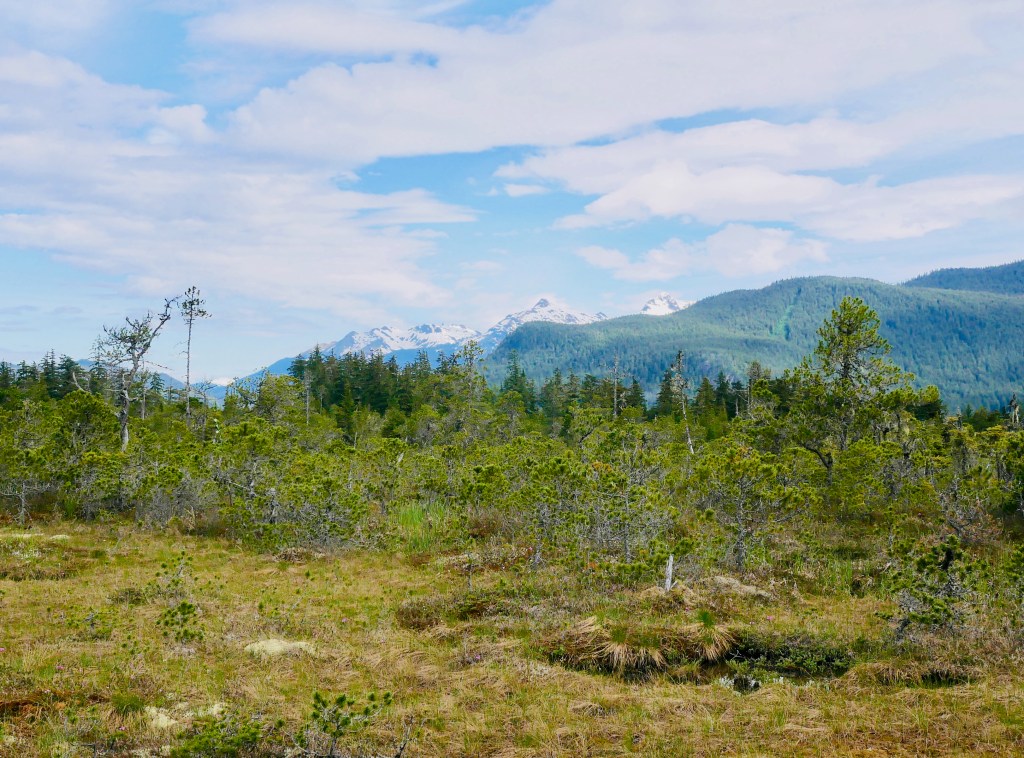
Aki is only a tiny red dot on a gravel road. I’m two hundred meters above her on a bog-covered hillside. I’m heading toward Cropley Lake. Aki is using her mental superpowers to force me off the mountain. It is not going to work today, little dog. I am not going to turn around, not on this sunny day. In less than a minute, Aki joins me. She doesn’t look happy, just determined.
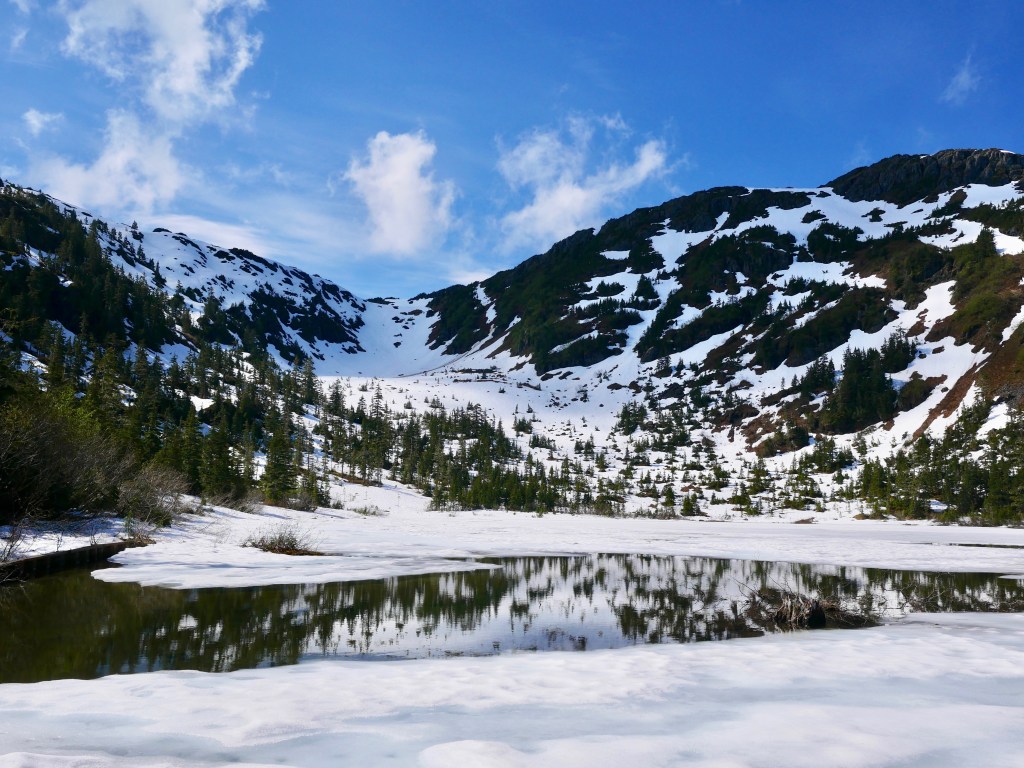
I know Aki will change her attitude when we reach the snow. But first we must climb up a stony stream to a false summit. From there the grade lessens but the trail conditions deteriorate. The little dog and I make our own trail across a meadow just awakening after winter. I stop once to fill my hand with bog cranberries that have wintered under the snow. When I offer Aki some of the berries, she nuzzles then out my palm like a hungry horse.
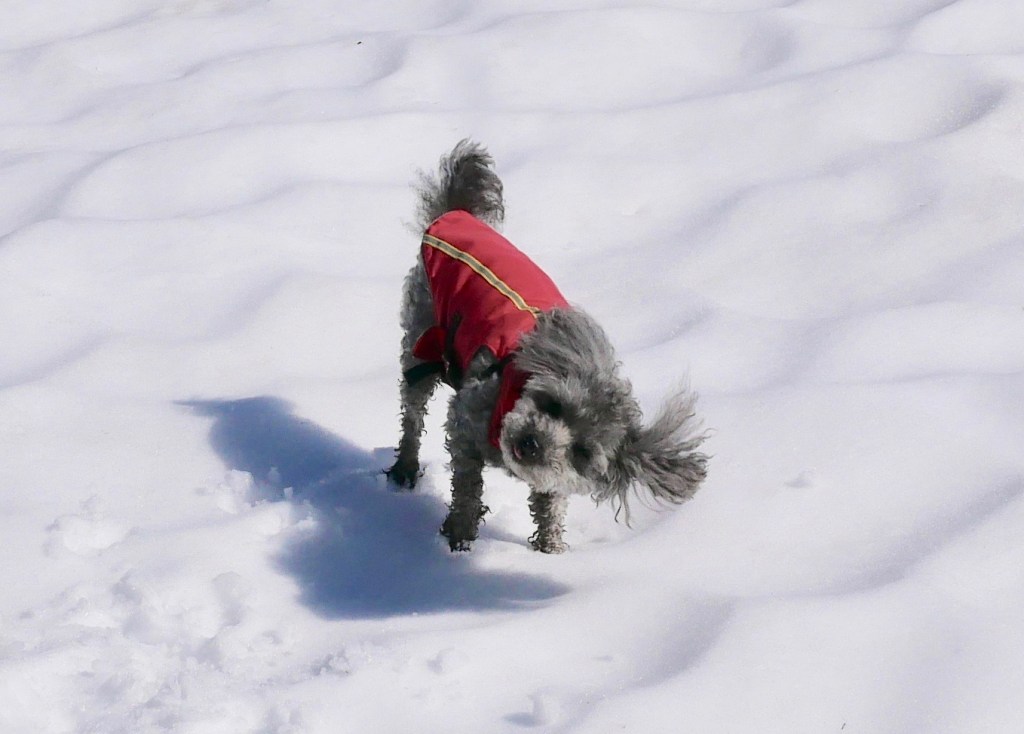
The little dog trots onto a snow field, which offers an easy way to summit a little hill. While she paws and plays in the snow, I continue up hill, following a line of bear tracks to the summit. Below, the still-frozen lake fills a little mountain basin.
Aki takes charge on the hike back to the car. She finds a gentle slope that would lead back to the rain forest. But to continue, we would have to cross Fish Creek. I worry that Aki would be swept away if she fell into the swollen creek. We back track and find a safe place to cross the stream and take a surer, if longer, route to the car.
No reading person could ignore the sign—a black silhouette of a bear walking across a square of yellow cardboard. Black block letters warn that we are entering bear country. Aki takes no notice. I also try to ignore the warning. We saw no bear sign on the beach. High water levels on the lake forced us off the beach and onto a trail that led into the Mendenhall Campground, a place with signs and federal officers to enforce the rules.
The little dog and I walk down the road that links all the campsites, stopping to watch a mallard hen and her chicks splash around a small pond lined with flowering British tobacco plants. All winter dogs have left pee mail messages along the road. Aki does her best to catch up. She runs free until we reach a bulletin board with another bear warning sign and a poster demanding that all dogs be kept on a six foot long leash. “It’s the Law.”
The normally law abiding Aki submits the leash. It does little to limit her actions. She has the ability to turn herself into a 50 pound rock when she wants to stop and sniff. I can’t shift her once she has exercised this superpower.
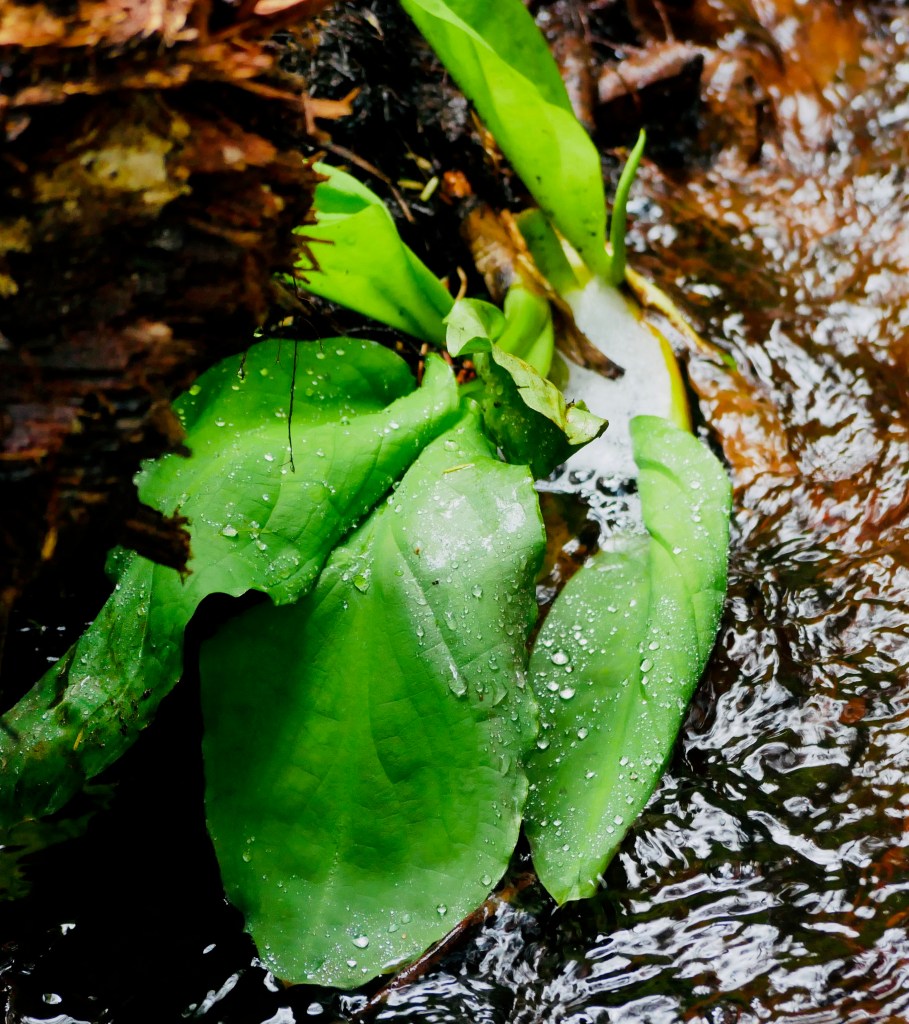
We rain forest dwellers take special care with our roofs. Under a good metal roof, you can fall asleep to the sounds of rain drops. Wearing good rain gear allows you to enjoy the sound of heavy rain drumming on broad-leafed plants, like devil’s club and skunk cabbage. This morning the rain is beating a comforting tattoo on the plants that lines the Rainforest Trail.
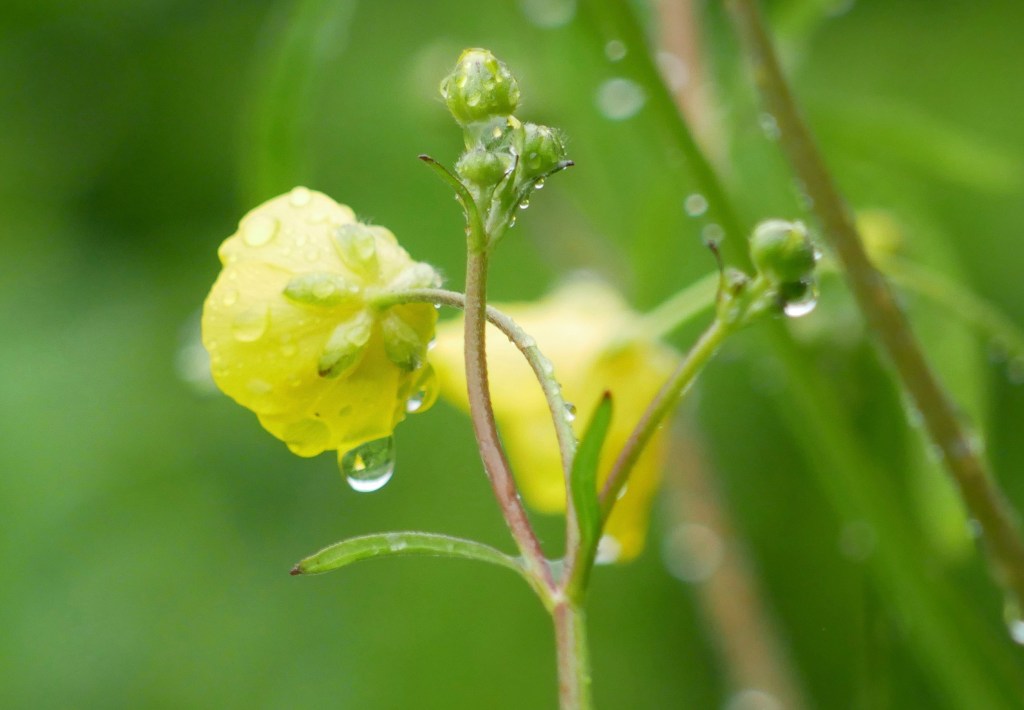
Aki is taking more than her usual amount of time reading her pee mail. Maybe she is worried that the rain will wash the messages away. I don’t mind. I use the extra time to watch water drops fattening at the end of buttercups and huckleberry blossoms.
We pass two young women on our way to the beach. One is wearing shorts and sandals, the other light canvas shoes. Rain has soaked their bare heads and limbs. One bends down to pet Aki. The other clutches beach greens in her hands. You can tell that both were born in the rain.
We are lost. Well, at least I am. Aki might know exactly where we are but she won’t share. It happens each time we try to find this meadow trail. To reach it, we must pass through a thicket of alders and shore pines. Deer paths crisscross each other in the tree tangle. Only one delivers you to a trail that cuts across the meadow to a small, rocky rise.
Passing through the thicket is like being spun while blindfolded at the beginning of pin the tail on the donkey. When the spinning stops, you have no idea of where you stand in regards to your goal. For Aki and I, our goal is the cross meadow trail. After emerging from the thicket, I have no idea of how to find it.
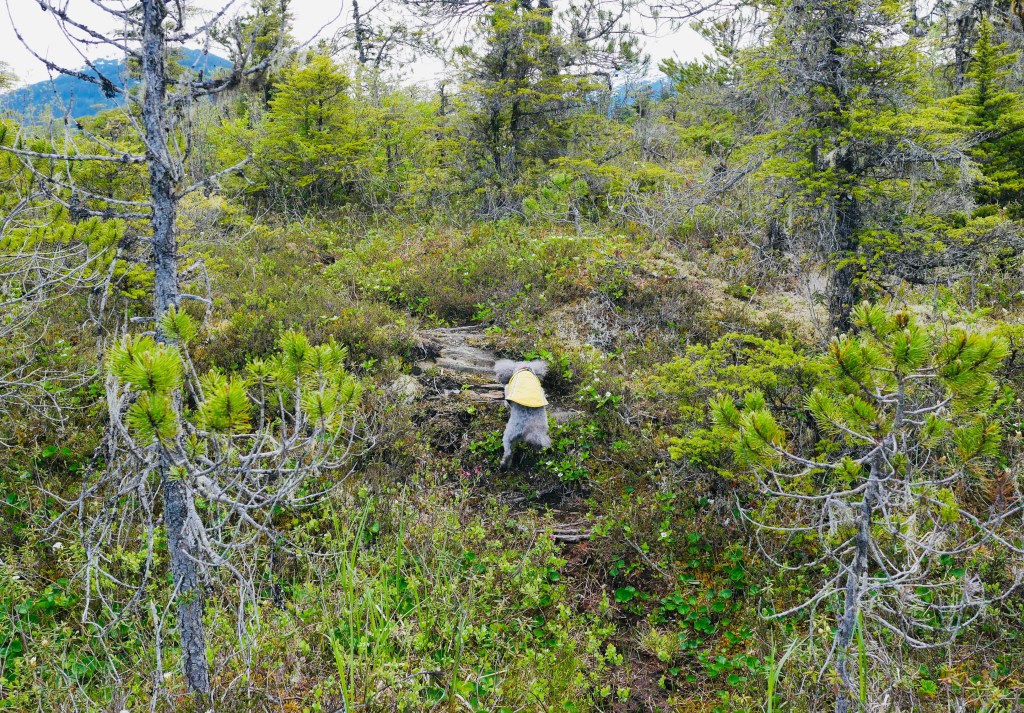
The little dog and I wander over an unfamiliar section of the meadow. It gives like a sponge. When Aki tries to find more stable ground, she ends up having to splash through a pond covered with floating moss. After that, she takes charge. Following her powerful nose, she starts off in a direction that I would never take. Every few meters, she looks over her shoulder to make sure I am following her.
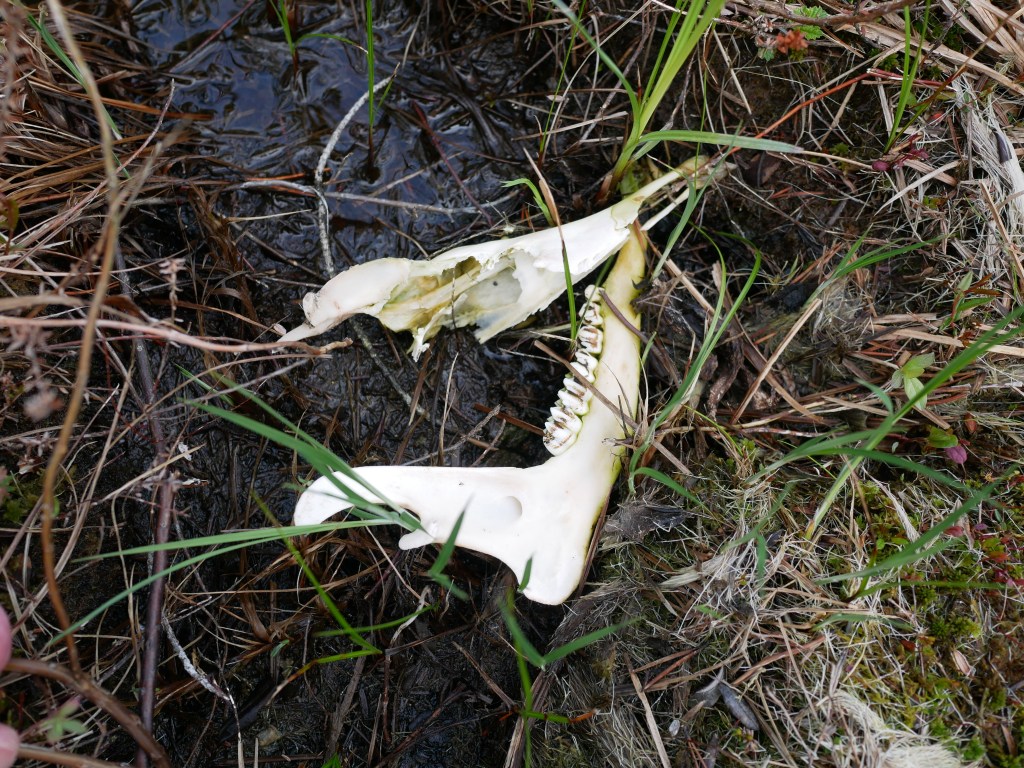
Relieved to have some direction, I follow her lead. In a few minutes we reach the good trail and follow it to the rocky rise. After a brief rest, Aki leads me off the rise and down the meadow trail. When she veers onto a faint deer trail, I follow to the end, where a deer had died. Time has reduced the carcass to fur and bones. Aki reluctantly agrees to follow me back to the main trail. Believing, probably falsely, that the balance of power in our relationship has shifted back to me, I lead the little dog back to portal thicket.
Aki and I are getting a late start on this walk down Bad Dog Trail. That’s our family name for it because one of our dog walker friends had too many run ins with bad dogs on it. Some of the trail users do let their dogs run wild, which puts a lot of stress on the birds. Maybe we should rename it the “Bad Dog Owner Trail.”
Fifty meters down the trail a male tree sparrow on a nesting box munches down a large dragon then looks up to glare at the little dog and I like a sentry. The swallow refuses to yield ground, even though the trail takes us to within two meters of its position.
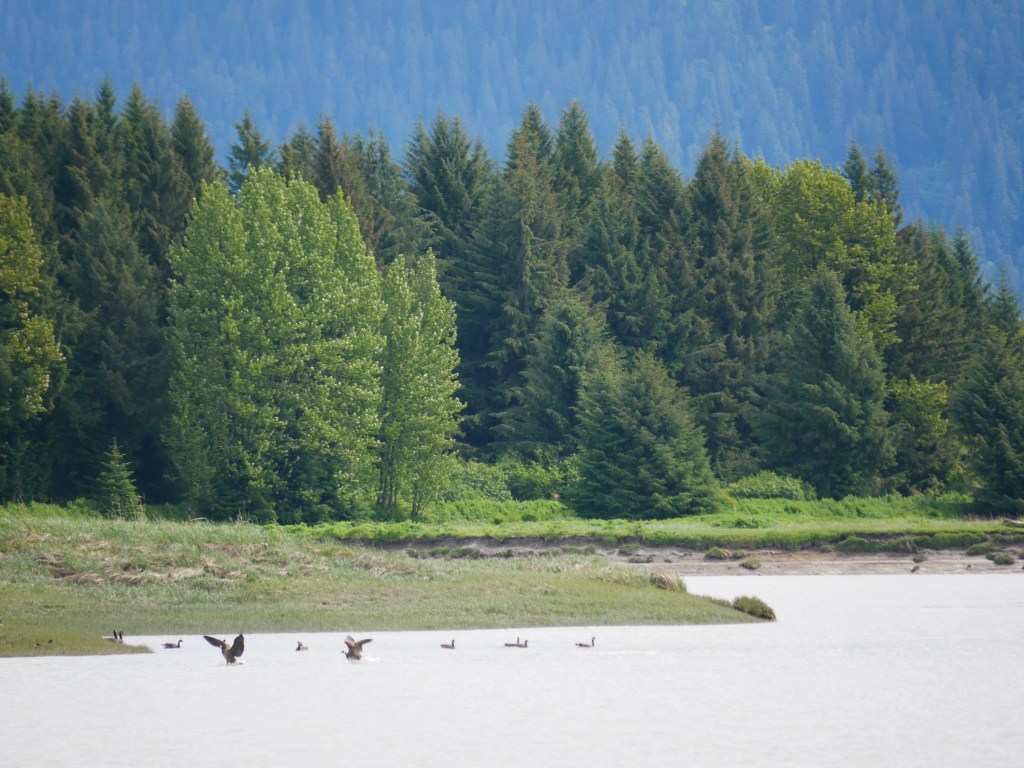
A boat moving up river with the tide flushes a hundred noisy Canada geese to flight. They relocate just offshore from a grassy island and return to their feeding. If there are ducks in the river, I can’ spot them. Other than the geese, the only birds we see are small, like the tree swallow.
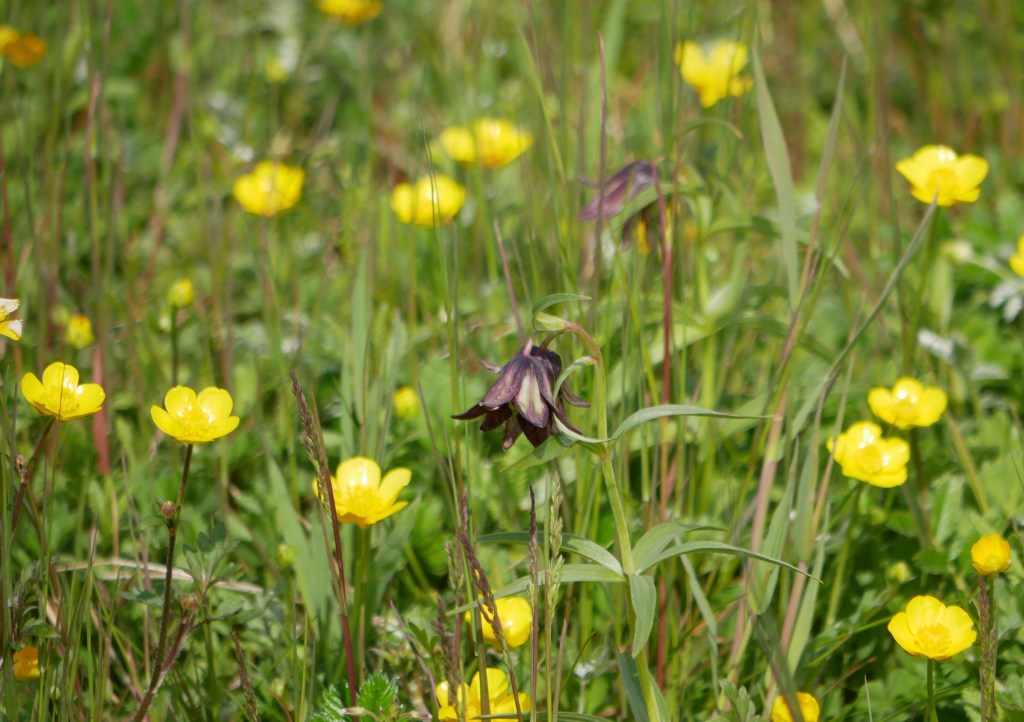
We stop to listen to a pine siskin sing that gives me a hard stare. Another bird refusing to give ground. Song sparrows flits away any time we come near them. Two bounce down in a mixed clump of chocolate lilies, buttercups, shooting stars and lupine. I envy their ability to look up through a canopy of blossoms shinning in the morning sun. The swallow sentry is waiting for us when we approach the car, ready to give us a “move along” look.
We are running late. It’s already noon so we should expect to find people having lunch on the Eagle Landing Beach. The almost full trailhead parking lot almost assure of running into someone on the trail. But we are the first dogs or humans to reach the beach where a brace of merganser ducks sunbathes.
The ducks must be stunned by the sun because they don’t stir even after we break out of the woods. The female is the first to notice the little dog and I. Without rising to her feet, she wakes up her mate with a squawk. The drake, with his chest nestled into the beach gravel and his head raised to the sun, still won’t move. Only when the hen stomps off toward the water does he rise.
It’s a treat to walk on a beach untracked since last night’s high tide. We only find the tracks of the mergansers and one deer. Aki and I make parallel tracks on the beach before returning to the woods. The trail leads across a little headland to another pocket beach. Just offshore a land otter fishes. He quickly disappears, perhaps into another forested headland. We cross that one two, finding not a land otter but plenty of evidence of its presence. Empty sea urchin shells litter the mossy floor. Near one such a shell pile, I discover a folding pad, the kind that cross country skiers sit on during coffee breaks. Seeing it detritus, I carry away the pad. At home, I find a ring of bite marks left by the otter that carrying into its keep.
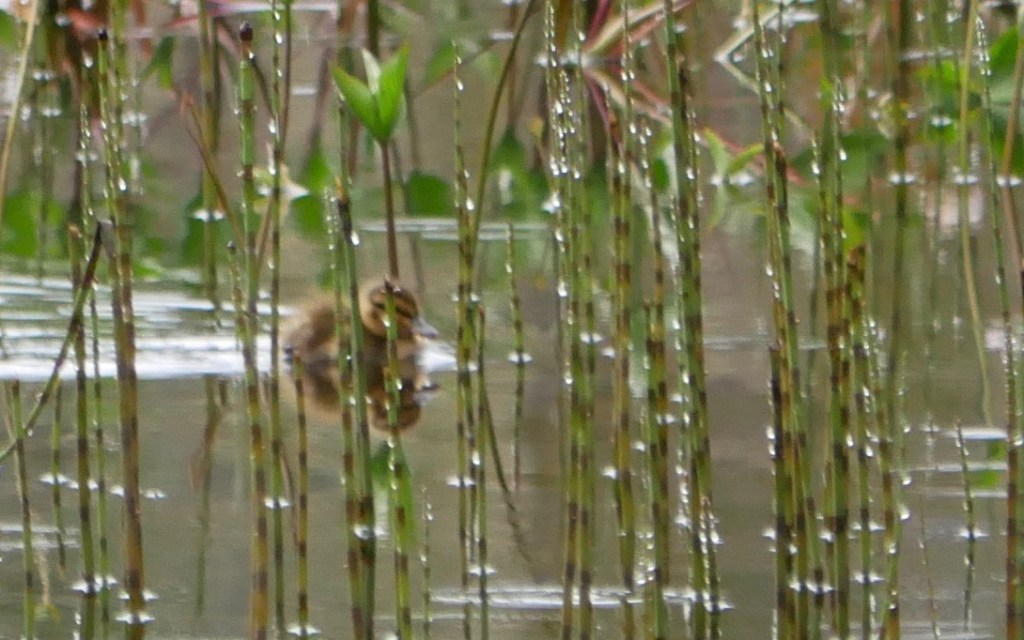
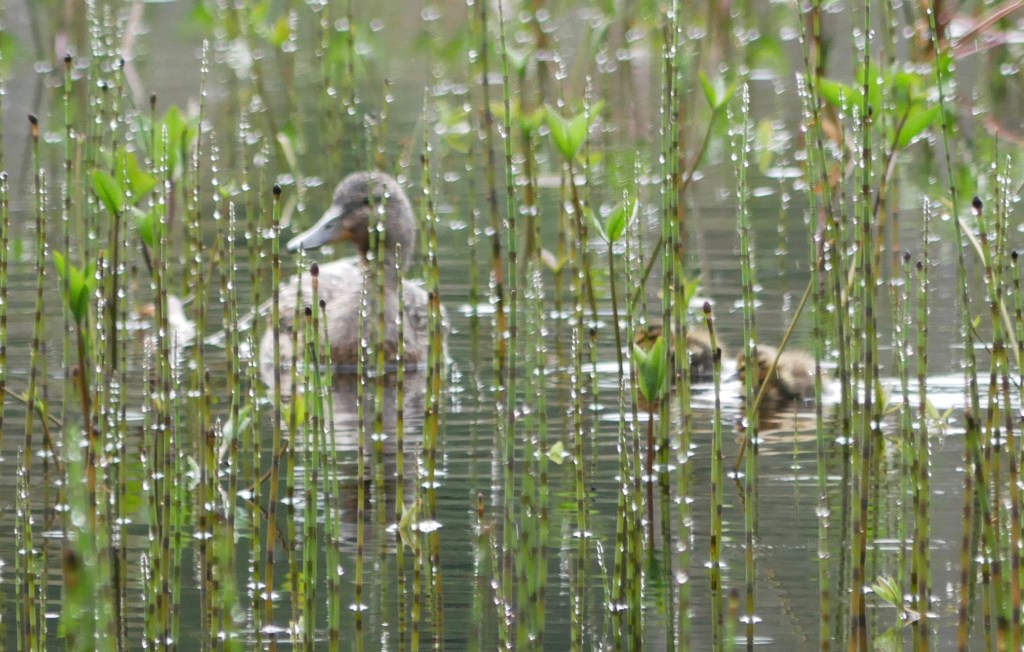
While Aki sniffs a pile of beaver dung, I stare at a yellow pond lily flower—the only strong show of color on this misty day. The little dog and I are both startled by a disturbance on the pond. It sounds violent, almost as dramatic as a beaver-tail slap. Something the size of a beaver’s head is moving with speed just beneath the surface of the water. But what emerges is a mallard hen surrounded by three of fuzzy chicks.
Last summer an eagle and a great blue heron stared down at the same mallard hen and her chicks as they tried to hide on a grassy beach. The number of chicks dropped each subsequent visit to the pond. Water now covers the beach so the hen has only pond reeds for hiding for her little family. I suspect the commotion we just witnessed was started by a low swooping predator.
Aki moves down the trail but I stay, trying to discern the duck family through a blind of reeds. It’s hard to see past the reeds because of the sparkling circles of rain water that brighten the stalk of each reed like Christmas lights.
Deeper in the forest, a raven chick screams for food. Both parents belt out even harsher tones but in a lower register. The chick will not stop squawking. I wonder if one of the raven parents had swooped down on the mallard family and failed to snatch on of the chicks. If it had gabbed one, all would be quiet in the ravens’ nest. Or maybe the duck baby was grabbed and delivered to baby raven and it was complaining about having to eat another fuzzy chick rather than French fries salvaged from beneath a picnic table.
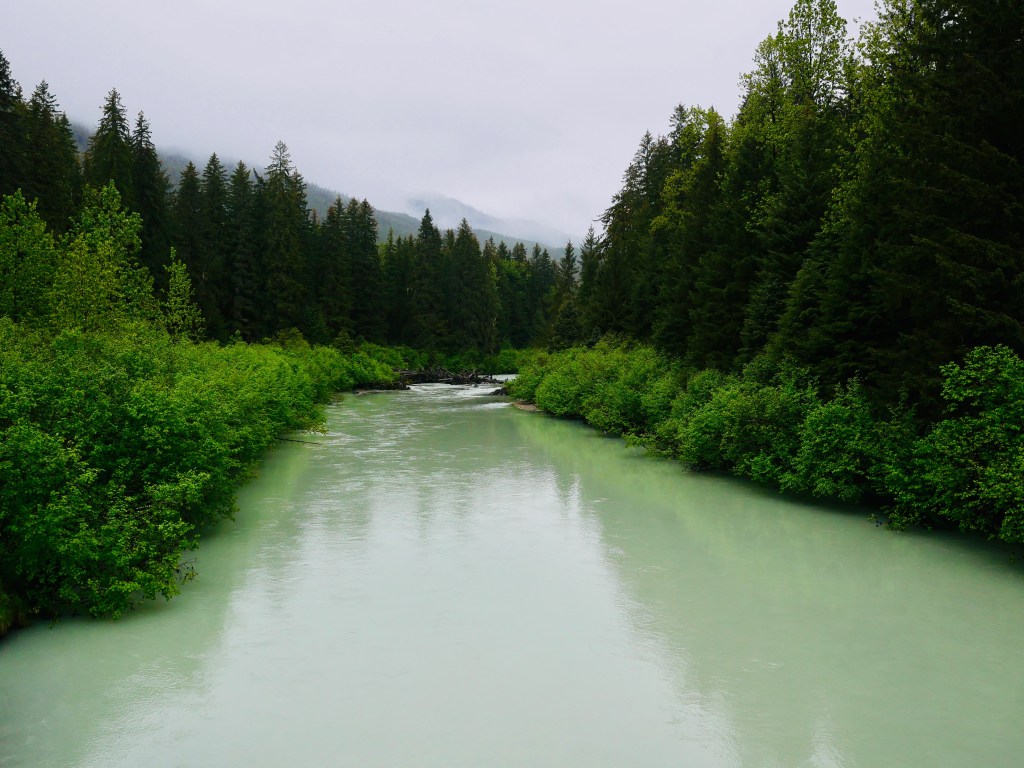
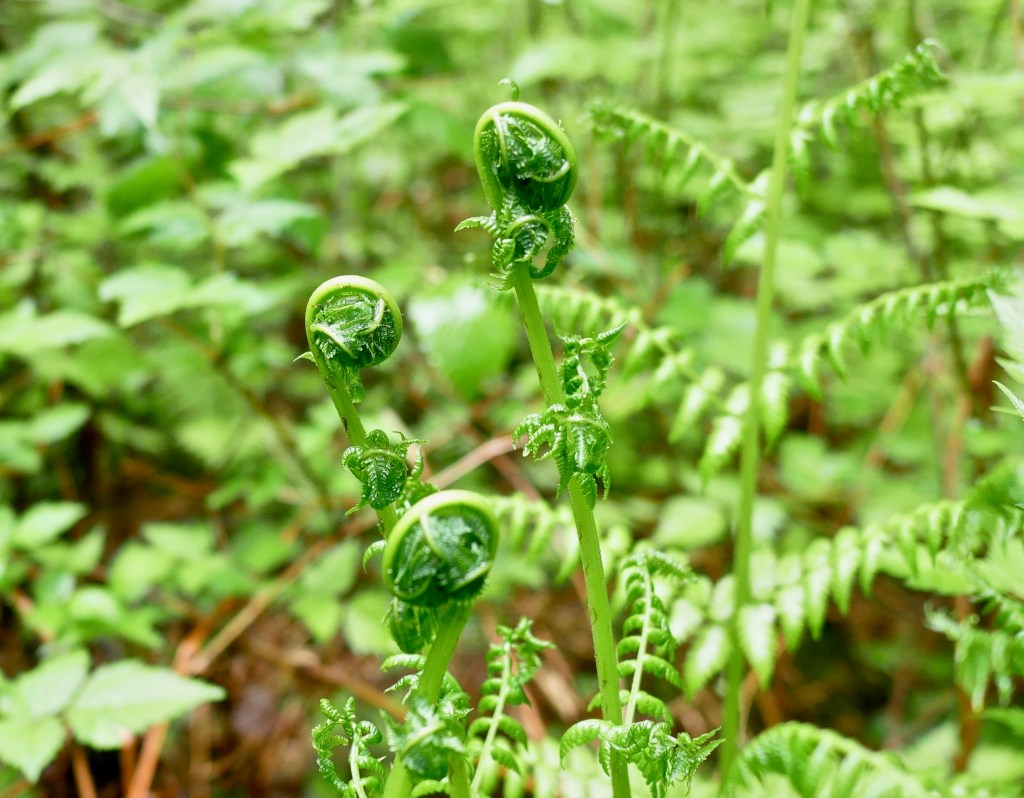
Summer is late to come on in this part of the rain forest. We are only 30 miles as the raven flies north of home, where the ferns long ago unfurled and blue berry bushes are already setting fruit. Here, along the Eagle River, tightly wrapped scrolls still top the bracken-like ferns. Wild cucumber plants have yet to flower.
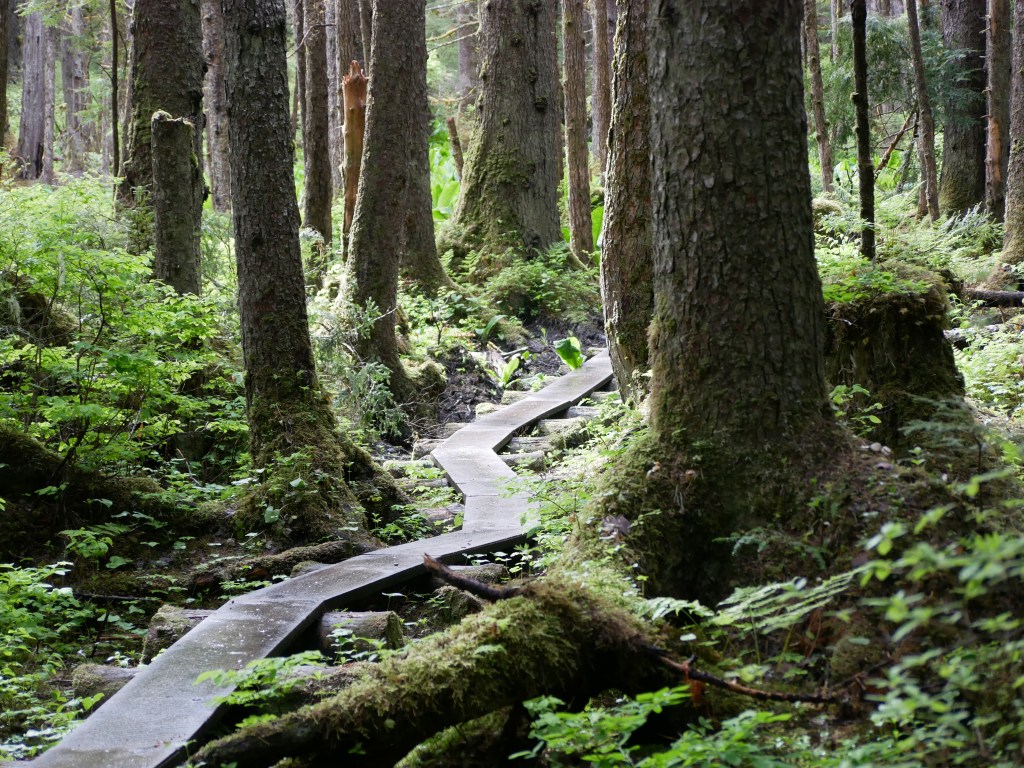
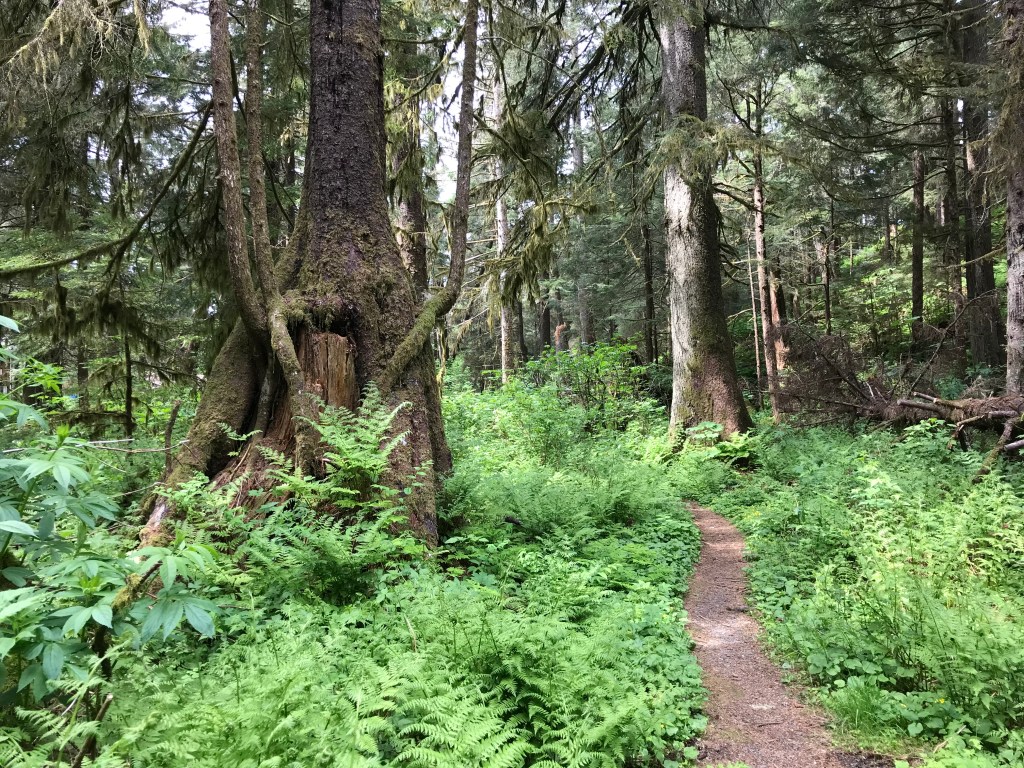
Aki leads me through an old growth spruce forest to a wooden bridge that crosses a swollen slough. In a month or so, the slough water will churn with spawning salmon. If we visit then, we will have to take care not to startle a fishing bear. Today all we have to worry about is slipping on the rain-slick boards that provide the only trail across a swampy meadow.
Near the end of the meadow, sprays of elderberry and service berry plant form a low canopy over the trail. A days’ worth of rain clings the green leaves and white flowers of both bushes. The little poodle-mix passes under the obstruction without disturbing a drop. Aki passing beneath the arbor without dislodging a drop. It all falls on me when I stoop to pass through.
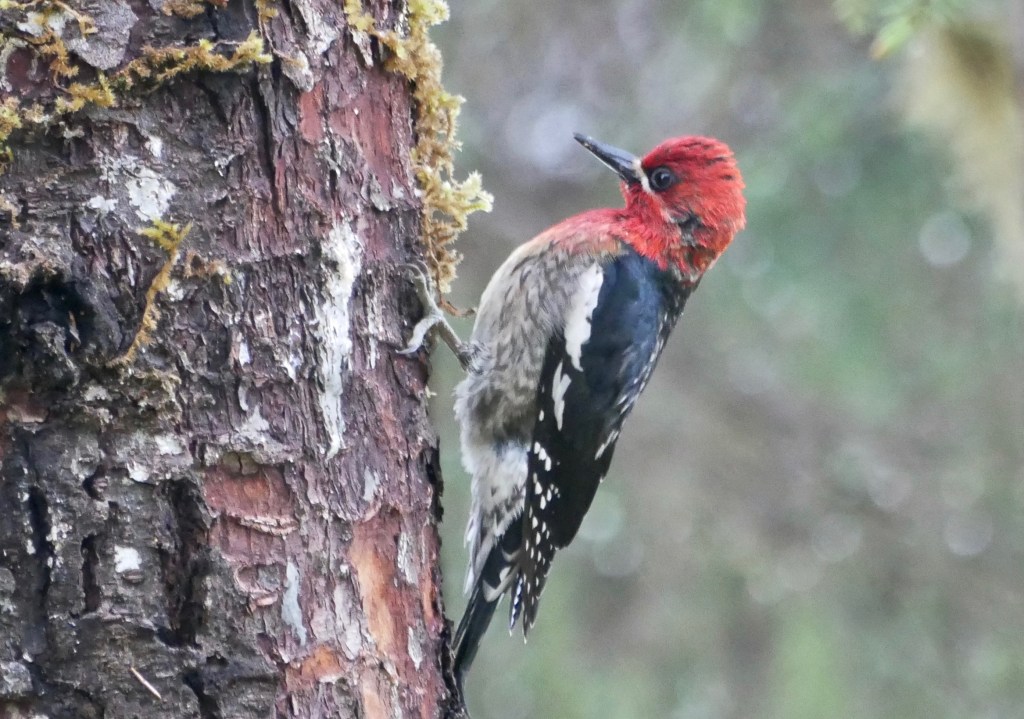
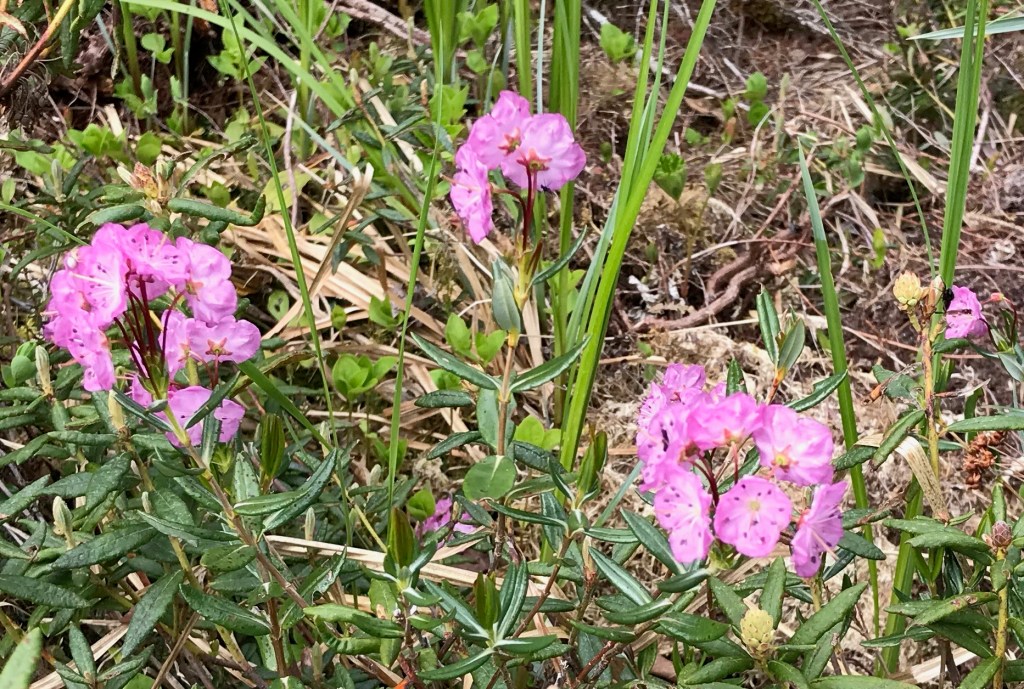
After shaking off water like a wet Aki, I follow her back to the car, hurrying past shooting stars, buttercups, wild rhododendrons, Canada geese, and a red breasted sap sucker very intent on its work.
While holding Aki, I move a couple of meters off the Marriott Trail and stand in shallow marsh water. Seconds before we were walking on a dry gravel trail that cuts like a pencil line across a swampy meadow. A minute ago, I left the trail to photograph a clump of wild rhododendrons, returning to see a family of four approached us down the narrow trail.
The parents wanted to move quickly past the little dog and I. But their four-year-old son stopped when he saw Aki. He stood like a statue with right hand pointed at the poodle-mix, grin affixed to his face. Nothing, not his parents’ orders or my pleas moved the little guy to action. The mosquitoes did. He finally trotted off toward his parents as the biting bugs swarmed around the little dog and I.
Wanting to avoid another traffic jam, we move into the woods on a trail that winds through a series of forest clear cuts. Each as stark as a battlefield. Ferns and blueberry bushes flourished in the oldest clear cut. Thin trunks of spruce trees rise above the green flour to support a thinning canopy. But nothing grows on the ground of the youngest cut, which was logged in 1962.
Before passing through the first clear cut, we meet a Tlingit man sitting beside a small smudge fire. He looks happy, if a little disappointed in the fire, which doesn’t produce enough smoke to the keep the mosquitos away. Still. he has found himself a quiet island in a forest surrounded by low income housing, the state prison, and our town dump.
The trail takes us down a steep hillside to an unlogged creek valley. Spruce trees older than America grow along the stream. I once found the carcass of a bald eagle in this almost-untouched place.
Aki has no problem climbing out of the old growth valley. We circle back to Switzer Creek and walk along it toward the car. On the last bridge before the trailhead we meet an old man wearing a painter’s billed cap. His tired-looking mountain bike leans against a spruce tree. He tells us that he comes here every day for the squirrels. “They’re back after months of being gone,” he says and them shares a crooked-tooth smile. I imagine him riding his old bike here every day that ice didn’t make the trail impassible just to check on the squirrels. He came to visit them when red-bodied salmon swirled beneath the bridge, and when trout flashed through the creek waters after salmon smolt. He came when rain muddied the trail or wind threatened to knock him from his bike. All for squirrels.
















 Walking with Aki