
Rising each morning is an act of faith
that day light will come and the coffee maker works
that planted seeds will sprout
and beloved will continue to love
Everyday
this plant
that word
these lives
blend in a communion of faith
Rising each morning is an act of faith
that day light will come and the coffee maker works
that planted seeds will sprout
and beloved will continue to love
Everyday
this plant
that word
these lives
blend in a communion of faith
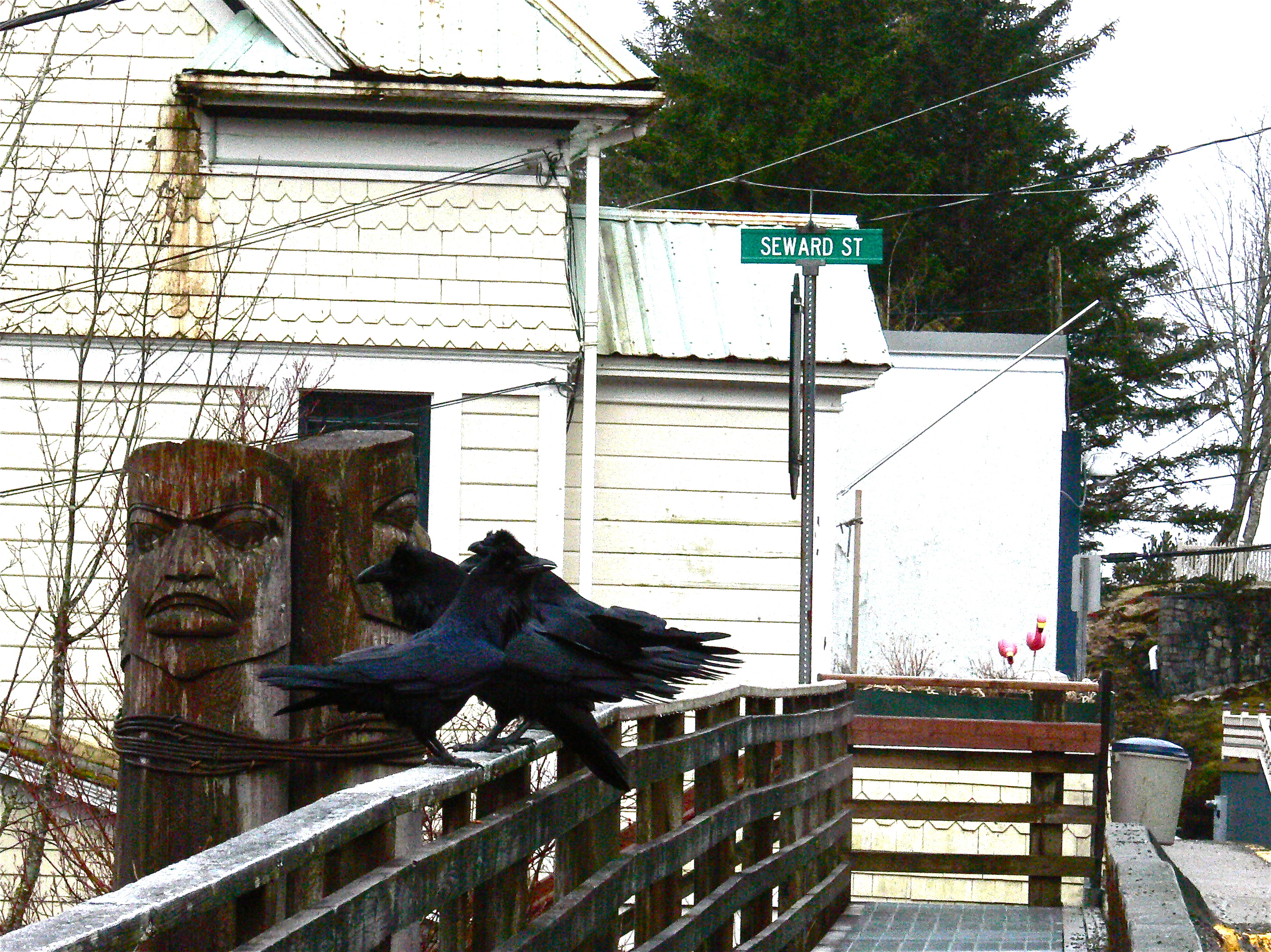
Three ravens told me that it’s garbage day on Chicken Ridge. Actually, it was their presence on a neighbor’s chimney that tipped me off. (I don’t speak their language). The big black birds position themselves each Tuesday morning so they can watch the drag of trash cans from bear proof locations to the edge of the street. How they gained their perfect knowledge of the town’s trash collection schedule is a mystery. Perhaps they have a contact at waste disposal.
The ravens look for spillage or unsecured can lids that they can cleverly remove when I’m at work. After being mugged a few times I now secure ours with a bungee cord.
If 7th Street yields nothing, they move down the ridge to 6th Street. That’s where I found the gang, loitering casually by the Beasley Brothers totems near the Seward Street Stairs. Most looked away from the 6th Street garbage cans, leaving one to monitor the garbage truck’s progress toward them. They all ignored the Pink Flamingos, knowing that the plastic birds can’t compete.
On this wet windy afternoon we find an almost empty parking lot at the trail head. In minutes we pass the only other people on the trail heading back to the their car. Aki has to content her self with the smells of animals that have gone before while the two humans in her life concentrate on safe passage of the icy trail.
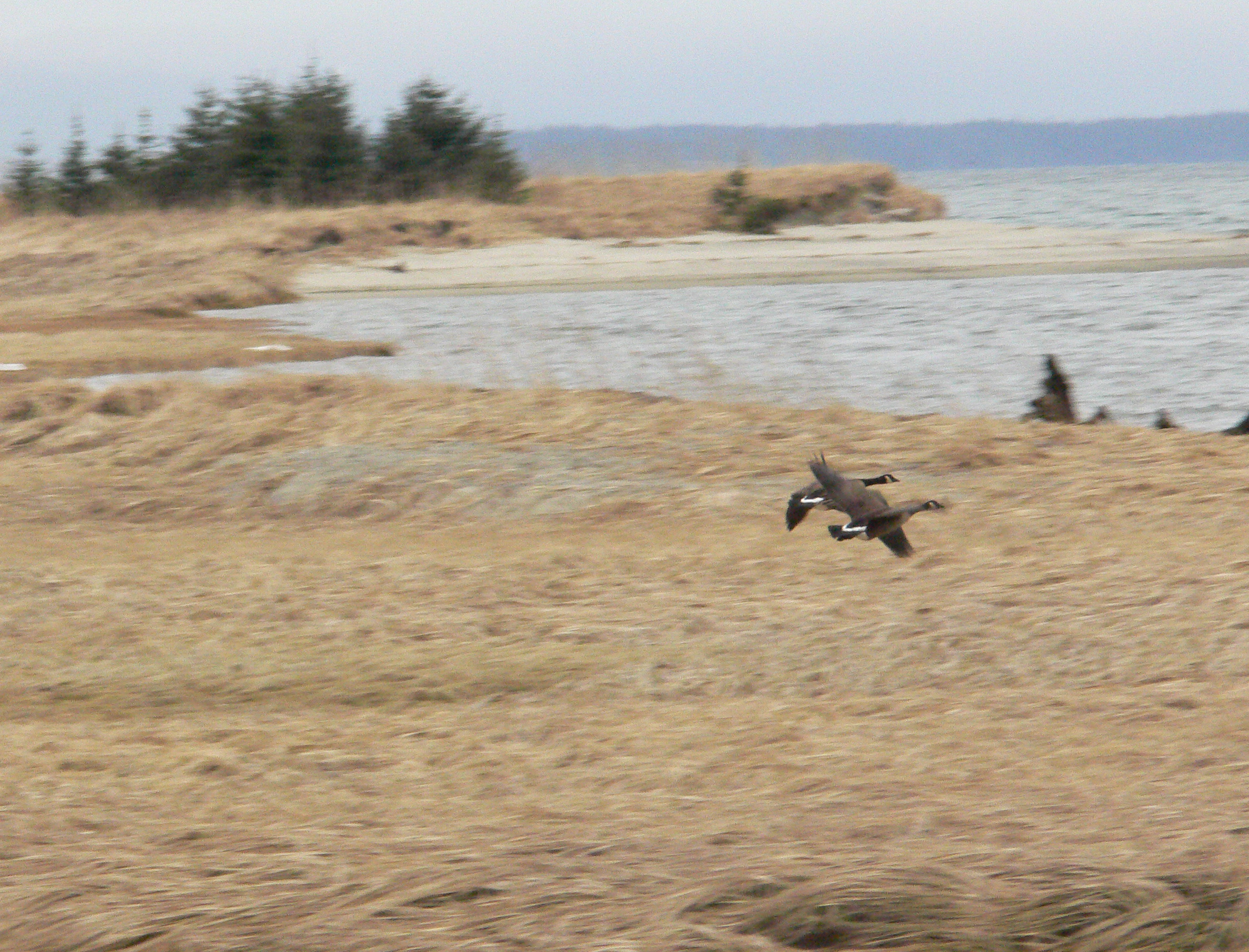
There are sounds; the river gorged by a rising tide and winter wren song — a long monochromatic trill blown by an unskilled bosun. We see robins but they are too busy gathering nest material to sing. Nearer the beach, a nervous mass of Canada geese honk loud warnings across the river to each other that reach us when still in the woods. We watch then gather into tight groups on a dead tidal meadow and then, for no apparent reason, burst by twos into the air.
To her credit Aki ignores the geese and presses her paws into the back of my legs when I take too long framing a photograph of the big birds. Comical on the ground, the geese can overload your heart with beauty when in flight. I’d watch for hours but for Aki’s impatience and the biting wind. Seeking the shelter of a nearby second growth forest, we find a dark windless corridor of green leading to the beach. When the forest opens into a snowy meadow Aki crisscrosses it with tracks as she dances after her orange frisbee to the non-ending chorus of geese song.
We reach the beach where two kingfishers scold us from an overhanging tree. On this chilled grey day the belted birds are one of the few promises of true spring.

Something like spring arrived last weekend bringing warm sunny days that softened the snow on this long meadow. A three day rain storm followed to wash much of it away. Today I’m left with an unstable snow machine track for skiing. Last year winter held on to the meadow until Mid-April to offer fine days of skiing. Tomorrow I either head for mountain trails or hang up the skis.
How can I break it to Aki, who is sitting out this trip? She who loves any expanse of snow. She’d be soaked by now on this thawing trail. That would not stop her from checking out these fresh tracks of a newly risen bear. I appreciate Aki’s absence when spotting my first robin of the season. Oh why don’t you sing plump bird with red breast? it won’t be true spring until you do.

Two rectangular towers rise at the edge of Douglas’ Sandy Beach. Islands during high tide, these silent campaniles once provided air for men working the long tunnels of gold that ran beneath Gasteneau Channel. That was before April 1917, when a big spring tide broke through and flooded the mine.
Two thousand men worked the mine, owned by John Treadwell. None of them died in the collapse. The mine once fed 900 stamp mines that ran 24 hours of day, reducing gold bearing ore to useable rubble. What wasn’t smelted was spread to form Sandy Beach.
Stamp mill noise filled the air of Treadwell town where his 2000 miners lived. Today the house lined streets of Douglas and an alder forest have all but erased Treadwell. Aki and I are wandering the ruins.
We expect to find these cast iron ruins — this ore car marooned in an alder grove and a large electric motor emerging from snow. The thick timber walls of the old stamp mill are a surprise. Even today they resist their still living cousins’ attempts to colonize.
Aki finds little of interest but I indulge a fascination, made worse by imagination, with well made machinery. What giant dropped this ore car so far from a place it could be used? Did this huge iron gear fall from his watch when he smashed it on Mt. Jumbo?
There are no giants here or even rabbits to grab Aki’s interest. We only find birds singing in an alder forest scattered with ruins.

Sometimes it is better not to know where the trail leads for ignorance increases the chance of adventure. This sunny morning we drive to Wolf Creek and start down what we thought was a 3 kilometer nature trail. Shoot, we’ll be back to the Whitehorse flesh pots in an hour.
Two and a half hours later we are skiing on the edge of a Yukon River bluff not having seen another person since we left town. The hard packed track made an easy passage as we skied through a mixed pine aspen forest. We followed a widening Wolf Creek Valley, stopping often to check out wolf and moose tracks or aspen trees savaged by now sleeping beavers.
Suddenly we break out of the forest and onto a narrow path that runs along the edge of a sixty foot bluff. The still frozen Yukon makes a sweeping turn toward a nearby mountain range. This world class stream passed by those mountains on its trip from the headwaters near Lake Bennett.
Here we could have watched an endless parade of gold seekers on their way to the Dawson gold fields in 1898. Settling for a single snow machine track on the river’s ice, we turn down river for a long slog back to the car.
Tomorrow we drive back to Skagway, making in a few hours, a trip that would have almost been impossible for the stampeders of ’98. Even taking advantage of the river, they would have taken months to make it this far from Skagway.

In Canadian Tire we find a rack of thermometers and wonder at the number that also measure relative humidity. Why would anyone want one when they live in a shower stall. You wouldn’t find these dual meters in Juneau or Ketchikan. Then we look at one and find out how dry it is here in Whitehorse.
Just 100 miles from our Southeast rainforest, these people live in a semi-desert. It shows in the quality of their snow and the trees that line the Mt. MacInytyre Nordic ski trails. That’s one of the reasons we make this spring pilgrimage to Whitehorse. That and the chance to eat Indian food, shop at Canadian Tire, and explore Canadian fiction at Mac’s Fireweed Bookstore.
On Mount MacIntyre, groomed trails roll through lodge pole forests carpeted with snow crisscrossed by animal tracks. Most were left by large red squirrels but once or twice we passed lonely moose tracks. The uniformity of pines lead to day dreams that shatter when the trail drops into a knot of aspens. Even as dormant winter trees, the aspens’ black triangles on light gray bark add needed spice to this rigid green forest.

Aki is spending the weekend with friend Zoe so the human couple in her life grabed an early ferry for Skagway, Juneau’s closest portal on to the North American road system. From there we drive up the dramatic White Pass and stop for a ski near the Yukon/British Columbia border.
The road took us past avalanche zones that recently deposited great amounts of snow on the highway. The “Do Not Stop Avalanche Zone” signs confirm that it may soon happen again.
It’s above freezing and sunny when we climb into the skis and cross the White Pass Railway right of way to a ski trail undulating through a Lodgepole Pine forest. Plaster white mountain domes appear above the forest on every horizon.
We turn back after reaching a long flat valley seasoned with scattered pines. It reminds me of Juneau’s own high pine meadows, framed as they are with rugged white mountains.
Skiing farther would take us to the ruins of the winter community formed by the thosands of men that rushed to the Klondike gold fields over one hundred years ago. After hauling thousands of pounds over the Chilcoot Pass they spent the winter of 1898 here sawing Ponderosa Pines like these into rough lumber for rafts or boats. When the ice broke on nearby Lake Bennett they loaded a year’s worth of gear into makeshift vessels and floated down to the Yukon River and then on to the Dawson.
From this meadow’s edge in 98 we could have heard these anxious men struggle with axe and whip saw. Today it is all a sun drenched snowy silence
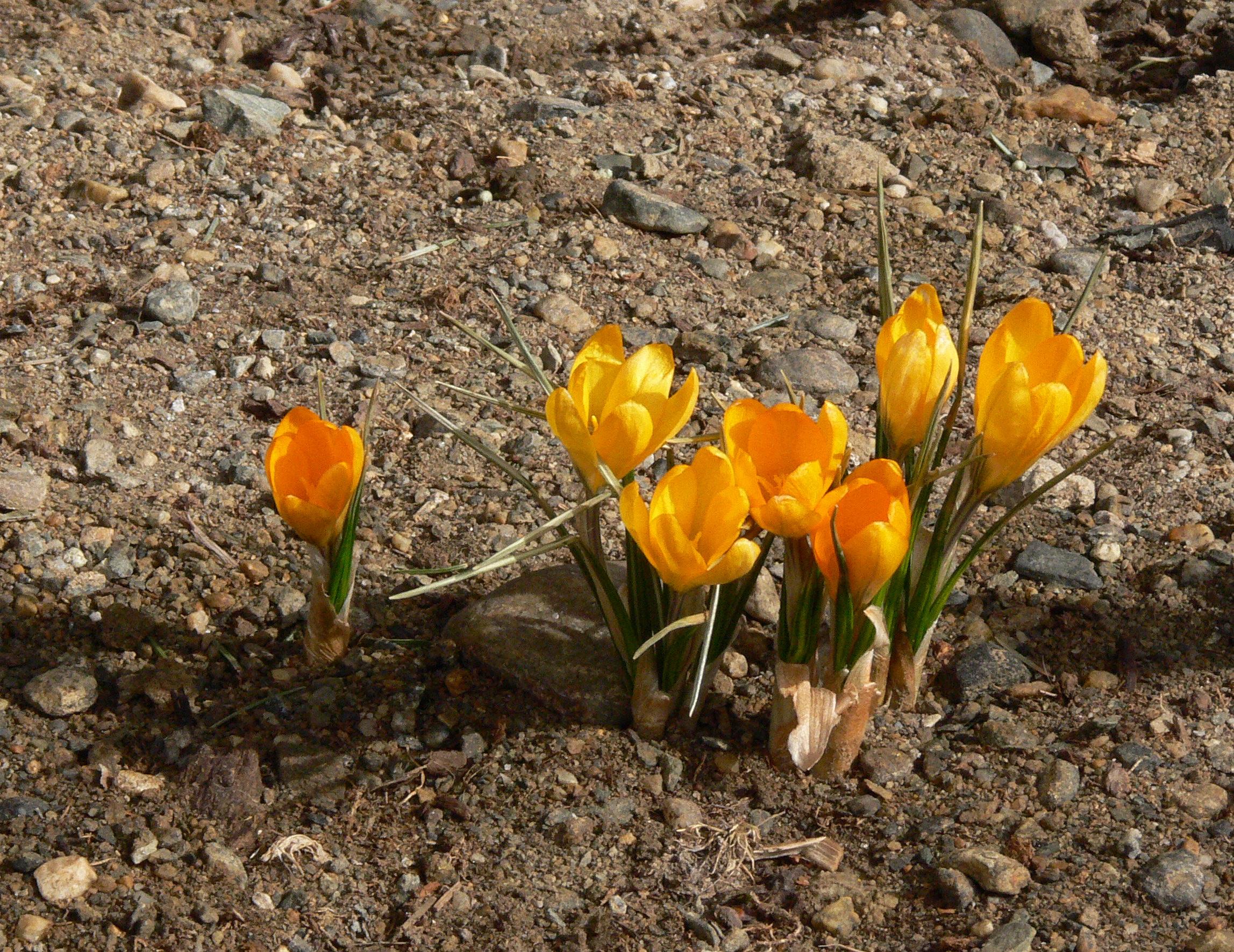
Only northerners
would find beauty in this clump of simple flowers
these dull yellow crocuses reaching four inches
above dead brown ground
Lovers of winter snow
stop to smile
when crocuses lay open
their petals to the harsh spring light
It is the way we are wired
we lucky enough to witness
winter give way to spring
and small flowers thrive on water
from melting snow

Wind blows hard into our faces here at sea level. We start climbing anyway to reach some open muskeg meadows. A passing dog walker warns that it will be whippy “up top.” Last month we might have turned around but it looks like winter has packed up for the year, leaving behind this sunny warmish day. Wind no longer delivers pain.
Several feet of snow still cover the land but it is slowly collapsing from within. It has no chance against the lengthening days to come. Yesterday’s thaw followed by last night’s freeze set up the meadow’s surface nicely for us. Aki dashes in zig zags through the shore pines until she fines fresh deer tracks. I join her and look at the sharp edged gashes made this morning by a large deer’s hooves. Spring can’t come soon enough for him. Later we find older tracks of a wolf who might be searching for the deer.
Sunlight reflecting off the field of snow makes me lazy so I close my eyes to listen. This is a dessert for birds and therefore quiet so Aki’s footfalls sound like those of a trotting horse on the snow crust. When she settles beside me there is only the wind blowing over my ears and the trees. It makes sound but no music. Sometimes it mimics rushing water and other times, a jet engine. Each tree is a cello’s string and the wind the bow. Ironically wind only produces music when moving over man made things like power lines.
 Walking with Aki