Category Archives: glacier moraine

Norton Lake

Beavers. Aki and I are on the lookout for the buck-toothed rodents on this walk across the moraine. We walk along the Mendenhall River, which is dropping after a recent run of high water. It was raining earlier, which might explain why we have the place to ourselves.
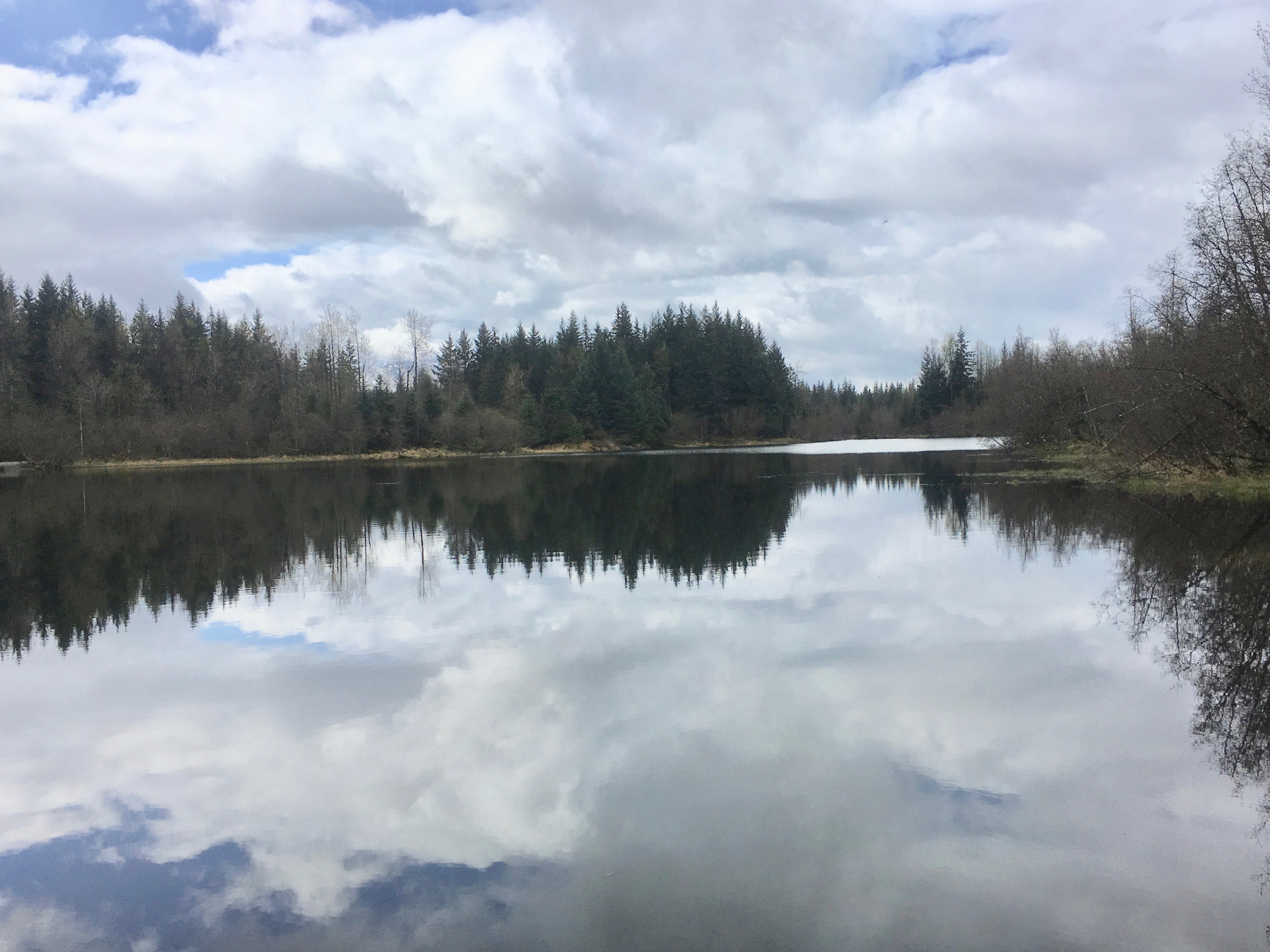
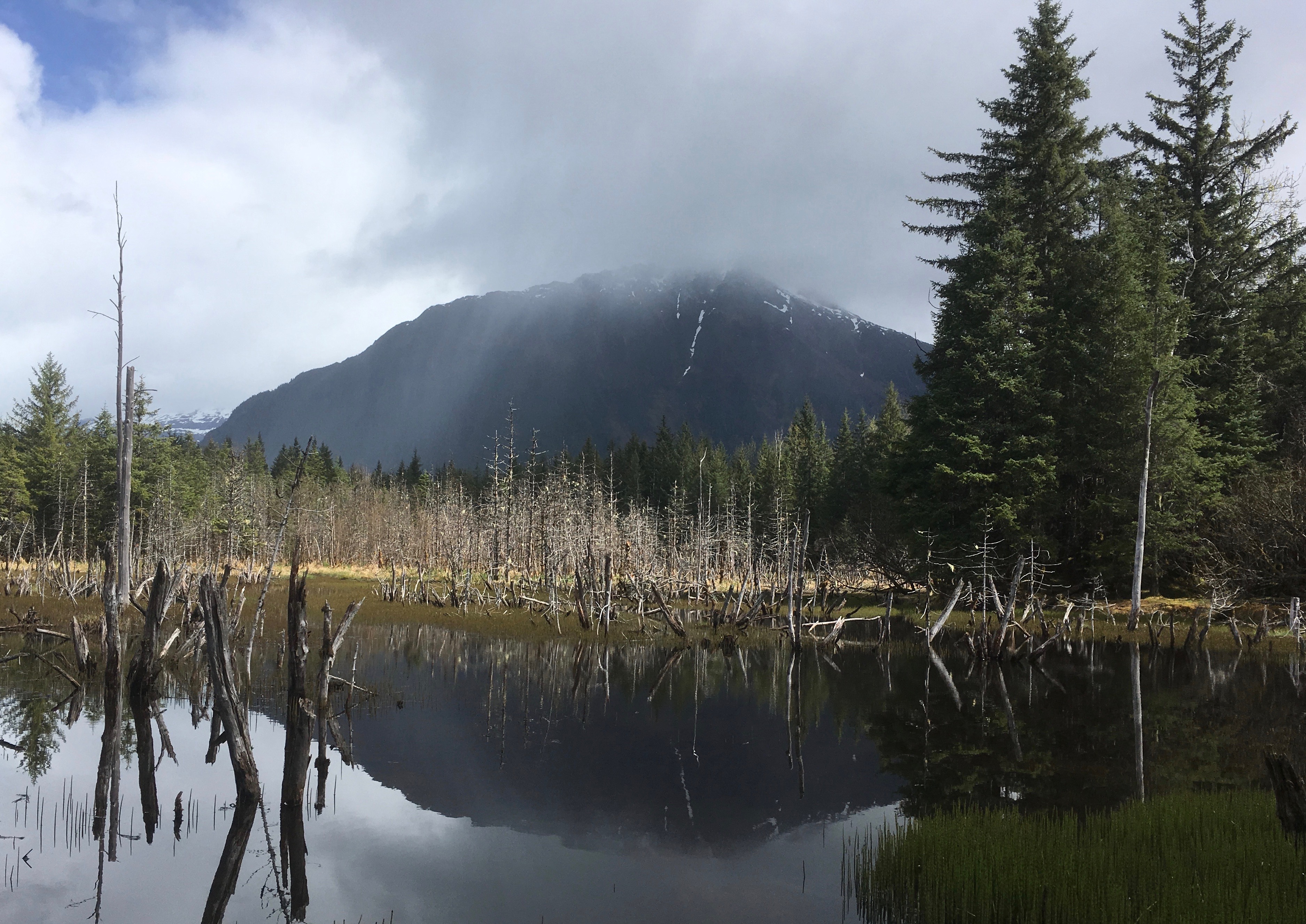
            Even though there is a large beaver house just upriver from our position, we have no chance of seeing one of them swimming across the water. We have to go deeper into the moraine—to the rarely visited Norton Lake. In years past, the little dog and I have been able to watch beavers tail slap the lake water and then swim towards us to check out the poodle wearing clothes. 
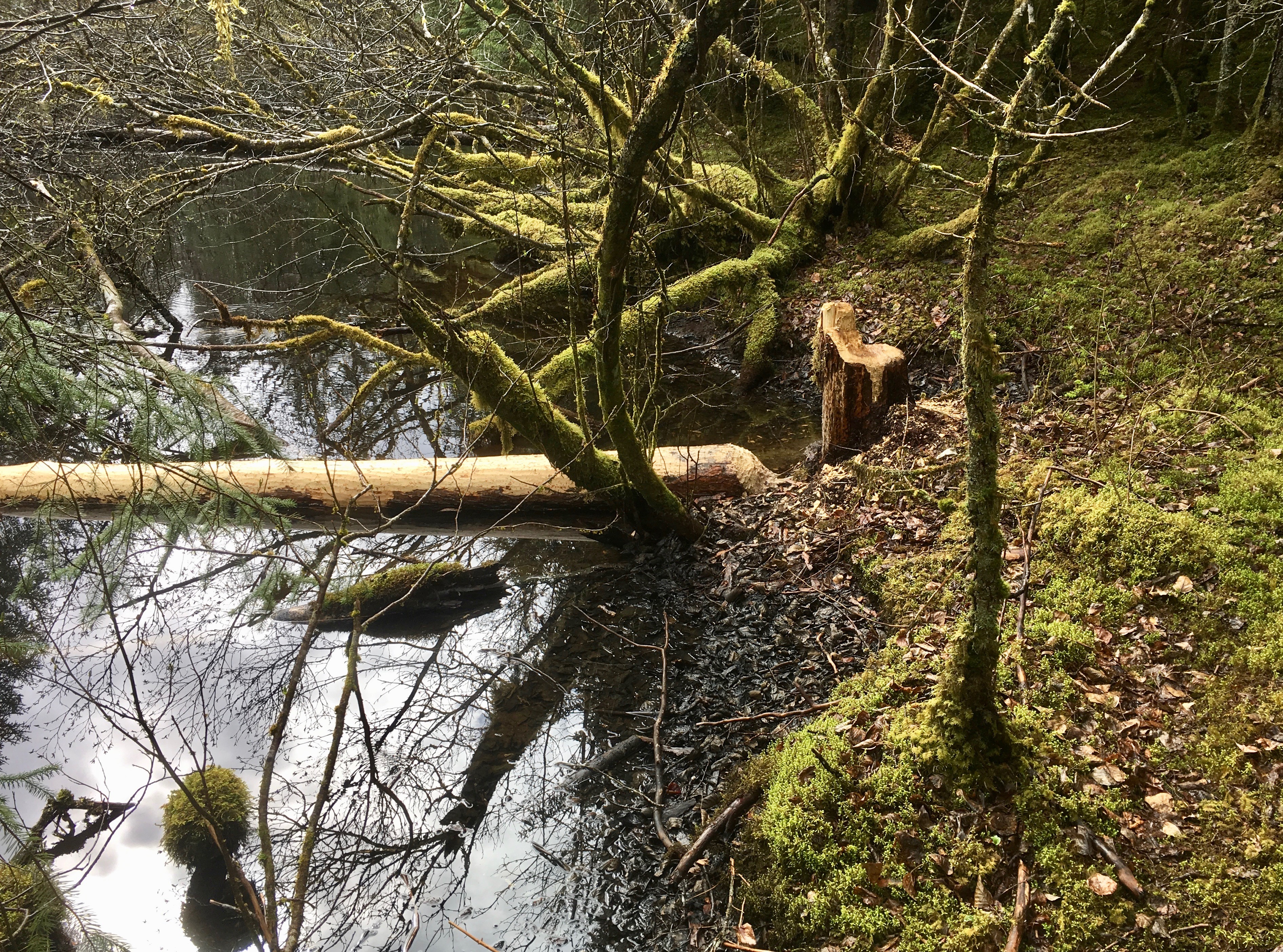
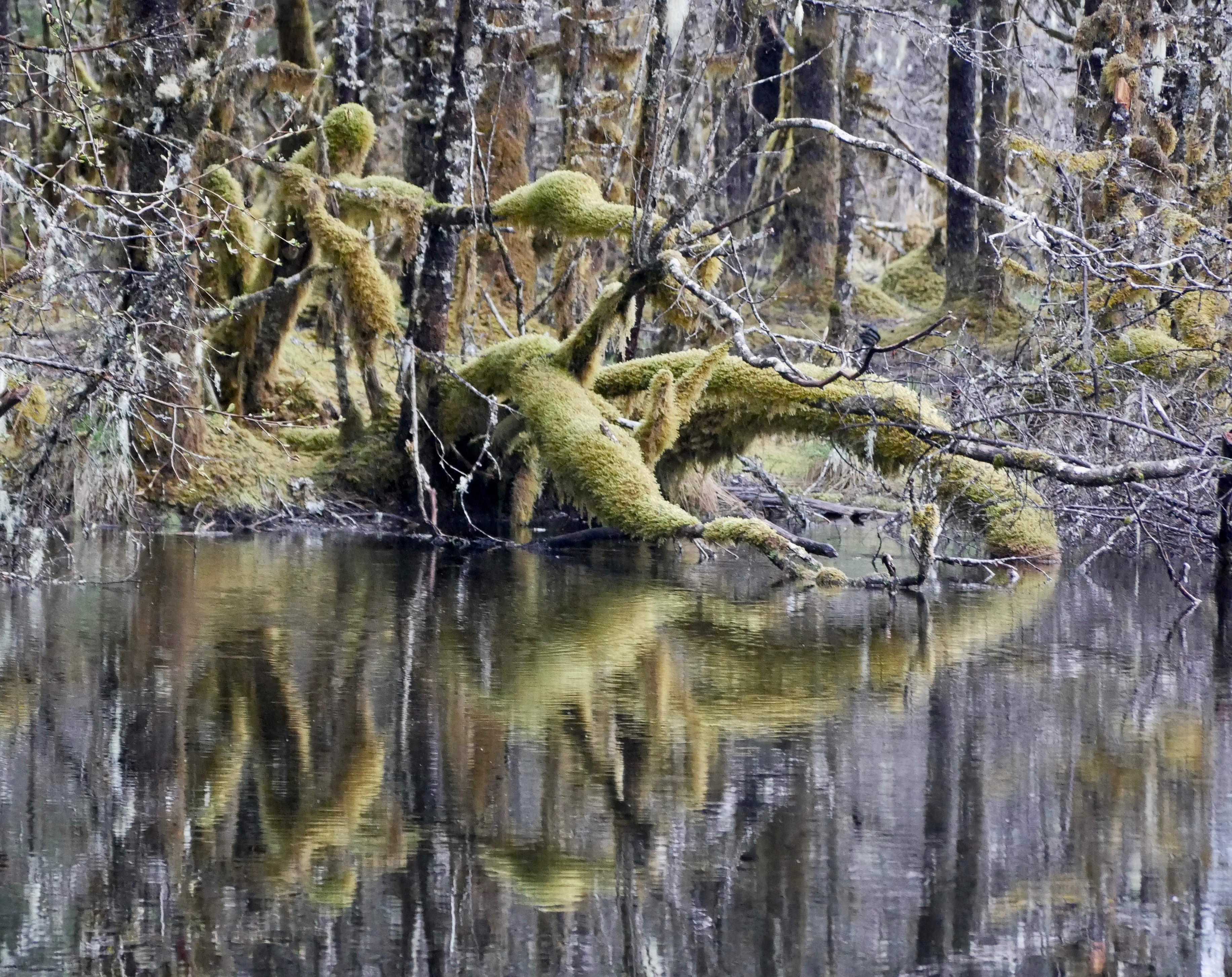
            The beavers have made it difficult to reach Norton Lake. You have to skirt a flooded portion of the trail and then tightrope walk along the top of one of their dams. After Aki and I walk maneuver our way through this obstacle course, I search the remains of beaver killed trees that rise like grave markers from the surface of the pond, looking for the arrow-head shaped beaver snout cutting a “v” across the water.  
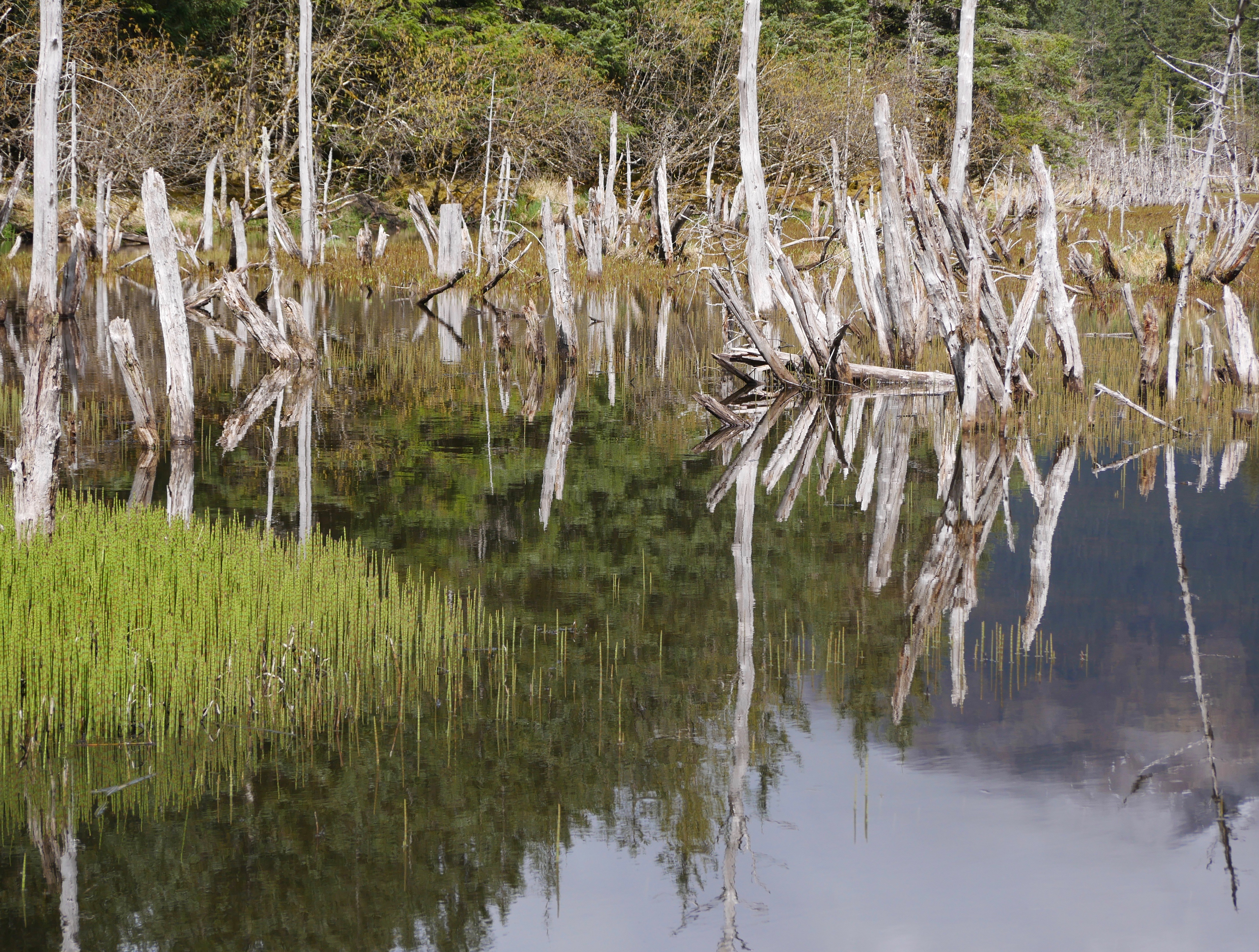
            There will no beavers sighted this day, a pair of mallard drakes floating without apparent purpose across the surface of the lake.   

Back to the Troll Woods

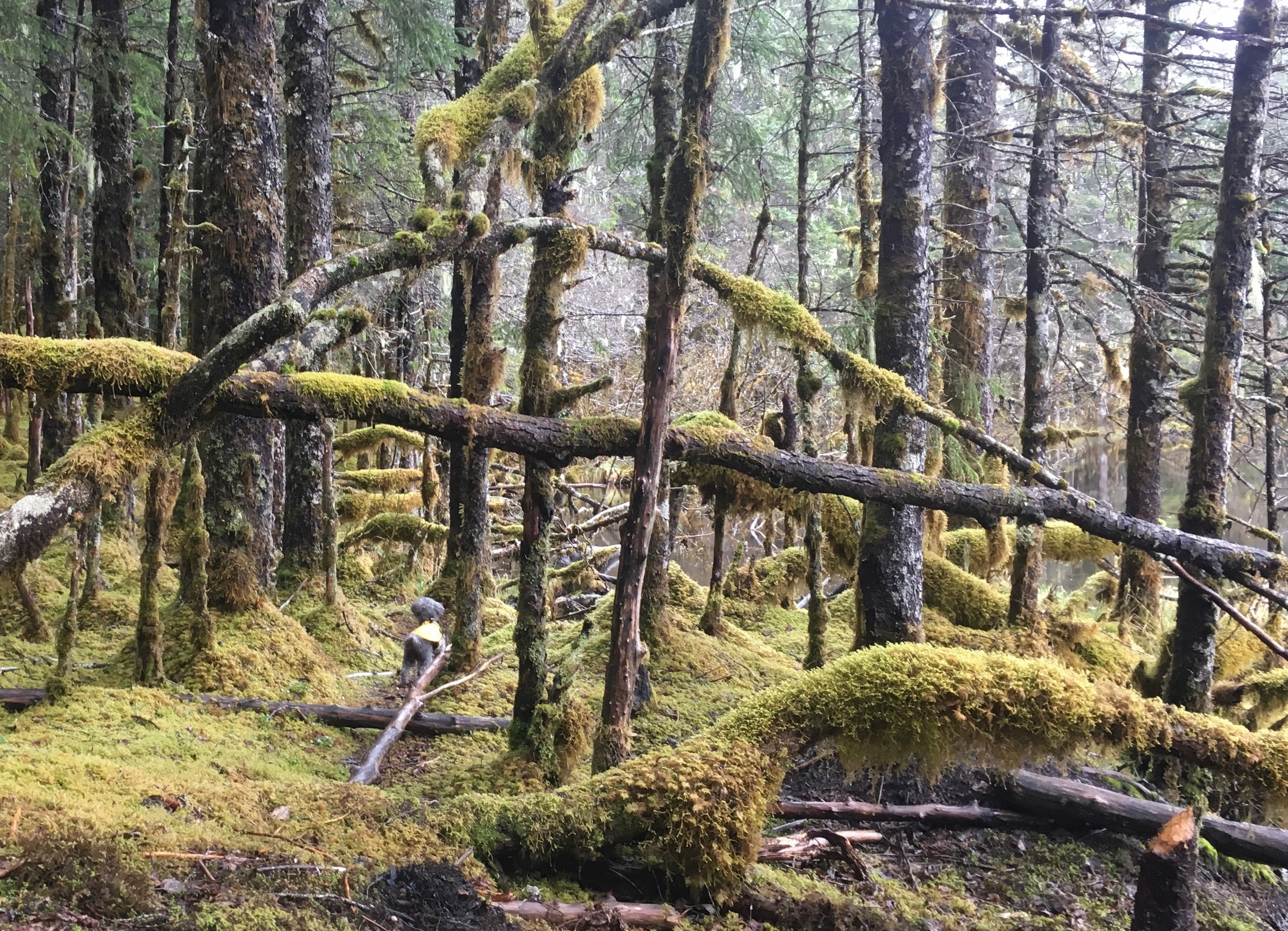
Aki and I are back in the Troll Woods after a long absence. It’s good to be in the peaceful place. This time of year the little dog doesn’t have to worry about eagles. We might run into a wandering black bear but that doesn’t trouble a dog with a heart way too big for her 10-pound body. 

Thick, yellow-green moss covers the forest floor and the trunks and branches of the trees, turning them into sculptures that could have been designed by Gaudi. It would be silent if not for the nesting songs of invisible birds and the muffled roar of Nugget Falls. 

There is beaver sign everywhere: cottonwood limbs stripped of their bark, trails formed by the beavers skidding wood into their ponds, small dams slowing the flow of every watercourse. We run into a member of the beaver patrol. Late every afternoon she caps a pipe that runs underneath the beaver’s main dam. Otherwise the sound of moving water would energize the beavers into building a bigger dam behind the one pierced by the pipe. Every morning she uncaps the pipe, allowing the pond’s water level to drop. Otherwise the trail we use to access to the woods would be flooded. 

Thanks Kids

Aki and I are cruising the Mendenhall campground, looking for the perfect spot to set up our family tents. We need a place with room for two tents that is within easy canoe carrying distance of the lake. From nearby comes the sound of preschool students heading in our direction. Aki, who thinks that little kids are really just puppies wearing funny clothes, tends to scare them with exuberant welcomes. To avoid that I lead the little dog down toward the lake and find a great blue heron fishing the shallows. 

            Either Aki can’t see the bird or she ignores it. Either way the heron doesn’t exhibit any signs of stress or concern. It lets me watch it stalk salmon smolt, moving slowly with its neck pulled back to form an “S.” When it freezes, it releases the tension in its neck to fire its head and long beak forward like a lance.  It does this several times. The fish win their first battles with the heron. Finally the tall bird snatches a meal from the water, flipping up its beak to force its prey down that long neck. 

            After the preschoolers move on, Aki and I return to the campground road and follow it around the edge of a large pond. Mergansers, buffleheads, and mallards are paddling toward the far shore when an osprey cruises over their heads to land in the top of a nearby spruce. It’s been years since I have seen one of the fish eagles. I would have passed the pond long before the osprey appeared if not the for noisy toddlers.

Worth It

One of Aki’s other humans and I paddle toward the glacier into a rain bearing head wind.  Kittiwakes from the nearby rookery watch us from a small iceberg. They don’t stir as we pass.  Members of their clan mew and keen before diving on sockeye salmon smolt in the lake waters. I worry that we will face worse conditions when we round a point of a rocky hill that has been partially blocking the wind. I am glad that Aki is home snug and warm.

It may be the lovely month of May but today is a wicked-wet day. It’s the only day I have to sneak in a kayak trip to the glacier. Soon an eco tourist company will be hauling cruise ship tourists across Mendenhall Lake in faux Chippewa canoes and lead them into the shrinking ice cave. I want to enjoy it when empty. 

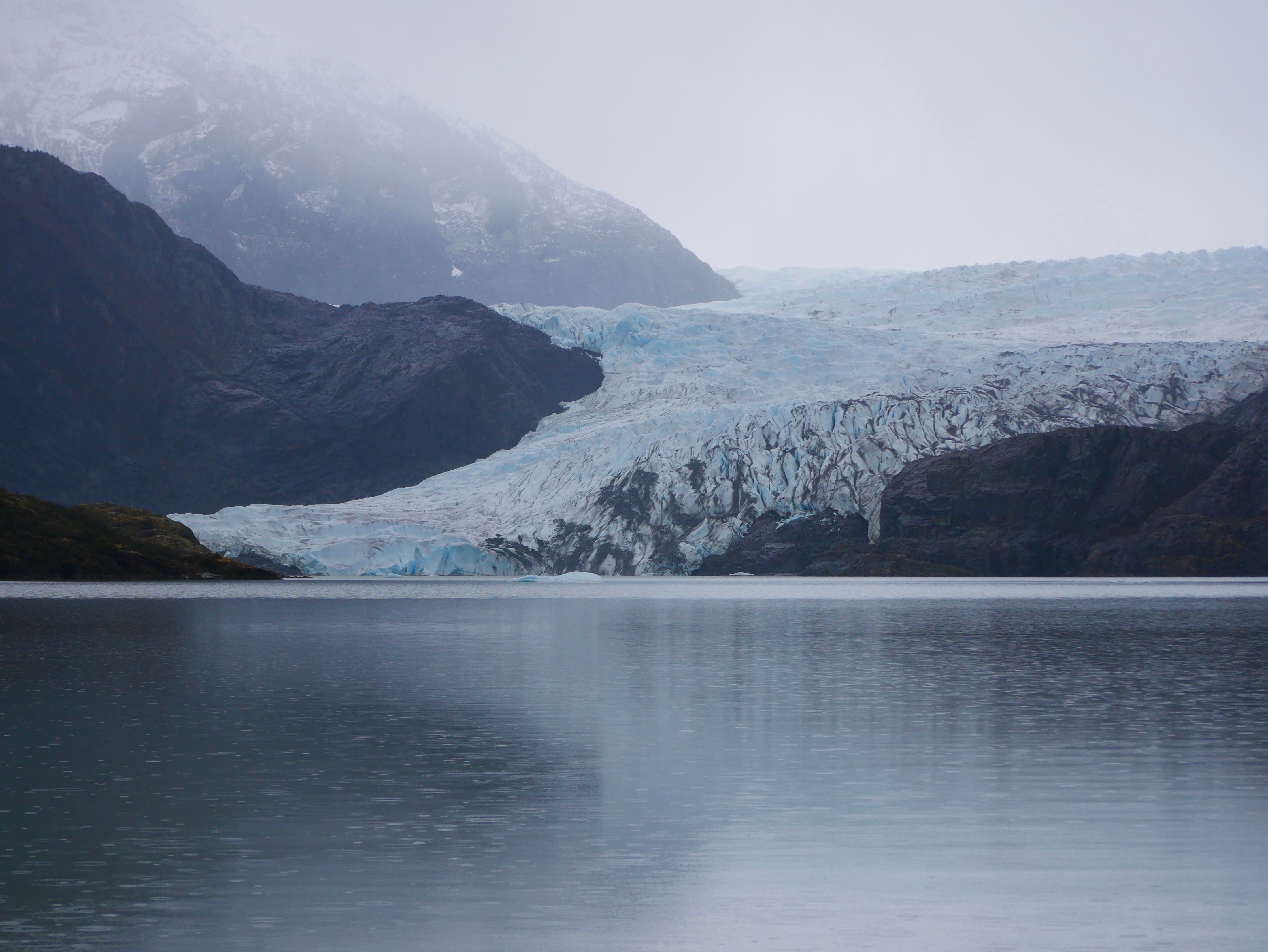
            Pulling past the point we get an unblocked view of the glacier descending out of rain clouds.  A rocky hill rises to our left, colored by low growing plants fertilized by kittiwake guano.  It seems to take hours to paddle the mile to the glacier in the now unrestrained wind. An empty tourist canoe sits on the beach where we haul out the kayak. Who, I wonder, would pay big money to ride here in an open canoe today? Must be a group of hardy Australians. 

            Listening for ANZAC accents, we walkover a landscape as barren as the moon’s surface. At first appearance, the trail seems to be well graveled. But I find myself slipping on portions that are really hard glacial ice covered with a thin layer of mud or pebbles. We pass torn chunks of trees just released from hundreds of years of icy imprisonment by the glacier’s retreat. The only bird sound we hear is from the keening kittiwakes. No songbirds could earn a living in such a sterile place. 

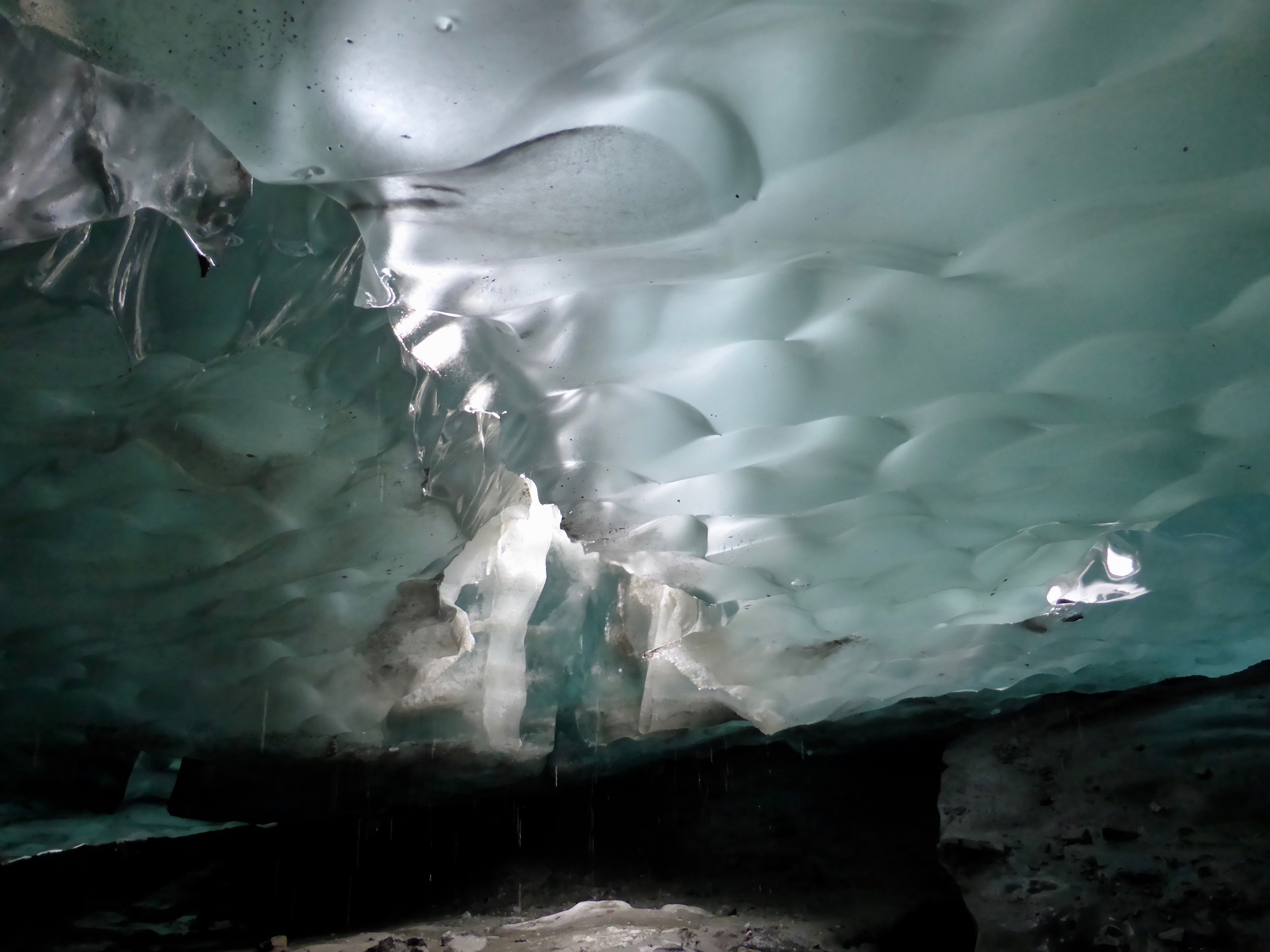
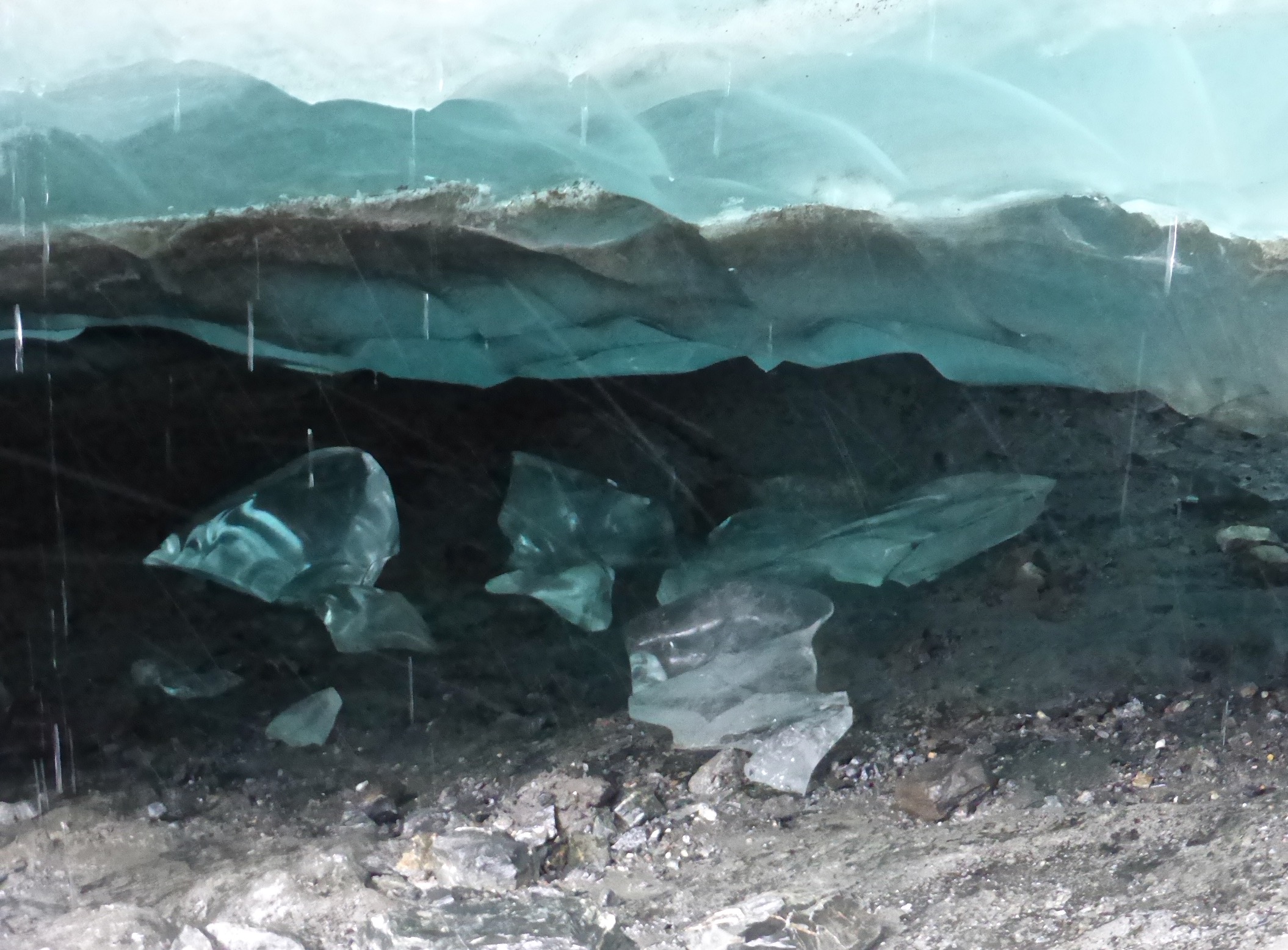
            The glacier seems to be collapsing into itself like an overripe pumpkin. Mocha brown water rushes from beneath the ice. I worry that the mystic blue ice that formed the glacial cave will now be fragile, and opaque. But in spite of our recent heat wave and the subsequent days of rain, the cave retains its basic shape and color. Rainwater streams from cracks in the overhead ice and some of the old entrances have collapsed. It is still a suitable venue for a religious ceremony or at least a brief prayer for our challenged world. 

All Birds

It rained last night for the first time in at least a week. It will rain again and soon. Good day to visit with the ducks. Aki and I head out to wetlands drained by the Mendenhall River.  We pass two bald eagles perched on the superstructure for one of the airport approach lights. After a third eagle flies over them, the roosting pair lean in toward each other, as if to gossip or show each other affection. Heads almost touching, the eagles watch the early morning jet to Anchorage. 

            To be honest, I here for the blue birds, not eagles or waterfowl. Many Juneauites have seen mountain bluebirds perched on snags above one of the wetlands meadows. The little dog and I leave the main trail to better scan the meadow for little guys. We won’t spot one of the rare songbirds but will make our first yearly sightings of northern shovelers and lesser scaups. 

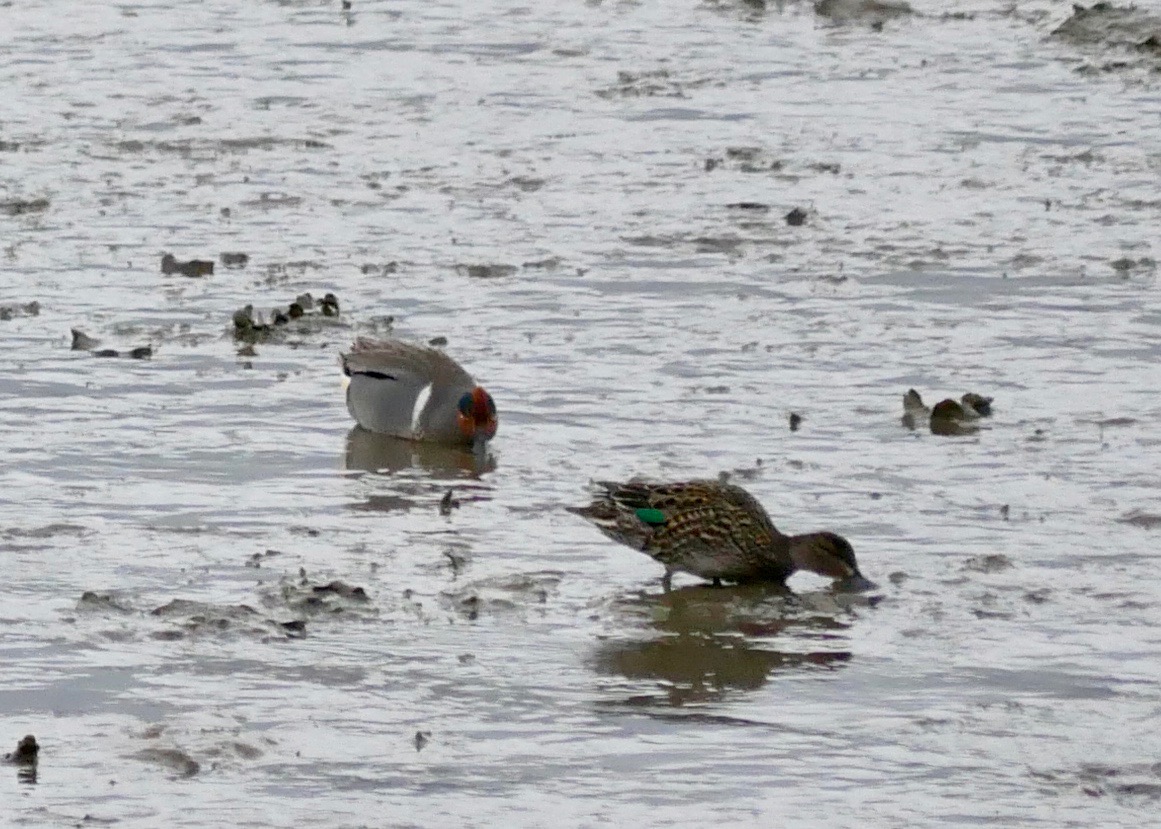
 We’ll have ample opportunities to watch green wing teals and American Widgeons patrolling the mud flats for food. At one point two Canada geese will fly over our heads, giving away their position by their persistent honking. 

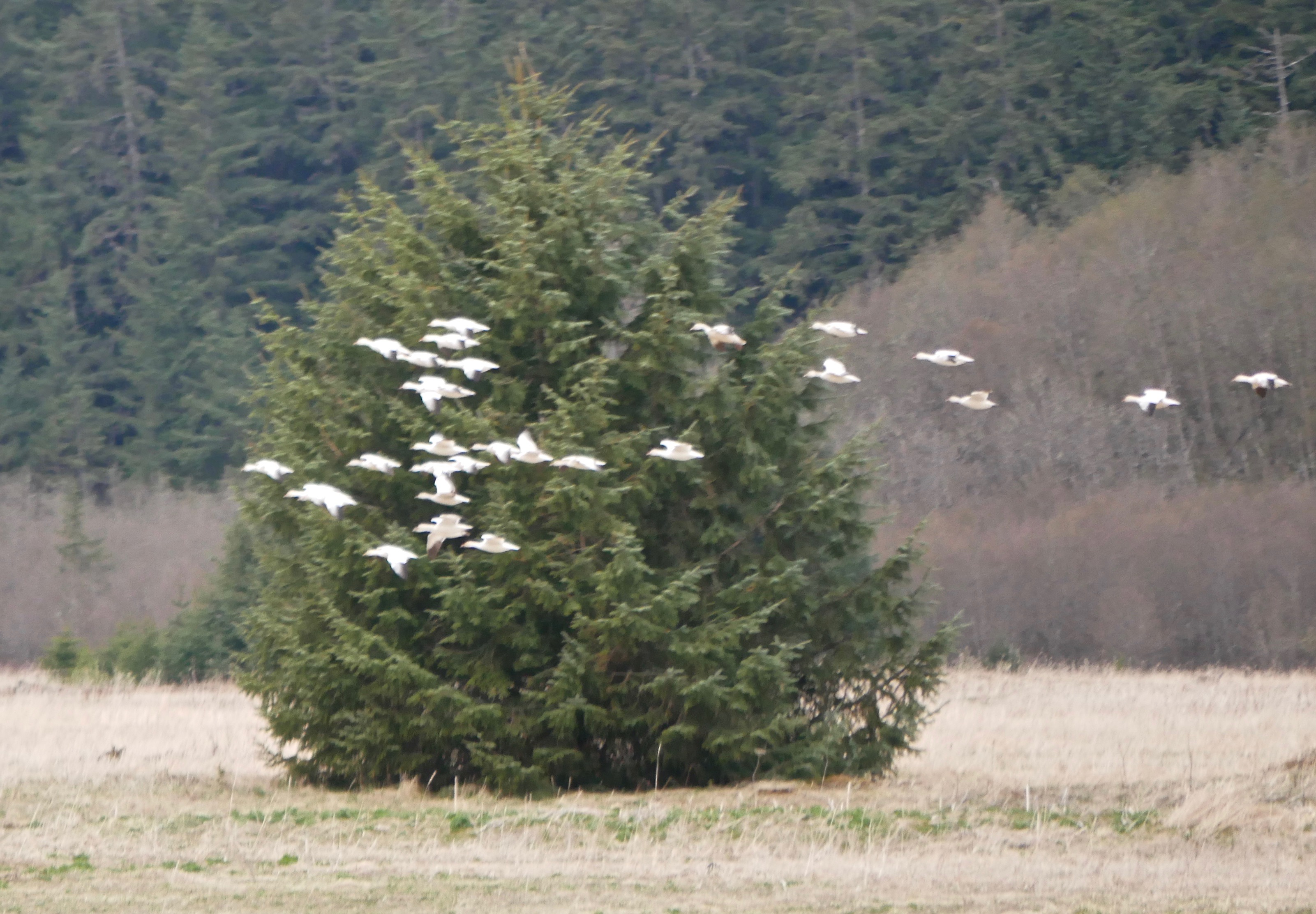
            There will be other eagles and a greater yellowlegs shorebird. But the big surprise, sprung on the little dog and I while crossing the most likely part of the meadow for spotting bluebirds, will be a flight of migrating snow geese that rise out of meadow grass and head down the Mendenhall River. 

Pilgrim at Fish Creek

The little dog and I rush out the door again, again wanting to see the Fish Creek delta while the morning light is still good. Okay, that was a human-centric statement. While I wanted to see the delta washed by the kind of light captured by Flemish painters, Aki would have preferred a sleep in. She’s joined up to make sure I don’t get into trouble. It’s still cold enough on the delta for me to need gloves. (Another human-centric statement). The grass not yet touched by the morning sun is covered with a fine frost. Crow caws and eagle screams let everything within a mile that Aki is back in town. 

            As I watch a solitary swallow thin out the mosquito population, I think about Annie Dillard and her book, Pilgrim at Tinker Creek. She dived deep in what her creek had to offer on each of her many visits. If she lived in our rain forest, what would she make of seeing only one swallow instead of the expected cloud of its kind diving and gliding after flying bugs. The scene might inspire her to get out her copy of Silent Sprintand return each morning in hope of seeing more swallows hunting over the meadow. 

            Trying on Ms. Dillard’s skin for size, I lead Aki along the creek, watching mallards in twos and threes fly over our heads and those of roosting eagles to the same meadow where I watched to swallow. Would she guess that the flooding tide forced the ducks into the air? 

            Crows seem to be every where, wading in shallow ponds, bathing in the fast moving creek, pecking their way through meadow grass. So are eagles. A brace of mature eagles keeps watch on each end of the causeway that links the mainland with a small, spruce-covered island. The island seems infested with noisy crows. We inadvertently flush an immature eagle from the edge of the island by walking under its roosting tree. It circles over our head and lands in a different roosting tree. Ms. Dillard might ask what is keeping all these eagles on the parameter of a crow-infested island. 

Aki gives me her worried look, something she conveys by flexing her eyebrows.  She doesn’t care about natural philosophy or biology or Annie Dillard. She was touched by the shadow of a predator. “Time,” the ten-pound-poodle-mix seems to say, “to go.” 

Convention of Ghosts

Wanting to sneak in at least one more trip to the glacier before the cruise ship hordes inundate its trails, I drive Aki out to the Mendenhall Visitor Center parking lot. The water level in the lake has dropped enough to allow the little dog and I to walk along the shore to Nugget Falls. But we soon find that the Forest Service has blocked off the beach to protect nesting sites of the income arctic terns.  Aki, whose little paws were already muddy with beach clay, is happy to reverse our way back to the regular trail. 

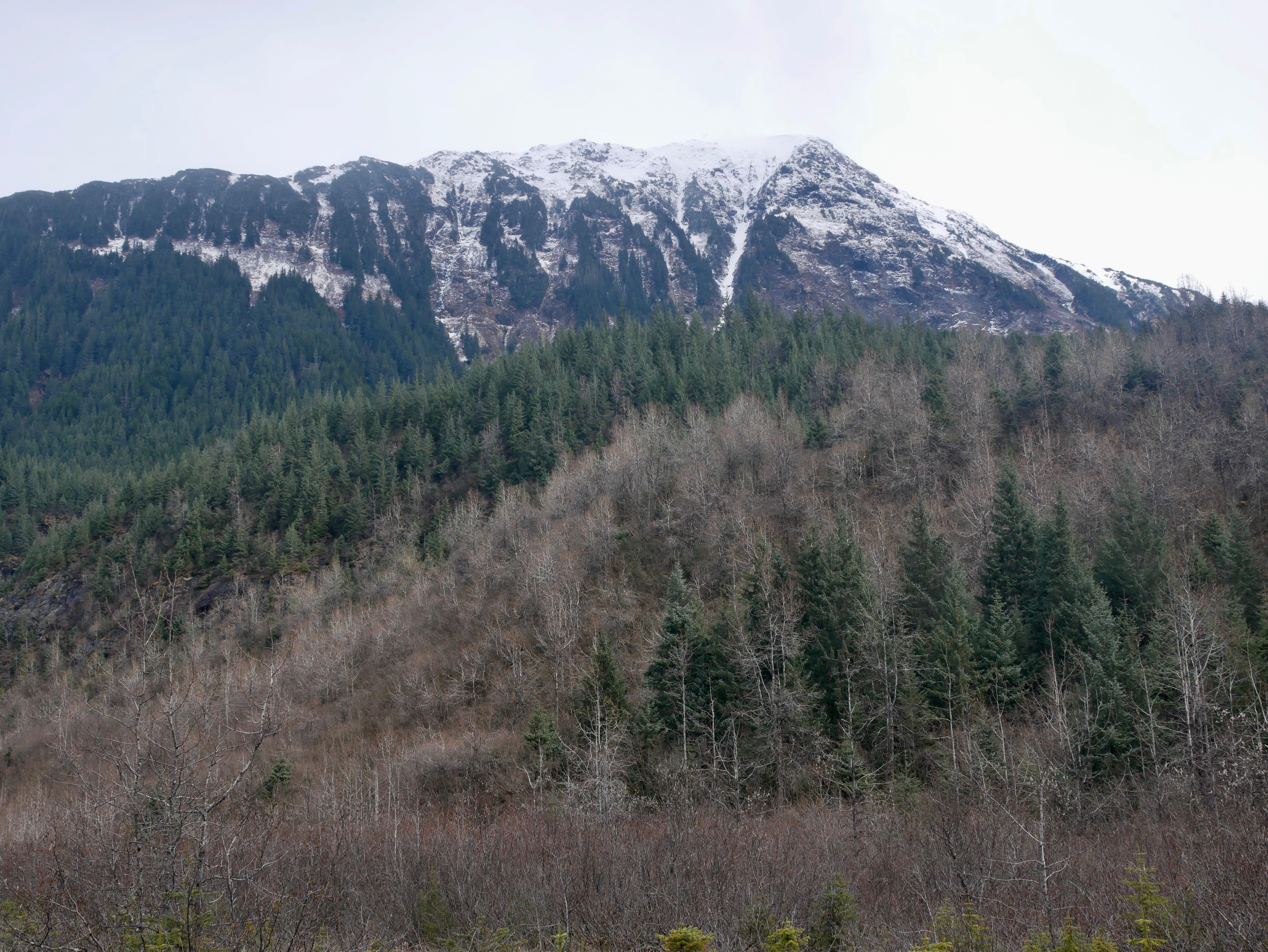
            The ice river meanders out of a layer of low clouds that hides the Mendenhall Towers but not Mt. McGinnis or Mt. Stroller White. Alder trees on the mountains’ slopes, bare except for their swollen, white buds, could be a convention of ghosts. One bald eagle circles a forest meadow on the far side of the lake. Otherwise the sky below the clouds is empty of obvious life. 

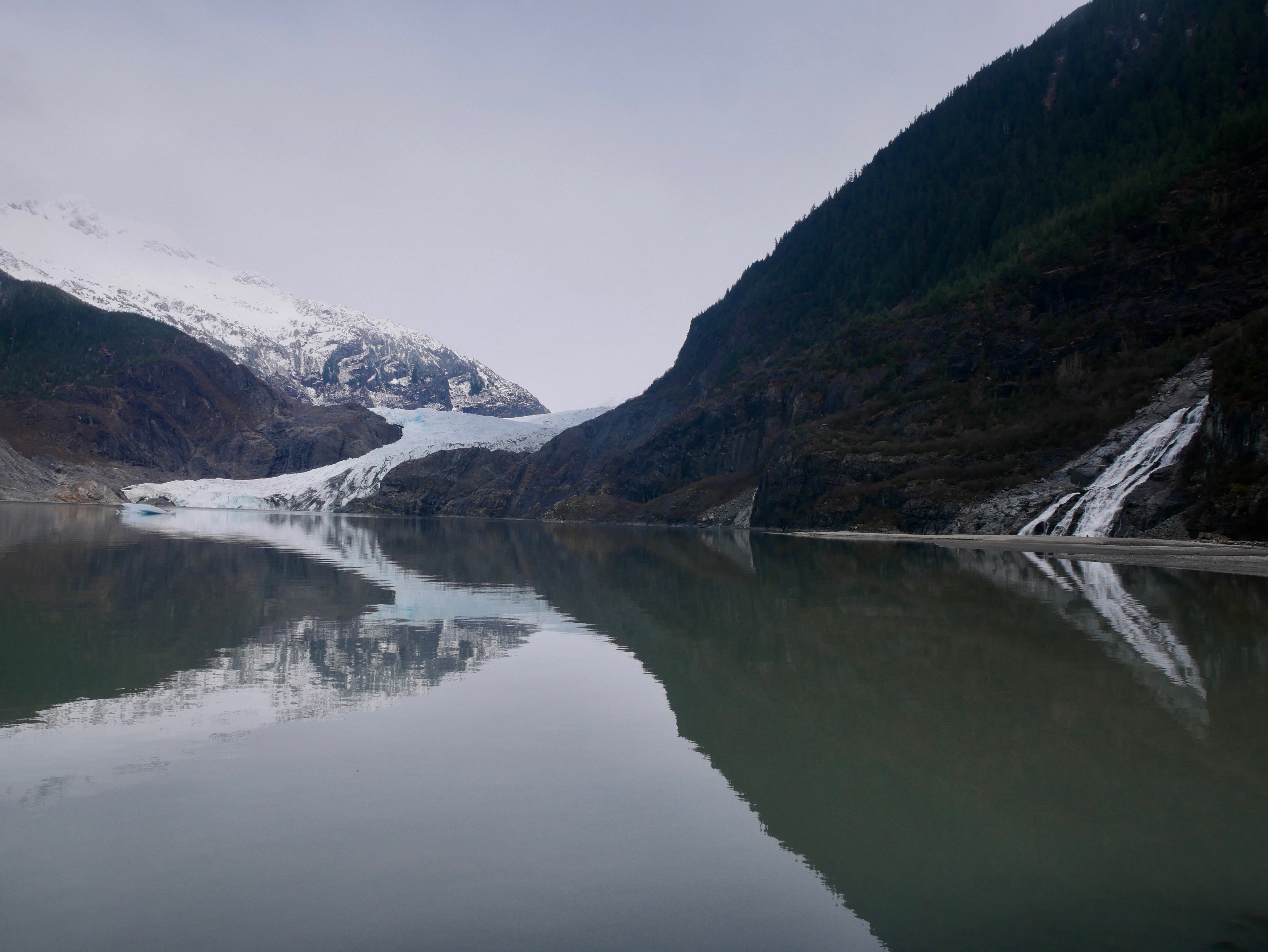
            At the beginning of the hike a constant breeze made the lake surface look like dun colored corduroy.  It dies out by the time we reach the falls, allowing the lake to form a mirror for the mountains, falls and glacier. 

Digging the Rain

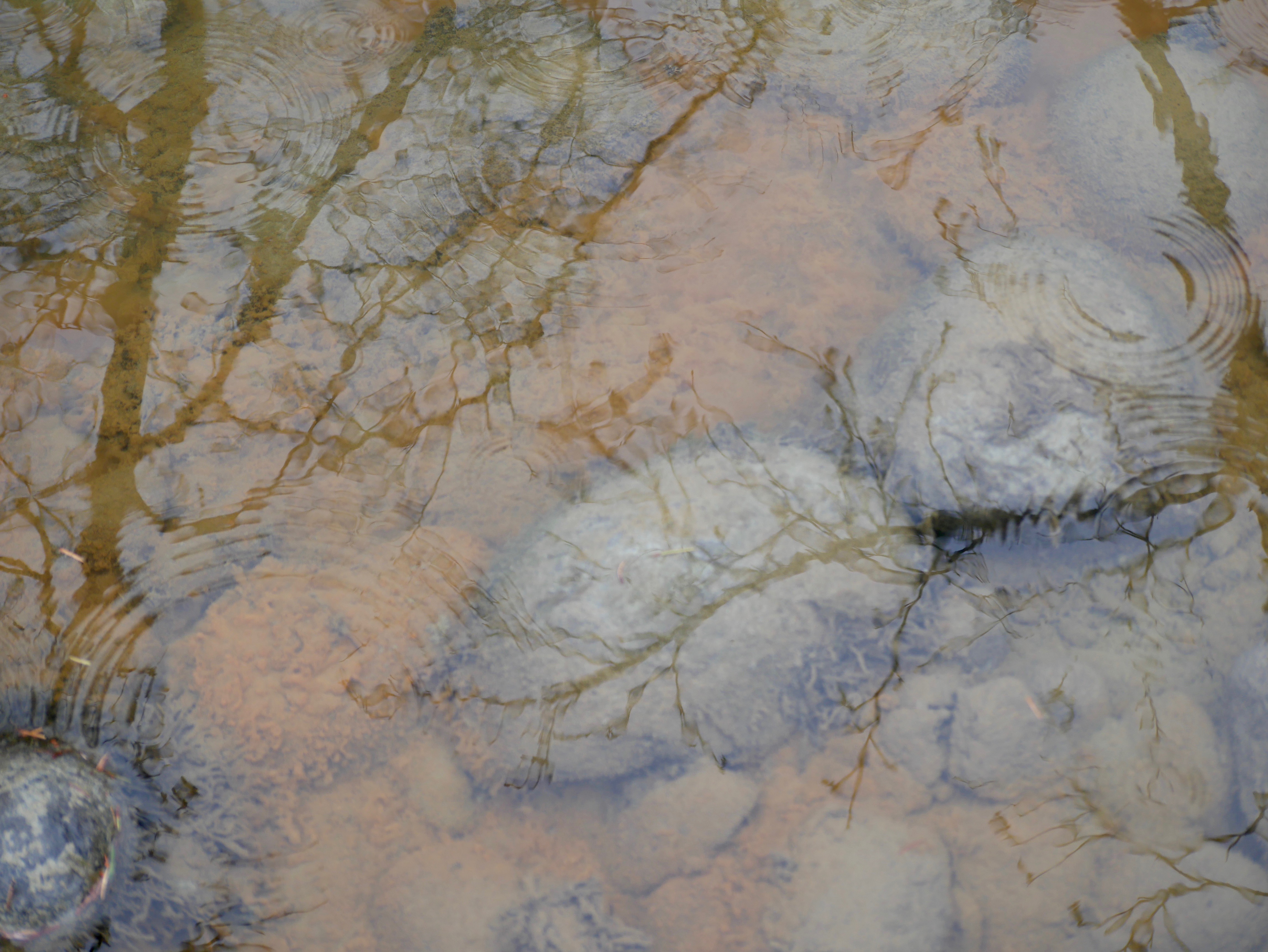
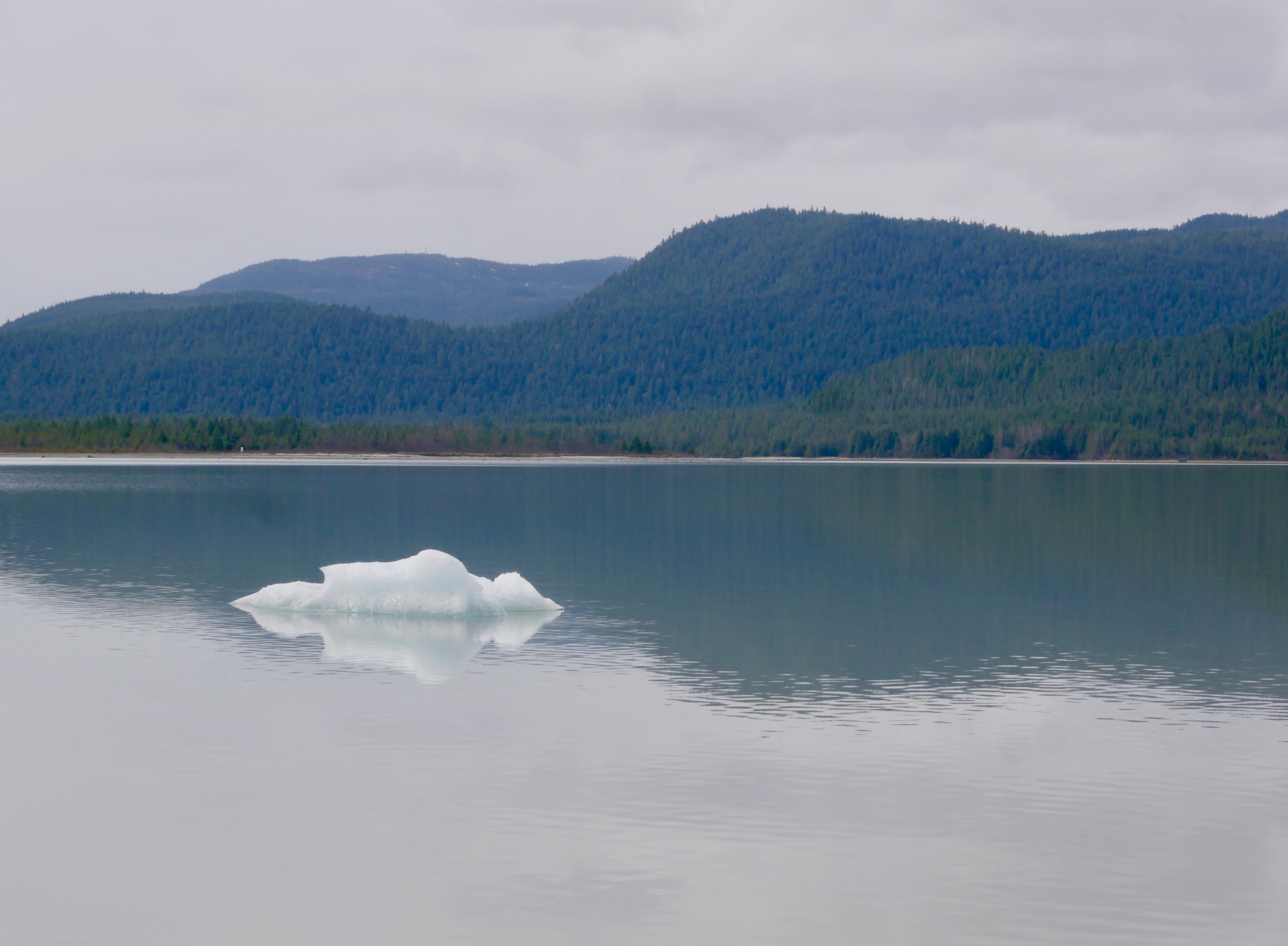
Rain pockmarks the surface of Mendenhall Lake and softens the handful of icebergs that migrated away from the glacier after the lake thawed. Across the lake kittiwakes reoccupy their traditional nesting sites. They don’t seem bothered by the persistent precipitation. 

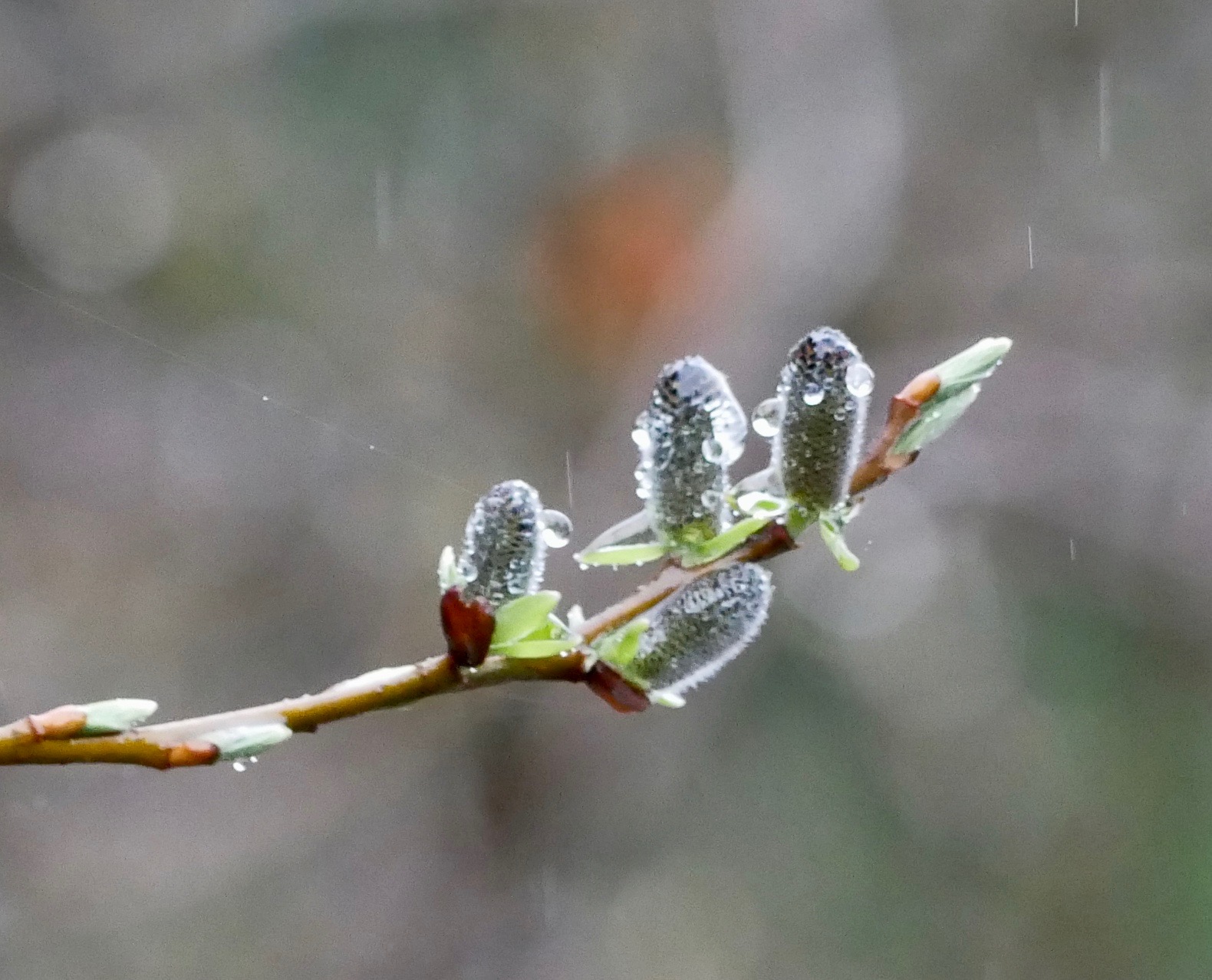
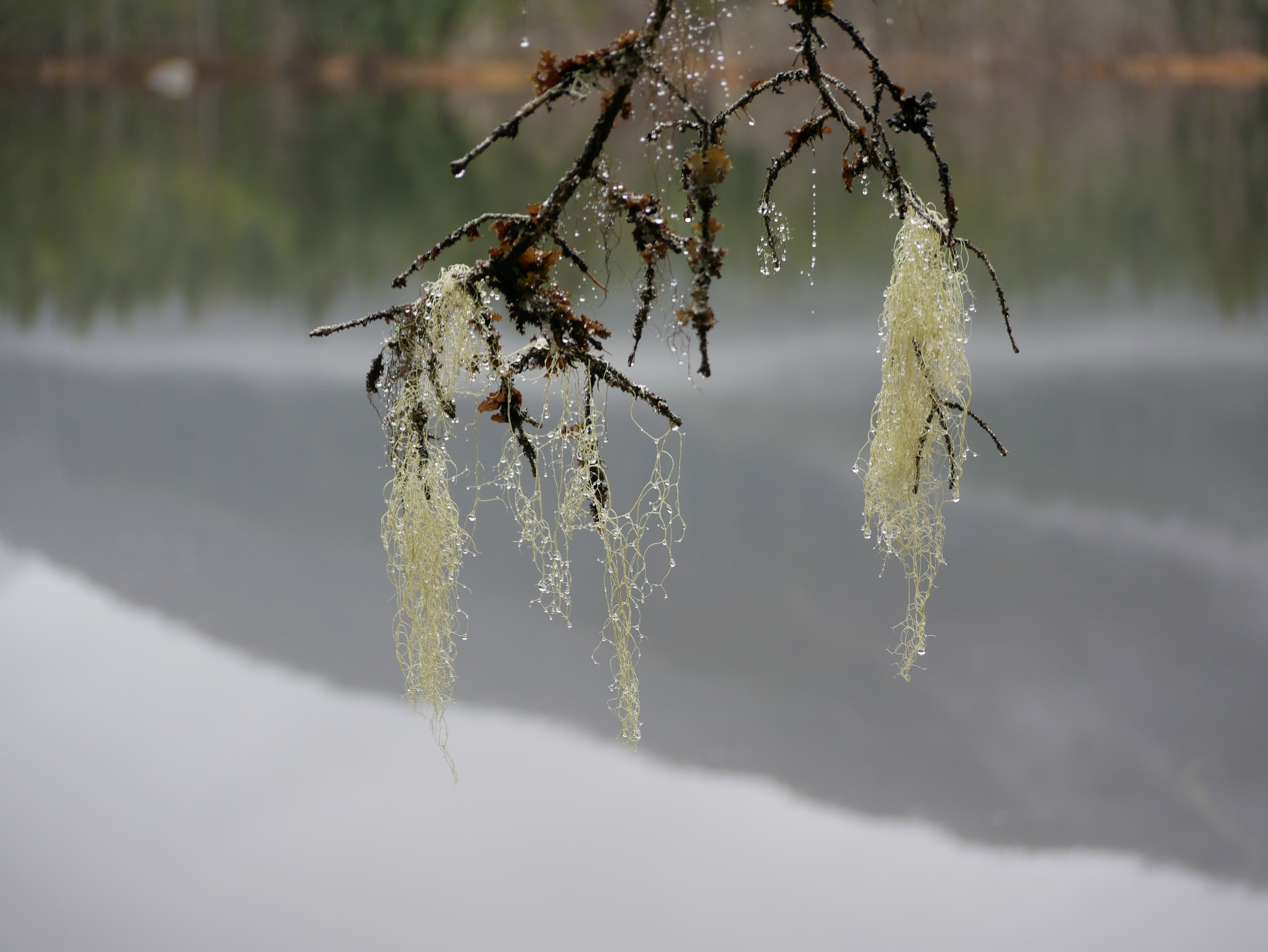
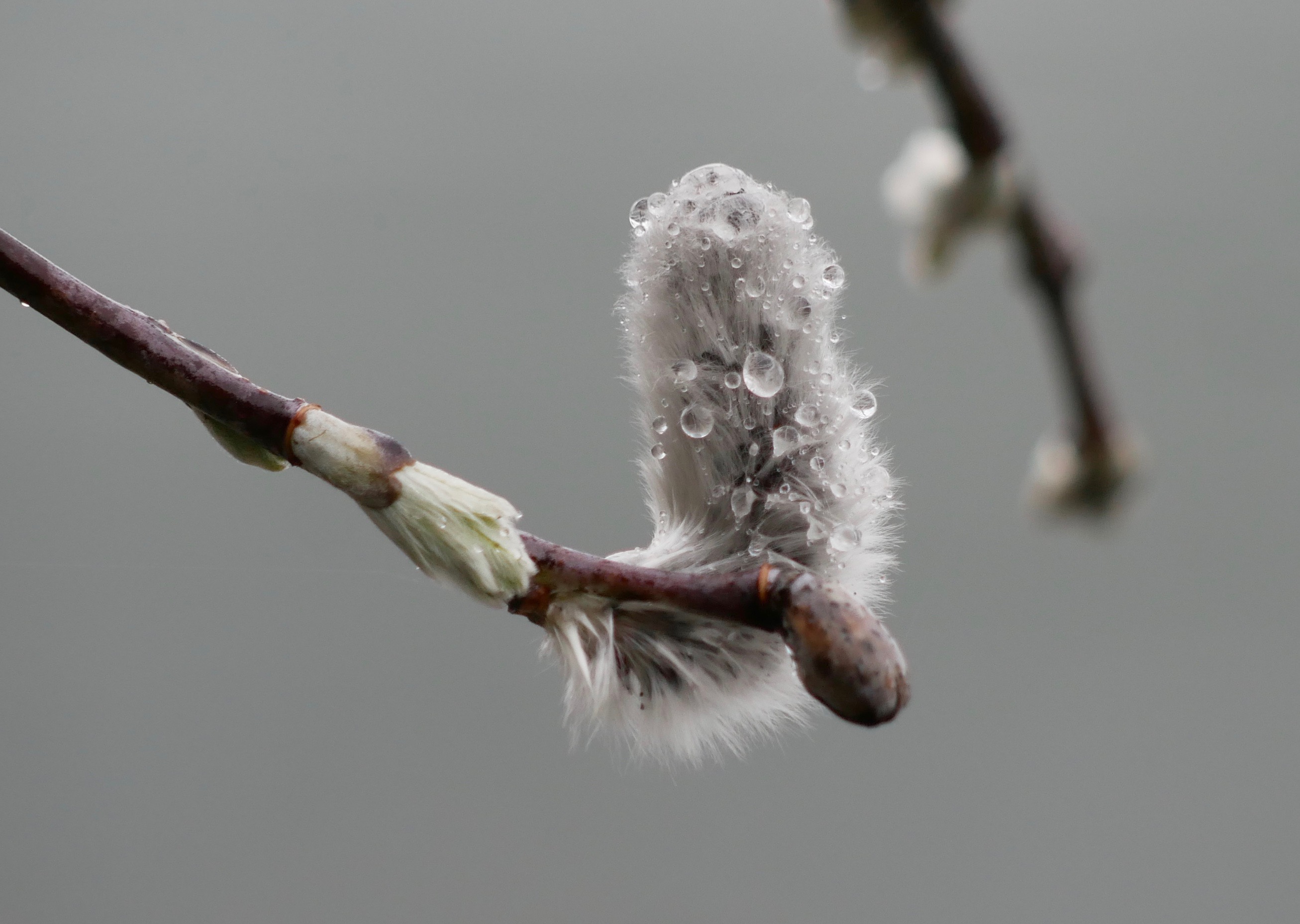
            I like the rain for the way it leaves sparkling bags of water on the willow catkins and makes the forest moss sparkle. It also might be responsible for the welcomed absence of other trail users. We have the lakeshore and moraine to ourselves. We also enjoy an absence of human-made noise. Planes can’t fly thanks to the low cloud ceiling. The roar of the supercharged Nugget Falls masks the other intrusive sounds. I can only hear the pat, pat, pat of rain on my rain parka and the sharp cries of the nesting kittiwakes. 

Hunkering Down

For the past few weeks robins have been a regular feature of our walks. Before today, they just trotted along in front of us as if to lead the little dog and I away from their young. But they didn’t sing. The robins infesting the forest near Fish Creek Pond this morning have switched into nesting mode—singing territorial songs and escaping into a surrounding tree when we approach. Black-capped chickadees harmonize with the robins as they move nervously through the forest canopy. 

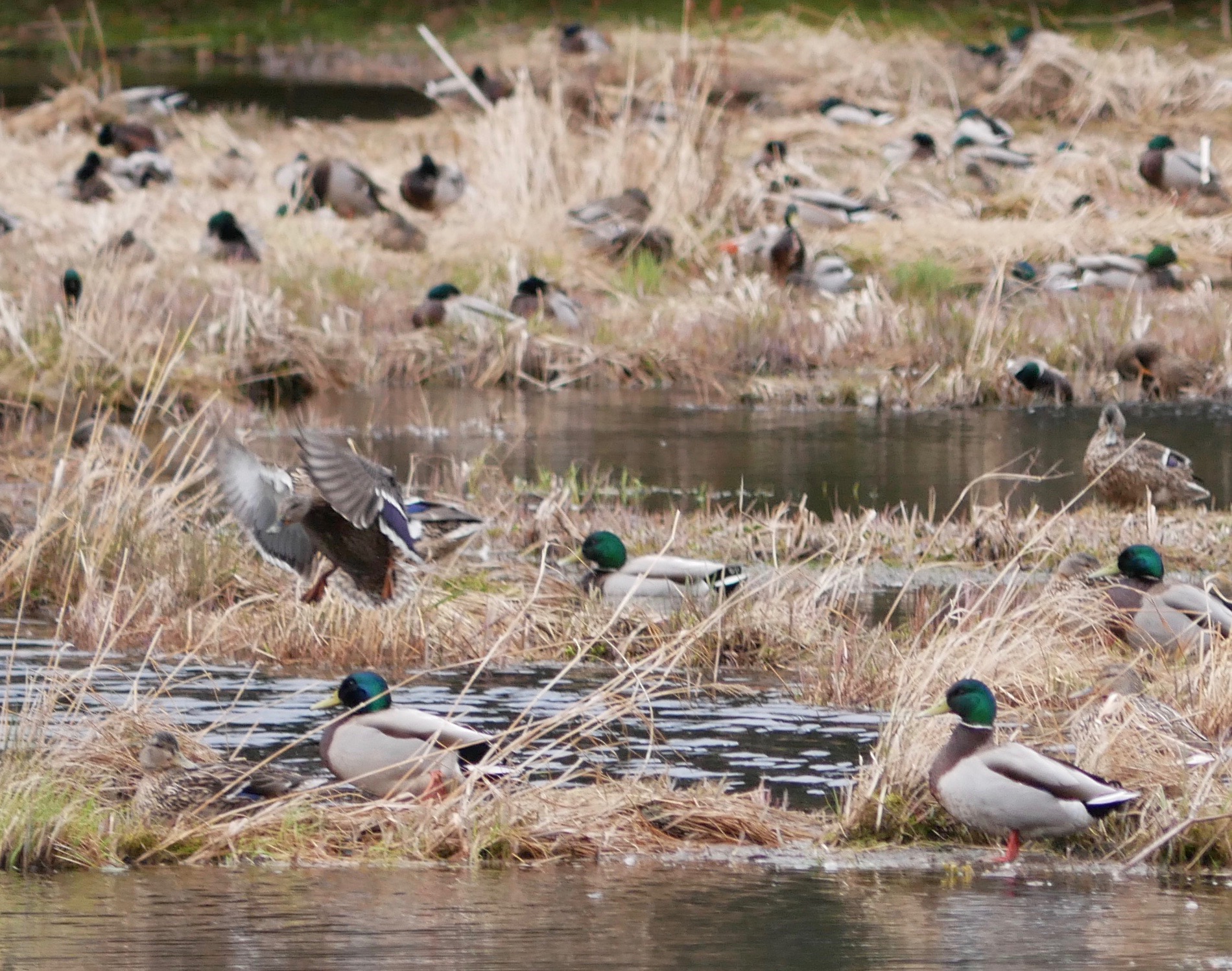
            Aki ignores the noisy birds. One of her other humans has brought along a Frisbee for the little dog to chase. While she is busy with her toy, I sneak off the trail to look at ducks gathered on a swampy meadow. At least one hundred mallards crowd on a series of tiny lakes. A northern pintail and several American widgeons wander among the mallards. Every minute two or three more ducks join the crowd. 

            The wind, which has being growing in strength since we left the car, can’t reach the ducks in their inland preserve. Nothing blocks it from whipping down the glacier, across Gastineau Channel, and over the Fish Creek Delta. Only crows use this open space. They toss themselves into the air, pop around like kites, and drop back onto the beach. 

Sleeping in the Rain

After 17 dry days the rain has returned to Southeast Alaska. You can almost hear the forest sigh with relief. I am doing the same. The rain has washed away a thin layer of glacier silt that covered the downtown streets and sidewalks. The rain may have discouraged other hikers from using the Dredge Lakes trail system. Alone, Aki and I move up a trail that parallels the Mendenhall River. On a clear day the trail offer views of the glacier and surrounding mountains. This morning only a sliver of the river of ice appears above the river. 

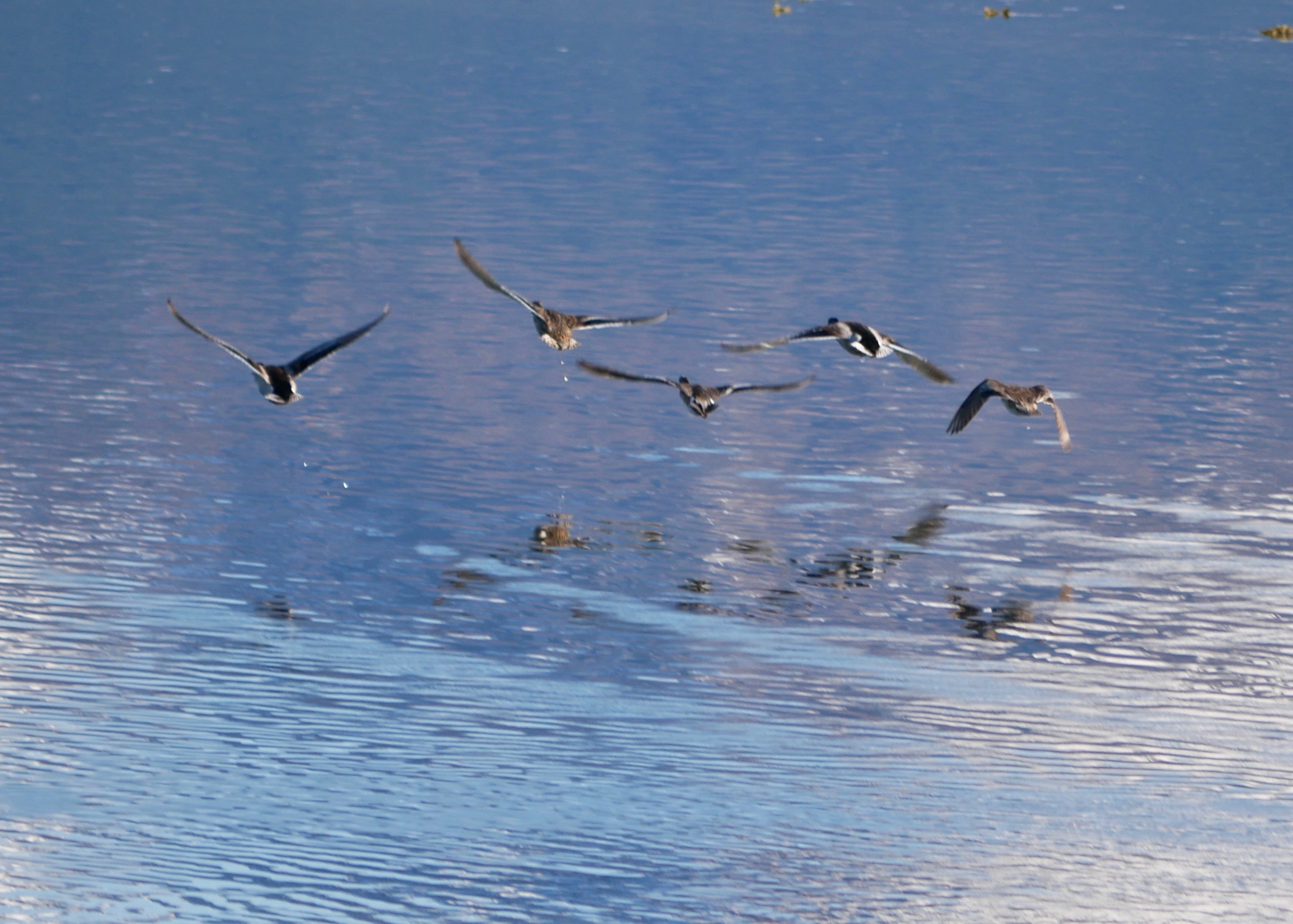
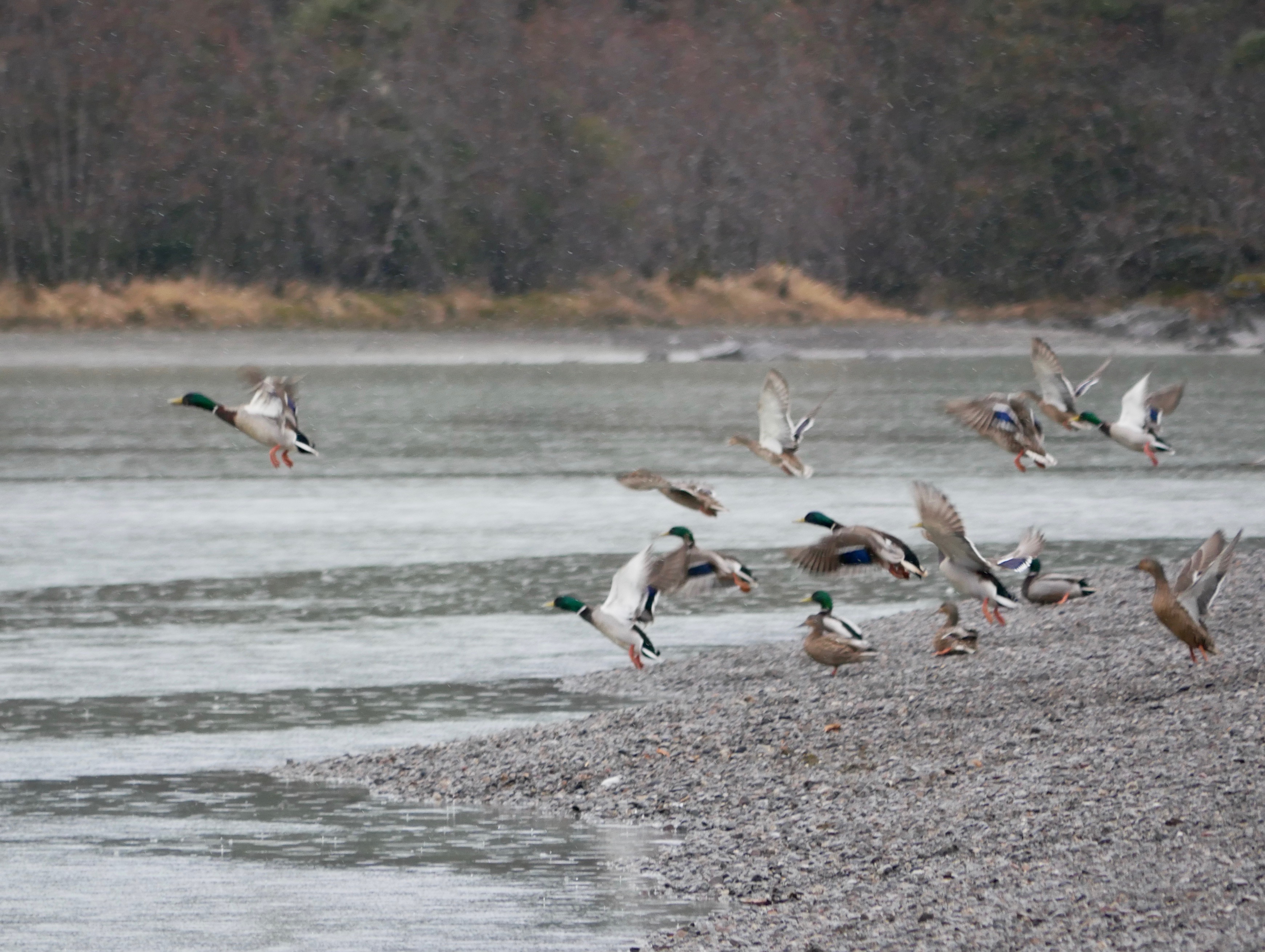
            Thanks to the recent stint of dry weather, a tributary normally too deep for us to cross has been reduced to a trickle. I take advantage and lead the little dog up a side slough to a section of the river we can rarely reach. Today it’s a hang out for mallards and merganser ducks. As we approach they fly off the beach in twos or threes and land a short ways off in the river. Soon the whole raft follows them. 

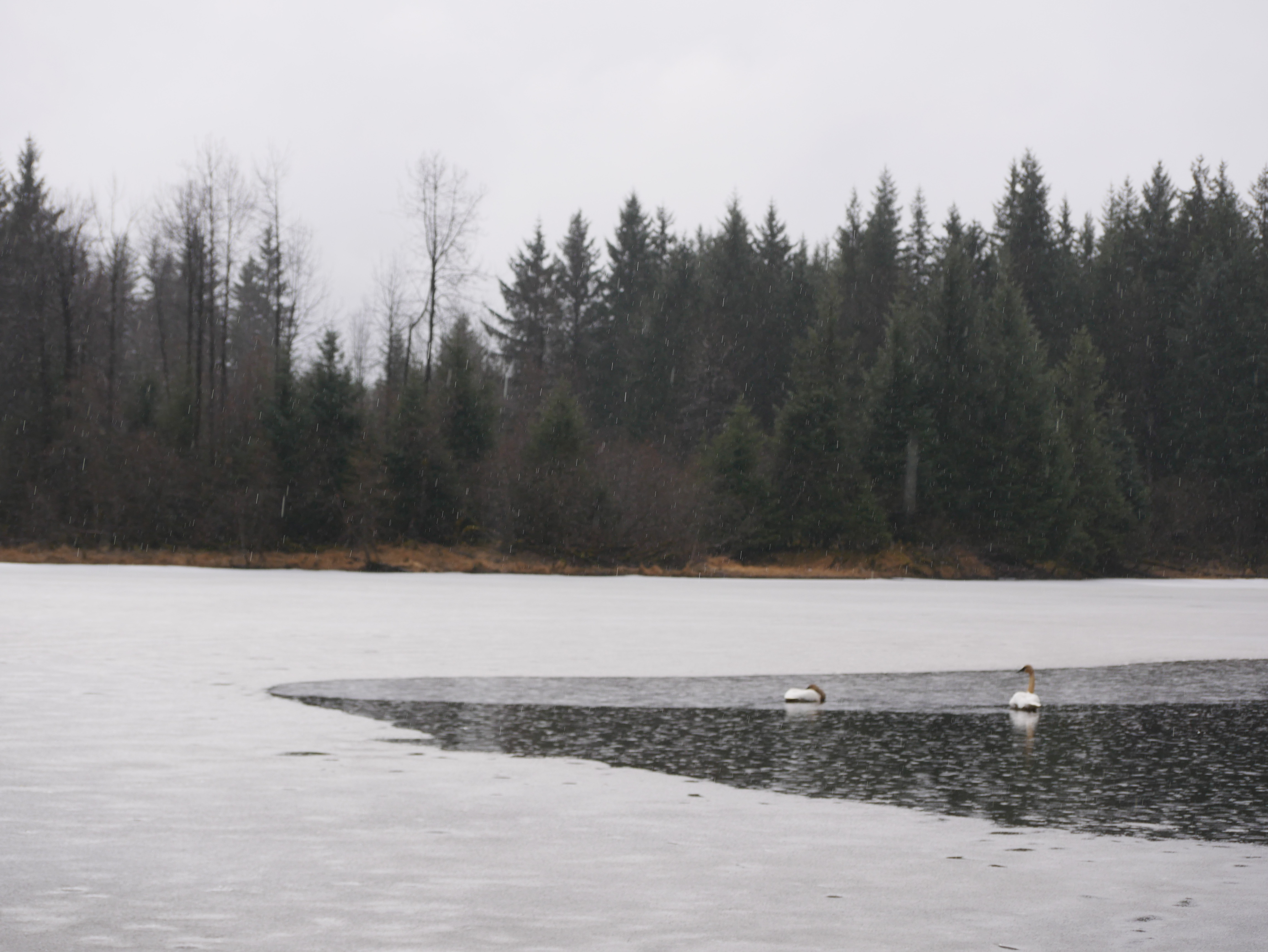
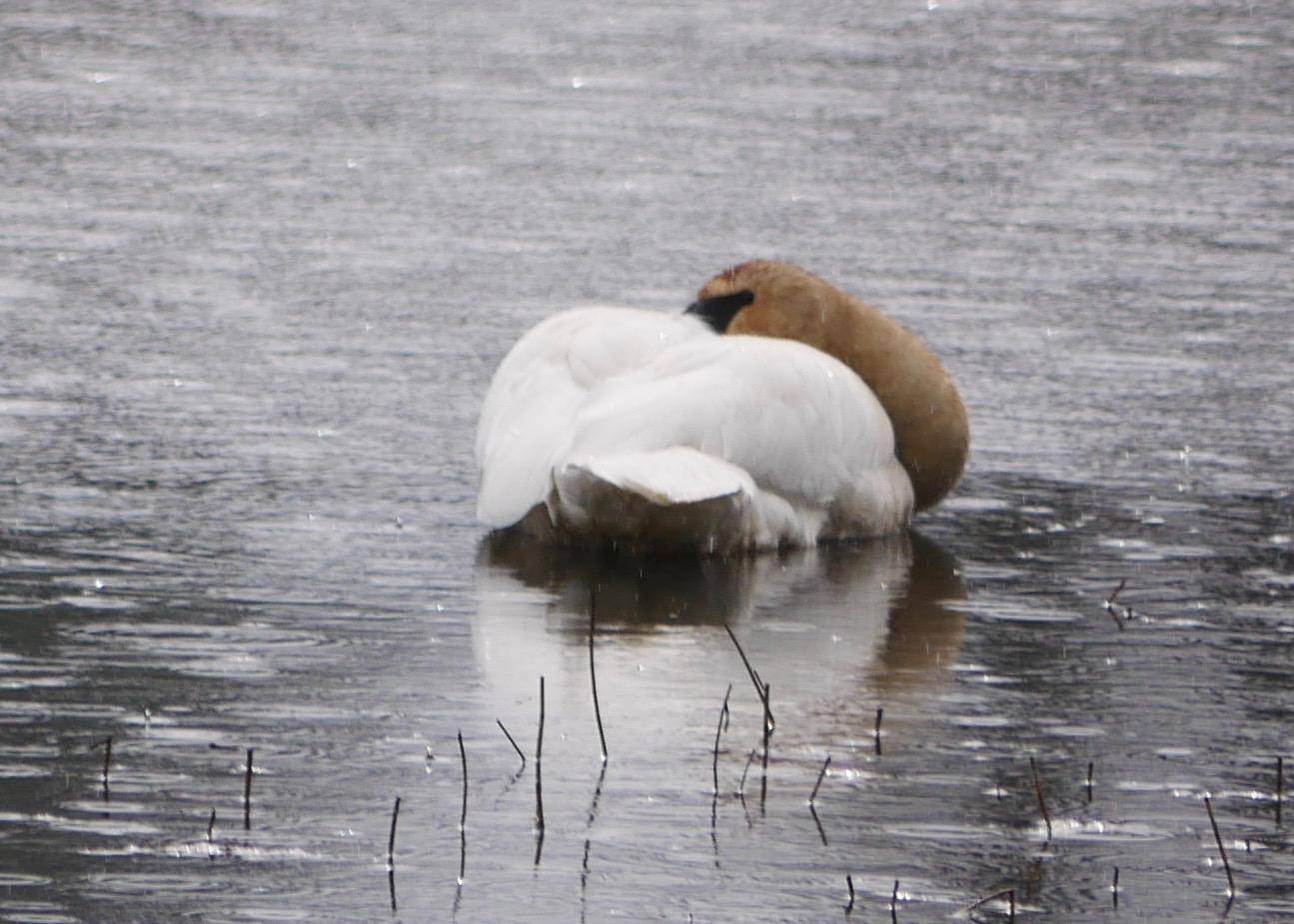
            After circling a large beaver den, we cut back through the woods to Moose Lake. While Aki rolls and rubs her face in a soft patch of trail snow I hear a bird with a powerful voice call “ko-hoh.” We move on, after an unsuccessful attempt to locate the caller,and reach the lake. Ice still covers most it. Two trumpeter swans float in a small patch of open water, their long necks stained brown by the muskeg water in which they recently fed. Now they sleep with their black beaks tucked into their back feathers. 
            One of the swans wakes up when my foot slips on some gravel. It looks at the little dog and me, then resumes its nap. I assume that they have just finished a leg of their northward migration. Now they must rest and feed before resuming their flight to the summer breeding grounds. 

            Aki and I meet two humans and their three dogs on our walk back to the car. When I mention the swans, they tell me that two swans were feeding on the lake last week. I wonder if our swans are the same birds, still recovering from the long flight or a newly arrived pair.