Category Archives: Aki

Many Shades of Snow

1

Before we leave Chicken Ridge for the Gastineau Meadows trail, I’m forced to destroy art: the bas-relief baroque frost feathers that obscure the rear window of our Subaru. From inside the car Aki watches the blade of our scraper plough through frost as thick as Victorian wallpaper. In seconds it is gone.
4.jpg

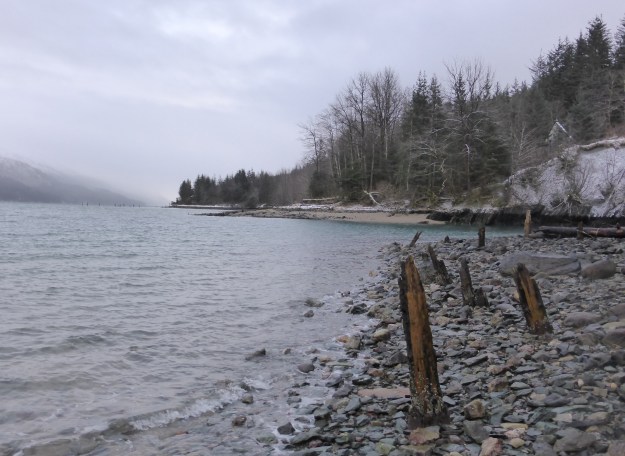
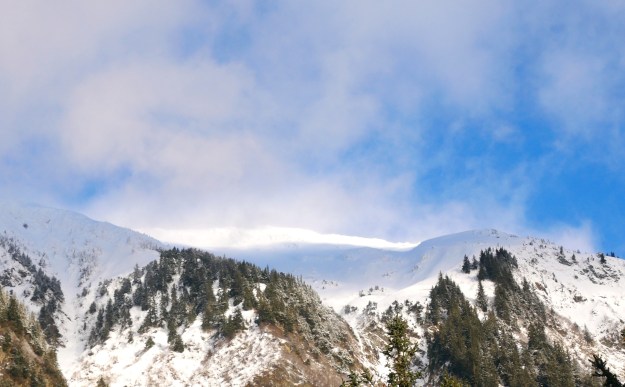
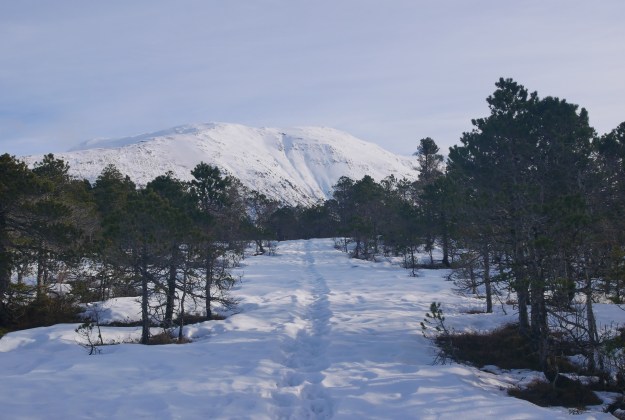
We see so many manifestations of frozen water during our visit to the meadows that I wonder why the English language has so few words to describe it’s many states. There’s the snow that still covers most of the meadow. Corse from repeated freezes and thaws, it can hold even my weight until the day’s sun softens away its crust. Thin sheets of opaque ice cover the ponds with abstract etchings that could have been by Joan Miro. On the main trail, many boots have pounded the snow covering into dense and smooth ice the color of milk. Aki and I avoid sections where a thin sheet of water the color of Irish breakfast tea has seeped over the trail ice.

3

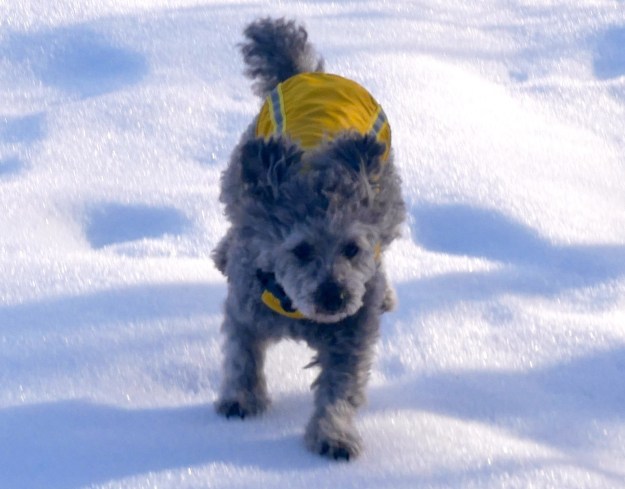
Air bubbles are still trapped in meadow ponds where last summer we watched water striders dimple the water. Beneath the ice their progeny wait with the water lilies for spring. Aki and I follow the trail of an adult deer that took advantage of the crusty snow last night. While I stop to photograph Mr. Roberts, the little dog starts racing up and down a solid stretch of snow, ears flapping. Often all four of her feet leave the ground at the same time like she is trying to fly. The little poodle-mix does love snow.
2

Surrendering to the Rain

2

I used to think that a willingness to lean into the winter wind was the primary requisite for surviving an Alaskan winter. After today, I wonder if you really need is the capacity to surrender.

1

Aki and I slip and slide over the paths through the Mendenhall Campground. It’s raining, like it has rained for a couple of days. Before that we had heavy, wet snow. My jacket is already soaked through and water drips off Aki’s fur. We don’t turn back to the car, just take extra care not to slip on the water-skimmed ice. We surrender to the rain.

1

This must be what it would be like post apocalypse if you and I were the sole survivors little dog. We are alone, maybe even a little lonely. No one comes out of the bathrooms or carries firewood to their campsite. No children play, no dogs bark, no cars purr as their driver looks for the perfect campsite. With this weather, we have no reason to expect help or even company.

4

Winter Orcas

3

While I’m checking out a spruce tree that now leans over the trail thanks to the last windstorm, Aki darts down the trail and out of view. When she squeaks, I trot around the corner and see her groveling before a matched pair of Australian shepherds. The dogs’ owner apologizes but I assure him that my little poodle-mix is just inviting the shepherds to play. With that cleared up, he tells me about the orcas. “You should see the whales the minute you break through the trees,” he says, “and with that telephoto you might get good pictures of them.”

I hustle toward the beach, scan the water, but only find a small raft of ducks near the surf line. Further out, near the northern edge of Shaman Island I briefly spot a splash of white water like that caused when swells strike against a partially submerged rock. But there is no rock there so maybe it was a killer whale roiling in the water. Encouraged, I scan for the plumes formed when an orca exhales or the sail-like dorsal fin of a mature male. But wind-blown rain clouds my glasses. The wind would wipe away any ocra plumes as they formed.

2

It should be enough to know that I am close to a pod of killer whales, but I want to see them fin, maybe even spy hop.

They must be the wolf pack—the meat eaters that hunt down seals and sea lions—not the larger pod we see each summer chasing down king salmon. I’ve kayaked near the summer pod several times, never felt threatened, even when a mature female swam to within twenty feet and rolled on her side to eyeball me. But even on a calm, warm day, I wouldn’t launch my boat into waters where the wolf pack hunts other mammals.

1

Avalanche Gun

1

At the south edge of the Treadwell ruins an avalanche control team fires shells from a cannon-like recoilless rifle across Gastineau Channel and into the south flank of Mt. Roberts. Worried by the buildup of snow at higher elevation of the Slide Creek avalanche chute, the team hopes that each shell will trigger a small snow slide. Otherwise, a major avalanche will crash down the mountain and bury the only road to the settlement of Thane. Even through we walk along the mountain’s north flank, the cannon booms fill the valley where we walk. At each report I hold still to listen for the heavy-surf sound of an avalanche. Aki stiffens into a cringe. When I smile and resume walking up the snowy trail, Aki dashes off to investigate interesting smells.

2

We are going through one of the dozen false springs the rain forest will suffer from until the bursting of cottonwood buds announces the death of winter. Most thaws increase avalanche danger, soften the snow cover, and flood mountain trails. The soft snow doesn’t slow down Aki as she dashes ahead to greet a couple of human friends. One asks me what thing impressed me the most during my recent visit to Cuba. “It was a handshake,” I answer. Not the handshake of a person or power for fame but that of a long line fisherman.

3

A local had introduced the man as the best fisherman in their village where every fishing day involves the setting and pulling by hand of a long line baited with hundreds of hooks. The highliner extended his hand and took mine. He didn’t crush it but I would have been unable to break the handshake against his will. His hand felt like leather from being repeatedly wounded by fishhooks and grooved by the daily pulling up of long lines. After I shared this with my friend on a snowy Juneau trail, she wondered, out loud, how my hand felt to him. “Soft and helpless,” I thought to myself.

4

Backfilling Silence

1

It’s snowing outside, fat wet flakes twirling in the wind, soaking the surfaces where they land. The flakes land everywhere. I am listening to The Cuban All Star Band and thinking about a kind woman that I had recently met in Havana. Another person present in the room had just asked the question all traveling Alaskans expect: Do you get a lot of snow up there? She had smiled at the mention of snow. “I saw snow just once, on a trip to Madrid,” she said and then smiled like the memory was one of her favorites. She had made snow angels.

2

When the snow is dry and gathered in deep drifts, Aki makes her own version of a snow angel. But this morning, during our walk on outer point beach, what snow that survived last night’s flood tide couldn’t even hide the whorls of driftwood that lie among the severed rockweed above the high tide line.

3

Aki can’t appreciate the swirling white beauty of snow carried on the wind. She doesn’t acknowledge the silence delivered by the storm. Thanks to the low cloud layer and lower visibility no airplane or boat can break the silence. Only the two resident eagles complain, and then only for a few seconds. My traitorous mind backfills the vacuum with memory of a song sung by a Cuban peanut vendor’s that had silenced a crowd of Canadian tourists on Brazil Street. A Spanish speaker would have recognized an artfully delivered sales pitch for the peanuts that filled the paper cones she clutched in one hand. In my ignorance, I heard a lover’s song of longing.

4

Aki Would Like Cuba

3

I’m back in Juneau walking with Aki through the Treadwell ruins. The weather forms a sharp contrast with that I had in Cuba, where I spent the last 10 days. There, we had lots of sunshine and temperature in the 80’s. Here, it’s hovering just below freezing and soft snow settles on the little dog’s gray curls as she trots past the bones of the hospital.

4

I spent most of my Cuba time in the old section of Havana, where narrow, cobblestone streets separate rows of houses with half-ruined marble staircases and still-beautiful courtyards. Folk in Havana treated me and the others in my people-to-people group with kindness and sometimes, bemusement. Just before sunrise we would head into the city, cameras clicking away at students and their parents making their way to jobs or school. Rather than swat us away like the mosquitoes we were, they smiled or just ignored us. After several photographers took pictures of an elderly woman on a second story balcony as she pulled up a rope to which a friend on the sidewalk had attached a bag filled with flour or rice, she shouted out that they owed her a dollar.

1

Another morning, while walking alone, I watched a man with only one good leg limp around the Plaza Vieja to feed stray dogs with restaurant leftovers. At least one of the strays had a sign around its neck, placed there by the government, that provided the name of the dog (P-9) and a request that people be gentle with it. Aki would like Havana.

2

Strong Light

`

2

This is our last walk together for a couple of weeks. Aki knows that I am leaving. She watched me pack a bag last night. We take the usual route through Downtown, squinting against a strong morning light. It clarifies with sharp contrasts of darks and lights and throws cloud shadows on to the flank of Mt. Juneau. On a telephone pole someone has attached a “Have You Seen This Cat?” sign. Beyond it I can see the nest of our neighborhood eagles. They usually carry off a few felines during famine time.


1

The little dog dawdles, stopping too often to sniff and mark spots with her scent. She doesn’t need clarifying light to learn who passed through here during the night. Where the hillside drops steeply away from Gastineau Avenue, three ravens sun themselves high in cottonwood trees. Two break off twigs, perhaps for a nest. The third stares down channel where dark clouds climb over the Douglas Island Ridge.

3

Down on South Franklin Street, a young woman pulls her luggage between shuttered tee shirt shops and jewelry stores and stops in front of a tropical clothing store. She opens a suitcase and fluffs out its contents, including a pink dress with fancy black trim suitable for 1890’s dance hall work. The police will soon find her in this light, make her pack up and move on like they do the other homeless.

The Gulls’ Day to Shine

3

An 18-foot high tide has forced the little dog and I off the beach. We scramble up and down a series of headlands near Amalga Harbor. Aki leads me down otter trails. Smaller than an otter, she glides under the alders and blue berry bushes that challenge me. Aki waits with apparent patience while I push through the barriers. Strong sun sparkles on surf just offshore and gives her a glowing gray aurora. We are trying to reach a little pocket beach that offers a private view of Lynn Canal and sometimes sea lions, seals and whales.

2

Breaking through a border of alder and crabapple brush, we stumble upon  a collection of Herring Gulls sunbathing on top of the rock outcropping that once offered us a great view of feeding humpback whales. Normally as common looking as pebbles on a storm beach, the gulls, squatting on electric green moss, backlit by the sun, look like self-possessed dowagers on the French Riviera.

p1000850

Invading the Privacy of Crows

1

We were talking politics when I slipped on shale and cut my hand (discussing politics with a human friend, not Aki). That was the second mistake. The first was attempting to round False Outer Point after the incoming tide had already covered the easy beach path.

1

The point provides us with a windbreak and no rain falls from the sky. But otherwise, the walk offers little but low-level risk and enough crows to satisfy Alfred Hitchcock.

2

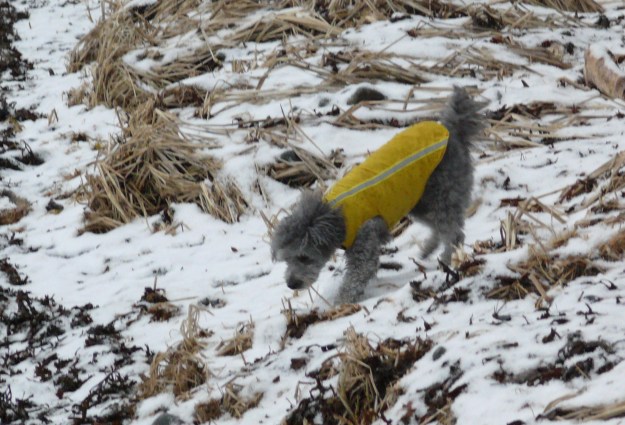
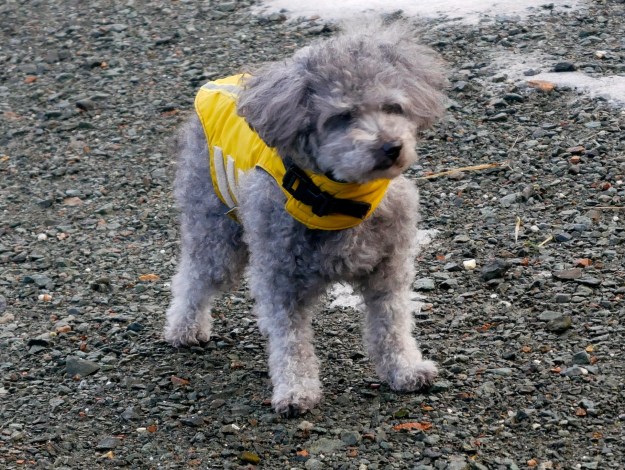
I don’t realize I’m bleeding until three crimson drops hit Aki’s yellow wrap. I elevate my injured hand and squeeze it closed to slow the flow. Overhead two bald eagles fly out over the channel and return to their spruce roosts. Crows darken the beach just ahead of us. When we cross their privacy line, they explode into the air. Are we invading the privacy they have come to expect each time the tide rises high enough to block human access to their beach? Maybe because my little dog looks so much like a stuffed animal I wonder if we have stumbled on the equivalent of a teddy bears’ picnic.

Timing or Luck?

3

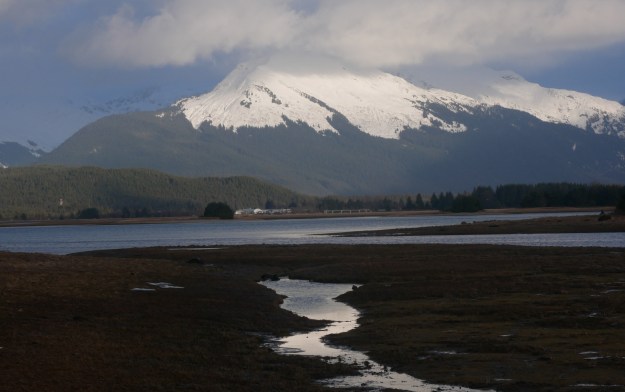
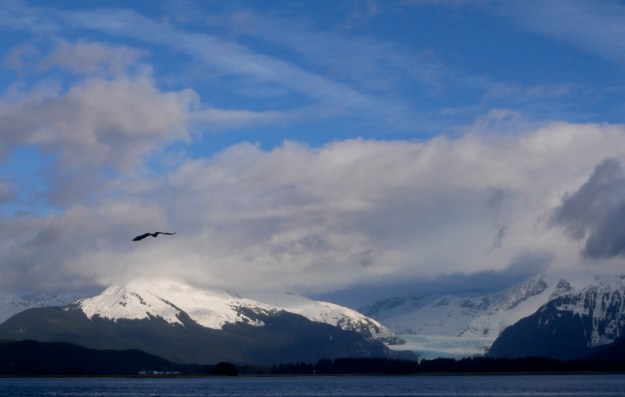
Aki and I just rounded the spit that forms the western jaw of Fish Creek’s mouth. In five minutes the path will be closed by the incoming tide. A strong wind blows down the creek, appearing to come from a break in the clouds hanging over the Douglas Island ridge. For the brief moments that the break will last, sunlight reaches the glacier and the lower flanks of the mountains that surround it.

2

A slim, white eagle feather spirals down, distracting me long enough for me to miss the flight of a mature bald eagle over our heads and into a screen of spruce trees. Ducks, spooked by the eagle fly off before I can photograph them against the face of the glacier. Bad timing, little dog. She gives me what looks like a “think it through dummy” stare. She probably just wants to escape the wind but my brief anthropomorphic moment makes me wonder whether opportunities to witness the wonderful or beautiful in nature is controlled more by luck than timing.

4

It was in part good timing that placed us here during the brief storm break illuminating the glacier. Such things tend to happen just as the sun first reaches mountain peaks. Knowledge of tide tables allowed us to sneak past the headland just before being cut off by the flooding tide. But the rest was a matter of uncontrollable luck.

1