It might be the largest porcupine I’ve ever seen. Just a few meters away, it waddles towards the protection of an alder thicket. I’ve just passed through a similar thicket. Luckily, Aki has stayed back to check out a smell, probably the scent of this huge porkie.
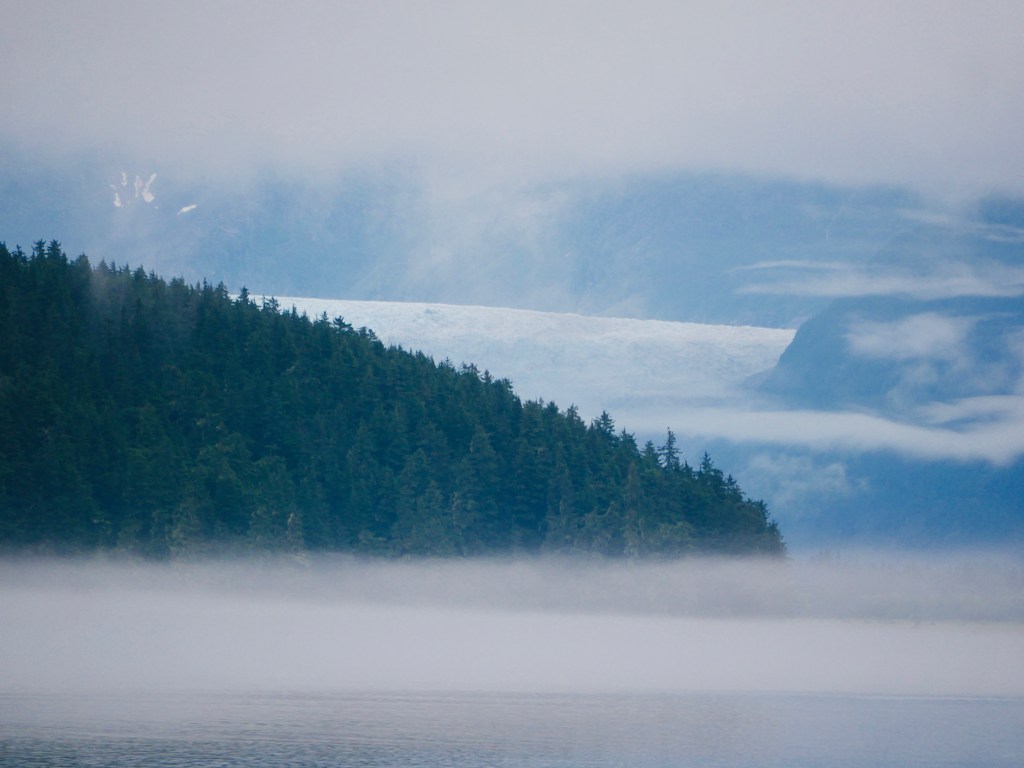
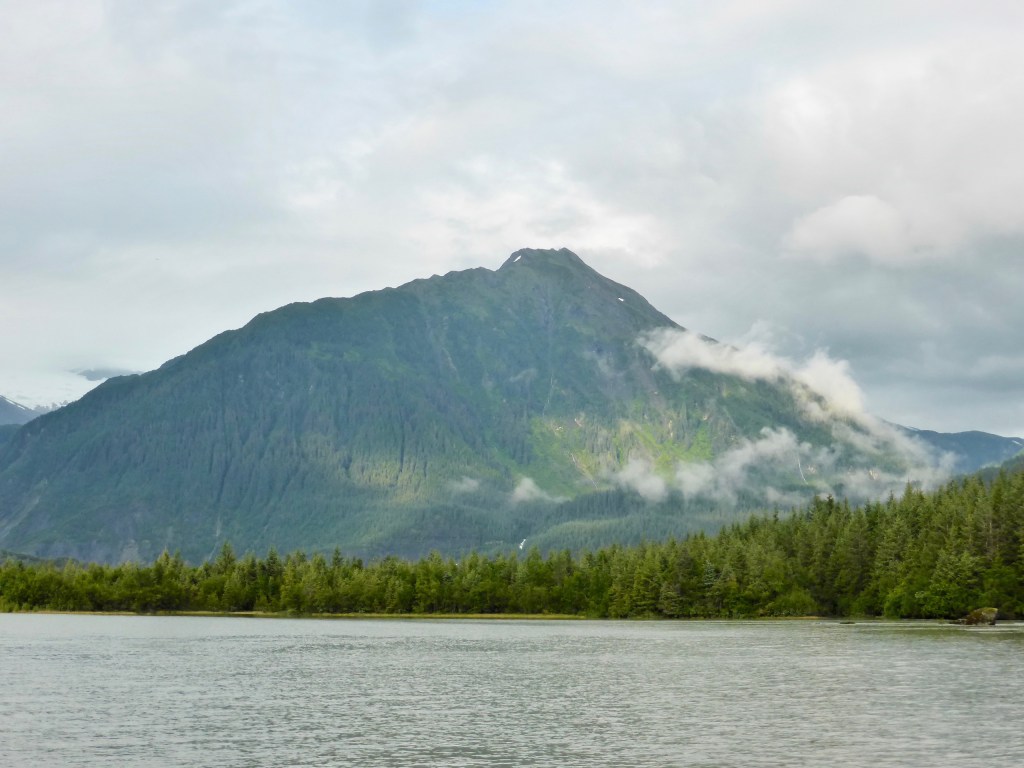
The last time Aki ran into a porcupine, it decorated her face with quills. This time, Aki’s luck holds. After giving the porcupine’s hideout a wide birth, we continue on towards Nugget Falls. Shafts of sunlight slide from the cloud cover to illuminate parts of the glacier or Mt. McGinnis.
When a shaft of light hits the ground where we walk, stop, closes my eyes, and wait for the sun to warm my face. But it’s too late in the summer for that to happen. Now is the time for sunlight to strengthen the colors of fall.
We would have passed the beaver pond without seeing the mallard hen if she hadn’t been flapping her wings. The lady was tucked deep in the reeds, invisible to old eyes like Aki’s and mine if she hadn’t moved. We had already seen a lot of wing flapping this morning.
On the drive to the trailhead we stopped at Three Mile to count eagles. More than a half-a-dozen crowded around a small pool in the creek. Most stood in the steam, flapping their wings in the water like song birds do in a bird bath. Other eagles powered down their wings for lift as they climbed from wetlands crowded by the incoming tide.
As we moved down the beach a juvenile varied thrush flit off the trail to land on top of some driftwood roots. If it was its cousin the American robin, I’d suspect that it was trying to draw us away for its young. But that is not the thrush’s way. Sometimes they are just stupid-brave.
Most folks would never call deer does brave. But the one we passed this morning held its ground as it stared at the little dog and I. It must have been enjoying something tasty when we disturbed its meal. I hope it shows more discretion than valor when doe hunting season starts.
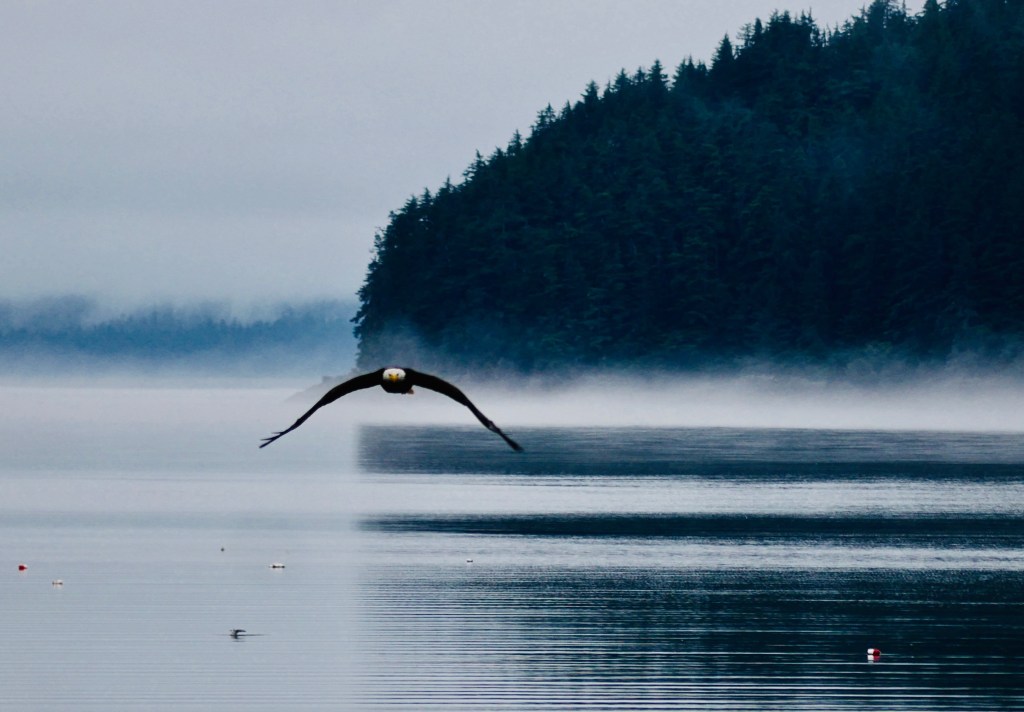
The day will offer spectacular views of eagles, some with the glacier as a backdrop. But two ravens, perched together near the opening into Fish Creek Pond, are the first to peek my interest. They do it with their voices, not their appearance. Looking into each other’s eyes, they speak in language with more clicks than the African bush people. It sounds sped up. Aki, could we understand them if we made a recording of it and then played it are a slower speed?
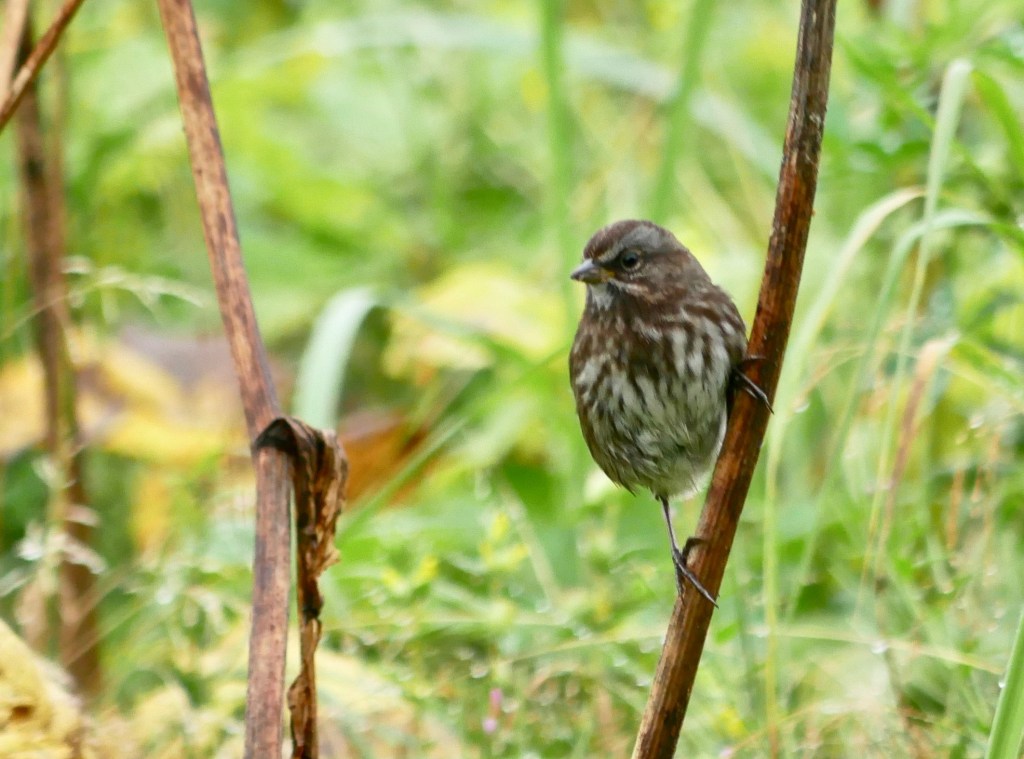
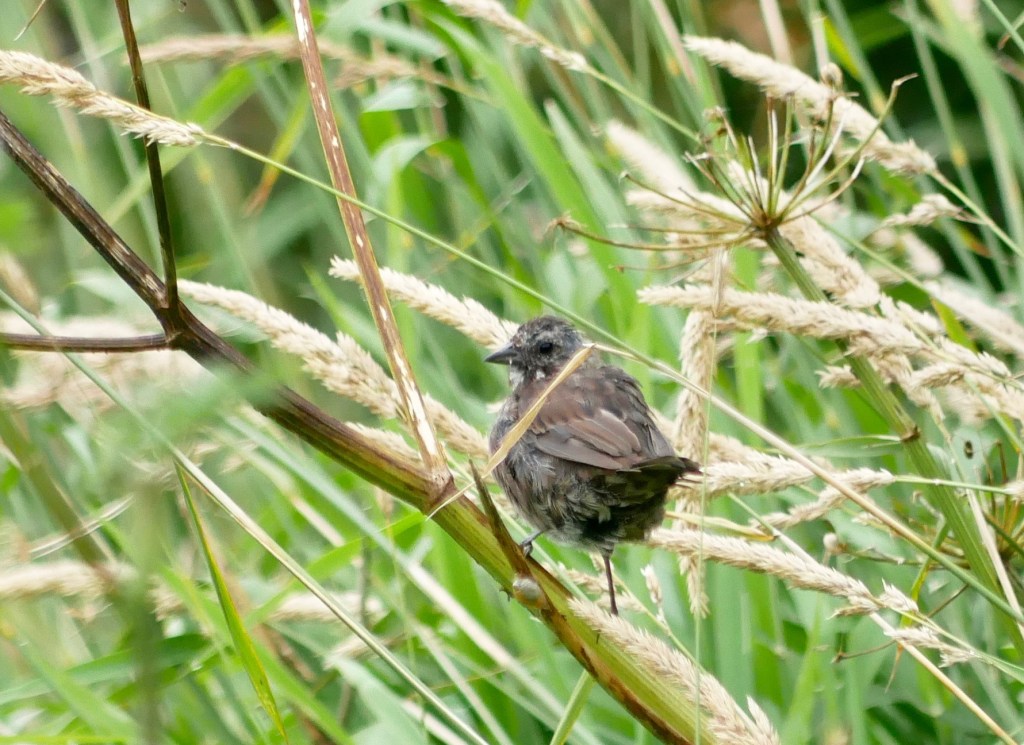
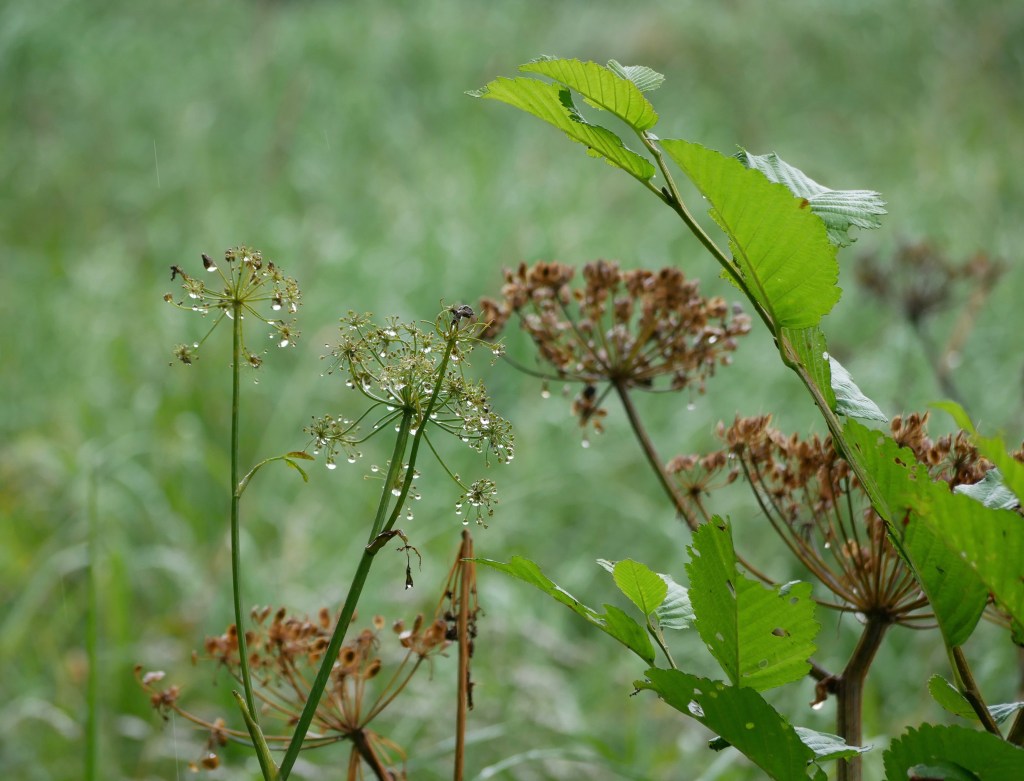
My question gets no response from the little dog but spooks the ravens into flight. We move on, leaving the pond for the spit trail, now almost closed in by wild roses and fireweed stalks aging into their fall colors. My pant legs are soaked by the time we pass through the gauntlet. Near the end, a sparrow observes us while perched on the side of a dried cow parsnip stalk. It is one of a large flock of sparrows harvesting the spit for seeds.
The outgoing tide has exposed wide swaths of wetlands. Eagles that usually roost in nearby spruce trees stand near the water’s edge. Some eat the flesh of spawned out salmon. Others just chill. A murder of crows takes to the air, bickering and banging into each other as they make their way to the little spruce island at the end of the spit.
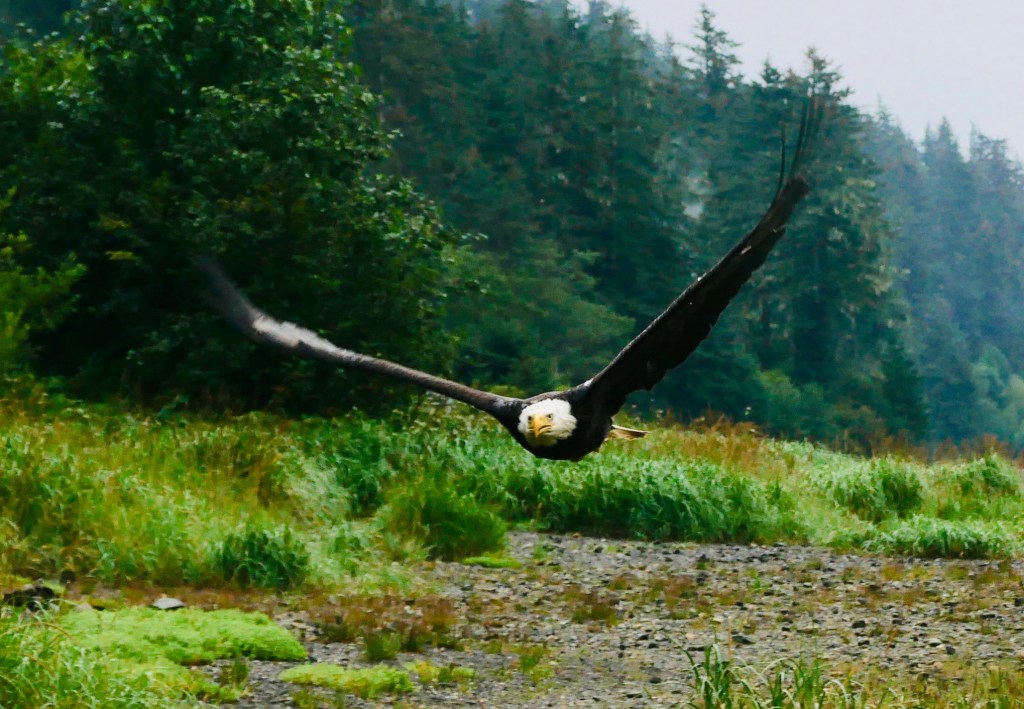
I spot something out of my eye just as we are about to round the island’s tip. One meter away, an adult bald eagle clutches a spruce limb with both talons. It is soaked but otherwise appears unharmed. We lock eyes and then I look away. It is still watching me when I aim my camera at it. I’ve never been this close to an eagle unless it was clutching something to eat. Even then, the raptor would not hold its ground with a stare as this bird is doing.
On the walk back to the car I called the raptor rescue center and with hesitation left a message about my close encounter. All the other eagles flew off when the trail took us within fifty meters of them. This one clutched its spruce limb tighter and drove me off with a hard look. Hopefully the eagle experts can determine if the bird is bum or brave. Hours later, I got a call from someone at the raptor center. From looking at my photos of the eagle, she learned that the eagle had a broken tail and had been on the ground for sometime. They would take it into protective custody so it can safely heal.
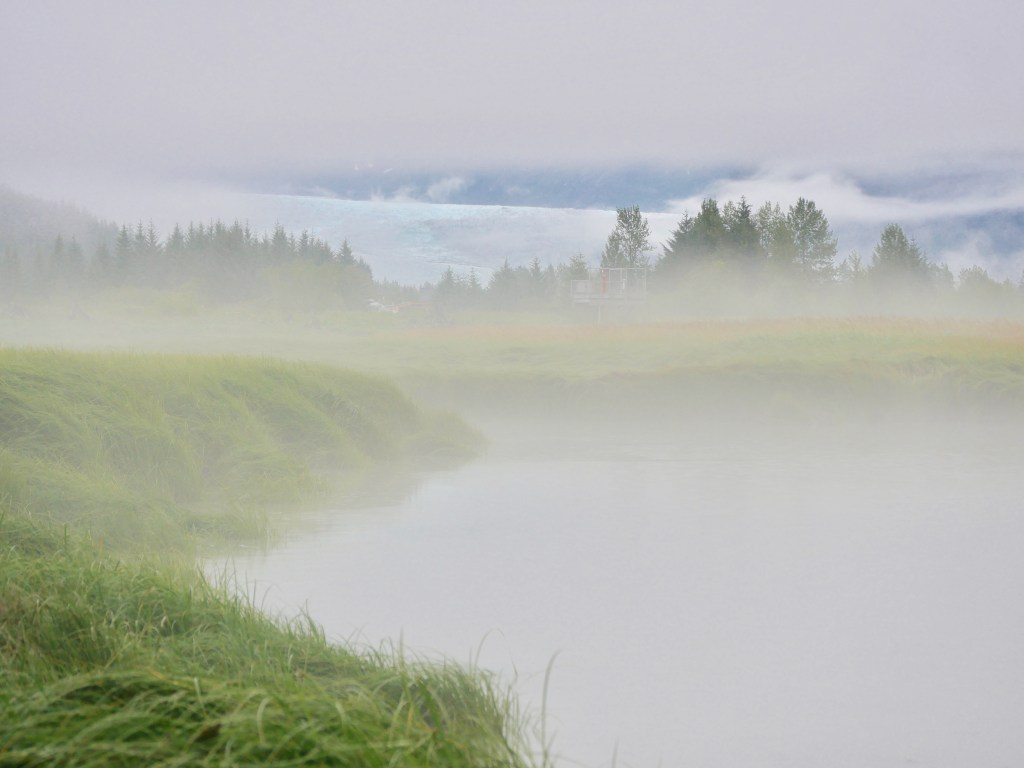
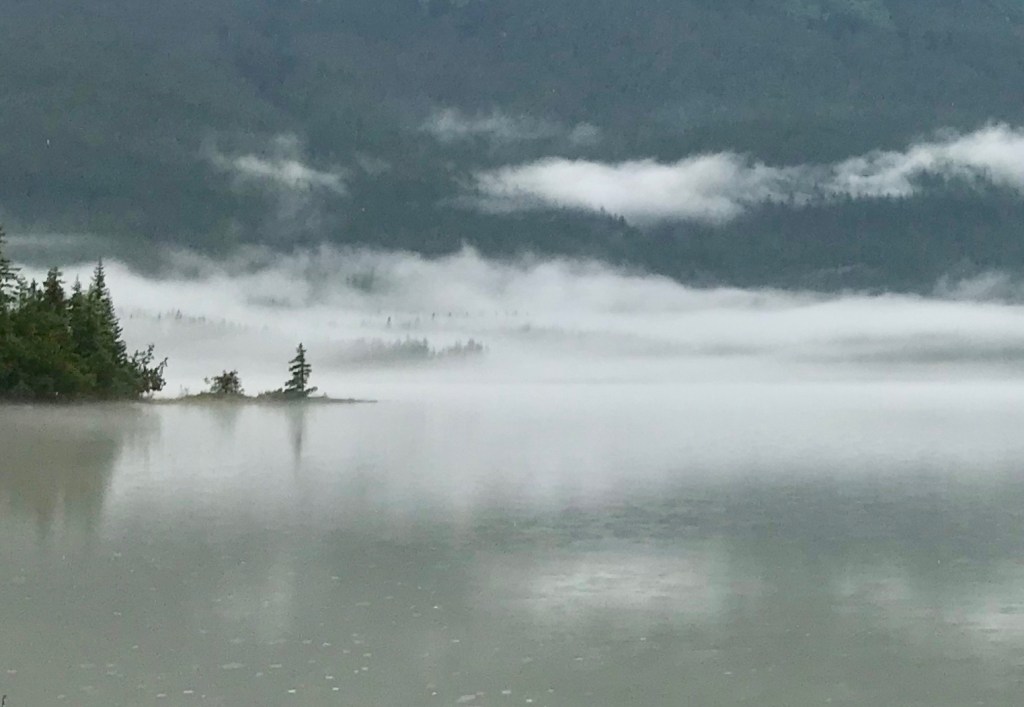
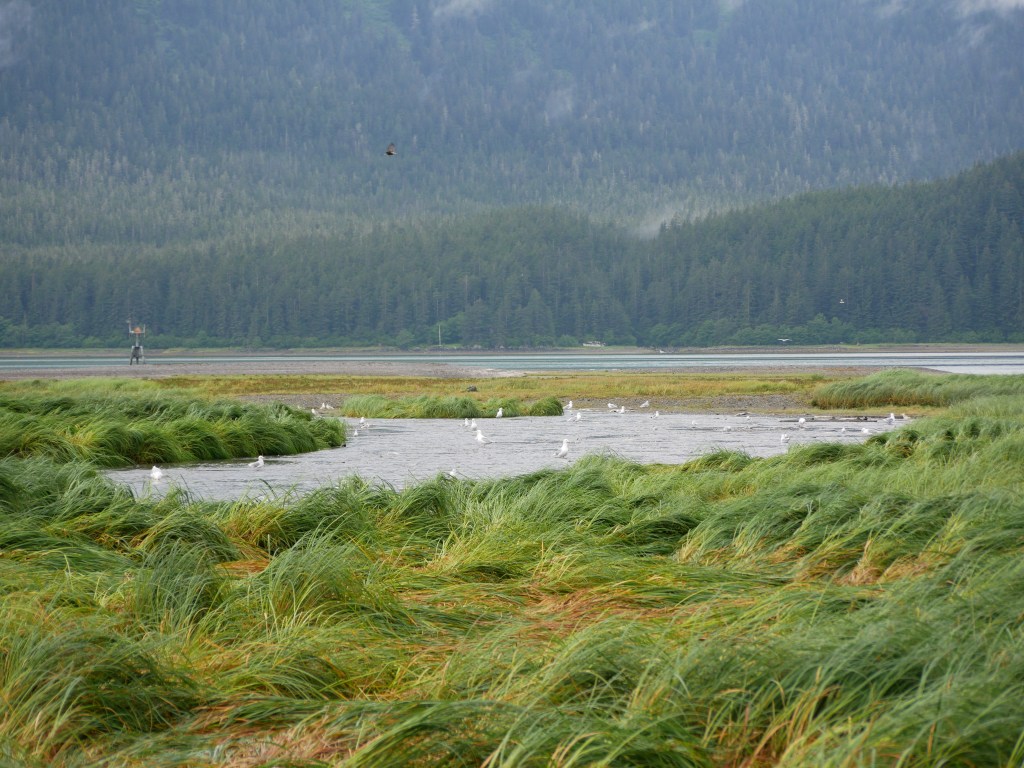
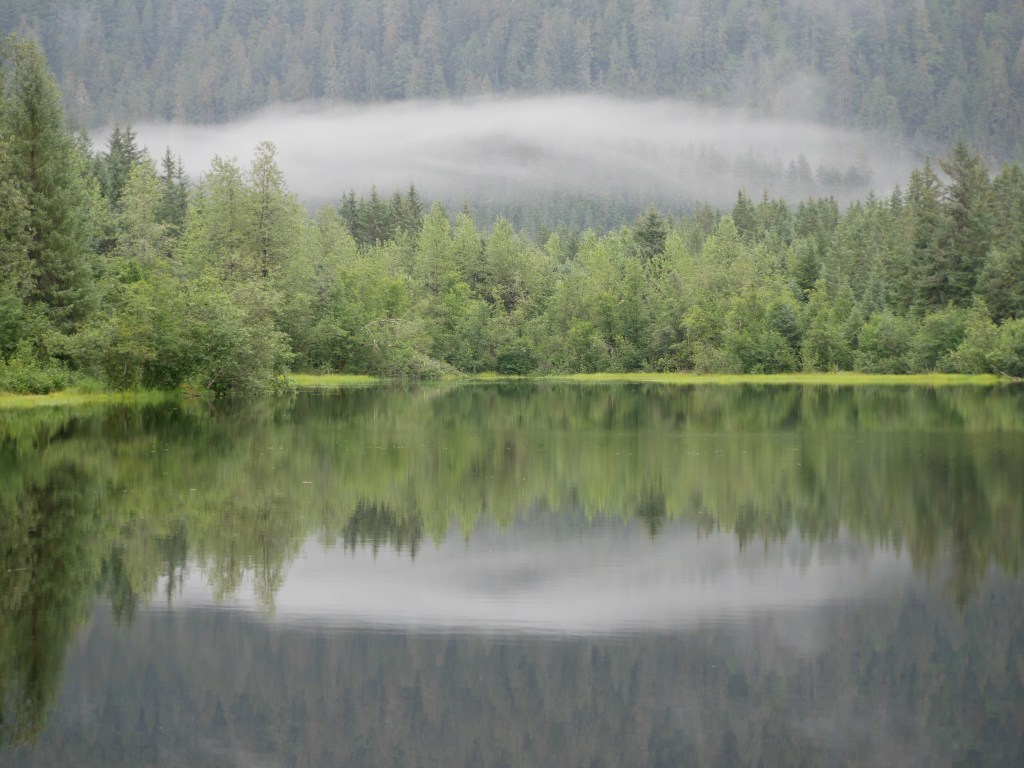
Rain can bring beauty as well as misery. Today it brings beauty with just a littler misery for the little dog and I. We are walking with another dog and her human along the Mendenhall River. Whips of fog curve around wooded islands and lay like a soft blanket over the grasslands.
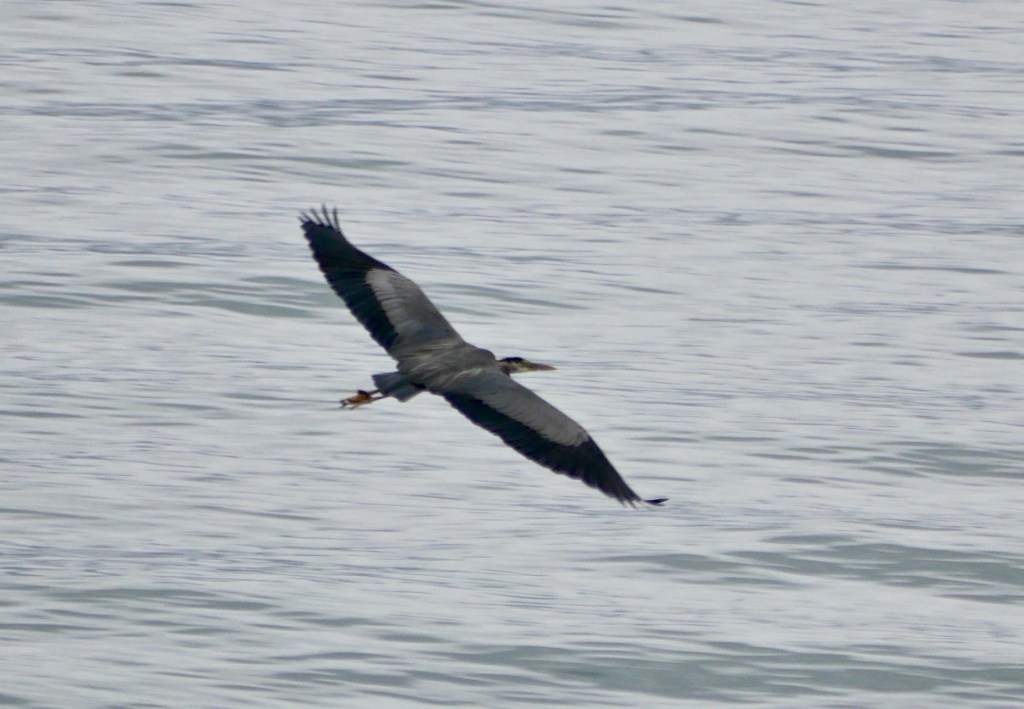
Two great blue herons fly over our heads, cross the river, and land in a red bed on the other side. In seconds they are hunting the water for fish. Downstream two eagles are hunched on top of a tangle of driftwood roots. They look at each other, as companions, not competitors.
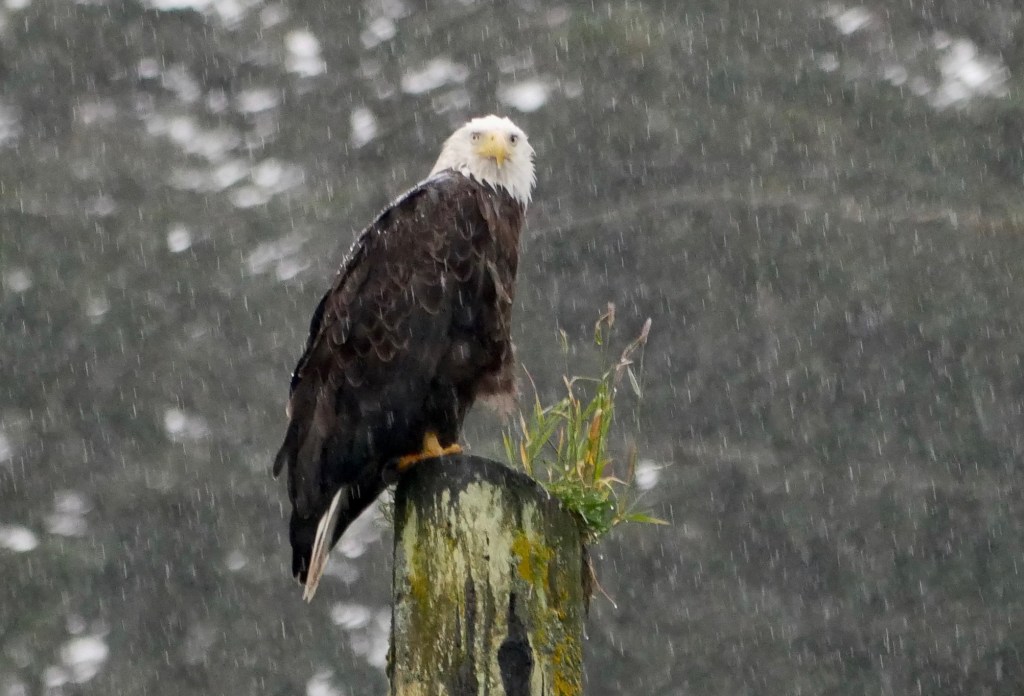
Later we spot a solitary eagle standing a top of a broken piling. It stares at the hillside until we come along. Then it looks at me, evaluating the way I shed water in the rain. Rain drops bead and bounce on its feathers. My rain coat stopped keeping me dry an hour ago.
It’s raining. Aki sits shivering in the lap of her other human as we paddle a kayak toward the glacier. The rain will stop soon, but that is not why the little dog shivers. She is excited or maybe nervous about being out on the water. Laying in the lap of her other human is one her favorite things to do. Having the whole family together is her second favorite. And we are heading for an adventure.
Wind blowing down the glacier raises small, white-capped waves as we move onto the main part of the lake. The kayak handles it well. If she could understand, I would tell her that we will soon slide into a side slough and get out to explore on foot. Heavy rainfall has raised the lake levels so we have no trouble crossing the bar that that protects the mouth of the slough.
A great blue heron watches us cross the bar and then lifts itself into the air. Looking more like a flying dinosaur than a bird, it glides a hundred meters down slough and returns to fishing. We land on an exposed sand bar and survey the blue berry crop.
The skies break open as we paddle back to our camp. Streaks of sunshine light up the mountains and highlight sections of the glacier. During a after dinner stroll, we stop to watch a beaver patrolling the parameter of a small pond.
A few days ago, I spoke to a photographer who was waiting for a bear. He stood on a walkway that crossed a sockeye spawning steam. The photographer assured me that he had the patience to wait for hours for a bear, even though it was raining. I doubted if his patience would pay off because no salmon were fighting their way up stream. Without them, there was nothing to draw in a bear. I looked down the stream, which wandered through a meadow to Mendenhall Lake. On an August day during a normal salmon year, they would be birds and bears. Today, nothing.
Before I left him to his vigil, the photographer told me that the dog salmon have finally arrived at Sheep Creek. “Bears never fish there, but there are always eagles.” This morning Aki and I confirmed that he was right.
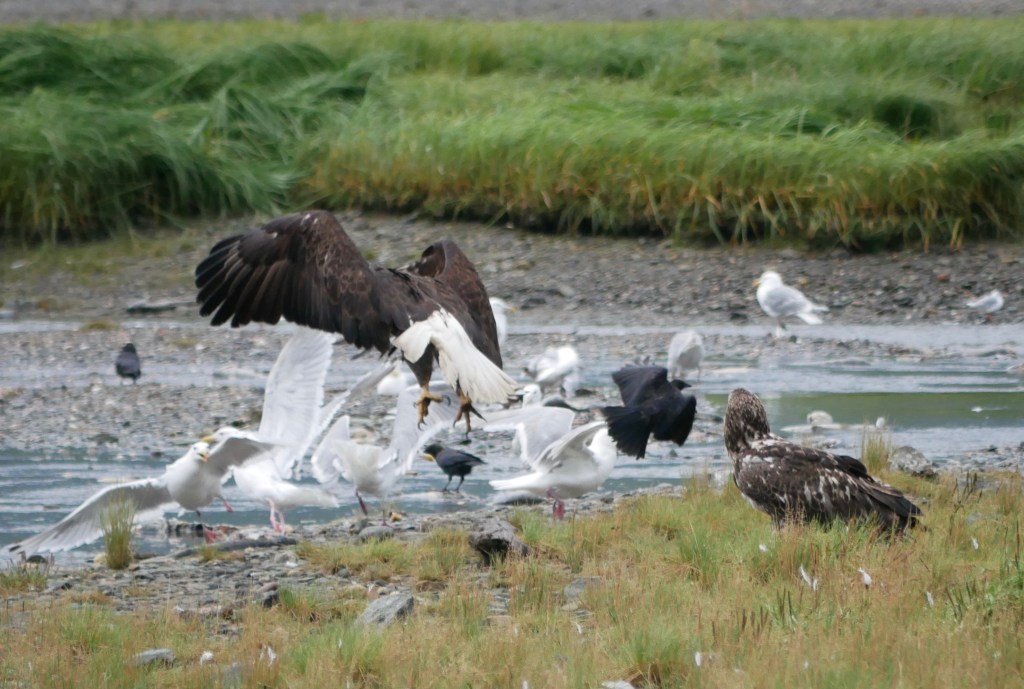
Decaying salmon bodies littered Sheep Creek Delta. Others, listless after spawning, let the water carry them back towards Gastineau Channel. Freshly arrived dog salmon muscled each other for spawning space in the creek. More than a dozen bald eagles sulked or fed on the creek’s gravel bars. Crows and gulls hung around the feeders, waiting for a chance to finish what the big birds started.
Bothered by the loud gull screams, Aki refused to approach the creek. I retreated and then followed her to a quieter section of the delta. Even here, we weren’t free of drama. After fighting over a scrap of salmon, two adult bald eagles left the stream. One chased the other. The one being chased flew low over the beach grass and right at the little dog and I. It passed within three meters of us before gaining enough altitude to clear the beach side cottonwoods.
There is no question that we have begun the annual slide into autumn. While walking across a Mendenhall wetland, we pass many plants gone to seed. Gray-black seed pods contrast with late flowering paintbrush and stalks of yellow chicken and egg blossoms.
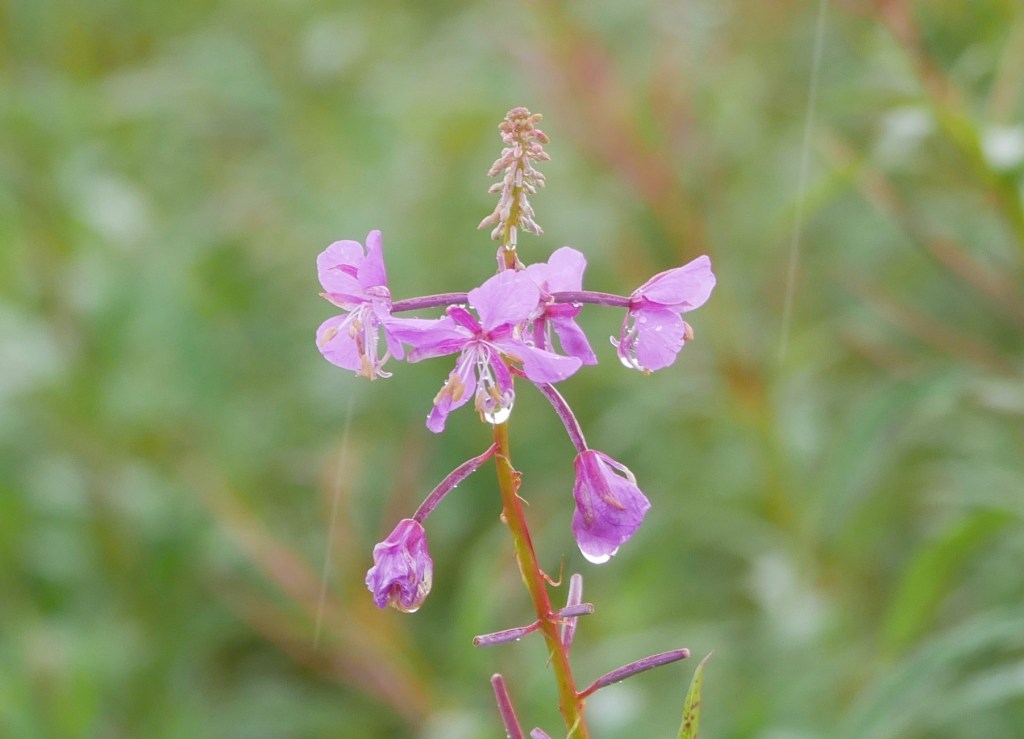
An immature dark-eyed junco pulls seeds from a dead-dry grass stalk and then turns to stare down the little dog. Beyond the junco, a field of magenta-colored fireweed flowers underline the Mendenhall glacier.
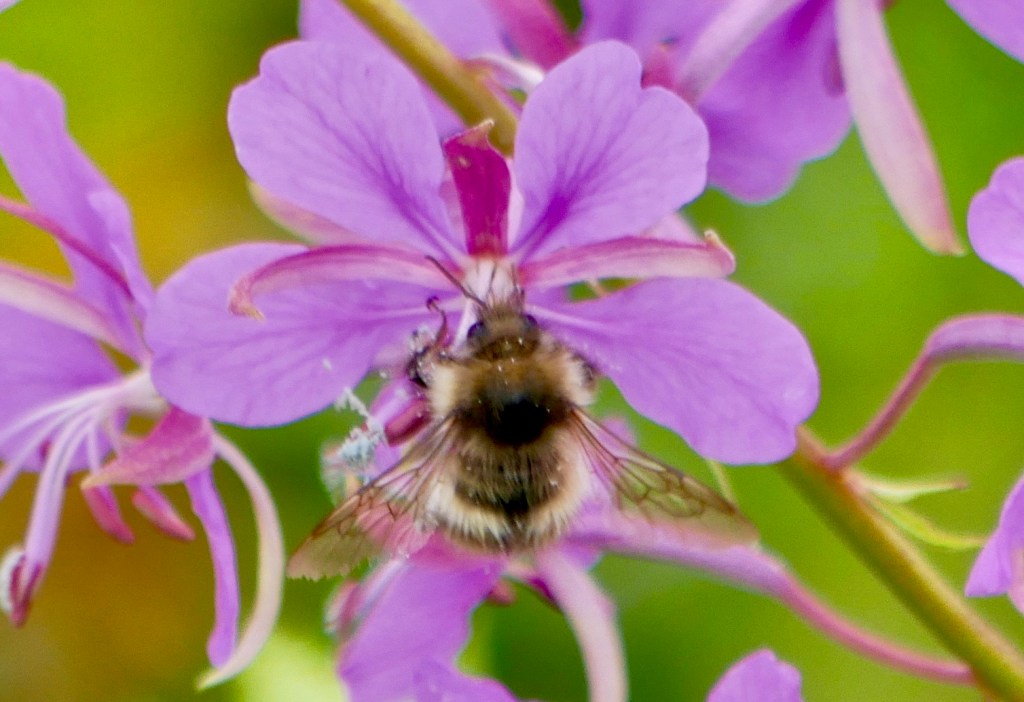
The time for the fireweed and the other late blooming flowers will soon end. Grass and broad leafed foliage will fade from rich green to soft reds and yellows. In their dying, they will provide the beauty on the wetlands.
Once or twice a year I bring a fishing pole along when Aki and I visit the Troll Woods. It’s best done in the fall, when trout and char follow silver salmon up one of the moraine streams. But given the pour returns of the other types of salmon to their spawning waters, I don’t think we can count on the silvers showing up next month.
The little dog and I take different approaches fishing. It’s serious business for Aki. She stands by my side as I cast, watching the lure or fly hit the water. For me the fishing pole becomes something to distract the practical part of my brain so my imagination can escape. After a few fruitful casts, Aki gives a little moan, which cancels my imagination’s leave of absence.
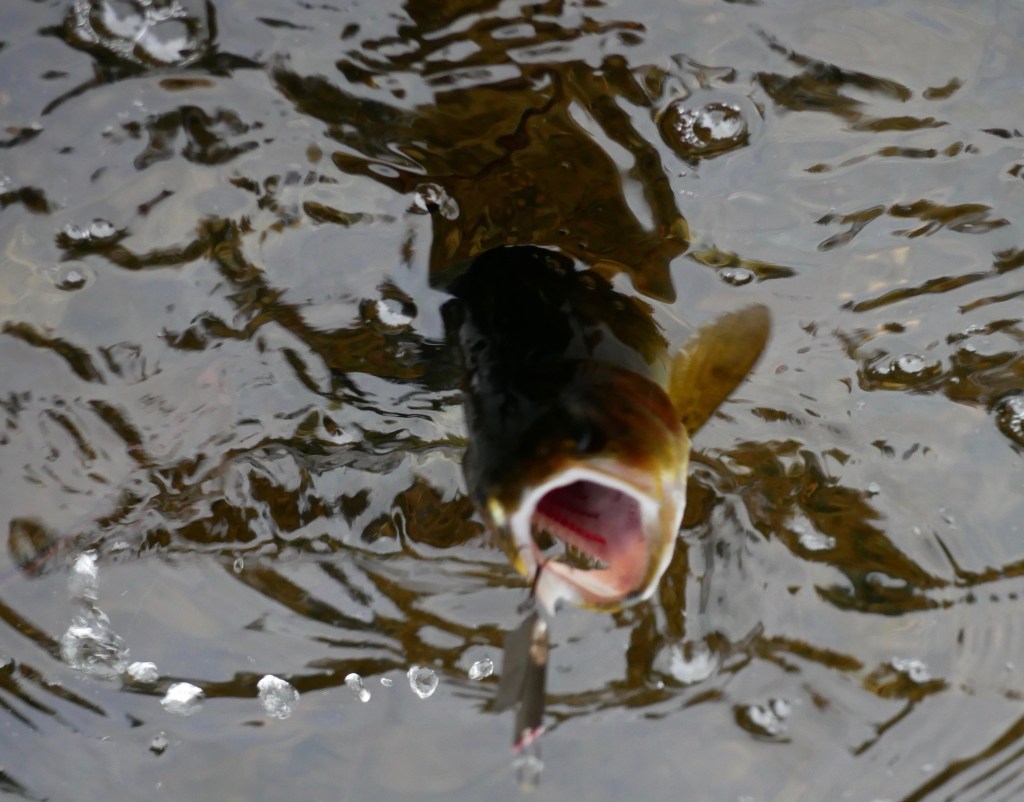
We move from place to place, stopping at breaks in the shoreside woods to fling out line. Once this morning, I felt a light tug. Another effort hooked a 10-inch cutthroat trout, beautiful in it crimson and gold blush. It would make a tasty lunch but it is 4 inches short of a keeper. Aki does not act pleased when I let it slip off the hook.
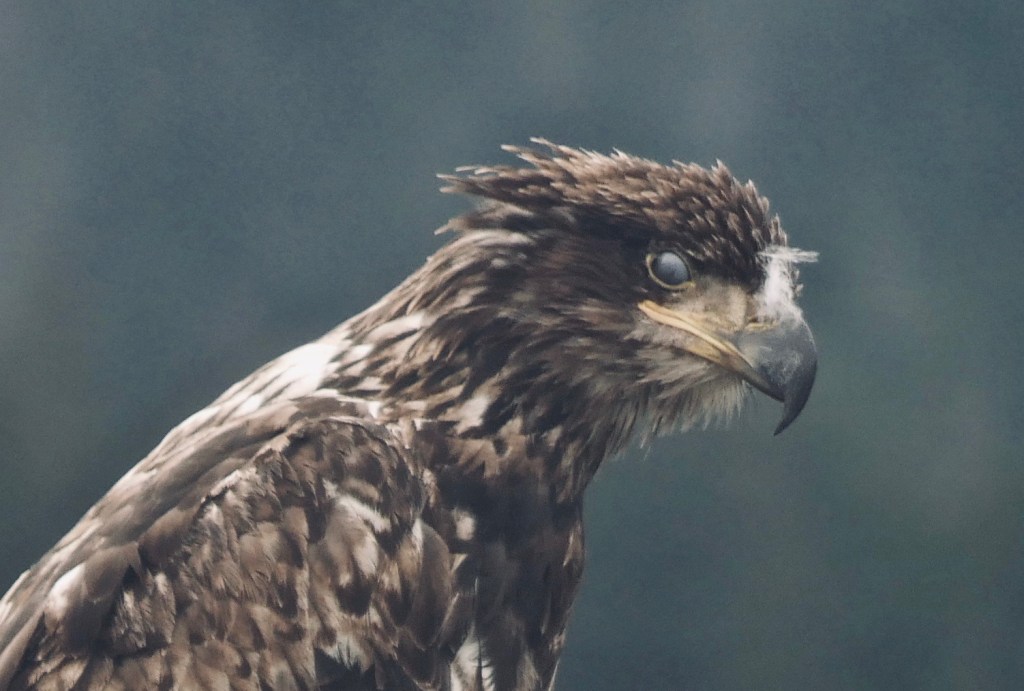
We stop at the hatchery on the way home to check out the scrap-hunting eagles that can be found there every low tide, sulking about the low salmon returns. Today, an immature eagle with a clump of down still stuck to the top of its beak puffs out its feathers and gives them a hard shake. The air fills with down.
I think of Tlingit dancers, who fill headdresses made with sea lion whiskers with eagle down. Body stiff with dignity, elbows extending their button-blanket cloaks to mimic eagle wings, they dance towards the audience and bow until the air is full of down.
Aki is excited to walk with an old friend this morning. She doesn’t mind that he is wearing a pandemic mask. Not understanding the need for social distancing, the little dog tries to keep us close together as we walk through the rain forest to the sea. Her two charges talk loudly through their masks, catching each other up with happenings since our last walk. When we stop for a moment, the little dog can hear the sound of swollen streams and rain drops bouncing off of devil’s club leaves.
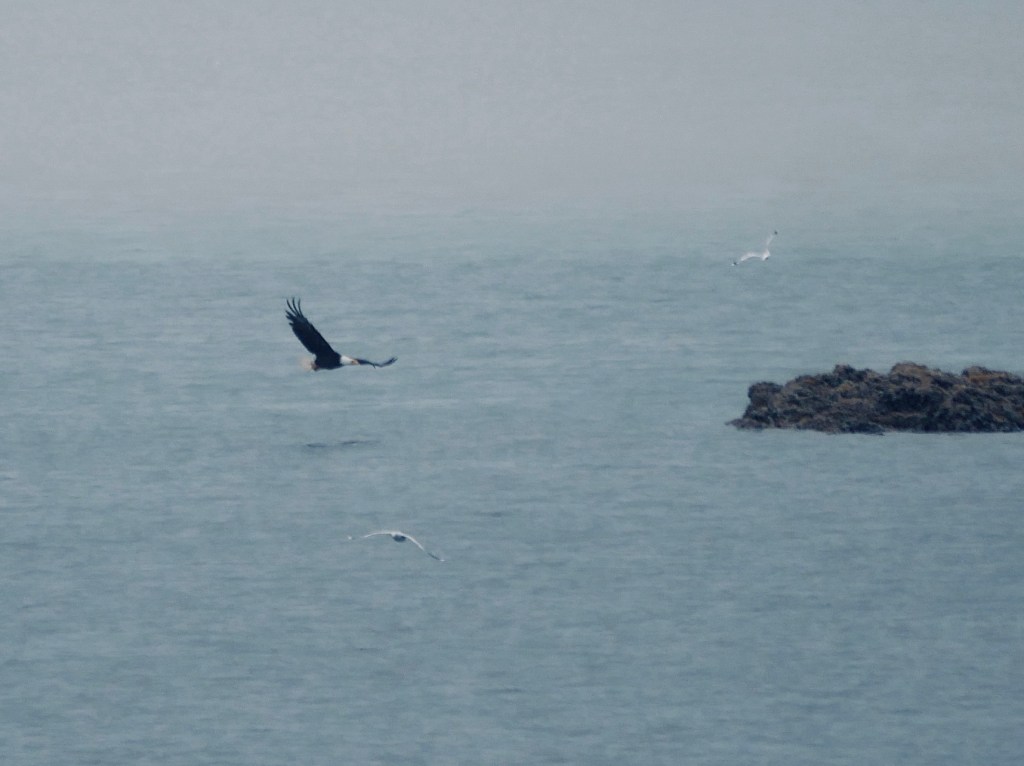
An eagle flies close overhead when we reach the beach. It cruises over to a little bay, circles and then drops with claws extended. After rising skyward with empty talons, it sets down on a rocky point, scattering a dozen gulls that had been lingering there. Eagles in groups of threes fly out to Shaman Island. Others find perches on recently exposed rocks. A raft of ducks fly between us and the island, over the head of two hunting seals. The salmon must be back.
Just after we reach Gastineau Meadow, a snowshoe hare breaks from a shelter in trailside alders. It gallops away from us down the trail and freezes. Aki must not see it. If she does, she doesn’t bother to react. After throwing us a quick glance, the hare leaps off the trail and out of sight.
I wonder again, whether the little dog’s eyes are failing. She will be 14 this November. But she was frisky enough last month to chase a bear down the street. She had no problem climbing with me to the meadow.
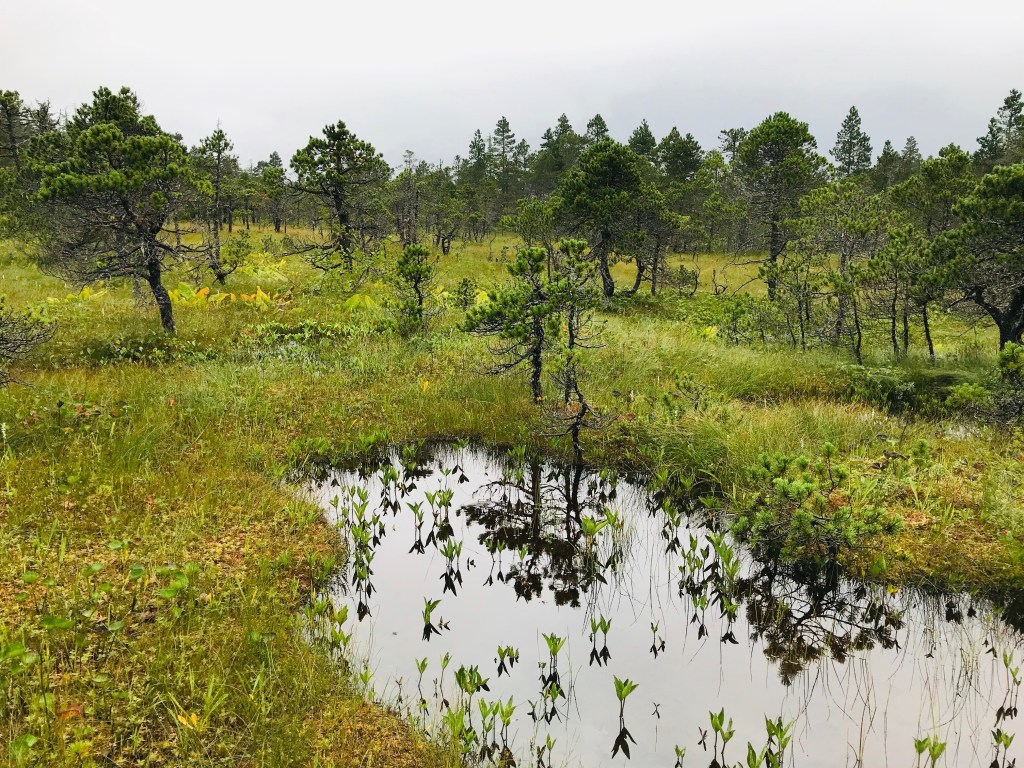
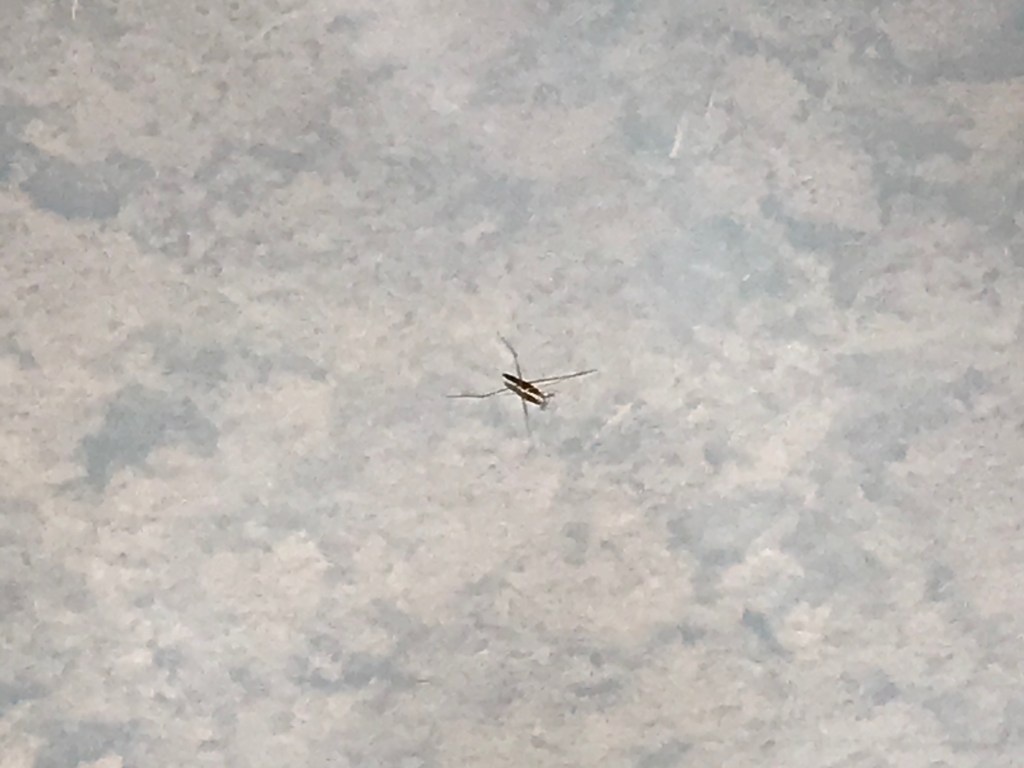
Aki refuses to leave the gravel trail when I do. But she has always preferred dry ground to wet muskeg. Some dogs might go on their walkabout when their masters give them this much freedom. Mine stands at attention on the trail at a spot where she can watch me watch water bugs skittering across the surface of a tiny pond. Her eyes tell me that she is ready to chase off any bear or wolf that places me in danger.


















 Walking with Aki